
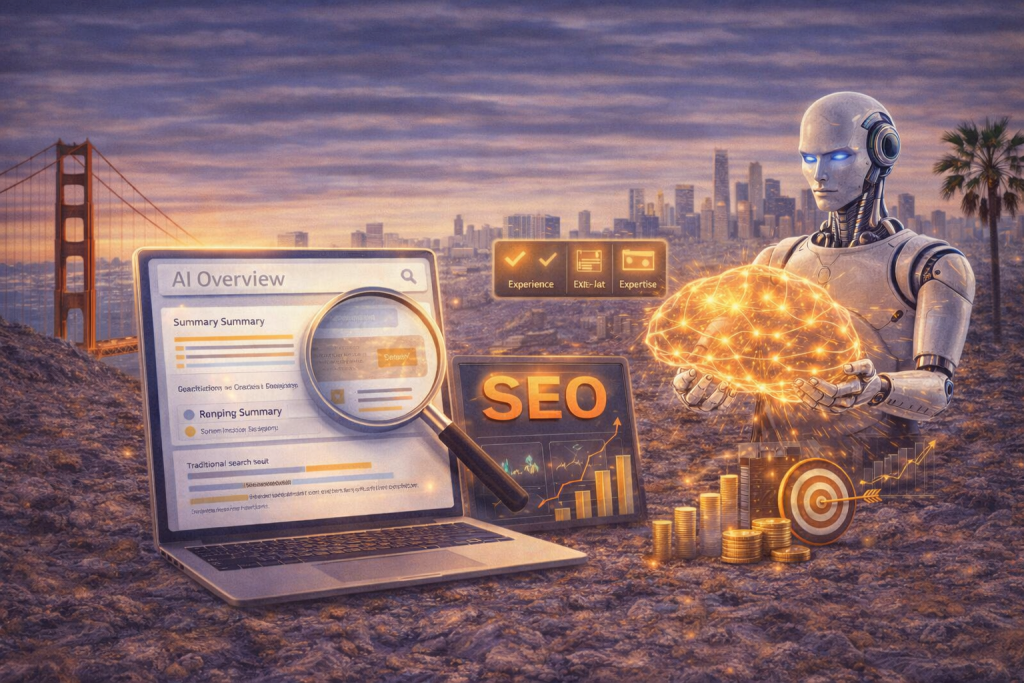
Search is transforming rapidly — driven not just by traditional algorithms but by AI-powered models and generative overviews. Recent reports from BrightEdge and Semrush show that while organic search remains essential, new forces are altering how traffic is discovered, how content is selected, and what it takes to be visible. Businesses that adapt now will lead; those that wait risk losing relevance.
Here are the latest insights, implications, and what you should do.

Key Data & Trends
Rapid Growth in AI Search Activity
BrightEdge’s report covering January through August 2025 finds that AI search referrals are rising at double-digit month-over-month growth rates. However, despite this growth, AI search still accounts for less than 1% of referral traffic to websites, with organic search continuing to dominate conversions.
Increase in AI Overviews Triggered Queries
According to Semrush, 13.14% of all queries in the US were triggering Google’s AI Overviews by March 2025 —up from 6.49% in January 2025. Most of these are informational queries (e.g. definitions, questions, comparisons) rather than transactional or heavily commercial ones.
Informational Content is Most Affected
The Semrush study shows that industries such as Science, Health, People & Society, Law & Government are seeing the biggest growth in AI Overviews. These are content-rich, high trust areas. Also, zero-click behaviour is more common for queries triggering AI Overviews — meaning users often get what they need from the summary without clicking through.
Organic Search Still Critical
Even though AI referrals are increasing fast, the percentage of overall traffic and especially revenue/conversion coming from organic search remains far higher. Reports show that businesses still depend on traditional SEO for leads and transactions.
What This Means for SEO & Content Strategy
Based on these data points, here are major implications for businesses and SEO strategy in 2025:
| Implication | Why It Matters |
|---|---|
| Visibility in AI Overviews matters | If a user gets an answer via an AI Overview and doesn’t click through, your content needs to be in that summary. Being in the top of organic results is no longer sufficient. |
| Content format & structure become critical | Content that is well-structured, uses FAQs, concise definitions, comparisons, is more likely to be used in AI summaries. |
| Authority & trust signals gain more weight | Because AI Overviews pull from multiple sources, a site’s trustworthiness (expertise, citations, domain authority) increases the chance of being included. |
| Expect changes in traffic patterns | Even if AI search accounts for <1% now, its growth rate suggests that over time, traffic from AI platforms will increase — both for informational content and potentially for commercial content. |
| Zero-click and partial click behaviours increase | Many users don’t click the links under the AI summary. If your content doesn’t make it into the summary, it may still get less traffic even if ranking highly. |
How to Adapt: Practical Strategies (Dexora’s Framework)
Here are actionable steps you (or your SEO agency) should take to future-proof content & capture visibility in the age of AI search and overviews:
- Audit & Optimize for AI Overviews
- Identify which of your target keywords already trigger AI Overviews.
- Analyze competitors whose content is cited. What structure/layout do they use? FAQs, bullet points, summaries upfront?
- Make your content concise, structured, and answer-first.
- Build Strong Trust & Authority Signals
- Use accurate schema markup (FAQ, HowTo, Article, LocalBusiness where relevant).
- Strong backlink profile, citations from reputable sources.
- Display authorship, credentials, recent updates — signals Google/AI tools trust.
- Focus on Informational & Long-tail Queries
- Many AI Overviews are triggered by informational queries still. Content that answers questions clearly (e.g. “What is ___?”, “How to ___”) will have an advantage.
- Long-tail, lower volume but high relevance keywords often have less competition there and are less saturated.
- Integrate Traditional SEO + GEO / AEO
- Continue optimizing meta titles/descriptions, page speed, mobile usability.
- GEO (Generative Engine Optimization) and AEO (Answer Engine Optimization) need to align with traditional SEO so your content ranks and is cited.
- Monitor AI Visibility & Referrals
- Use tools that track when AI Overviews appear and whether your site is in them or cited.
- Monitor shifts in CTR for your high ranking pages once AI Overviews appear for those keywords.
- Prepare for Zero-Click Trends
- Optimize your content so even when users see AI summaries, they trust your brand enough to click through when deeper answers are required.
- Use rich media (images, video, interactive content), structured data, credible sources to make your pages stand out.
⚠️ Risks If You Don’t Adapt
- Loss of traffic: As AI Overviews become more common, traffic might drop for pages that used to rank well if they are not included in those summaries.
- Lower engagement & conversions: Users might stop clicking deeper if their questions are answered in overviews, reducing opportunity for your content to convert.
- Competitive disadvantage: Brands who adapt early will capture trust and visibility in new AI channels. Others will fall behind.
What Businesses Should Do Now
- Begin by running an AI-overview detection audit: find which of your keywords are already impacted.
- Update existing content with summary paragraphs, FAQ sections, optimized schema.
- Create new content answering informational, long-tail queries with trust and clarity.
- Strengthen off-page signals: citations, backlinks, author credibility.
- Maintain your traditional SEO foundation: technical performance, domain authority, local signals.
Cases & Projections
- AI search referrals are exploding, but still small in share (<1%). Organic search still delivers most conversions and leads.
- Semrush shows the percentage of queries that trigger an overview has doubled in just a few months (from ~6.5% to 13% among many tested keywords).
- Projections suggest by 2027, visibility in AI search and overviews could become a major revenue driver for many businesses.
FAQs: AI Search, SEO, GEO & AEO in 2025
1. What is AI search?
AI search refers to search powered by large language models (LLMs) like ChatGPT, Google Gemini, and Perplexity. Instead of returning only a list of links, AI search generates direct answers, summaries, or recommendations by analyzing multiple sources at once.
2. How is AI search different from traditional Google search?
Traditional search engines rank web pages using algorithms based on keywords, backlinks, and authority. AI search, on the other hand, focuses on natural language understanding and often provides a zero-click answer. It pulls information from high-authority sources instead of relying solely on keyword matching.
3. What is GEO (Generative Engine Optimization)?
GEO is the practice of optimizing content for AI-driven platforms so it is recognized, cited, and referenced in AI-generated answers. It goes beyond traditional SEO by ensuring that structured data, entity relationships, and contextual clarity are strong enough for AI to trust your content.
4. What is AEO (Answer Engine Optimization)?
AEO focuses on structuring your content so it is used directly in AI or voice-based answers. This includes optimizing for FAQs, conversational queries, schema markup, and providing concise, authoritative definitions that fit into answer boxes or AI summaries.
5. Why is AI search growing so quickly in 2025?
According to BrightEdge and Semrush, AI search adoption is growing at double-digit rates month over month because consumers prefer faster, conversational answers over scanning multiple links. Tools like ChatGPT and Perplexity are becoming everyday search companions.
6. Does AI search mean SEO is dead?
No. SEO is evolving, not disappearing. AI search depends on high-quality, optimized content to generate answers. If your site isn’t optimized, it won’t appear in Google SERPs or in AI Overviews, meaning you’ll miss visibility on both fronts.
7. What industries are most impacted by AI search in 2025?
Reports show that healthcare, legal, finance, education, and local services are seeing the biggest impact. These industries rely heavily on trust, expertise, and clear information — exactly what AI tools prioritize when generating answers.
8. What are AI Overviews in Google Search?
Google’s AI Overviews are AI-generated summaries that appear above traditional search results. They provide a short, synthesized answer with citations to websites. For businesses, being included in AI Overviews means more visibility but often fewer clicks.
9. How can my business appear in AI Overviews?
To increase chances of inclusion:
- Use structured data (schema)
- Add FAQs and definitions to content
- Build backlinks from trusted sites
- Show authorship, expertise, and recent updates
- Write content that directly answers who/what/why/how questions
10. Does AI search reduce website traffic?
Yes and no. Some industries are experiencing zero-click behavior where users don’t click links after reading AI summaries. But if your business is cited within those summaries, you still gain brand visibility, authority, and indirect leads.
11. How do GEO and traditional SEO work together?
GEO ensures that AI platforms (ChatGPT, Perplexity, Gemini) understand and trust your content. Traditional SEO ensures you rank on Google SERPs. Together, they future-proof visibility across both search engines and generative models.
12. How do I measure success in AI SEO?
Metrics include:
- AI citation tracking (is your site referenced in AI answers?)
- Organic traffic trends from informational queries
- CTR changes when AI Overviews appear
- Conversions from branded AI mentions
- Competitor benchmarking for AI visibility
13. How long does it take to see results from AI SEO?
Most businesses see movement within 2–3 months, especially if they already have strong content foundations. For competitive niches, it may take 6–12 months to consistently appear in AI search citations.
14. What role do reviews and local SEO play in AI search?
For local businesses, AI tools often pull data from Google Business Profiles, citations, and reviews. A well-optimized local presence with strong NAP (Name, Address, Phone) consistency increases the chance of being mentioned in AI Overviews and voice searches.
15. Can small businesses compete in AI search?
Yes. In fact, smaller businesses that optimize early may gain faster traction because AI models value authority on niche topics. Focused, trustworthy, and structured content can help SMBs outrank larger brands in AI search contexts.
16. What technical steps improve AI SEO?
- Optimize Core Web Vitals
- Fix crawlability/indexing issues
- Implement JSON-LD schema
- Maintain canonical URLs
- Ensure mobile-friendliness and HTTPS
Technical health makes your site more “AI-readable.”
17. How does E-E-A-T affect AI SEO?
Google and AI models rely heavily on Experience, Expertise, Authority, and Trustworthiness (E-E-A-T). Content with clear authorship, citations, expertise, and fresh updates is more likely to be used by AI systems.
18. Which AI platforms should businesses focus on?
The top platforms in 2025 are:
- ChatGPT (dominant global share)
- Google Gemini (fastest growth projection)
- Perplexity (popular for clean UI and reliable results)
- Bing Copilot (enterprise integrations)
Optimizing for all ensures maximum visibility.
19. Will AI search affect paid ads (Google Ads, PPC)?
Yes. As AI overviews reduce clicks to organic results, paid ads may see higher competition and cost. Businesses should balance paid strategies with AI SEO to ensure visibility across both ad and AI-driven search environments.
20. How can Dexora Digital help businesses with AI SEO?
At Dexora Digital, we specialize in AI SEO, GEO, and AEO strategies. Our services include:
- AI SEO audits (weekly & monthly)
- Schema & structured data implementation (See our article on schema)
- Content clustering for AI discoverability
- Local SEO + GBP optimization (see our local seo services)
- Competitor benchmarking
- 24/7 reporting dashboards
We also offer a money-back guarantee for businesses that don’t see ranking and traffic improvements.
🔚 Conclusion
AI is changing search — but it isn’t killing SEO. What it’s doing is shifting what SEO means:
- Visibility isn’t just about ranking on page one.
- It’s about being the source AI tools choose to mention.
- Trust, clarity, structure, and authority are now as important as keyword optimization.
If you’re ready to stay ahead, investing in AI Overviews readiness, combined with traditional SEO and GEO/AEO strategies, is essential.
At Dexora Digital, we help businesses audit, optimize, and dominate both organic search AND AI-powered search results. Want to see where your content stands in AI Overviews? Let’s schedule a free assessment.
👉 See Dexora GEO Services
👉 Book Consultation with our Experts
See Related Articles
👉 Google Zero: How AI Overviews Are Changing SEO and What Businesses Must Do
👉 Is AI Replacing SEO? The Truth About AI, SEO & GEO
👉 Generative Engine Optimization (GEO): The Future of SEO in the Age of AI
👉 Normal SEO Works for Google AI Overviews: What You Need to Know in 2025
👉 How AI Overviews & Instagram Indexing Are Rewriting SEO in 2025
👉 How Is Google AI Overviews Going to Affect SEO? July 2025 SEO Update

Local SEO and AI Search (AEO & GEO) Specialist.
Building search visibility that converts into qualified demand.
Today, businesses need visibility on Google Maps and AI powered search and websites that actually convert visitors into leads. I am a Local SEO, AI Search & Conversion Rate Optimization (CRO) Specialist with 5+ years of hands on experience helping businesses turn underperforming websites into high converting growth engines. My work combines Local SEO, Technical SEO, Semantic SEO, GEO/AEO, and conversion focused landing page optimization to ensure brands are discoverable and profitable.
My Experience
I have delivered SEO and web growth projects across the US, UK, Australia, Canada, Finland, Germany, and the Czech Republic, working in industries such as local businesses (electrician, hvac, cleaning, Real estate, healthcare, B2B, eCommerce, SaaS, and environmental services.
Some Results
>> 200+ websites audited globally
>> specifically worked with 100+ local business (80% from USA)
>> 80+ websites improved through technical SEO & schema fixes
>> 20+ businesses featured in Google AI Overviews (SGE)
>> Multi million impression growth for eCommerce & SaaS brands
Book Free Consultation: calendly.com/dexora/30min
