

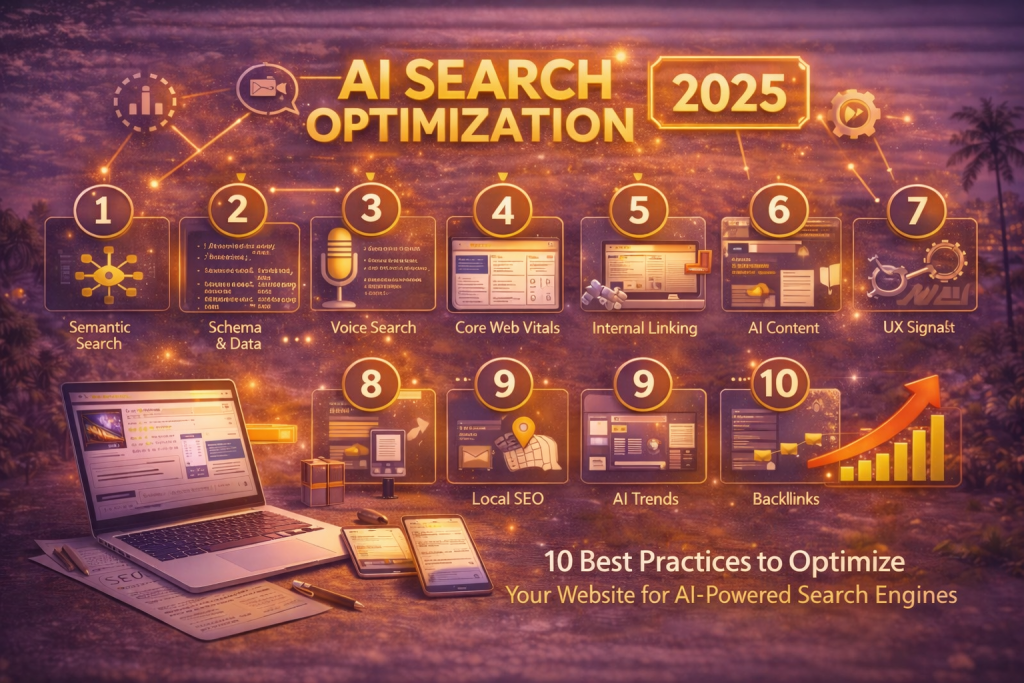
With AI transforming search, SEO strategies must evolve to keep pace with the latest advancements. As search engines like Google and Bing integrate more AI technologies into their algorithms, optimizing your website for AI-driven search engines is no longer optional. To help you stay ahead of the competition, we’ve compiled 10 best practices to ensure your website ranks higher and performs better in AI search engines.
1. Prioritize Semantic Search Optimization
What is Semantic Search?
AI search engines such as Google’s BERT (Bidirectional Encoder Representations from Transformers) and RankBrain prioritize context and user intent over traditional keyword matching. This means that optimizing for semantic search is vital to ensure your content ranks for a wide variety of related queries.
Why It Matters
Semantic search helps AI engines understand the nuances of your content and how it connects to other topics. Instead of targeting single keywords, you should focus on creating topic clusters that provide deep, relevant content.
Pro Tip: Use LSI (Latent Semantic Indexing) keywords, related terms, and variations to ensure content depth and relevance.
2. Implement Structured Data & Schema Markup
What is Structured Data?
Structured data, implemented through schema markup, enables search engines to understand the context of your content. By using JSON-LD schema, you give AI engines clear information about your products, services, events, and more.
Why It Matters
Search engines leverage structured data to display rich results, like featured snippets and knowledge graphs, which boost visibility. AI-powered search engines use structured data to deliver direct answers to user queries.
Tip: Use schema for articles, products, reviews, and FAQs to improve search result visibility.
Explore our GEO Services for optimizing your content for AI-driven results.
3. Optimize for Voice and Conversational Search
Why Voice Search Matters?
As voice assistants like Siri, Alexa, and Google Assistant grow in usage, voice search optimization is crucial. AI models powering these devices rely on conversational, long-tail queries. Websites optimized for voice search align with how people naturally phrase their searches.
Best Practices
- Use natural language in content.
- Implement question-based titles and FAQs.
- Optimize for local searches with geo-targeted keywords.
Why It Matters
Optimizing for voice search increases your chances of appearing in voice-activated search results, directly impacting your visibility on AI-powered platforms.
4. Focus on Core Web Vitals & Page Speed
Core Web Vitals Overview
Google’s Core Web Vitals are a set of metrics that measure the user experience of your website, particularly how quickly it loads, how stable it is, and how quickly it responds to user interactions.
Why It Matters
AI-powered search engines use these metrics to determine how well users interact with your site. Sites with poor performance and slow load times are penalized, while fast and responsive websites rank better.
Pro Tip: Use tools like Google PageSpeed Insights and Lighthouse to monitor and optimize your Core Web Vitals scores.
5. Build a Strong Internal Linking Structure
What is Internal Linking?
Internal linking helps search engines crawl your website efficiently. By linking related pages together, you ensure that AI-powered search engines can easily access and index your most valuable content.
Why It Matters
AI algorithms analyze your internal linking structure to understand which pages are most important. Strong internal linking boosts your site’s SEO by distributing page authority and improving your ranking potential.
Tip: Use keyword-rich anchor text and link relevant articles or product pages to each other.
6. Invest in AI-Powered Content Generation Tools
AI-Powered Content Tools
Generative AI tools like GPT-4 can assist in content creation by generating ideas, researching topics, and even writing optimized content. However, human input is still necessary to ensure authenticity, relevance, and value.
Why It Matters
AI-powered content can help scale your content strategy, but it’s essential to maintain a balance between AI generation and human oversight to ensure quality and engagement.
Pro Tip: Use AI tools for content ideation, but refine the output for tone, accuracy, and engagement.
7. Leverage User Experience (UX) Signals
Why UX Matters
AI models factor in user engagement metrics such as dwell time, bounce rate, and interaction rates. If users quickly leave your site or don’t engage with your content, AI-powered engines will rank your pages lower.
Best Practices
- Simplify site navigation.
- Improve content accessibility (e.g., fonts, colors, alt-text).
- Ensure smooth user journeys across all devices.
Tip: Track user engagement with Google Analytics and refine your content to boost user retention.
8. Optimize for Local Search and Geographical Relevance
Why Local SEO Matters:
AI search engines increasingly focus on delivering hyper-local results, especially for queries like “near me” or “in [city].” Local businesses must optimize their websites for AI-driven search engines to appear in local search results.
Best Practices
- Optimize your Google My Business profile.
- Add location-based keywords to your website.
- Use local schema (e.g., LocalBusiness).
Pro Tip: Local search optimization is key for brick-and-mortar businesses to attract regional customers using AI-driven search tools.
9. Monitor AI Search Trends & Adapt Your Strategy
Why Staying Updated Matters
As AI-powered search engines evolve, your SEO strategy must adapt. Search engines constantly update their algorithms and ranking factors, so staying informed about changes in AI search trends is essential for long-term SEO success.
Best Practices
- Follow Google Search Central for updates.
- Subscribe to SEO news and forums.
- Use Google Trends and Search Console to monitor search patterns.
Tip: Continuously refine your SEO tactics to stay ahead of the AI curve.
10. Build High-Quality Backlinks
Why Backlinks Matter
Backlinks are a significant ranking factor for AI-powered search engines. High-quality backlinks from relevant, authoritative sources signal to AI models that your website is trustworthy and valuable.
Best Practices
- Focus on getting backlinks from reputable sites in your industry.
- Engage in content partnerships and outreach programs.
Pro Tip: Build relationships with influencers and industry leaders to generate high-quality backlinks.
Key SEO Metrics for AI Optimization
| Metric | Description | Tool |
|---|---|---|
| CTR (Click-Through Rate) | Percentage of users who click your result after seeing it in search results. | Google Search Console |
| Core Web Vitals | Metrics that assess user experience based on site speed and stability. | PageSpeed Insights |
| Impressions | The number of times your site appears in search results. | Google Search Console |
| Bounce Rate | The percentage of visitors who leave after viewing one page. | Google Analytics |
| Dwell Time | Time users spend on your website before returning to search results. | Google Analytics |
Frequently Asked Questions (FAQs)
1. What is AI-powered SEO?
AI-powered SEO refers to the use of artificial intelligence technologies to optimize websites for search engines that rely on AI, such as Google’s Search Generative Experience (SGE). This involves creating content that is contextually relevant, ensuring it is properly structured, and optimizing it for voice search and AI algorithms.
2. How does semantic search impact SEO?
Semantic search uses AI to understand the intent behind user queries and deliver more relevant results. Optimizing for semantic search means focusing on the meaning behind keywords and creating content that answers specific questions or provides in-depth information on topics.
3. Is voice search important for AI SEO?
Yes, voice search is crucial for AI SEO. As more users engage with voice assistants like Siri and Google Assistant, it’s important to optimize your content for natural, conversational queries. AI-driven search engines prioritize content that matches the way people speak.
4. How do I improve my Core Web Vitals for AI search?
Improving Core Web Vitals involves optimizing for speed, interactivity, and visual stability. Focus on reducing load times (LCP), minimizing layout shifts (CLS), and optimizing interactivity (FID) to provide a smooth user experience.
5. What role does structured data play in AI-powered SEO?
Structured data helps AI-powered search engines understand the context of your content. By using schema markup, you can enhance your content’s visibility in search results, including appearing in featured snippets and knowledge panels.
Conclusion: Future-Proof Your SEO with AI Optimization
As AI continues to reshape search, optimizing your website for AI-powered search engines is more important than ever. By implementing these best practices, you can ensure that your content ranks higher, attracts more traffic, and provides a better user experience. Stay ahead of the curve by focusing on semantic search, structured data, voice search optimization, and AI-powered tools to drive sustainable growth.
Ready to optimize your website for AI-powered search?
Contact us today for a free consultation and SEO audit!

Local SEO and AI Search (AEO & GEO) Specialist.
Building search visibility that converts into qualified demand.
Today, businesses need visibility on Google Maps and AI powered search and websites that actually convert visitors into leads. I am a Local SEO, AI Search & Conversion Rate Optimization (CRO) Specialist with 5+ years of hands on experience helping businesses turn underperforming websites into high converting growth engines. My work combines Local SEO, Technical SEO, Semantic SEO, GEO/AEO, and conversion focused landing page optimization to ensure brands are discoverable and profitable.
My Experience
I have delivered SEO and web growth projects across the US, UK, Australia, Canada, Finland, Germany, and the Czech Republic, working in industries such as local businesses (electrician, hvac, cleaning, Real estate, healthcare, B2B, eCommerce, SaaS, and environmental services.
Some Results
>> 200+ websites audited globally
>> specifically worked with 100+ local business (80% from USA)
>> 80+ websites improved through technical SEO & schema fixes
>> 20+ businesses featured in Google AI Overviews (SGE)
>> Multi million impression growth for eCommerce & SaaS brands
Book Free Consultation: calendly.com/dexora/30min
