

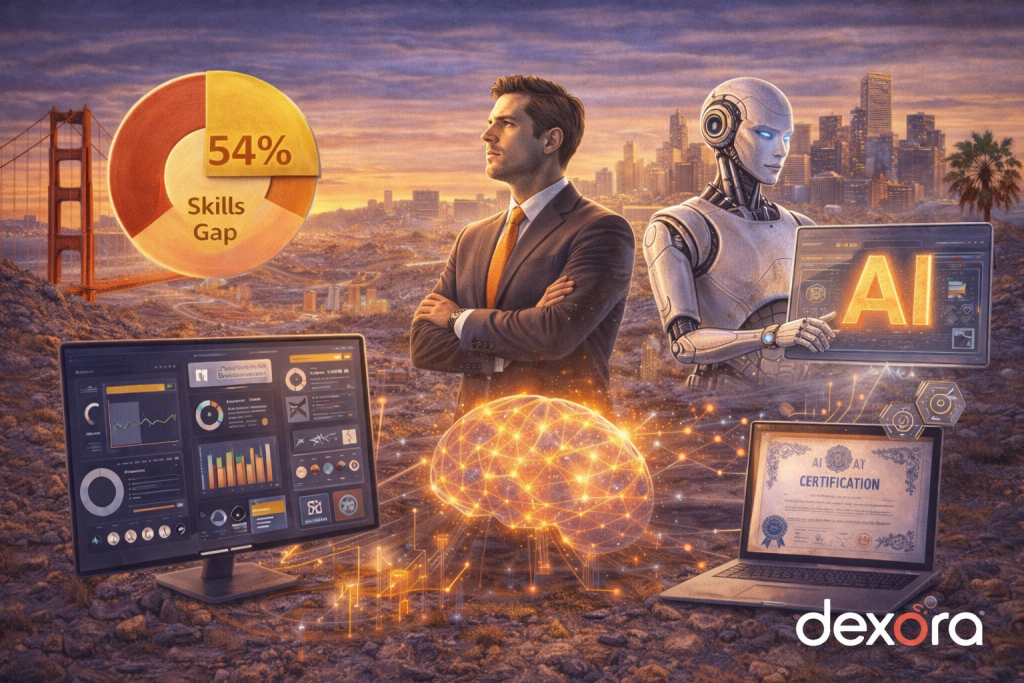
Artificial intelligence has rapidly become the defining force in modern marketing. Across industries, AI-driven insights, automation, and personalization have reshaped how organizations engage customers, allocate budgets, and measure impact. Yet despite the technology’s momentum, a deep skills chasm persists: 54% of marketing leaders report their teams lack the necessary AI expertise to compete effectively in 2025.
For chief marketing officers (CMOs), this skills gap represents both a strategic risk and a transformative opportunity. The risk lies in stagnation—AI-enabled competitors can innovate faster, make smarter decisions, and deliver more personalized experiences. The opportunity is to lead the charge toward an AI-first marketing culture that blends human creativity with data intelligence.
This blueprint outlines a practical, executive-level roadmap for CMOs to close the AI skills gap and build sustainable AI-driven marketing organizations. It highlights key dimensions of AI transformation—technology adoption, talent development, data governance, and ethical operations—while offering proven frameworks Dexora Digital uses to guide global brands through AI evolution.
Understanding the 54% AI Skills Gap
Despite record investments in digital transformation, most marketing teams remain underprepared for the AI era. The 54% skills gap stems from three key challenges: lack of technical fluency, fragmented data systems, and outdated marketing operating models.
Many teams still approach marketing as a sequence of campaigns rather than an ongoing optimization process. In an AI environment, marketing must function as a continuously learning system where algorithms, not calendars, define performance cycles. The absence of AI literacy means marketers often rely on intuition where machine learning could offer predictive accuracy.
Recent research from Deloitte and Gartner reinforces this trend. Over half of surveyed CMOs admit that while they invest in AI tools, they struggle to extract measurable ROI because teams do not understand model outputs or how to integrate them into workflows. The issue is not the lack of tools—it’s the lack of strategy and skills alignment.
Forward-thinking U.S. enterprises are closing this gap by pairing AI adoption with structured workforce transformation programs. They begin with capability assessments, benchmark team readiness, and create learning tracks customized to functional areas such as content, analytics, and media.
For insights on how organizations have successfully restructured around AI capabilities, explore Dexora’s Case Studies showcasing real-world digital transformation results.
The 2025 AI Marketing Ecosystem
By 2025, marketing technology will no longer be defined by isolated tools but by interoperable intelligence systems. Generative AI, predictive analytics, and autonomous optimization engines will converge into unified platforms capable of end-to-end campaign orchestration.
Generative Content Automation
AI-powered tools will handle 70–80% of baseline creative work, including ad variants, email copy, and image generation. Human oversight will focus on creative direction and brand integrity rather than manual execution.
Predictive Analytics and Customer Modeling
Advanced customer data platforms (CDPs) will leverage AI to predict intent, churn probability, and purchase likelihood, allowing marketers to deploy hyper-personalized experiences across every touchpoint.
AI-Driven SEO and Personalization Engines
AI algorithms are already rewriting how search engines interpret content. Marketers will need to adapt to semantic optimization, natural language generation, and entity-based SEO. Dexora’s AI + LLM SEO Guide explores how large language models redefine organic visibility.
The Shift to Continuous Learning Systems
Traditional campaign cycles will give way to real-time feedback loops where data informs content and budget decisions instantly. Marketing success will depend on how effectively CMOs design intelligent systems that learn, adapt, and scale autonomously.
The CMO’s AI Strategy Blueprint
Step 1: Audit and Benchmark Current Capabilities
Every AI transformation begins with clarity. CMOs should start with a comprehensive audit of data maturity, tool adoption, and process readiness. This includes evaluating existing martech stacks, data pipelines, and analytics systems to identify redundancies and skill bottlenecks.
Step 2: Build a Data and AI Readiness Foundation
Data remains the fuel for all AI initiatives. Marketing leaders must ensure data is accurate, accessible, and ethically managed. Establishing unified data models and cloud-based infrastructure enables teams to feed machine learning systems with high-quality information.
Step 3: Integrate AI Across Channels
AI should be embedded within every marketing function—SEO, paid media, CRM, email automation, and customer experience. The goal is not to replace human decision-making but to enhance it with data-driven precision. CMOs should establish integration roadmaps that connect analytics, creative, and operations under one intelligence layer.
Step 4: Develop Human–AI Collaboration Teams
The most successful AI strategies position technology as a partner, not a replacement. Cross-functional “AI pods” can unite data scientists, content creators, and strategists to co-develop predictive campaigns and insights-driven storytelling. This interdisciplinary collaboration fosters innovation and continuous learning.
Step 5: Set Ethical and Governance Standards
As AI becomes central to customer engagement, governance frameworks must ensure transparency, accountability, and compliance. Establishing AI ethics committees, bias testing, and explainability protocols is no longer optional—it’s foundational to brand trust.
Step 6: Measure ROI Through Intelligent Analytics
ROI measurement in the AI era extends beyond conversions. CMOs must track learning velocity—how quickly systems adapt and improve—as a key metric. Continuous feedback loops should connect performance data to predictive models, driving compounding returns.
Building the AI-Ready Marketing Workforce
Technology without talent yields no transformation. Closing the skills gap requires deliberate investment in training, cultural change, and leadership alignment.
Reskilling Current Teams
Organizations should prioritize internal training programs that teach marketers the fundamentals of machine learning, data visualization, and prompt engineering. Building AI literacy across departments ensures that every employee can interpret insights and apply them effectively.
AI Literacy Programs
CMOs can introduce AI bootcamps or internal learning hubs that translate complex AI concepts into practical marketing applications. This democratization of knowledge empowers teams to experiment and innovate with confidence.
External Partnerships
Collaborations with universities, AI research labs, and technology vendors can accelerate workforce upskilling. Strategic partnerships also provide access to proprietary datasets and advanced tools that internal teams can adapt over time.
Performance Measurement
Dexora recommends developing an AI Capability Index (AICI) that tracks improvements in tool adoption, efficiency, and innovation metrics. This quantifies transformation progress and aligns workforce performance with enterprise goals.
Governance, Ethics, and Compliance
Responsible AI deployment is as important as innovation itself. The marketing industry faces growing scrutiny over data privacy, algorithmic bias, and transparency.
Ethical Marketing Frameworks
Every CMO must establish ethical guardrails governing data collection, automated decision-making, and personalization practices. Trust is the currency of digital marketing, and transparency sustains it.
Regulatory Compliance
AI-driven marketing must adhere to evolving regulations such as the EU’s AI Act, U.S. FTC guidelines, and state-level data protection laws. CMOs should collaborate with compliance teams to align AI use with legal standards.
Customer Transparency
Consumers increasingly demand to know how their data is used. Marketers should adopt explainable AI systems that clarify why certain recommendations or offers are presented.
Dexora Digital’s Privacy and Compliance Services guide businesses through these evolving governance challenges.
Case Study Insights: AI Strategy in Action
Dexora Digital has partnered with U.S. enterprises across retail, healthcare, and SaaS sectors to design and implement AI-first marketing ecosystems. These initiatives consistently deliver measurable improvements in engagement, efficiency, and ROI.
Example 1: Predictive Customer Engagement for a National Retailer
By integrating AI-driven recommendation engines, a leading retailer increased customer retention by 34% and reduced acquisition costs by 18% within six months.
Example 2: AI Content Automation for a Healthcare Provider
Using generative AI for content production, Dexora helped a healthcare network reduce campaign turnaround time by 60%, maintaining compliance with medical advertising regulations.
Example 3: SEO and LLM Optimization for a SaaS Firm
A U.S.-based SaaS company adopted Dexora’s AI + LLM SEO framework, achieving a 45% lift in organic traffic through semantic optimization and AI-assisted keyword clustering.
For more real-world results, explore our Case Studies.
The Future of CMO Leadership in the AI Era
The next generation of CMOs will not be defined by creative vision alone but by their ability to architect intelligent systems that learn, adapt, and grow. Leadership in the AI era demands fluency in technology, ethics, and human behavior.
By 2030, AI-driven marketing departments will operate like data labs—testing, learning, and deploying insights at scale. CMOs who embrace AI as a strategic partner will transform their organizations into predictive, proactive, and personalized ecosystems.
The time to act is now. Those who delay risk falling irreversibly behind competitors who master AI sooner. The blueprint is clear: audit, educate, integrate, and govern.
To begin your organization’s AI transformation, Contact Dexora Digital today.
Frequently Asked Questions (FAQ)
1. Why is there a 54% AI skills gap in marketing?
The 54% gap exists because most marketing teams have adopted AI tools faster than they’ve developed internal capabilities to use them effectively. Training, data literacy, and strategy alignment have lagged behind technology adoption.
2. How can CMOs start implementing AI without major disruption?
Start small. Conduct an audit of existing data systems and identify processes that can benefit most from automation. Build internal pilot programs before scaling across departments.
3. What are the most critical AI skills for marketers in 2025?
The most valuable skills include prompt engineering, data analysis, predictive modeling, and understanding generative AI applications for content and personalization.
4. How can marketing teams stay compliant with AI regulations?
Compliance requires establishing data governance frameworks, following FTC and privacy laws, and maintaining transparency about how AI makes decisions affecting customers.
5. How can Dexora Digital help close the AI skills gap?
Dexora Digital provides consulting, workforce enablement, and AI integration services designed to help CMOs build data-driven, AI-ready marketing teams. Learn more through our AI Marketing Consulting page.

Local SEO and AI Search (AEO & GEO) Specialist.
Building search visibility that converts into qualified demand.
Today, businesses need visibility on Google Maps and AI powered search and websites that actually convert visitors into leads. I am a Local SEO, AI Search & Conversion Rate Optimization (CRO) Specialist with 5+ years of hands on experience helping businesses turn underperforming websites into high converting growth engines. My work combines Local SEO, Technical SEO, Semantic SEO, GEO/AEO, and conversion focused landing page optimization to ensure brands are discoverable and profitable.
My Experience
I have delivered SEO and web growth projects across the US, UK, Australia, Canada, Finland, Germany, and the Czech Republic, working in industries such as local businesses (electrician, hvac, cleaning, Real estate, healthcare, B2B, eCommerce, SaaS, and environmental services.
Some Results
>> 200+ websites audited globally
>> specifically worked with 100+ local business (80% from USA)
>> 80+ websites improved through technical SEO & schema fixes
>> 20+ businesses featured in Google AI Overviews (SGE)
>> Multi million impression growth for eCommerce & SaaS brands
Book Free Consultation: calendly.com/dexora/30min
