

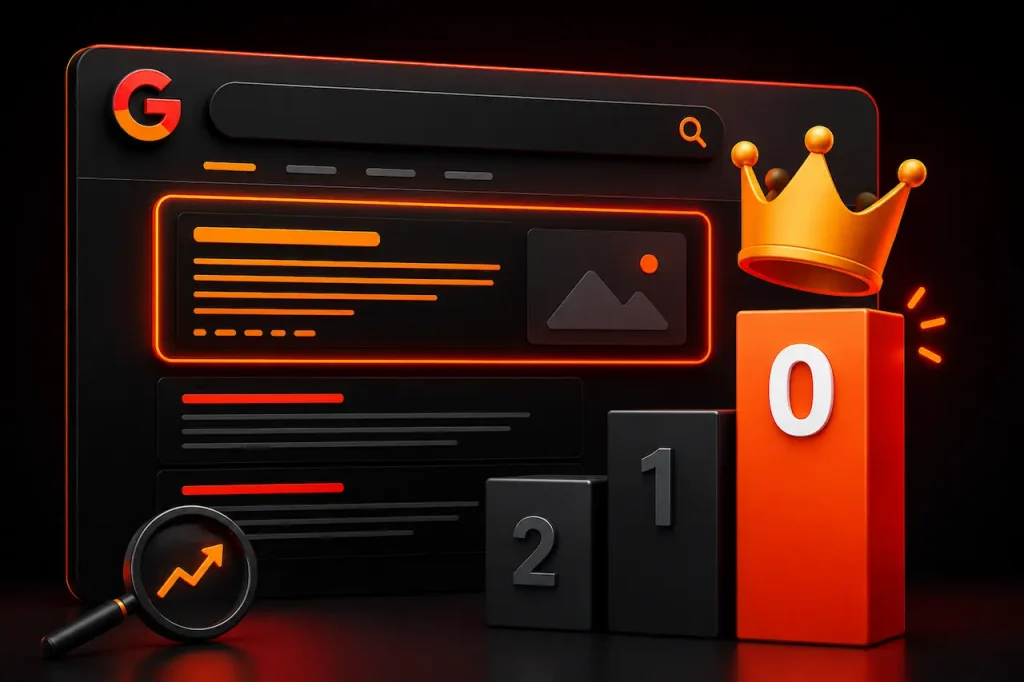
There is a position above position one on Google. Most businesses don’t know it exists, let alone that they can deliberately target it.
It is called a featured snippet — or ‘position zero’ — and it appears above all organic results as a direct answer to a search query. It gets roughly 35% of all clicks for the queries where it appears.
The remarkable thing about featured snippets is that they are not reserved for the highest-authority sites. Any page that correctly answers a specific question in the right format can win one. I have seen client pages in positions 8–15 win featured snippets for important keywords and triple their organic click-through rate overnight.
Featured snippets are one pillar of the SEO strategies we build →
What a Featured Snippet Actually Is
A featured snippet is a selected search result that Google places at the top of the results page — above the standard organic listings — to directly answer a query. It typically shows a text excerpt, sometimes with an image, and a link to the source page.
Google pulls the snippet from an existing ranking page. You cannot apply for a featured snippet. You earn one by having content that Google determines is the most direct and helpful answer to the query.
Google’s documentation on how featured snippets are selected and displayed →
The Main Types of Featured Snippets
Paragraph snippets: a text answer of 40–60 words. Most common for ‘what is’ and ‘why’ queries. Your content should have a clear, concise paragraph that directly answers the question.
List snippets: a numbered or bulleted list. Most common for ‘how to’ and ‘best X’ queries. Your content should use actual list formatting (not just commas) for the relevant answer.
Table snippets: data displayed in a table format. Common for comparison, price, or schedule queries. Formatted HTML tables in your content are more likely to be pulled.
Video snippets: a relevant video, often from YouTube. For queries where a visual demonstration is most helpful.
The format of your answer is as important as the content of it. Google must be able to extract and display it cleanly.
Why Featured Snippets Matter More in 2026
Two developments have elevated the importance of featured snippets significantly.
First: Google AI Overviews often pull from the same content that wins featured snippets. Pages written for direct, clear answers to questions are precisely the pages AI Overviews cite. Optimising for featured snippets is, functionally, optimising for AI Overview citation.
Second: Voice search uses featured snippet content as its answer. As smart speakers and voice-activated devices grow, the featured snippet position is the only organic result that gets read aloud. Appearing in voice search answers is only possible for content that could win a featured snippet.
AI search optimisation and featured snippet optimisation share the same strategy →
Ahrefs data study on which content features most often in featured snippets →
How to Optimise Your Content for Featured Snippets — Specifically
Step 1: Target Question-Based Keywords
Featured snippets almost exclusively appear for question-based queries: ‘what is,’ ‘how to,’ ‘why does,’ ‘how much,’ ‘what are.’ Your featured snippet strategy should begin with identifying question keywords in your niche.
Use the People Also Ask boxes in Google search results. Every question in that box is a potential featured snippet target. So is every Google autocomplete suggestion that starts with ‘what,’ ‘how,’ or ‘why.’
Step 2: Give the Direct Answer in the First 60 Words
When structuring content around a question keyword, provide a direct, clear answer in the first paragraph after the question heading. Don’t warm up to it. Answer it.
The format: H2 heading that matches or closely mirrors the search query. Then a paragraph of 40–60 words that directly answers it. Then expand in the rest of the section with more detail. Google extracts the direct answer paragraph.
Step 3: Use the Correct HTML Format
For paragraph snippets: use standard paragraph tags. For list snippets: use actual HTML ordered or unordered lists (not dashes or asterisks in a text block — proper HTML list tags). For table snippets: use proper HTML table markup.
Google cannot reliably extract a list from a paragraph of comma-separated items. It needs list markup to display a list snippet.
Step 4: Target Queries Where You Already Rank in Positions 2–15
Featured snippets are almost always won by pages already ranking on page one (or very close to it). A page on page 5 is unlikely to win a snippet. The strategy: identify which of your page-one rankings don’t yet have a featured snippet, and optimise those pages specifically.
This is more efficient than building new content from scratch. You are improving pages already close to the prize.
Step 5: Answer the Follow-Up Questions
Pages that win featured snippets often hold them because they answer not just the query itself, but the logical follow-up questions. Google sees this as a sign of genuinely helpful, complete content.
For any featured snippet target: what would the reader ask next after getting the direct answer? Answer those questions on the same page.
Common Mistakes in Featured Snippet Optimisation
Mistake: Writing vague, hedging answers. Why it happens: wanting to appear thorough rather than committing to a clear answer. What it costs you: Google cannot extract a clear snippet from mealy-mouthed language.
Mistake: Using informal list formatting instead of proper HTML lists. Why it happens: WYSIWYG editors can make this invisible in the interface while breaking the HTML. What it costs you: list snippets go to competitors with correct markup.
Mistake: Targeting queries where featured snippets don’t appear. Why it happens: not checking Google before optimising. What it costs you: optimising for a position that doesn’t exist for that query type.
Mistake: Changing content so aggressively for snippets that it stops being useful for human readers. Why it happens: treating featured snippet optimisation as a purely technical exercise. What it costs you: higher bounce rates and worse engagement signals that eventually erode your overall ranking.
Search Engine Land on featured snippet optimisation and position zero strategy →
FAQ: Featured Snippets
Q: What is a featured snippet in Google?
A: A featured snippet is a selected excerpt that Google displays at the very top of search results — above organic listings — to directly answer a query. Also called ‘position zero,’ it is pulled from an existing ranking page and shows a text answer, sometimes with an image. The source page receives a significant click-through rate boost, typically 30–40% of total clicks for that query.
Q: How do I get my content to appear as a featured snippet?
A: Target question-based keywords, provide a direct 40–60 word answer in the first paragraph after the question heading, use correct HTML formatting (proper list tags for list snippets, table markup for table snippets), and ensure the page is already ranking in the top 10 for the query. Featured snippets cannot be directly requested — they are earned by having the most directly helpful answer.
Q: Does winning a featured snippet always increase traffic?
A: Usually, but not always. For informational queries, some ‘zero-click searches’ occur — the user reads the snippet and doesn’t click through. However, most studies show featured snippet pages receive a net increase in clicks compared to ranking in the same position without a snippet. The brand visibility benefit — appearing prominently for important queries — has value beyond direct traffic.
Q: Can featured snippet rankings be lost?
A: Yes. Competitors can take featured snippets by publishing better-formatted, more directly helpful content. Google also periodically adjusts which page it pulls from as content changes. Winning a featured snippet is not permanent — it requires maintaining the quality and formatting of the winning content.
Q: Are featured snippets related to AI Overviews?
A: They share the same underlying optimisation. Content that wins featured snippets — clear, direct answers to specific questions, well-structured, authoritative — is the same content Google’s AI Overviews and third-party AI tools like ChatGPT tend to cite. Optimising for featured snippets and optimising for AI search citation are largely the same strategy.
Position Zero Is There for the Taking
Featured snippets reward one thing: being the clearest, most direct answer to a specific question. Not the longest. Not the most complex. The clearest.
For every industry, there are dozens of question keywords with featured snippets that your competitors haven’t optimised for. Pages already ranking in positions 4–15 that could win the top position with better structure.
That is the opportunity. It is not complicated. It requires clarity, correct formatting, and the patience to go back through your existing content and improve it.
The clearest answer wins position zero — every time.
An SEO audit identifies your featured snippet opportunities and what it takes to win them →
We’ll find the questions in your industry worth winning and build the strategy to win them.