


By Taqweem Ahmad | Founder, Dexora Digital | July 24, 2026 | Google Ads · News
If you run Local Services Ads for a plumbing, HVAC, electrical, roofing, cleaning, pest control, or lawn care business Google just changed how you manage your campaigns.
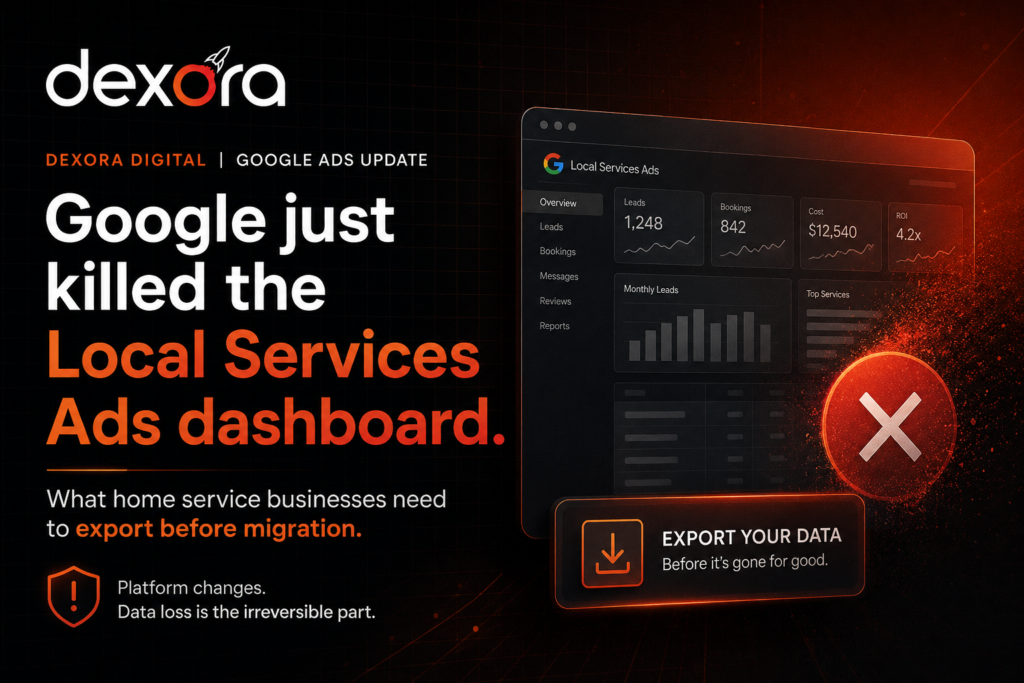
On July 20, 2026, Google officially announced that the standalone Local Services Ads dashboard is being shut down and replaced. All LSA campaigns are migrating into Google Ads as a specialized Performance Max campaign type built for pay-per-lead goals.
The migration starts in August 2026 for home service businesses and runs through 2027 for lawyers, real estate agents, financial planners, and all remaining categories.
⚠ The most important thing in this announcement is not the new campaign name. It is this: your historical LSA performance reports do not transfer. Once your account migrates, they are gone unless you export them first.
What Google Actually Announced
Google’s July 20 announcement — confirmed by Google Ads Product Liaison Ginny Marvin and published in the Google Ads Help Center — covers a phased migration of every LSA campaign into a new campaign type inside the main Google Ads platform.
The new campaign type is called Performance Max with pay-per-lead goals. Despite the Performance Max name, it is not the same as a standard PMax campaign. It does not expand into YouTube, Gmail, Display, or Discover. It stays on Search and Maps only — same as LSA does today.
The change is about platform, not product. Where you manage the campaign is changing. How the campaign works is mostly staying the same.
ℹ Official source
Google Ads Help Center — Local Services Ads transition to Performance Max campaigns. Published July 20, 2026.
The Migration Timeline
Google is rolling this out in phases. Here is the confirmed schedule:
| Phase | Timeline | Who Is Affected |
| Phase 1 | August 2026 | Plumbers, HVAC contractors, electricians, appliance repair, house cleaning, lawn care, roofing, pest control, moving services — select US advertisers first |
| Phase 2 | Late 2026 | Service-area businesses without physical storefronts, accounts with custom bidding or booking configurations, broader US advertiser groups |
| Phase 3 | 2027 | Lawyers, real estate agents, financial planners, healthcare providers, all remaining LSA categories, all non-US accounts |
You will not be migrated without warning. Google sends an email to the account administrator 14 days before your migration date, followed by a 7-day reminder and a banner inside your LSA dashboard. You will also receive a confirmation once the migration completes.
But the 14-day window is not enough time to recover data you did not export. Export it now.
What Is Staying the Same
The core of Local Services Ads — the part that makes it valuable for home service businesses — is not changing.
✓ Pay-per-lead pricing — you still only pay for valid leads such as phone calls and messages, not ad clicks
✓ Search and Maps placements only — your ads will not appear on YouTube, Gmail, Display, or any other Google property
✓ Keywordless targeting — Google continues matching you to searches based on your service categories, service area, and Google Business Profile
✓ Your Google Guarantee or Google Screened badge
✓ Your lead history — all lead records transfer to Google Ads
✓ Your existing budget, targeting settings, and creative assets transfer automatically
✓ GBP sync improves — business profile updates (photos, details, hours) now sync in real time to your campaign
What Is Going Away
Some features will not survive the migration. These are the changes that require action.
✗ The standalone Local Services Ads dashboard — access ends after your migration date
✗ Manual cost-per-lead bidding — being deprecated as part of the transition
✗ Industry-level Target CPA — Google is consolidating bidding options to align with Google Ads models
✗ Better Business Bureau callouts — removed during migration
✗ Historical performance reports — lead history transfers, but campaign-level performance reports do not
✗ Weekly budget management — your weekly budget converts to a daily budget with a monthly cap
Your historical LSA performance reports will not transfer. Once your account migrates and the old dashboard closes, any data you did not export is permanently inaccessible.
The Budget Change You Need to Know About
This one catches a lot of advertisers off guard.
Your LSA weekly budget is converting to a daily budget during migration. Google calculates your daily budget as your weekly budget divided by 7, with a monthly cap set at roughly daily budget multiplied by 30.4.
If you have been managing spend on a weekly rhythm — checking performance and adjusting weekly — the pacing will feel different after migration. Daily budgets can fluctuate day to day and may spend up to twice the daily amount on a single day, as long as the monthly cap is not exceeded.
Review your budget settings before your migration date and adjust for daily management. Do not wait until the campaign is already live in Google Ads to make sense of the new structure.
The One Thing You Need to Do Right Now
Export your LSA performance history immediately.
This is the only irreversible part of the migration. Everything else — bidding strategy, budget structure, campaign settings — can be adjusted after migration. Missing data cannot be recovered.
Before your migration date, export:
→ Your campaign-level performance reports — impressions, clicks, leads, cost, cost per lead
→ Your historical spend by month, quarter, and year for client reporting and internal benchmarks
→ Any seasonal performance data you use for budget planning
→ Your lead dispute history if you track rejected leads
To export: log into your LSA dashboard, go to Reports, select the date range you need, and download. Do this for every date range you will want to reference — Google does not specify how long the dashboard remains accessible after migration, so do it now.
What This Means for Your Google Ads Strategy
For most home service businesses, this migration is a platform change, not a performance change. The campaigns that are working today should continue working in the new structure.
But there are three things worth thinking about as you approach your migration date.
1. Bidding will need attention
With manual bidding and industry-level Target CPA going away, you will need to work with the bidding options available in Google Ads. If you have been running a tightly controlled manual bid strategy in LSA, talk to your Google Ads manager before migration about what replaces it and what the transition plan looks like.
2. GBP quality becomes more important
Because your campaigns are now directly integrated with Google Ads — and because your Google Business Profile now syncs in real time with your campaign — the quality of your GBP directly affects campaign performance. Make sure your GBP is fully optimised before migration: complete categories, accurate service areas, recent photos, and a strong review profile.
Google Business Profile Help Center (Source: Google)
3. Organic SEO becomes your safety net
Paid lead generation through LSA and Google Ads is valuable. It is also entirely dependent on budget and platform stability. The businesses that are most resilient during platform changes like this one are the ones with strong organic rankings that generate leads independently of ad spend.
If your business relies entirely on LSA for lead flow, this migration is a good moment to ask what your organic presence looks like and whether it is generating anything without paid support.
For Lawyers, Real Estate Agents, and Financial Planners
You are not migrating in August. Your timeline is late 2026 and through 2027. But the announcement covers every LSA category eventually, so this is coming for you too.
Use the time you have now to:
→ Export your historical LSA data before anything changes
→ Review your bidding strategy and identify what you will replace manual CPA with
→ Strengthen your Google Business Profile
→ Build organic SEO alongside paid so a future platform change does not cut off your lead flow entirely
Summary — What to Do Before Your Migration Date
| # | Action | Why |
| 1 | Export all LSA performance reports | Historical data does not transfer — this is permanent and irreversible |
| 2 | Review your bidding setup | Manual CPA is going away — understand what replaces it in Google Ads |
| 3 | Update your Google Business Profile | GBP now syncs in real time with your campaign — quality matters more |
| 4 | Adjust for daily budgets | Weekly budgets convert to daily — review pacing before migration |
| 5 | Note your migration date | 14-day email warning arrives — watch for it and plan around it |
| 6 | Brief your team or agency | Whoever manages your campaigns needs to know the new platform and workflow |
ABOUT THE AUTHOR
Taqweem Ahmad
Founder, Dexora Digital | Google Ads & Local SEO Strategist for US Home Service Businesses
Taqweem Ahmad has managed Google Ads and Local SEO campaigns for home service businesses across the USA for 7+ years. His agency, Dexora Digital, has delivered 113 Google Ads conversions at $78.60 cost per conversion for a Birmingham, Alabama home services client — outperforming Angi.com in auction impression share. He regularly covers Google Ads platform changes and their practical impact on local service businesses.
Frequently Asked Questions
Q: When exactly will my LSA campaign migrate to Google Ads?
A: The first wave begins in August 2026 for home service businesses including plumbers, HVAC contractors, electricians, roofers, appliance repair, cleaning, lawn care, pest control, and moving companies. You will receive an email 14 days before your specific migration date, followed by a 7-day reminder. If you are a lawyer, real estate agent, financial planner, or in another non-home-service LSA category, your migration is scheduled for late 2026 or 2027.
Q: Will my LSA ads stop showing during the migration?
A: Google states the migration is automated and designed to minimise downtime. Your existing budgets, targeting settings, and creative assets transfer automatically. The transition is described as a platform move rather than a campaign rebuild, so lead flow should continue without interruption. However, your bidding setup should be reviewed in advance since manual CPA bidding is being deprecated.
Q: Do I need to rebuild my LSA campaign after migration?
A: No. Google migrates your existing campaign settings, budgets, targeting, and assets automatically. Your Google Guarantee or Google Screened badge transfers without any action required. What you do need to do is export your historical performance reports before migration, since those do not transfer to Google Ads.
Q: What happens to my historical LSA performance data?
A: Your lead history transfers to Google Ads. Your historical campaign-level performance reports do not. Once your account migrates and the old LSA dashboard is shut down, any reports you did not export are permanently inaccessible. Export all historical data — by month, quarter, and year — before your migration date. This is the only irreversible part of the migration.
Q: Is Performance Max with pay-per-lead the same as a regular Performance Max campaign?
A: No. Despite sharing the Performance Max name, the LSA migration creates a specialized campaign type built specifically for pay-per-lead goals. Unlike a standard Performance Max campaign, it will not expand into YouTube, Gmail, Display, or Discover. Placements remain on Google Search and Google Maps only, in the same ad positions as Local Services Ads today.
Q: What should I do to prepare for the migration?
A: There are six actions: export all historical LSA performance reports now; review your bidding setup since manual CPA is going away; ensure your Google Business Profile is fully optimised because it now syncs in real time with your campaign; review your budget since weekly budgets convert to daily; watch for the 14-day migration email; and brief anyone who manages your campaigns on the new Google Ads workflow.
Running Google Ads for a home service business?
We manage Google Ads for plumbers, HVAC contractors, roofers, electricians, and home service businesses across the USA.

Local SEO and AI Search (AEO & GEO) Specialist.
Building search visibility that converts into qualified demand.
Today, businesses need visibility on Google Maps and AI powered search and websites that actually convert visitors into leads. I am a Local SEO, AI Search & Conversion Rate Optimization (CRO) Specialist with 5+ years of hands on experience helping businesses turn underperforming websites into high converting growth engines. My work combines Local SEO, Technical SEO, Semantic SEO, GEO/AEO, and conversion focused landing page optimization to ensure brands are discoverable and profitable.
My Experience
I have delivered SEO and web growth projects across the US, UK, Australia, Canada, Finland, Germany, and the Czech Republic, working in industries such as local businesses (electrician, hvac, cleaning, Real estate, healthcare, B2B, eCommerce, SaaS, and environmental services.
Some Results
>> 200+ websites audited globally
>> specifically worked with 100+ local business (80% from USA)
>> 80+ websites improved through technical SEO & schema fixes
>> 20+ businesses featured in Google AI Overviews (SGE)
>> Multi million impression growth for eCommerce & SaaS brands
Book Free Consultation: calendly.com/dexora/30min