


Link building has the worst reputation in SEO. That reputation is deserved — but not for the reasons most people think.
Most link building advice teaches you to acquire links. The actual strategy is to earn them. Those are fundamentally different activities with fundamentally different outcomes.
This guide covers seven link-building strategies that hold up in 2026 — after every algorithm update, after AI search changed the landscape, after Google became much better at identifying manipulation.
our off-page SEO service builds editorial links that compound over time →
Why ‘Link Building’ Needs a New Definition in 2026
The phrase ‘link building’ implies construction. You go out, you build links, you come back with a stack of them.
The reality is that the links that move rankings in 2026 are almost entirely editorial. They come from a journalist deciding your research is worth citing. From a blogger deciding your guide answers their reader’s question better than anything else they’ve found. From a business deciding to feature you in their industry roundup because you genuinely belong there.
Those links cannot be built. They have to be earned by being worth earning.
The most powerful link building strategy is the one that doesn’t look like link building at all.
Ahrefs definitive guide to link building — strategies ranked by scalability and impact →
Strategy 1: Create Link-Worthy Assets
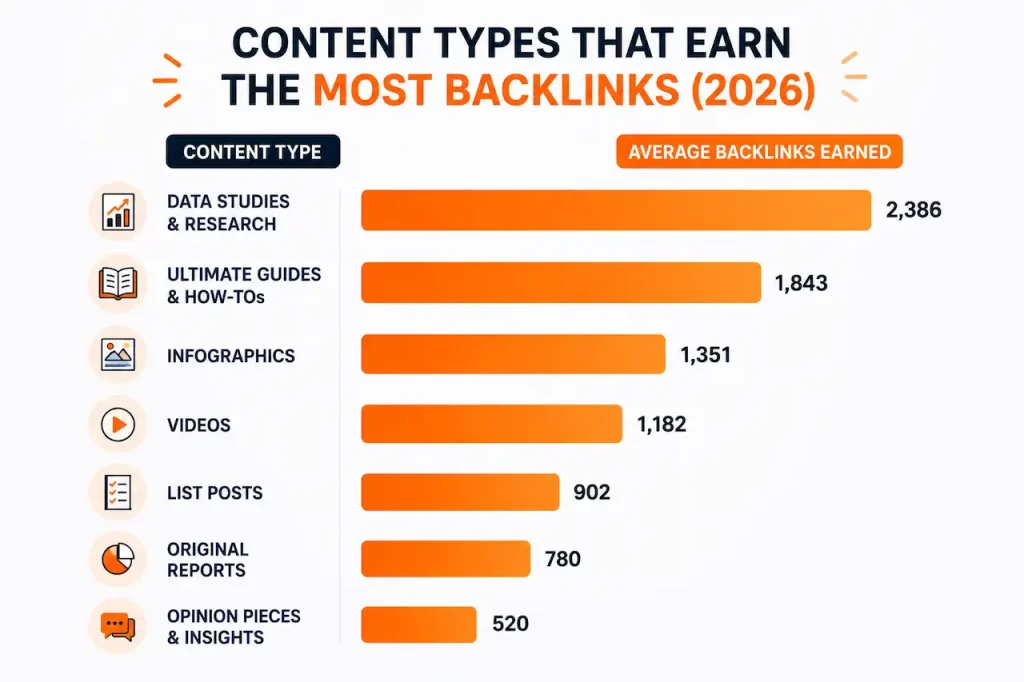
The highest-return investment in link building is creating something genuinely worth linking to. Not more blog content. Something different.
Original Research and Data
Survey your customers. Analyse data from your work. Compile publicly available statistics into a coherent, first-ever study. Industries are full of assumptions and anecdotes that nobody has actually quantified.
For a client in the heating industry, we compiled data on boiler failure rates by brand and age across 200 installation jobs. We published it as a data report. Within three months it had earned 18 backlinks from home improvement publications and consumer advice sites — all editorial, all high quality.
Free Tools and Calculators
A useful, free tool earns links because it has ongoing utility. A mortgage cost calculator. An SEO audit tool. A calorie counter for a food business. People link to tools they use and recommend.
Comprehensive Guides That Become the Standard Reference
A 5,000-word guide that answers every question about a specific topic becomes a reference that others link to whenever they need to explain the topic. It takes longer to write than a blog post. The links it earns for years are worth the investment.
Strategy 2: Digital PR — Earning Media Coverage
Journalists and editors are looking for expert sources, data, and perspectives for their stories every day. Getting featured in relevant publications earns editorial backlinks — the highest quality type.
How to identify opportunities: use HARO (Help a Reporter Out), ResponseSource, or Connectively to find journalist queries in your industry. Respond quickly with specific, expert-level insight. Not generic comment — original perspective based on actual experience.
The publications that matter for link authority vary by industry. For local businesses: local news outlets, regional business publications, and local authority sites. For national businesses: industry trade publications, major business press, specialist vertical media.
Creating Newsworthy Stories
What data does your business generate that would be interesting to the press? What patterns have you noticed in your industry that nobody else has reported? Surprising statistics. Counter-intuitive findings. Trends your clients are experiencing.
A newsworthy angle doesn’t require unusual data. It requires framing ordinary data in a way that answers a question journalists’ audiences are asking.
Search Engine Journal on digital PR as a link building strategy →
Strategy 3: The Skyscraper Technique
Identify content that has already earned significant backlinks in your industry. Create something comprehensively better. Then reach out to the sites linking to the original and let them know you’ve built the superior version.
The logic is sound: those sites have already demonstrated they link to this type of content. If your version is genuinely better — more current, more detailed, more useful — some of them will update their links.
The important qualifier: your content must be genuinely better. Not marginally more words. A material improvement in quality, completeness, or currency. Otherwise the outreach will fail and your effort is wasted.
How to Find Linkable Content in Your Niche
Search your primary topics in Ahrefs Content Explorer or BuzzSumo. Filter by most backlinks or most shares. These are the benchmark pieces in your space — the current standard others link to.
Strategy 4: Broken Link Building
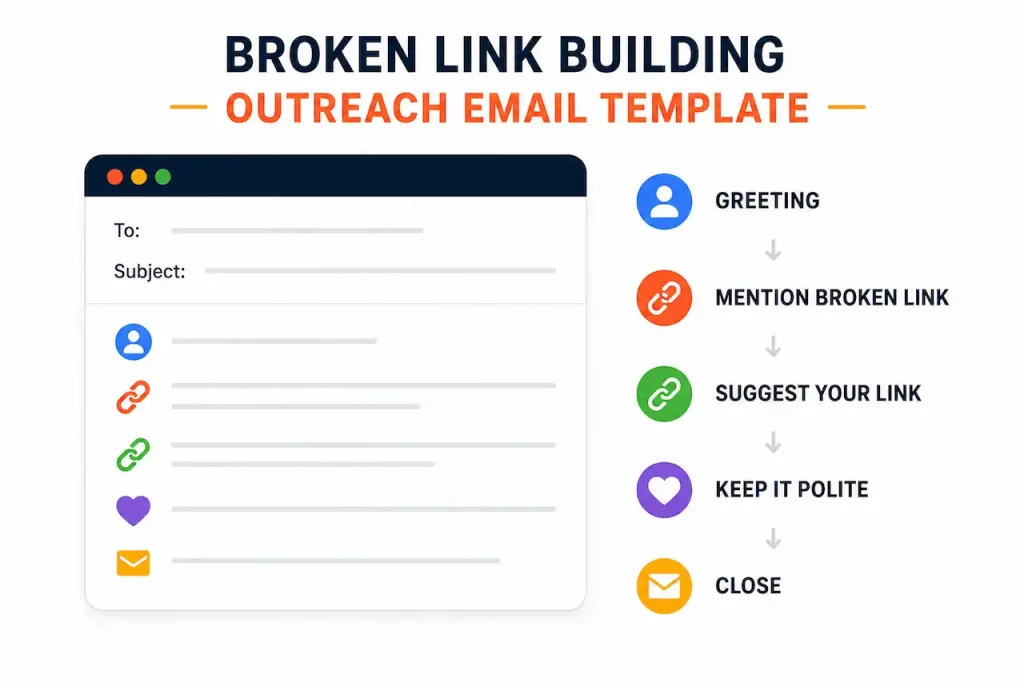
Find pages on relevant websites that link to content which no longer exists (results in 404 errors). Contact the site owner, inform them of the broken link, and suggest your relevant content as a replacement.
This strategy works because it provides value to the site owner — you’re helping them fix something broken. The conversion rate on well-targeted broken link outreach is genuinely higher than cold link requests.
How to Find Broken Link Opportunities
Use Ahrefs’ Broken Backlinks report for competitors in your space. Find external pages they link to that return 404s. If your content matches the topic of the dead page, you have a natural replacement to propose.
Alternatively, use Chrome extensions like Check My Links to scan relevant pages in your industry for broken external links.
Strategy 5: Unlinked Brand Mentions
Find places on the web where your brand, business name, or key personnel are mentioned — but not linked. These are warm targets: the site is already aware of you and has chosen to reference you. Asking for a link is often a simple, successful request.
Use Google Alerts for your brand name. Use Ahrefs’ Content Explorer to search for your business name and filter for pages without a link to your domain.
When outreaching: be brief, friendly, specific about the mention, and low-pressure. ‘Thanks for mentioning us in your [article] — would you mind adding a link so your readers can find us easily?’ That is the whole ask.
Strategy 6: Local and Industry-Specific Link Building
For local businesses, the most accessible high-quality backlinks are often the most obvious ones that get ignored.
Local business associations. Chamber of commerce memberships. Charity sponsorships that include website mentions. Local event coverage. Industry accreditation bodies. Trade membership organisations.
These links are relevant (local and industry signals), often have reasonable domain authority, and are attainable without complex outreach campaigns.
Sponsoring a local sports team, community event, or charity walk can earn multiple local site mentions with genuine editorial placement. The ROI per link is often very high.
Strategy 7: Testimonials and Case Studies as Link Bait
Offer genuinely positive testimonials to suppliers, tools, or services you use. Many companies feature client testimonials on their website with a link to the client’s site. You get a backlink; they get social proof.
Similarly, offering to be a case study for a tool or service you use can result in a long-form feature with a prominent editorial link from an established site.
This works because the site featuring the testimonial or case study is motivated to make it live. You’re not asking for a favour — you’re giving them content they want.
BuzzSumo research on content sharing, links, and virality →
What Not to Do — The Shortcuts That Backfire
Buying links: results in Google manual penalties, ranking drops, and sometimes complete deindexing. The short-term gain is never worth it.
Link exchanges: trading links with other sites is an obvious manipulation pattern. Small numbers of genuinely relevant links with partner organisations may be acceptable. Systematic large-scale exchanges are not.
Spamming outreach: sending the same templated email to thousands of sites asking for links. Low response rate. High risk of your email domain being flagged as spam.
Low-quality guest posting at scale: publishing watered-down content on sites with no relevance or authority purely for the link is a tactic Google’s SpamBrain has become good at detecting.
FAQ: Building Backlinks in 2026
Q: How many backlinks should I build per month?
A: There is no target number. Sustainable, editorial link building results in whatever pace quality opportunities allow — typically 5–20 meaningful backlinks per month for a focused campaign. A sudden spike of 200 links in a month followed by silence looks manipulative to Google. Consistency and quality matter more than volume.
Q: Is link building still necessary with AI search?
A: Yes. AI search tools like ChatGPT and Perplexity prioritise sources that are cited across the web — which is another way of saying sources with strong backlink profiles and high domain authority. Building editorial backlinks improves your visibility in both traditional and AI search simultaneously.
Q: What is a realistic link building budget for a small business?
A: Meaningful results from professional link building typically require a minimum of £500–£1,000/month for a basic campaign. Higher-competition industries require more. Much of the most cost-effective link building — creating linkable assets, digital PR, unlinked mentions — requires time investment more than direct budget. The opportunity cost of doing it poorly is higher than the cost of doing it right.
Q: How do I know if a backlink is hurting my site?
A: Signs include: a sudden ranking drop following a period of aggressive link building, a manual penalty notification in Google Search Console, or a backlink audit showing a high proportion of links from irrelevant, low-authority, or obviously spammy domains. Ahrefs and SEMrush’s backlink analysis tools flag toxic links with a toxicity score.
The Real Foundation of Link Building
The businesses I have seen build genuinely strong backlink profiles over time are not the ones who ran the most campaigns. They are the ones who became genuinely worth citing.
They published real research. They built tools people used. They earned press coverage for doing interesting things in their industry. They contributed to their field.
The links followed the work.
Link building is one part of a complete SEO strategy — see how the pieces fit →
If you want people to link to you, become the kind of source people naturally link to.
Want to see your current backlink profile and where the gaps are? →
We’ll audit your existing links and build a strategy to close the gap on competitors.

Local SEO and AI Search (AEO & GEO) Specialist.
Building search visibility that converts into qualified demand.
Today, businesses need visibility on Google Maps and AI powered search and websites that actually convert visitors into leads. I am a Local SEO, AI Search & Conversion Rate Optimization (CRO) Specialist with 5+ years of hands on experience helping businesses turn underperforming websites into high converting growth engines. My work combines Local SEO, Technical SEO, Semantic SEO, GEO/AEO, and conversion focused landing page optimization to ensure brands are discoverable and profitable.
My Experience
I have delivered SEO and web growth projects across the US, UK, Australia, Canada, Finland, Germany, and the Czech Republic, working in industries such as local businesses (electrician, hvac, cleaning, Real estate, healthcare, B2B, eCommerce, SaaS, and environmental services.
Some Results
>> 200+ websites audited globally
>> specifically worked with 100+ local business (80% from USA)
>> 80+ websites improved through technical SEO & schema fixes
>> 20+ businesses featured in Google AI Overviews (SGE)
>> Multi million impression growth for eCommerce & SaaS brands
Book Free Consultation: calendly.com/dexora/30min