




Most businesses build their content strategy backwards. They write about what they want to say. Then they wonder why no one is searching for it.
Keyword research is the discipline of finding out what your potential customers are actually typing into Google — before you write a word. Done correctly, it tells you exactly which topics to cover, in what order, and how hard each one will be to win.
This guide walks through the exact process I use with clients. No expensive tools required to start. No guesswork about what will rank.
Keyword research is step one of every SEO campaign we run →
Why Most Keyword Research Fails — And What to Do Instead
The classic mistake: open a keyword tool, type your main service, see the highest-volume keywords, target them. Then spend 12 months publishing content that never ranks because every competitor has spent years on the same terms.
Volume is a trap. High search volume on a keyword means high competition. For a new or emerging site, those are keywords you cannot win yet regardless of how good your content is.
The right approach is to search for keywords where: the intent matches what you offer, the volume is sufficient to be worth targeting, and the competition level is appropriate to where your site currently sits.
The keywords worth targeting are the ones you can actually win — not the ones you wish you could win.
Step 1: Start With Your Business, Not a Keyword Tool
Before opening any tool, write down the answers to three questions.
What services or products do you offer? Be specific. Not ‘plumbing services.’ Emergency plumber call-outs. Boiler installation. Bathroom renovation. Blocked drain clearing.
What problems do your customers arrive with? What are they frustrated by? What do they search for at 11pm when something’s gone wrong?
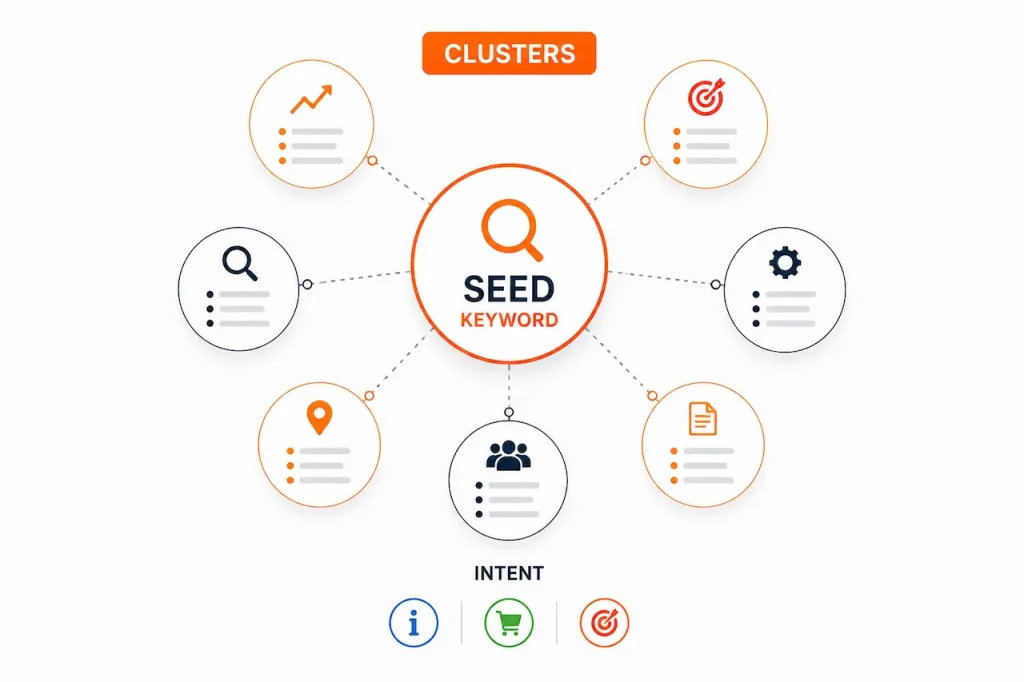
What questions do your best customers ask you repeatedly? Those questions are keywords. The answers are content.
This exercise gives you a seed keyword list of 20–40 real terms before you open any tool. Everything that follows is expansion and refinement of this list.
Step 2: Understand Keyword Intent — The Filter That Changes Everything
Not all keywords want the same thing. Before evaluating volume or difficulty, classify the intent behind each keyword. There are four types.
Informational Intent
The searcher wants to learn. ‘How does SEO work.’ ‘What is a backlink.’ ‘Why is my boiler making a noise.’ These keywords drive blog traffic. They don’t directly convert, but they build brand awareness and topical authority.
Commercial Intent
The searcher is researching before they buy. ‘Best SEO agency Bristol.’ ‘SEO agency vs freelancer.’ ‘Boiler installation cost.’ These are high-value keywords — the person is close to a decision and comparing options.
Transactional Intent
The searcher is ready to act. ‘SEO agency Bristol quote.’ ‘Book plumber London.’ ‘Buy boiler installation.’ These are your highest-converting keywords. Competition is usually highest here too.
Navigational Intent
The searcher is looking for a specific site or brand. ‘Dexora Digital SEO.’ ‘BBC weather.’ Navigational keywords for your own brand are important to own — for others, they’re usually not worth targeting.
Once you know the intent, you know what type of content to create. Informational keywords get blog posts. Commercial and transactional keywords get service or landing pages. Mismatch intent and content type and you will not rank no matter how well you write.
Ahrefs guide to keyword research and search intent →
Step 3: Use Tools to Expand and Evaluate
Now you open a keyword tool. The free ones — Google Search Console, Google Keyword Planner, Google’s autocomplete suggestions, and People Also Ask — are sufficient to start. Paid tools (Ahrefs, SEMrush, Ubersuggest) dramatically accelerate the process.
The Free Method: Google Itself
Type your seed keyword into Google. Look at: the autocomplete suggestions (these are real searches), the People Also Ask box (real questions), the Related Searches at the bottom (more real searches), and the titles of the top 10 results (they tell you what’s competing).
The Paid Tool Method
In Ahrefs or SEMrush, enter each seed keyword and look at: monthly search volume, keyword difficulty (KD) score, related keyword suggestions, and top-ranking pages for each keyword. Export the results and build a spreadsheet.
Evaluating Keyword Difficulty for Your Site
For a new or low-authority site: target keywords with KD 0–15. For an established site with some authority: KD 15–30 is accessible. For a well-established, high-authority site: KD 30–50 is achievable. KD 50+ requires significant domain authority and active link building.
Most businesses should start with long-tail keywords (3+ words, lower volume, lower difficulty) and work their way to head terms as authority builds. This is not settling for less. It is being strategic about where your effort actually pays off.
Google Keyword Planner — free keyword volume data from Google Ads →
Step 4: Group Keywords Into Clusters
One page cannot and should not target dozens of unrelated keywords. Group your keywords by topic.
All keywords related to the same underlying topic (same intent, same reader, same answer) should be covered by the same page. This is keyword clustering.
Example: ’emergency plumber Bristol,’ ’emergency plumber Bristol 24 hours,’ ’24 hour plumber Bristol,’ ’emergency plumbing near me Bristol’ — these all want the same page. One well-written service page targeting all of them simultaneously.
Example of what NOT to do: separate pages for each of those keywords. You create internal competition, dilute your authority, and confuse Google about which page to rank.
Build Your Content Priority Matrix
Now prioritise. Columns: keyword cluster, monthly volume, keyword difficulty, content type needed, current ranking (if any), priority score.
Score each cluster by multiplying volume by an inverse of difficulty. High volume and low difficulty = highest priority. Low volume and high difficulty = lowest priority. This gives you a ranked content roadmap.
Step 5: Validate Keywords With Real Search Results
Before investing significant effort in a keyword cluster, search it yourself and evaluate what’s ranking.
Is the first page dominated by huge national brands and news publishers? That’s a signal of extreme competition for a new site. Are the top results thin, outdated, or poorly written? That’s your opportunity — content quality is the barrier, not domain authority.
Does the first page include your direct service or product type? If the results are all informational for a transactional keyword, Google may be misreading the intent and the keyword may not convert even if you rank.
The best keyword isn’t the one with the most searches. It’s the one you can rank for and actually convert.
Common Keyword Research Mistakes
Mistake: Targeting only high-volume head terms. Why it happens: big numbers are exciting. What it costs you: 12 months of content that never reaches page 1 because the competition is insurmountable.
Mistake: Ignoring keyword intent. Why it happens: keyword tools show volume without clearly marking intent. What it costs you: you create blog content for transactional keywords and service pages for informational queries both rank poorly.
Mistake: Not updating your keyword research annually. Why it happens: it feels like a one-time task. What it costs you: you miss new search trends, AI-generated keyword opportunities, and competitor gaps that open up over time.
Mistake: Targeting keywords with no search volume. Why it happens: the phrase feels like what a customer would search. What it costs you: traffic that never materialises because no one actually searches it.
FAQ: Keyword Research in 2026
Q: What are the best free keyword research tools?
A: Google Search Console (shows keywords your site already ranks for), Google Keyword Planner (search volumes from Google Ads), Google Autocomplete (real search suggestions), People Also Ask (question-based keywords), and AnswerThePublic (question and preposition-based keyword visualisation). These free tools are sufficient for most small business keyword research needs.
Q: How many keywords should I target on one page?
A: One primary keyword plus 3–5 closely related secondary keywords per page. These should all share the same search intent and essentially answer the same underlying question. Targeting more than one distinct topic per page creates conflicting signals and dilutes the page’s relevance.
Q: What is a good keyword difficulty score to target?
A: New sites should target keywords with a difficulty score under 15 (on Ahrefs’ 0–100 scale). Established sites with moderate authority can pursue 15–30. Well-established sites can target 30–50. Keywords above 50 require significant domain authority, extensive backlink profiles, and are generally not appropriate targets for sites under 2–3 years old.
Q: Should I do keyword research for local SEO differently?
A: Local keyword research adds a geographic modifier to standard research. Instead of ‘plumber Bristol’ you research ’emergency plumber Bristol,’ ‘boiler repair Bristol,’ ‘Bristol plumbing company’ etc. Focus on transactional and commercial intent keywords with local modifiers. Also research question-based informational keywords your local audience asks, as these build local topical authority.
Q: How do AI search queries affect keyword research in 2026?
A: AI search users often ask natural language questions rather than using short keyword phrases. This makes question-based keyword research (People Also Ask, Quora, Reddit, customer questions) increasingly important. Optimise for the full question, not just the keyword fragment. Pages that directly and comprehensively answer natural language questions are positioned for both traditional search and AI search recommendation.
Search Engine Journal on keyword intent and how to match content type →
Keywords Are a Map — Not the Destination
Keyword research doesn’t tell you what to create. It tells you what people want to find. The creation still has to be good.
The businesses that grow through SEO are not the ones who found the cleverest keywords. They are the ones who found what their customers needed and then actually created the best answer to that need. Keyword research is just how you figure out what to answer.
A full SEO audit includes a keyword gap analysis — see what you’re missing →
Keywords are the question. Your content is the answer. Make the answer worth finding.
Want a keyword research strategy built for your specific industry and competitive landscape? We map the keywords worth targeting, the ones to avoid, and the content roadmap to get there.
Book a Free Strategy Consultation →