


The businesses that grow fastest through SEO are almost never the ones targeting the biggest keywords.
They are targeting the specific ones. The ones that tell you exactly who is searching and what they need. The ones with enough volume to be worth winning, but specific enough that winning them is actually possible.
Long-tail keywords are the SEO strategy most beginners skip because the volume numbers look small. That is precisely why they work.
What Makes a Keyword ‘Long-Tail’
A long-tail keyword is a specific, multi-word search phrase with lower search volume than a broad head term. ‘SEO’ is a head term — millions of searches, extremely competitive. ‘Affordable SEO services for plumbers Bristol’ is long-tail — lower volume, dramatically lower competition, and a very specific searcher.
The name comes from the ‘long tail of the demand curve’ — the concept that in most markets, the bulk of demand is distributed across thousands of niche, specific queries rather than concentrated in a handful of popular terms.
For keywords: the head terms (top 20% of keywords) drive around 20–30% of all searches. The long tail (the other 80%) drives the remaining 70–80%. Most of the search demand in any industry is in the long tail.
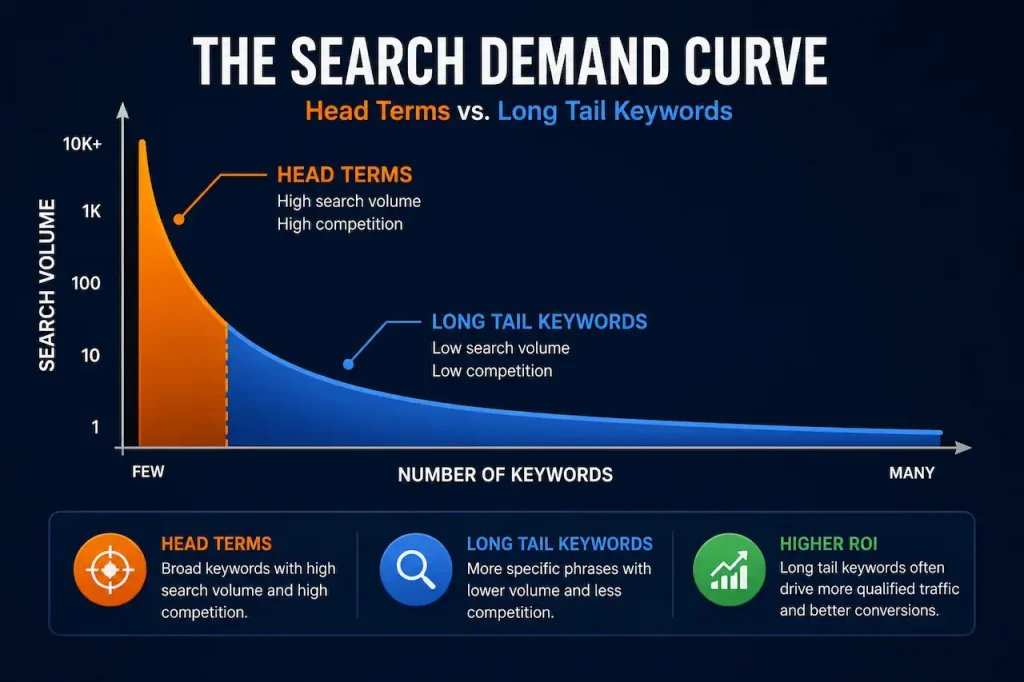
Moz’s original explanation of the keyword demand curve and long-tail strategy →
The most valuable SEO traffic is often invisible on a keyword report because the individual volumes look too small to care about.
Why Long-Tail Keywords Convert Better Than Head Terms
Someone searching ‘plumber’ might be researching how plumbing works. They might be a student. They might be curious. The intent is ambiguous.
Someone searching ’emergency boiler repair Bristol tonight’ is in their house, cold, possibly anxious, and looking to book someone. The intent is crystal clear.
Long-tail searchers are more specific in their queries because they have a specific need. That specificity correlates with purchase intent. The data consistently shows this: long-tail keywords drive lower bounce rates, higher pages-per-session, and higher conversion rates than their high-volume alternatives.
The Conversion Intent Spectrum
Short head term (‘plumbing’): informational, early stage, low buying intent. Medium keyword (‘plumber Bristol’): local, likely looking for options, moderate intent. Long-tail (’emergency plumber Bristol 24-hour no call-out fee’): high specificity, high urgency, high intent.
Every business should have content at all three levels — but new sites and sites with limited authority should prioritise the long tail because it is genuinely winnable.
For local businesses, long-tail local keywords are the highest-converting SEO investment →
How to Find the Best Long-Tail Keywords
Method 1: Your Own Customers
What exact phrases do customers use when they contact you? What do they say in their first message or call? Those phrases are long-tail keywords. The language real customers use is often different from the language businesses assume they use.
Method 2: Google’s Own Suggestions
Type any head term into Google and pause — the autocomplete suggestions are real searches. Scroll to the bottom and read ‘Related Searches.’ Click on a few results and read the People Also Ask box. Every question in PAA is a long-tail keyword.
Method 3: Keyword Research Tools
In Ahrefs or SEMrush, enter your head term and filter for: low keyword difficulty (under 15 for new sites), 3+ words, informational or commercial intent. Export the results and you will have hundreds of long-tail targets.
Method 4: Forum and Community Research
Reddit, Quora, and niche forums are where your potential customers ask questions they don’t know how to phrase as search queries. These questions are long-tail keyword gold. The question format itself is often the exact phrasing they’ll search.
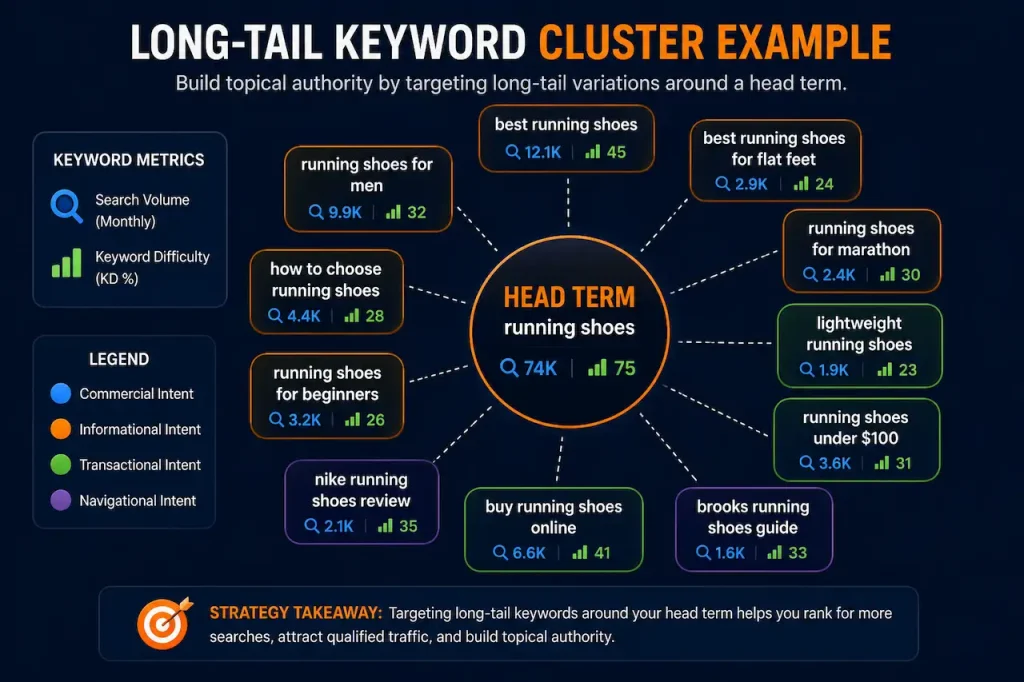
Ahrefs data on long-tail keyword search volume distribution →
How to Use Long-Tail Keywords in Your Content Strategy
One article per distinct topic cluster. Not one article per keyword.
Group all long-tail variations of the same query into a single target page. ‘Boiler repair cost Bristol,’ ‘how much does a boiler repair cost,’ ‘Bristol boiler fix price’ — these all belong on the same page. Write one comprehensive article targeting all of them. Trying to write separate articles for each variation creates duplicate content issues and keyword cannibalisation.
Optimise for the Question Format
Long-tail searches are often phrased as questions. Your content should include the full question as an H2 or H3 heading and answer it directly in the following paragraph. This is exactly the format that wins featured snippets and gets cited by AI search tools.
Build Topical Authority Through Long-Tail First
New sites should build a comprehensive cluster of long-tail content before targeting competitive head terms. Covering every niche question in your industry thoroughly establishes topical authority — which eventually makes the head terms achievable.
This is the sequence: win the long tail, build the authority, earn the short tail. Not the other way around.
AI search users ask long, specific questions — which makes long-tail SEO and AI search optimisation the same investment →
Common Mistakes With Long-Tail Keywords
Mistake: Dismissing keywords below 100 monthly searches. Why it happens: volume feels like a proxy for value. What it costs you: a keyword with 50 monthly searches but 8% conversion rate is far more valuable than a keyword with 5,000 searches and 0.1% conversion rate.
Mistake: Creating a separate page for every long-tail variation. Why it happens: it feels thorough. What it costs you: duplicate content issues, keyword cannibalisation, and internal competition that dilutes each page’s authority.
Mistake: Not checking whether the long-tail keyword actually has a specific answer. Why it happens: volume and difficulty metrics don’t capture this. What it costs you: content that answers a question nobody is actually asking in that way.
FAQ: Long-Tail Keywords in SEO
Q: What is a long-tail keyword in SEO?
A: A long-tail keyword is a specific, multi-word search phrase with lower search volume than broad head terms. For example, ‘SEO services’ is a head term (high volume, high competition). ‘Affordable local SEO services for small plumbing companies’ is long-tail (lower volume, lower competition, highly specific intent). Long-tail keywords collectively account for the majority of all search queries.
Q: Are long-tail keywords better for SEO?
A: Better is contextual. Long-tail keywords are easier to rank for (lower competition), have higher purchase intent, and often convert better than head terms. For new sites or sites building authority, they are the most realistic path to page-one rankings. As domain authority grows, the head terms become achievable — but the long-tail remains valuable because of its conversion advantage.
Q: How many words make a keyword ‘long-tail’?
A: Typically 3 or more words. Single-word keywords (SEO, plumber, dentist) are head terms. Two-word keywords (local SEO, Bristol plumber) are mid-tail. Three-word-plus keywords with specific modifiers, locations, or qualifiers are long-tail. The defining characteristic is specificity of intent, not strictly word count.
Q: Can I use multiple long-tail keywords on the same page?
A: Yes — and this is best practice. Group all long-tail variations of the same underlying question into a single, comprehensive page. A page answering ‘how much does boiler repair cost’ also naturally covers ‘boiler repair price,’ ‘cost of fixing a boiler,’ and ‘boiler service charges’ — all variations of the same intent. One page, one topic, multiple keyword variations.
Q: Do long-tail keywords work for AI search and ChatGPT?
A: Especially well. AI search users tend to ask natural language questions — which are inherently long-tail. A user asking ChatGPT ‘what is the best way to find an emergency plumber in Bristol at night?’ is using long-tail search language. Content that directly and comprehensively answers these specific questions is exactly what AI tools recommend and cite.
Start Where You Can Win
The fastest path to real SEO traction for most businesses is not targeting the most popular keywords. It is dominating the specific ones that your exact customer is searching for at the exact moment they need you.
That is the long tail. Low competition. High intent. Genuinely winnable.
Win these first. Build authority. Then the broader terms become achievable. That is the sequence that actually works.
Our SEO strategy always starts with winning the long tail and building from there →
The search queries nobody else is targeting are the ones with the highest ROI waiting inside them.
Find your long-tail keyword opportunities with a free SEO audit →
We’ll identify the specific, winnable keywords in your niche that your competitors are ignoring.