
Your competitor is on page one. They got there two ways: they paid for it with ads, or they earned it with SEO. The difference matters more than most businesses realise.
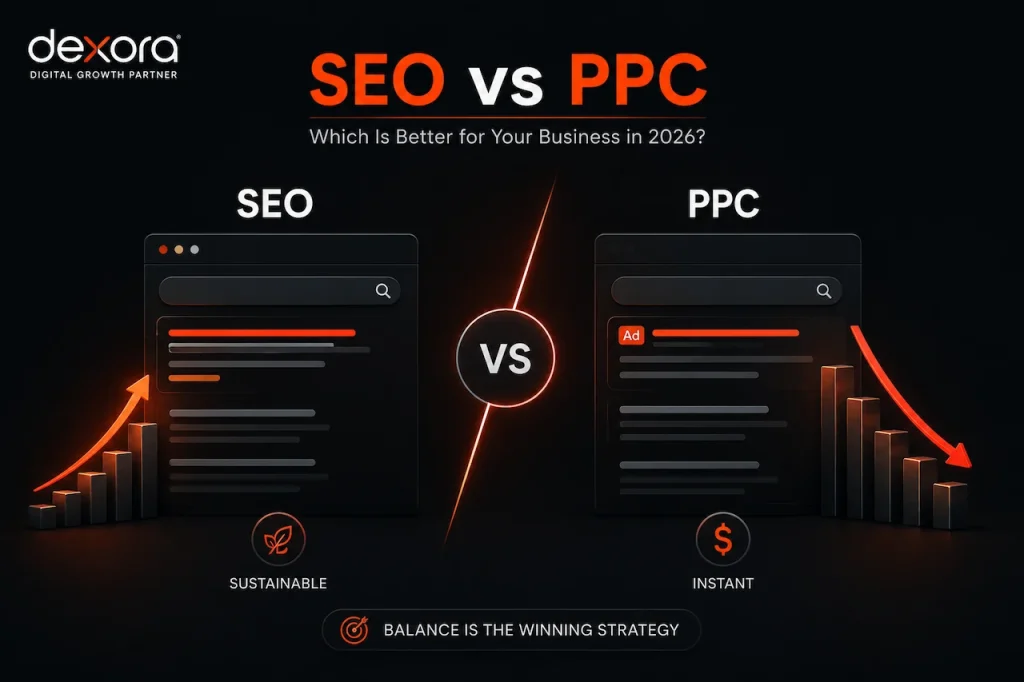
Paid advertising (PPC — pay-per-click) is a tap. Turn it on, traffic flows. Turn it off, silence. SEO is a pipe you build. The building takes time and effort. But once it’s there, water flows whether you’re watching or not.
Most businesses need both at different times. Here is the honest breakdown of when each one wins and when choosing the wrong one costs you.
See how a full SEO strategy builds the kind of traffic PPC can’t sustain →
The Real Difference Between SEO and PPC — Beyond the Obvious
Both SEO and PPC put your website in front of people searching for what you sell. That is where the similarity ends.
With PPC, you bid for placement. The highest bidder, combined with quality score, gets the top ad positions. The moment your campaign pauses, you disappear. The money you spent yesterday bought yesterday’s traffic.
With SEO, you invest in earning a position that belongs to you. A page that ranks number one for a valuable keyword continues generating traffic months and years after the content was published. The work compounds.
With PPC you rent visibility. With SEO you own it.
The Numbers Most Agencies Don’t Tell You
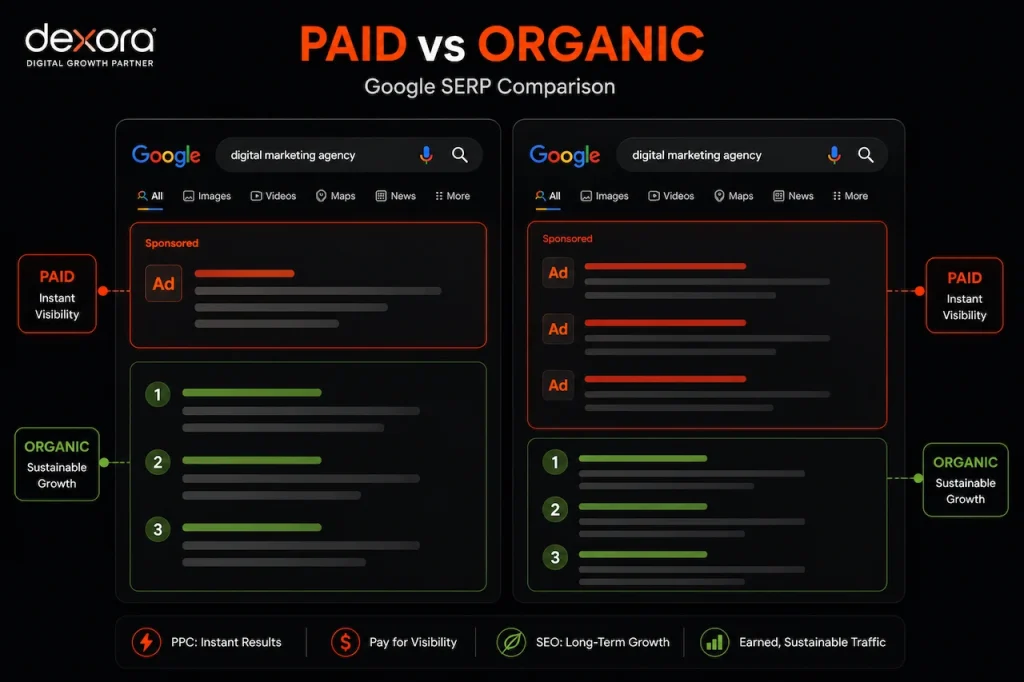
Organic search results receive approximately 70% of all clicks on a typical search results page. Paid ads receive around 15%. The remaining 15% goes to Google’s own features — maps, shopping, AI Overviews.
That means the organic position you’ve been ignoring is receiving 4–5 times more clicks than the paid position you’re spending thousands per month to maintain.
However and this matters PPC converts differently. Someone clicking a well-crafted paid ad is often further along the buying journey. The intent is sharpened by the ad copy. That is why PPC’s cost-per-click can be justified even with lower total click volume.
WordStream research on PPC click-through rates and cost benchmarks →
When PPC Is the Right Choice
PPC is not the enemy of SEO. It is a different tool with a specific use case. Here is when it wins.
When You Need Traffic Today
You are launching a new product next Monday. You have a promotional window that closes in 30 days. Your site is new and has no organic authority.
In every one of those scenarios, PPC is the only option. SEO doesn’t move fast enough for time-sensitive opportunities.
When You Are Testing Keywords
Before investing months of SEO effort into a keyword cluster, paid ads let you test whether that traffic actually converts. A two-week paid campaign on your target keywords tells you whether people who search for those terms buy. That is valuable data you cannot get any other way.
When Your Industry’s CPC Is Low Enough to Make It Sustainable
In some industries — niche B2B products, specialist services — the cost-per-click is low enough that PPC delivers sustainable ROI indefinitely. For most competitive consumer-facing businesses, this is not the case.
When You Are Competing in an AI Overview Dominated Search
For some informational queries, Google AI Overviews now answer the question before anyone clicks. In those cases, paid ads maintain visibility even when organic results are pushed below the fold.
When SEO Is the Right Choice
SEO wins in the long game. Here is specifically when.
When You Have a 12-Month-Plus Planning Horizon
If you are building a business meant to last — not launching a campaign — SEO is the only channel that generates compounding returns. Every piece of quality content you publish today is a traffic asset that runs without a monthly invoice.
When Your PPC Costs Are Getting Unmanageable
In competitive industries, PPC costs have skyrocketed. Legal, finance, insurance, and home services regularly see cost-per-click figures of £30–£200+. At that price, your only sustainable path to search visibility is organic rankings.
When You Want to Build Brand Authority
Consistently appearing in organic results for useful, expert content does something PPC ads can’t: it builds credibility. When searchers see you ranking for question after question in your industry, they perceive you as the authority. Ads are trusted less.
When You Are in eCommerce With High Product Volume
Organic product and category page rankings are among the highest-ROI investments an eCommerce business can make. A well-optimised product catalogue drives traffic to hundreds of pages simultaneously — leverage that no PPC budget can match.
The SEO + PPC Hybrid — When Both Make Sense Together
The smartest businesses don’t choose one. They use PPC to cover the short term while SEO builds for the long term.
Here is a strategy I have implemented with clients repeatedly: use PPC to generate immediate leads and revenue in months 1–6. Use the revenue and data from those campaigns to fund and inform the SEO strategy. As SEO rankings build (months 6–12), gradually reduce PPC spend on the keywords now ranking organically. Reallocate that PPC budget to new keywords not yet ranking.
The result: you never have a zero-traffic period. Your cost-per-acquisition decreases over time. And the PPC campaigns stay focused on their highest-return use case: capturing demand that SEO can’t yet reach.
The businesses with the most durable marketing don’t choose between SEO and PPC. They sequence them strategically.
Smart Insights research on organic vs paid click behaviour →
Common Mistakes When Choosing Between SEO and PPC
Mistake: Running PPC forever on keywords you could rank for organically. Why it happens: PPC feels controllable. What it costs you: you pay for every click, indefinitely, for traffic you could own.
Mistake: Starting SEO and stopping it after two months because results are slow. Why it happens: ROI isn’t visible in the early months. What it costs you: you restart the clock every time you stop, and never build the compound advantage.
Mistake: Investing in PPC without tracking conversions, not just clicks. Why it happens: setup takes time. What it costs you: you are paying for traffic that may not be converting — and you can’t tell.
Mistake: Assuming high PPC spend means you don’t need SEO. Why it happens: PPC is delivering results, so why change? What it costs you: complete dependency on a channel that gets more expensive every year with a competitor landscape that gets more crowded.
Local businesses benefit most from combining local SEO with highly targeted local PPC →
FAQ: SEO vs PPC
Q: Is SEO or PPC better for a new business?
A: For a new business with an immediate need for traffic and revenue, PPC is often the faster path. However, starting SEO simultaneously — even at a modest pace — builds the long-term asset while PPC generates short-term leads. Many new businesses make the mistake of running PPC exclusively and never building organic visibility.
Q: Which is more cost-effective long-term, SEO or PPC?
A: SEO is almost always more cost-effective over a 2+ year horizon. Once pages rank, they generate traffic without ongoing per-click costs. PPC requires continuous spend to maintain traffic. The tipping point is typically around 12–18 months, after which SEO traffic often costs less per visitor than equivalent PPC traffic.
Q: Can you do both SEO and PPC at the same time?
A: Yes — and this is often the ideal strategy. PPC covers immediate traffic needs while SEO builds long-term authority. Data from PPC campaigns (which keywords convert best) can directly inform your SEO keyword strategy, saving months of testing.
Q: Does running PPC ads help with SEO rankings?
A: No. Google has confirmed that paid advertising has no direct effect on organic rankings. Running ads does not improve your SEO position. The two systems are entirely separate. Traffic from PPC may indirectly improve user engagement metrics, but this is a secondary and unproven effect.
Q: When should I stop PPC and rely on SEO only?
A: Consider reducing PPC for a keyword once your organic result ranks consistently in the top 3 for that term. You are paying for clicks you are already earning organically. Reallocate that budget to keywords not yet ranking organically rather than stopping PPC entirely.
The Decision: Which One Is Right for You Right Now?
If you need traffic in the next 30 days: PPC. If you are building a business that needs to acquire customers at sustainable cost in 12+ months: SEO. If you have any budget and planning horizon at all: both, in sequence.
The businesses that win long-term in search are not the ones who chose correctly between SEO and PPC once. They are the ones who understood both tools well enough to deploy them at the right time.
The traffic you earn is always cheaper than the traffic you rent — eventually.
HubSpot data on inbound marketing and long-term organic channel performance →
Not sure whether SEO, PPC, or both is right for your business right now? We’ll review your current position and give you a straight answer — no sales pitch, no one-size-fits-all approach.
Book a Free Strategy Consultation →

Local SEO and AI Search (AEO & GEO) Specialist.
Building search visibility that converts into qualified demand.
Today, businesses need visibility on Google Maps and AI powered search and websites that actually convert visitors into leads. I am a Local SEO, AI Search & Conversion Rate Optimization (CRO) Specialist with 5+ years of hands on experience helping businesses turn underperforming websites into high converting growth engines. My work combines Local SEO, Technical SEO, Semantic SEO, GEO/AEO, and conversion focused landing page optimization to ensure brands are discoverable and profitable.
My Experience
I have delivered SEO and web growth projects across the US, UK, Australia, Canada, Finland, Germany, and the Czech Republic, working in industries such as local businesses (electrician, hvac, cleaning, Real estate, healthcare, B2B, eCommerce, SaaS, and environmental services.
Some Results
>> 200+ websites audited globally
>> specifically worked with 100+ local business (80% from USA)
>> 80+ websites improved through technical SEO & schema fixes
>> 20+ businesses featured in Google AI Overviews (SGE)
>> Multi million impression growth for eCommerce & SaaS brands
Book Free Consultation: calendly.com/dexora/30min