



After running over 500 SEO audits for businesses across the USA, UK, Australia, Canada, and Europe, I have seen one pattern repeat itself more than any other. Business owners assume their website is fine. It loads. It looks professional. Nobody told them it was broken.
The most expensive SEO problems are invisible to casual observation. A single line in your robots.txt blocking ChatGPT from accessing your website. Missing LocalBusiness schema preventing Google Maps rankings. Core Web Vitals failing on mobile and suppressing every page simultaneously. None of these produce visible errors. All of them cost you traffic and customers every single day.
This is the complete SEO audit guide for 2026. It covers every audit type, every critical check, and connects directly to the tools and professional services that fix what you find.
Run your free complete audit right now at allinoneseoaudit.com. All seven dimensions. 60 seconds. No signup required.
What Is an SEO Audit
An SEO audit is a structured health check of every factor that determines your website’s visibility in search engines and AI search systems. It identifies what is broken, what is missing, and what is actively suppressing your rankings. A good audit does not just find problems. It prioritizes them by impact so you know exactly what to fix first.
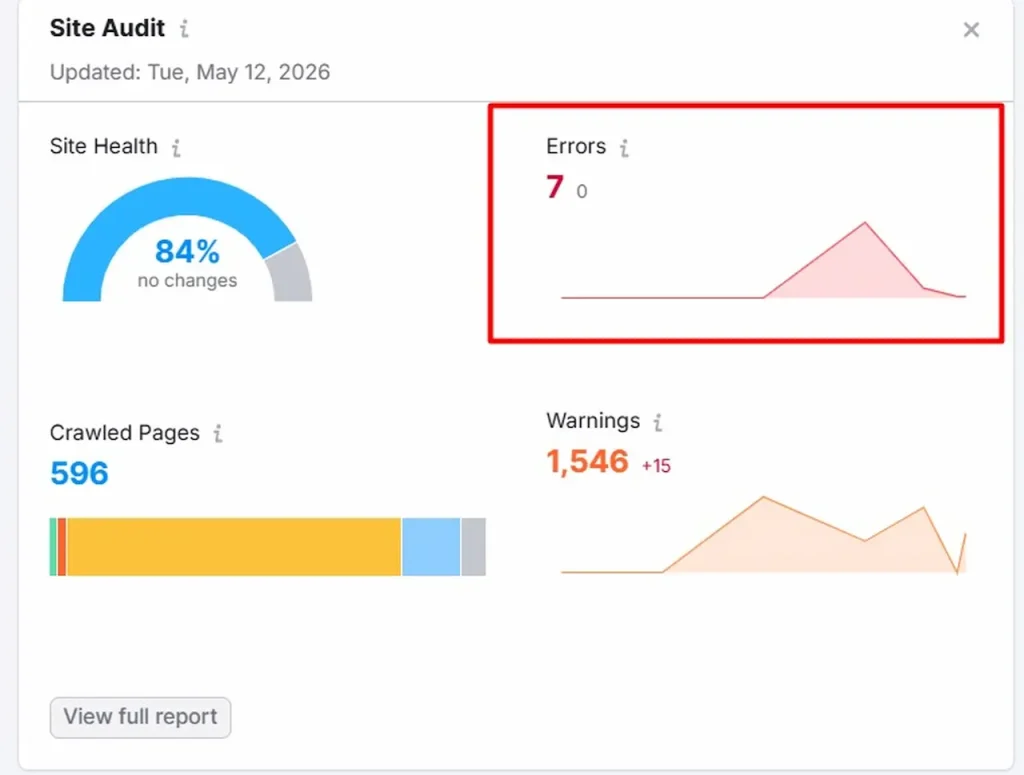
In 2026 a complete SEO audit covers seven critical dimensions:
Technical SEO — the infrastructure layer that determines whether search engines and AI systems can access your content at all.
Core Web Vitals — the performance layer Google uses as a direct ranking factor.
On-Page SEO — the content layer that determines whether Google understands what your pages are about.
CRO — the conversion layer that determines whether your traffic becomes customers.
Local SEO — the geographic layer that determines your visibility in Google Maps and local search.
AI SEO and EEAT — the newest layer determining whether ChatGPT, Perplexity, and Google AI recommend you.
Schema Markup — the structured data layer that unlocks rich results and AI citations.
Most free tools check one or two of these. Our professional SEO audit services at Dexora Digital cover all seven as the starting point for every client engagement.
Why SEO Audits Matter More in 2026
Three things changed in the last 18 months that make regular SEO auditing more important than ever.
Google’s algorithm updates are more frequent and more impactful. The August 2025 Spam Update, the June 2025 Core Update, and the February 2026 update all reshaped rankings across industries. Businesses without regular audits discovered traffic drops months after the causal event, making recovery slower and more expensive.
AI search is now a real traffic channel. ChatGPT, Perplexity, and Google AI Overviews are directing users to specific websites. Businesses appearing in AI recommendations are getting calls, leads, and purchases from a channel their competitors have not addressed. Businesses blocking AI crawlers are invisible to this channel entirely.
Core Web Vitals failures are compounding. Only 43 percent of websites pass mobile Core Web Vitals. Every failing website is being penalized across every page simultaneously. The penalty compounds as competitors improve their scores.
The Eight Types of SEO Audit
1. Full Website SEO Audit — Start Here
A full website SEO audit covers all seven dimensions simultaneously. This is always the starting point. Without the complete picture you cannot prioritize correctly. You might spend three months fixing on-page issues on a website where the real problem is AI crawlers being blocked in robots.txt.
Our SEO audit service runs the complete seven-dimension audit as the foundation of every Dexora Digital engagement. The free version is available at allinoneseoaudit.com.
2. Technical SEO Audit — The Foundation
A technical SEO audit checks whether search engines and AI systems can access, crawl, and index your pages. This is the most critical audit type because technical issues block every other optimization from working at full capacity.
The checks that matter most in 2026:
robots.txt configuration. One incorrectly placed Disallow rule can block Google, ChatGPT, Perplexity, and every AI system simultaneously. Check this first using the Dexora Digital AI agent checker. Our technical SEO services include a complete robots.txt audit and fix as standard.
XML sitemap validity. Your sitemap must be valid and submitted to Google Search Console. Every page you want ranked must be included.
Canonical tags. Incorrect canonical tags split ranking authority across duplicate URLs. This is one of the most common critical findings on established websites.
Redirect architecture. Redirect chains lose link equity with every hop. Broken redirects create 404 errors that damage crawl efficiency.
Core Web Vitals. LCP under 2.5 seconds, INP under 200 milliseconds, CLS under 0.1 on mobile. Google confirmed these as ranking factors. Failing scores penalize every page on your website.
For the complete 40-point technical checklist see our technical SEO audit checklist.
3. On-Page SEO Audit
An on-page SEO audit evaluates whether Google can understand what each of your pages is about and whether they match the search intent of your target keywords.
Key checks include title tag uniqueness and keyword alignment, meta description quality, single H1 per page with primary keyword, heading hierarchy, content depth relative to competing pages, image alt text, and internal linking structure.
The most common findings: duplicate meta descriptions across multiple pages, multiple H1 tags creating topical confusion, and thin content pages under 300 words competing for commercial keywords.
For the complete on-page process see our on-page SEO audit guide.
4. Local SEO Audit
For any business serving a specific geographic area, the local SEO audit is often where the highest-impact fixes are found.
A local SEO audit checks NAP consistency across your website and all directories, LocalBusiness schema validity, Google Business Profile alignment signals, location page quality, and AI local search visibility.
The single highest-impact fix available on most small business websites is adding valid LocalBusiness schema. Most do not have it. Google has to guess your business identity from content rather than reading it directly from structured data. This single fix consistently produces the fastest Google Maps ranking improvement of any local SEO change.
Our local SEO services include a complete local audit as the starting point for every local engagement. See our local SEO audit guide for the full process.
5. eCommerce SEO Audit
eCommerce websites have unique SEO challenges that standard audits do not address. Faceted navigation generating thousands of duplicate URLs. Manufacturer product descriptions duplicated across product pages. Missing Product schema preventing rich results in Google.
Our eCommerce SEO audit services cover all of these dimensions with platform-specific guidance for Shopify, WooCommerce, and BigCommerce.
Key finding that costs most eCommerce stores the most: faceted navigation URL proliferation consuming crawl budget on pages that will never rank. This is silent, invisible, and expensive.
6. AI SEO Audit
This is the newest and most urgently needed audit type in 2026. An AI SEO audit checks whether your website is accessible and trustworthy enough to be recommended by ChatGPT, Perplexity, Google AI Overviews, and other AI search systems.
The primary check: are AI crawlers allowed in your robots.txt? GPTBot, ClaudeBot, PerplexityBot, and Google-Extended are separate crawlers from traditional Googlebot. Most websites built before 2023 are blocking them through legacy rules without knowing it.
Check yours immediately at aiagentchecker.net. This takes 30 seconds. If any AI crawlers are blocked, fixing robots.txt is a 10-minute change that can unlock an entirely new traffic channel within two to four weeks.
Beyond crawler access, the AI SEO audit checks entity signals, content structure for AI citation, llms.txt presence, and EEAT indicators. For the complete framework see our AI search optimization services and the how to get recommended by AI search guide.
7. Enterprise SEO Audit
Enterprise websites face scale challenges that make standard audit approaches insufficient. Hundreds of thousands of pages. JavaScript-rendered content. International hreflang across 10 plus locales. Multiple teams contributing to the website simultaneously.
Enterprise audits focus on crawl budget management at scale, template-level findings rather than individual page findings, JavaScript rendering verification, and international SEO signal integrity.
For the complete enterprise framework see our enterprise SEO audit guide.
8. White Label SEO Audit
For digital marketing agencies, white label SEO audits are one of the highest-converting tools for new client acquisition and existing client retention.A branded audit report showing critical issues across all seven dimensions is more compelling than any sales presentation. The issues are the conversation. Our white label SEO audit service provides unlimited branded audits for $199 per month. Every report carries your agency branding.
The Complete SEO Audit Process
Regardless of audit type, the process follows the same seven steps.
Step 1: Run the automated complete audit. Use allinoneseoaudit.com to run all seven dimensions simultaneously in 60 seconds. This gives you the complete picture before prioritizing.
Step 2: Check AI crawler access. Visit aiagentchecker.net specifically for AI crawler verification. This is the fastest potential win in all of SEO right now and deserves its own dedicated check.
Step 3: Prioritize critical technical issues. Crawl errors, AI crawler blocking, redirect chains, and canonical issues must be resolved before other optimizations have full effect.
Step 4: Address Core Web Vitals. Check LCP, INP, and CLS on mobile specifically. These directly suppress rankings across every page until fixed.
Step 5: Fix on-page issues. Rewrite title tags, meta descriptions, and H1 tags starting with your highest-traffic commercial pages.
Step 6: Implement missing schema. Organization schema, LocalBusiness schema, FAQPage schema, and page-type specific structured data. Check and validate at allinoneseoaudit.com/schema-markup.
Step 7: Build the 90-day roadmap. Translate all findings into a timeline with clear owners and specific deliverables. Month one covers critical technical fixes. Month two covers on-page and schema. Month three covers content and AI search optimization.
What Our SEO Audits Have Found and Fixed
I want to share specific results because claims without evidence are just marketing.
Keentel Engineering — complex B2B industrial website, started at 81 ranking keywords with near-zero organic traffic. Reached 718 keywords in Google’s top 100 and position one featured snippets for Substation Design Services and NERC Compliance, outranking nerc.com and ieee.org. The audit identified missing entity-based schema, thin content on service pages, and crawl architecture issues as the three primary blockers. See the full GEO case study.
Local service business — 56 percent increase in organic clicks in 28 days through technical SEO fixes and schema implementation. The audit identified AI crawler blocking and missing LocalBusiness schema as the two critical issues.
Awayzing.no — travel website,grew from 13 to 331 referring domains, 16K to 32.6K impressions, and achieved citations in ChatGPT, Perplexity, and Google AI Overviews.
All three started with a complete SEO audit. All three improvements were directly traceable to specific audit findings.
SEO Audit Cost and Pricing
Understanding what each price point delivers helps you make the right investment.
Free — The All In One SEO Audit provides a complete seven-dimension audit at no cost. Overall score, module grades, and top priority issues. No credit card. No signup.
$49 one-time — Full detailed fix guide for every finding, competitor comparison, audit history, and action roadmap. Best for small to medium businesses implementing fixes themselves.
$199 per month — Unlimited audits, white label branding, client workspaces, dedicated manager. Best for agencies running multiple client audits.
$500 to $2,000 — Professional audit engagement from Dexora Digital including manual expert review, competitor gap analysis, strategy consultation, and 90-day implementation roadmap. Book a free consultation to discuss your project.
For the complete pricing breakdown see SEO audit cost guide.
The Most Important SEO Audit Finding in 2026
I have saved this for last because it is the most actionable thing in this entire guide.
The single most common critical finding across every audit I run in 2026 is AI crawler blocking. Websites built before 2023, particularly those that followed standard SEO practice of restricting bot access, are blocking GPTBot, ClaudeBot, PerplexityBot, and Google-Extended simultaneously through legacy robots.txt rules.
The owner does not know. No warning appears in Google Search Console. No traffic anomaly triggers. The website simply does not exist to AI search systems.
Every time someone asks ChatGPT to recommend a business like theirs, they are invisible. Every AI Overview that could cite their content does not. Every Perplexity answer that could reference their expertise skips them.
Fixing this takes 10 minutes. The impact can be measurable within two to four weeks.
Check yours right now at aiagentchecker.net. Then run the complete seven-dimension audit at allinoneseoaudit.com.
If you want professional help with any of this, my team at Dexora Digital runs complete audits and builds the full implementation plan. Book a free 30-minute consultation.
Frequently Asked Questions
Q1: What is the difference between a technical SEO audit and a full SEO audit?
A technical SEO audit focuses specifically on your website’s infrastructure — crawlability, indexation, page speed, redirects, and AI crawler access. A full SEO audit covers all seven dimensions simultaneously including on-page, local, AI visibility, CRO, and schema alongside the technical layer. Always start with a full audit to understand the complete picture before going deep on any single dimension.
Q2: How much does a professional SEO audit cost?
Free for the automated seven-dimension audit at allinoneseoaudit.com. $49 for the full detailed fix guide. $199 per month for agencies with unlimited white label audits. $500 to $2,000 for professional audit engagements with expert review and strategy consultation. See the complete pricing guide.
Q3: How often should I run an SEO audit?
Quarterly as standard practice. After every significant website change. After every major Google algorithm update. Immediately when you see an unexplained drop in organic traffic. Regular auditing catches problems before they compound.
Q4: What is the most important thing an SEO audit checks in 2026?
AI crawler access. If GPTBot, ClaudeBot, or PerplexityBot are blocked in your robots.txt, your website is invisible to AI search regardless of content quality. This affects a majority of established websites and is the fastest fix available. Check immediately at aiagentchecker.net.
Q5: Can I do an SEO audit myself?
Yes. Run the free complete audit at allinoneseoaudit.com. It covers all seven dimensions in 60 seconds and presents every finding in plain English with prioritized fix guidance. No technical knowledge required.
Q6: What is a white label SEO audit?
A white label SEO audit is a professional audit report delivered under your agency’s branding rather than the platform that generated it. It is used for lead generation, client onboarding, and monthly reporting. See the white label SEO audit guide.
Q7: How long does it take to see results after an SEO audit?
The fastest results come from fixing AI crawler blocking and adding schema markup, typically two to four weeks. Core Web Vitals improvements show ranking impact within one to two Google crawl cycles. On-page fixes produce CTR improvements within days. Structural improvements like location pages and content expansion take three to six months to compound into significant ranking changes.
Q8: What is the difference between an SEO audit and an SEO strategy?
An audit is the diagnostic. A strategy is the prescription. The audit tells you what is wrong and in what order to fix it. The strategy builds on the audit findings to define the 90-day implementation plan, content roadmap, and link building approach. At Dexora Digital every strategy engagement starts with a complete audit.
Q9: Do eCommerce websites need a different type of SEO audit?
Yes. eCommerce audits need to address crawl budget management, duplicate content from product variants and faceted navigation, Product schema implementation, and platform-specific technical issues for Shopify, WooCommerce, or BigCommerce. See the eCommerce SEO audit guide.
Q10: What is the ROI of a professional SEO audit?
A single ranking improvement from audit findings can generate significant recurring revenue. A local service business moving from position 12 to position three in the Map Pack typically generates 10 to 30 additional monthly enquiries. At $300 average job value that is $3,000 to $9,000 per month from one audit finding being implemented. The audit pays for itself with the first ranking improvement.
Taqweem Ahmad is the Founder of Dexora Digital and creator of All In One SEO Audit. Top Rated on Upwork with 100% Job Success. Connect on LinkedIn or book a free consultation.