

Google is not rewarding the best individual pages anymore. It is rewarding the best sources.
That shift changes everything about how SEO works. It means a new, thin website with one ‘perfect’ article will almost always lose to an established site that has covered a topic comprehensively — even if the established site’s individual articles are less polished.
Topical authority is the concept behind this. Understanding it is the difference between grinding away at individual keywords and actually becoming the site Google trusts for a subject.
Topical authority is the engine behind every content strategy we build →
What Topical Authority Actually Means
Topical authority is Google’s assessment of how deeply and comprehensively your site covers a subject.
Imagine a spectrum. On one end: a site with one excellent article about plumbing. On the other end: a site with 200 articles covering every aspect of plumbing — from emergency repairs to pipe materials to cost guides to DIY vs professional advice to local regulations.
When someone searches for anything plumbing-related, Google trusts the second site more. Not necessarily because each individual article is better, but because the sheer depth of coverage signals genuine expertise in the domain.
Topical authority is Google’s way of identifying who the real experts are versus who is just trying to rank.
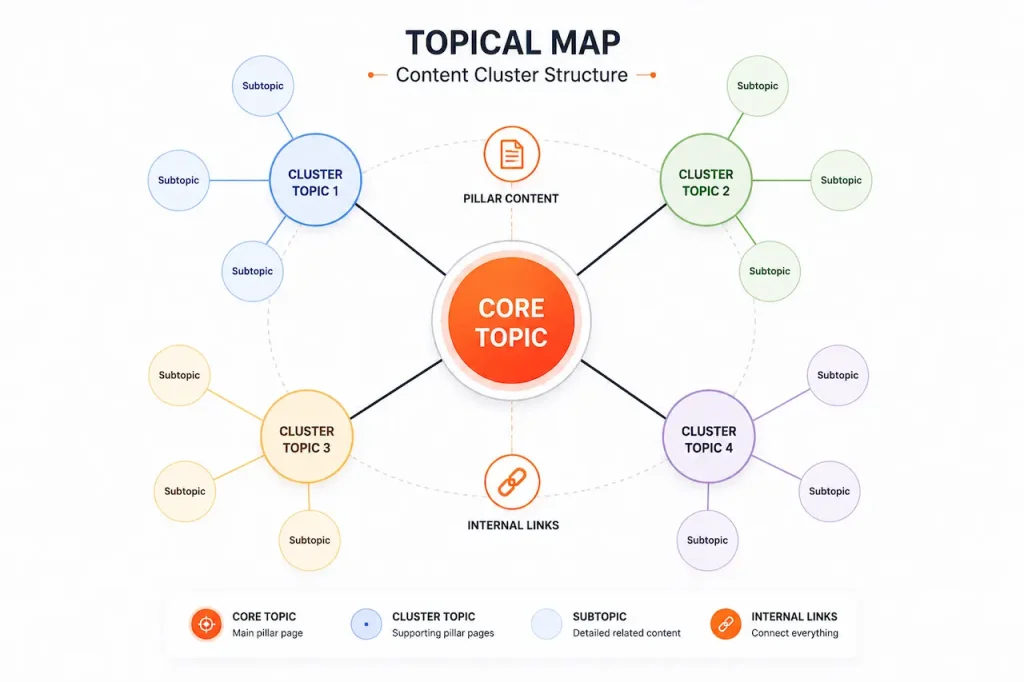
This matters enormously for new sites. A new site that tries to rank for dozens of unrelated topics will build authority in none of them. A new site that goes 100 miles deep on one topic has a realistic path to becoming the trusted source faster than trying to compete broadly.
Why Topical Authority Changed How SEO Works
Until a few years ago, SEO could be won page-by-page. You found a keyword. You wrote a good page. You built links to it. It ranked.
That still works for isolated, low-competition queries. But for anything competitive — and increasingly for anything at all Google now evaluates the entire domain before deciding how much to trust any single page.
Google’s Helpful Content system (introduced in 2022 and expanded significantly since) explicitly penalises sites it identifies as ‘unhelpful overall’ meaning a site where most content is thin, generic, or unrelated can have its entire domain’s rankings suppressed, even pages that individually would have ranked well.
The inverse is also true. A site with genuine topical depth gets a domain-wide authority boost. New pages on that site rank faster because Google trusts the source before reading the page.
Google’s guidance on what it means to have a helpful site overall →
How to Build Topical Authority — The Practical Method
Building topical authority is not complicated. It is patient. Here is exactly how to do it.
Step 1: Choose One Topic Domain and Go Deep
Pick the one subject area you want to own. For Dexora Digital, that is SEO, AI search, and digital visibility for businesses. Not ‘digital marketing broadly.’ Not ‘web design and social media and email and SEO.’ One coherent domain.
Then map every subtopic within it. Every question your target audience asks. Every comparison they want. Every how-to they need. Every fear they have. Every objection they raise.
That map is your content plan. Not keywords — topics.
Step 2: Build the Pillar Page
A pillar page is a comprehensive, authoritative overview of your core topic. It covers the topic broadly, links to supporting articles that go deep on each subtopic, and acts as the hub of your content cluster.
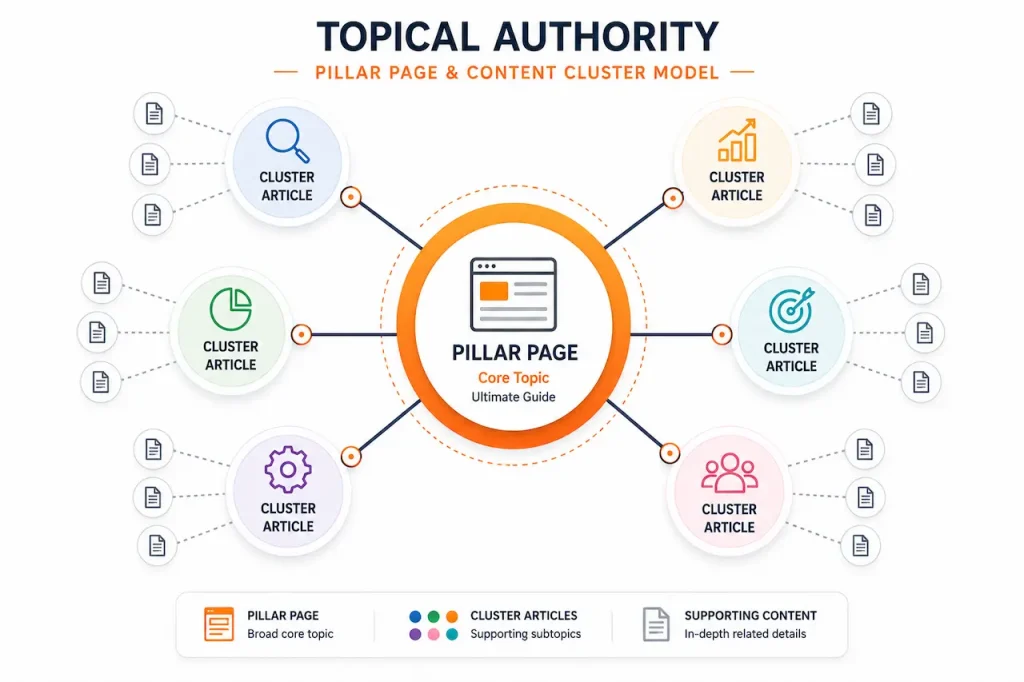
Your pillar page on ‘SEO for Plumbers’ might be 3,000 words. It touches on local SEO, Google Business Profile, keyword strategy, content ideas, technical basics. Then it links to 10 supporting articles that go deep on each of those areas.
Step 3: Publish Supporting Cluster Content
Each supporting article picks up where the pillar page’s treatment of a subtopic left off. It goes deep. It answers the specific question thoroughly. It links back to the pillar page and to other related cluster articles.
The goal is for someone reading any article in the cluster to feel like they are in the hands of the most knowledgeable source on the subject. They should never need to leave your site to find the answer to a follow-up question.
Step 4: Build Internal Links Deliberately
Internal linking within a cluster is what tells Google the cluster exists as a coherent whole. Every supporting article should link to the pillar page. The pillar page should link to every supporting article. Related articles should cross-link where topics overlap.
This is not automatic. It requires deliberate planning. But the SEO impact of a well-linked content cluster is measurably higher than the same content with poor internal linking.
Step 5: Cover the Gaps Your Competitors Leave
The fastest way to build topical authority is to identify the questions in your space that nobody is answering well. These are your low-competition, high-value opportunities. A single genuinely useful article on an overlooked question can rank and drive traffic within weeks — and it contributes to the depth signal that builds your overall authority.
Semrush research on how content depth affects domain rankings →
Topical Authority for Local Businesses — It Works Here Too
Local businesses often assume topical authority is only for publishers or large content operations. It is not.
A plumbing company that publishes 50 genuinely useful articles about plumbing problems, solutions, costs, DIY guides, and local regulations becomes the most trusted plumbing source in its geographic area — in Google’s eyes and in the community.
The scale is smaller. The impact on local rankings is the same.
One client — a 3-location HVAC company in the south-east of England — built a content cluster of 30 articles around heating and cooling topics specific to their service area. Within 8 months, they ranked in the top 3 for over 120 local search variations. Not because of any single article. Because Google recognised them as the go-to local source for heating expertise.
Local SEO and topical authority compound when built together →
Mistakes That Prevent Topical Authority from Building
Mistake: Publishing on too many unrelated topics. Why it happens: content ideas feel good in isolation. What it costs you: diluted authority signal across topics, none of which consolidates enough depth to register.
Mistake: Publishing cluster articles without internal links to the pillar page. Why it happens: internal linking is often treated as optional. What it costs you: Google doesn’t recognise the cluster as a coherent whole, so the authority signal is fragmented.
Mistake: Building breadth before depth. Why it happens: more published articles looks like more progress. What it costs you: 50 articles that each scratch the surface build less authority than 20 articles that each go genuinely deep.
Mistake: Stopping before the cluster is complete. Why it happens: it’s a long project. What it costs you: incomplete clusters build incomplete authority. A half-built cluster doesn’t generate half the benefit it may generate almost none.
FAQ: Topical Authority in SEO
Q: What is topical authority in SEO?
A: Topical authority is Google’s assessment of how comprehensively and deeply a website covers a particular subject. Sites that cover a topic exhaustively — answering many related questions with genuine expertise — are trusted more than sites with isolated articles. This domain-level trust means new content from an authoritative site ranks faster and sustains rankings better.
Q: How long does it take to build topical authority?
A: Most sites see meaningful topical authority signals in Google’s behaviour within 6–12 months of consistent, cluster-based content publishing. Signs include: new articles in the cluster ranking faster, existing articles improving in position, and Google returning multiple articles from your site for related searches. Building topical authority is a long-term investment, not a quick tactic.
Q: How many articles do I need to build topical authority?
A: There is no fixed number. For a niche local service business, 20–50 articles covering all aspects of your service and area can establish meaningful authority. For a national-level topic, the number may be in the hundreds. The question is not how many — it is whether you have covered the topic more comprehensively than your competitors.
Q: Can a small website build topical authority against large competitors?
A: Yes — by going narrower and deeper. A small specialist site that covers one niche exhaustively can outrank large general sites that cover the same topic superficially. Google rewards depth and specificity. A small site that becomes the definitive source for a specific subtopic has a real competitive advantage over a larger site that touches everything lightly.
Q: What is the difference between topical authority and domain authority?
A: Domain authority (a Moz metric) is primarily backlink-based — it measures how many high-quality links point to your domain. Topical authority is content-based — it measures how comprehensively you cover a subject. A site can have low domain authority but high topical authority in a niche, and rank extremely well for that niche. Both matter; neither alone is sufficient.
Become the Source — Not Just Another Page
The businesses that will dominate their industries in search over the next five years are the ones building comprehensive, honest, expertise-driven content around a specific topic domain right now.
Not the ones writing 800-word articles to tick a keyword box. Not the ones rephrasing competitor articles with slightly different phrasing. The ones who decide that their job is to be the most useful source on the internet for their specific subject — and then do the unglamorous work of actually achieving that.
Pick your topic. Build the cluster. Go deep. Be patient. That is topical authority.
Topical authority is the foundation of the SEO strategy we build for every client →
The sites that rank for everything start by committing to rank for one thing — completely.
An audit shows how your current content scores on topical depth →
We’ll map your content gaps and show you exactly what’s needed to build genuine authority.
Get Your Topical Authority Audit →