
In 1998, two Stanford researchers named Larry Page and Sergey Brin filed a patent for a search engine based on a simple insight: a web page that other pages link to is probably more important than a page nobody links to.
That insight became Google. Twenty-six years later, backlinks remain one of the strongest ranking signals in search. The sophistication around them has changed dramatically. The underlying logic hasn’t.
Here is what backlinks actually are, why they matter in 2026, and — critically — which ones help you versus which ones quietly destroy your rankings.
Our off-page SEO service builds the backlinks that move rankings →
What a Backlink Is — The Actual Mechanics
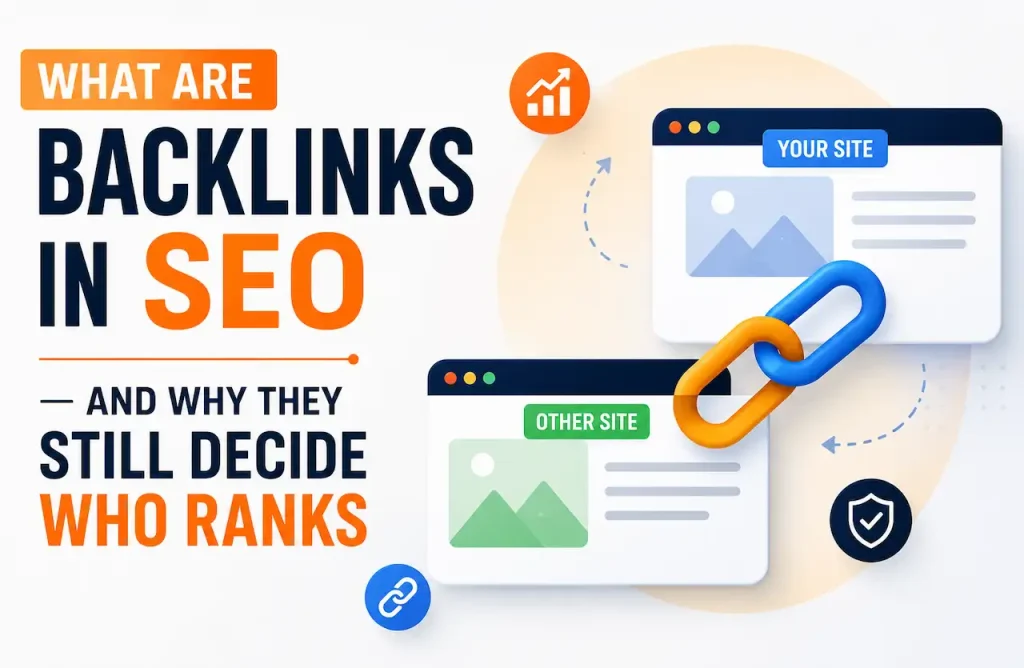
A backlink is a link on another website that points to yours. When the Guardian newspaper links to your research. When a local directory lists your business. When a client features you in their ‘trusted suppliers’ page. All backlinks.
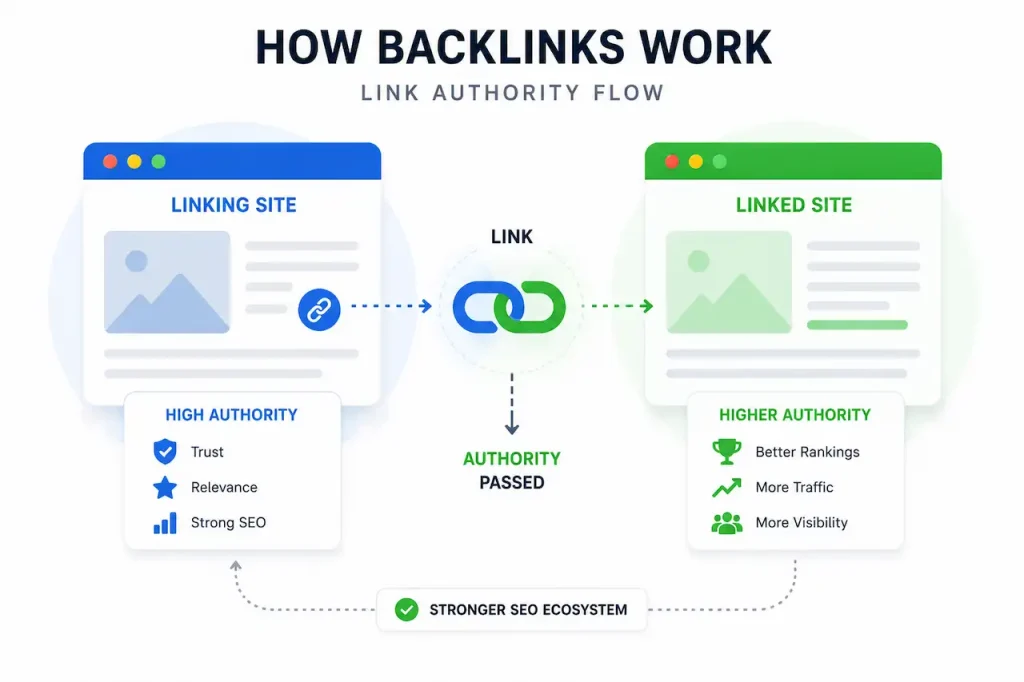
In Google’s model, each backlink is a signal of endorsement. The site linking to you is effectively saying: this page is worth reading. Google weights these endorsements based on the credibility and relevance of the site giving them.
The Difference Between a Backlink and an Internal Link
An internal link connects two pages on the same website. A backlink (also called an external link or inbound link) comes from a different domain entirely.
Internal links are important for site architecture and distributing authority within your own domain. Backlinks are the external votes that tell Google your domain is worth trusting in the first place.
Every backlink from a credible site is a vote you didn’t cast for yourself.
Why Backlinks Still Matter in 2026 — Despite Everything
A reasonable question: in an era of AI-generated rankings, Google’s own content generation, and algorithm updates targeting manipulation — do backlinks still matter?
Yes. Extensively. Google has stated publicly that backlinks remain one of its top three ranking signals. A study by Ahrefs found that the top-ranking page for any given keyword has, on average, 3.8x more backlinks than pages in positions 2–10.
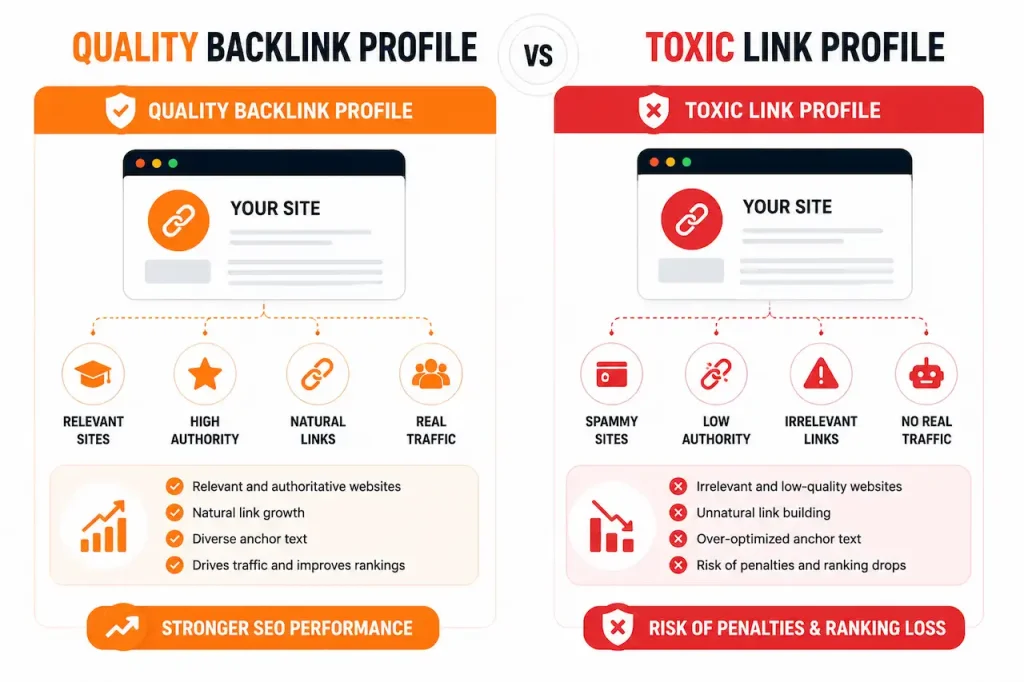
The nature of the backlinks that matter has changed dramatically. In 2010, any link from any site helped. In 2026, only links from relevant, credible, editorially placed sources move the needle. Low-quality links no longer help and can actively hurt.
But the principle — external validation from trusted sources as a trust signal — has not changed and shows no sign of changing. It is structurally too good an idea.
Ahrefs study on the correlation between backlinks and search rankings →
What Makes a Backlink Valuable — The Four Quality Signals
1. Domain Authority of the Linking Site
A link from a page with a domain authority score of 80+ (major publishers, government sites, universities, established industry publications) is worth far more than a link from a new, low-authority site. Not all links are created equal.
2. Relevance of the Linking Site
A link to your plumbing company from a home improvement magazine is more valuable than a link from a tech blog — even if the tech blog has higher authority. Relevance signals to Google that the endorsement comes from within your industry or topic area.
3. Editorial Placement
A link that appears naturally within the body of an article, as a genuine reference, is more valuable than a link in a footer, sidebar, or link directory. Editorial links are the result of your content being genuinely cited — not purchased or exchanged.
4. Anchor Text
The clickable text of the link carries meaning. A link with anchor text ‘technical SEO audit services’ tells Google what the linked page is about. Natural anchor text variety is important — if 80% of your backlinks have identical anchor text, it signals artificial manipulation.
How to Earn Backlinks — Strategies That Actually Work
Here is what separates legitimate, durable link building from the shortcuts that result in penalties.
Create Content Worth Linking To
This is the most scalable, most durable backlink strategy. Original research, unique data, comprehensive guides, free tools, and expert opinions generate natural links — because other sites have genuine reasons to cite them.
For one of our clients — a specialist insurance broker — we created a data report on claims trends in their sector. Within 60 days, it had earned 12 editorial backlinks from industry publications without any active outreach.
Digital PR and Media Outreach
Getting featured in publications your audience reads builds both brand and backlinks simultaneously. This requires having something worth saying — a data point, an expert opinion, a story. Journalists link to the sources they cite.
Broken Link Building
Find pages on relevant sites that link to content that no longer exists (404 errors). Reach out to the site owner, flag the broken link, and suggest your relevant content as a replacement. It gives them value; it gives you a link.
Guest Posts — With Caution
Writing guest articles for relevant, quality publications can earn good backlinks. The caution: guest posting on low-quality sites for the sole purpose of link acquisition is exactly what Google’s guidelines penalise. The guest post must be genuinely useful to the host site’s audience.
What Kills Your Rankings — The Backlinks to Avoid
The promise of quick backlinks is one of the oldest scams in SEO. Here is exactly what to avoid.
Paid links from link farms: networks of sites that exist purely to sell links. Google identifies these and penalises both the selling site and the buyer.
Link exchanges: ‘I’ll link to you if you link to me.’ Obvious patterns of reciprocal linking are a manipulation signal.
Low-quality directory submissions in bulk: submitting to hundreds of generic directories was a 2008 tactic. It is now a liability.
Comment spam: posting comments on blogs with links in them. Universally nofollow and universally ineffective.
Private Blog Networks (PBNs): networks of sites controlled by one party, used to funnel links to a target site. Google has become extremely good at identifying and penalising these.
FAQ: Backlinks in SEO
Q: How many backlinks do I need to rank on page 1?
A: There is no fixed number — it depends entirely on your competition. Check the backlink profile of the pages currently ranking in the top 10 for your target keyword. That gives you a realistic benchmark. For some low-competition local keywords, 10–20 quality backlinks may be sufficient. For national head terms, hundreds of authoritative links may be needed.
Q: Are nofollow backlinks worthless?
A: Not entirely. Nofollow links (which include a rel=’nofollow’ attribute instructing Google not to pass authority) don’t directly improve rankings in the same way as followed links. However, they contribute to a natural link profile, can drive referral traffic, and Google has indicated it treats some nofollow links as ‘hints’ rather than strict directives. A healthy backlink profile includes both.
Q: Can backlinks hurt my SEO rankings?
A: Yes — specifically toxic, spammy, or manipulative backlinks. If your site has accumulated a significant volume of low-quality backlinks (often through past black-hat SEO), you may be eligible for a Google manual penalty. The solution is a backlink audit followed by a disavow file submission — telling Google to ignore the problematic links.
Q: How do I check my current backlink profile?
A: Free options include Google Search Console (Backlinks report, though incomplete) and Ahrefs Webmaster Tools (free plan). Paid tools including Ahrefs, SEMrush, and Majestic provide comprehensive backlink data. Look for: total referring domains, domain authority of linking sites, anchor text distribution, and any toxic or spammy links.
Q: Do social media links count as backlinks for SEO?
A: Links from social media platforms (Twitter/X, Facebook, LinkedIn, etc.) are almost universally nofollow and do not pass direct ranking authority. However, social media visibility drives real traffic, brand searches, and can lead to editorial backlinks from people who discover your content via social. Social is a distribution channel that indirectly supports link earning.
Build Links the Way You’d Want to Be Cited
The businesses with the best backlink profiles didn’t build them by chasing links. They built them by creating things worth referencing.
That is the real insight underneath all of it. Google’s algorithm for evaluating links is an imperfect approximation of one question: does the wider internet consider this source credible? If the honest answer is yes, the links follow. If the answer is manufactured, it eventually unravels.
Build the credibility first. The links are the evidence of it.
See how a comprehensive SEO strategy includes link building as one coherent part →
The best backlink you’ll ever earn is one you never had to ask for.
Get a backlink audit to see where you stand against your competitors →
We’ll show you your current profile, the gaps, and exactly how to close them.
Get Your Free Backlink Audit →