
Google is not trying to rank the best-written page. It is trying to rank the most trustworthy page.
That distinction separates the sites that rank in 2026 from the ones that don’t. And the framework Google uses to evaluate trust has a name: E-E-A-T.
In this article, I am going to explain what E-E-A-T means in plain language, why it matters more than almost any other SEO factor right now, and specifically what you need to do on your site to demonstrate it to Google and to the people actually reading your content.
What E-E-A-T Actually Means — Breaking Down All Four Letters
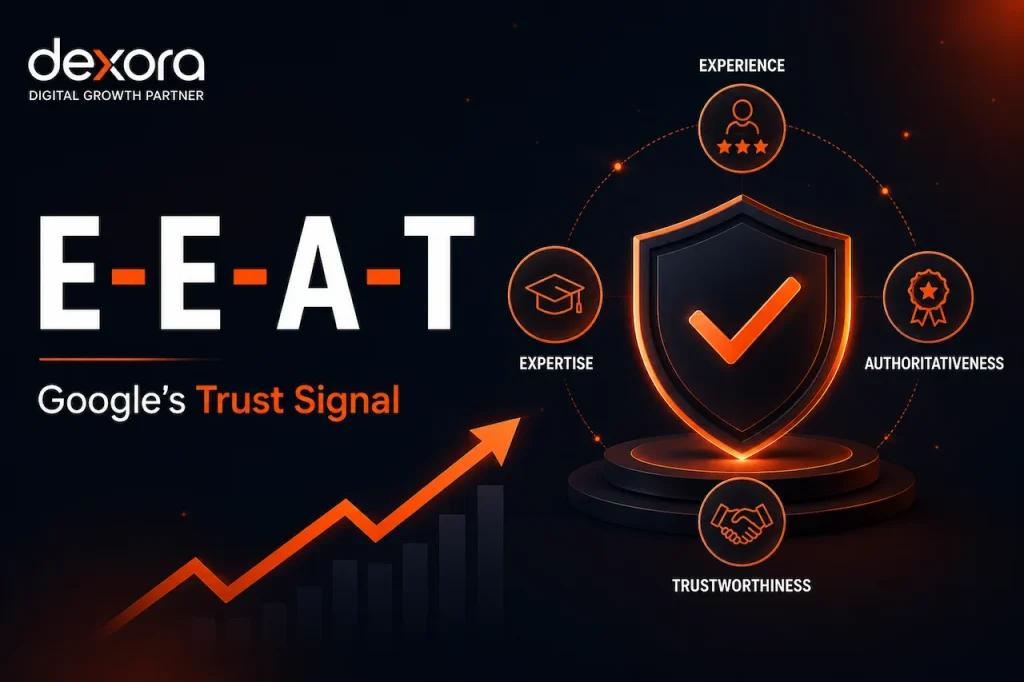
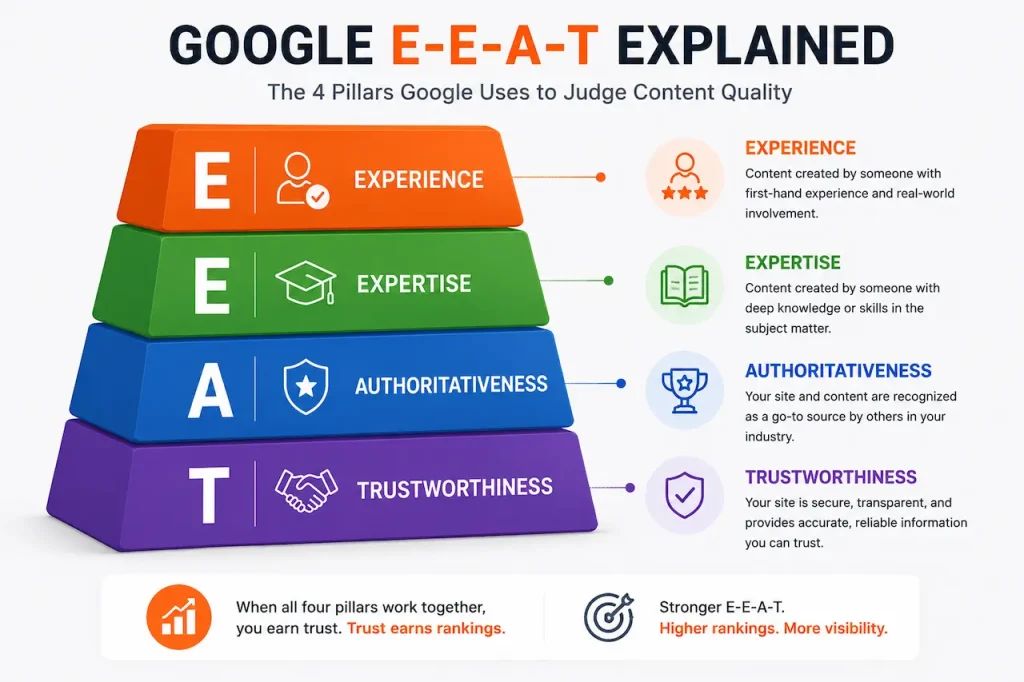
E-E-A-T stands for Experience, Expertise, Authoritativeness, and Trustworthiness. Google introduced the framework in its Search Quality Rater Guidelines — a document used to evaluate whether search results are meeting the standard Google wants.
The first E (Experience) was added in December 2022. It was a significant change. Before that, Google cared whether you were an expert. Now it cares whether you have actually done the thing you’re writing about.
Experience — Have You Actually Done This?
Experience is first-hand involvement with the topic. A financial advisor who has managed client portfolios through market crashes has experience. A freelance writer who researched those crashes and wrote a summary does not.
Google can evaluate this through signals like: personal anecdotes, specific case study references, unique observations that only come from having done the work, and the specificity of the language used. Generic language gets scored lower than specific, earned insight.
For service businesses, this means writing from actual client results and real-world knowledge — not from what seemed plausible after a quick read of the competition.
Expertise — Do You Know Your Field?
Expertise is domain knowledge. It is demonstrated through the accuracy of your information, the depth of your analysis, the correct use of technical terminology, and the ability to go beyond surface-level explanations.
An expert explains why things work, not just what to do. They address edge cases. They acknowledge nuance and trade-offs. They don’t pretend the answer is always simple.
Authoritativeness — Does Anyone Else Vouch for You?
Authority is the external validation of your expertise. Backlinks from credible, relevant sites. Citations of your work in other publications. Press coverage. Speaking engagements. Accreditations and industry memberships.
This is where off-page SEO and E-E-A-T intersect. Every credible backlink is evidence that someone with standing in your field thinks you are worth referencing.
Trust — Is Your Site Safe, Honest and Transparent?
Trust is the most foundational of the four. Google says: ‘Trust is the most important member of the E-E-A-T family.’ A page can have experience, expertise, and authority — and still rank poorly if users don’t trust it.
Trust signals include: an accurate about page, clear authorship of content, physical contact details, transparent pricing and policies, HTTPS, and a reviews profile. On YMYL topics (health, finance, legal, safety) — the trust bar is dramatically higher.
Experience you’ve earned. Expertise you’ve built. Authority others grant you. Trust your entire site earns — or loses — every day.
Why E-E-A-T Matters More Than Ever in 2026
Two things happened in recent years that made E-E-A-T the central battleground in SEO.
First: AI-generated content became trivially easy to produce at scale. The internet is now flooded with content that is technically correct but entirely generic — assembled by machines without first-hand knowledge or real insight. Google is actively penalising this. The Helpful Content Update was specifically designed to identify and demote mass-produced, experience-free content.
Second: AI search tools (ChatGPT, Perplexity, Google AI Overviews) are now answering queries directly. The sources they cite are consistently the same sites that demonstrate strong E-E-A-T. Being the source AI tools recommend requires the same investment as ranking well organically — because it IS the same investment.
E-E-A-T isn’t a new technique. It is Google formalising what the best sites have always done naturally.
AI search optimisation and E-E-A-T are deeply connected — here’s how →
Search Engine Land analysis of how E-E-A-T affects rankings →
How to Demonstrate E-E-A-T on Your Site — Specifically
This is where most articles on E-E-A-T stop at abstract advice. I am going to give you specifics.
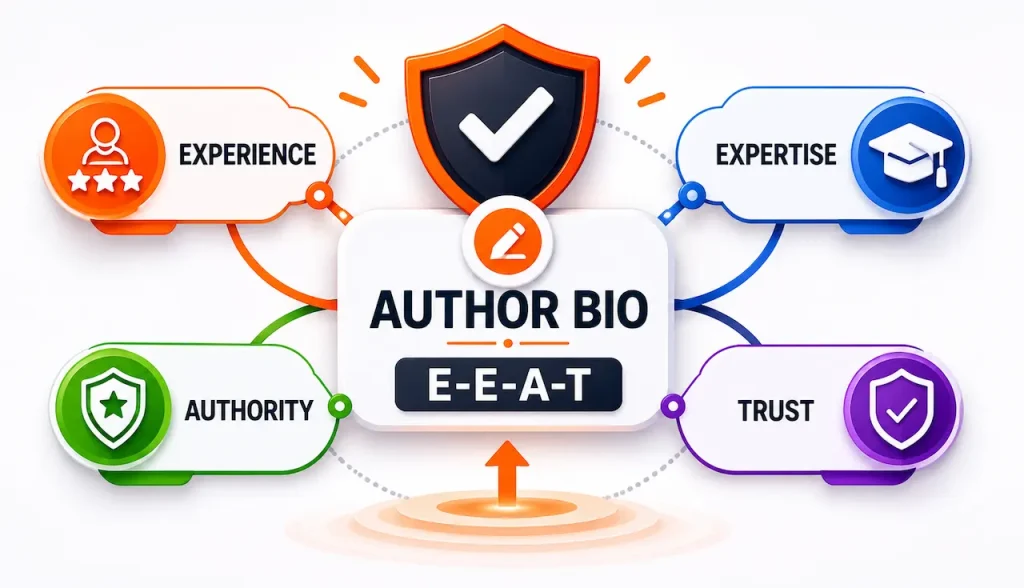
Author Bios That Actually Work
Every piece of content on your site should be attributed to a named author. That author’s bio should clearly explain their qualifications and relevant experience — not just their job title.
Weak bio: ‘Taqweem Ahmad is the founder of Dexora Digital.’
Strong bio: ‘Taqweem Ahmad is the founder of Dexora Digital, an SEO agency that has managed search campaigns for over 50 businesses across the UK, US, and Scandinavia. He specialises in technical SEO, AI search visibility, and local search domination.’
The strong version establishes experience (50+ businesses), expertise (specific disciplines), and the beginning of authoritativeness.
First-Person Experience Throughout Content
Content with E-E-A-T doesn’t describe what someone might do. It describes what you have done and what happened.
‘For one of our clients — a 3-person plumbing business in Bristol — a combination of technical SEO fixes and 8 pieces of location-specific content resulted in a 340% increase in Google Business Profile views over 90 days.’
That sentence signals experience, expertise, and enough specificity to be credible. Generic equivalents (‘businesses that use local SEO often see significant growth’) signal nothing.
Third-Party Validation
Actively seek coverage in credible publications. Ask satisfied clients for reviews on Google, Trustpilot, or relevant industry directories. Get listed in industry roundups. Pursue backlinks not just for SEO value but for the credibility signal they send about who takes your work seriously.
About Pages, Contact Pages, and Trust Architecture
Your about page should tell a real story. Not corporate boilerplate. Who built this company? Why? What have they done that qualifies them to help your specific customer?
Your contact page should have real details. A physical address (even a registered address) adds trust. A phone number adds trust. An email address that is not a generic Gmail adds trust.
YMYL — When the Trust Bar Is Much Higher
YMYL stands for Your Money Your Life. It describes topics where bad advice causes real harm: health, finance, legal, safety. If your business operates in any of these areas, Google holds your content to a substantially higher E-E-A-T standard.
A blog post about plumbing written by someone without plumbing experience is low-stakes. A blog post about medication dosage written by someone without medical qualifications is not. The standards are different and appropriately so.
E-E-A-T is embedded in every service we deliver — here’s the full approach →
Moz’s breakdown of how to build E-E-A-T signals site-wide →
Common E-E-A-T Mistakes That Cost Rankings
Mistake: Publishing content with no named author. Why it happens: it feels more ‘brand’ to publish as the company. What it costs you: Google has no person to evaluate for expertise or experience.
Mistake: Writing generic content that could have been produced by anyone. Why it happens: outsourcing content to writers with no domain experience. What it costs you: content that ranks briefly, then declines as Google’s systems correctly identify it as low-experience.
Mistake: Ignoring your about page and author profiles. Why it happens: they feel like administrative work. What it costs you: you’re invisible as a trusted entity — to Google and to your readers.
Mistake: Claiming expertise you don’t have. Why it happens: the desire to appear authoritative. What it costs you: your reputation and, eventually, your rankings. Google evaluates consistency — if your content doesn’t demonstrate the expertise your about page claims, the gap is noticed.
FAQ: E-E-A-T SEO in 2026
Q: What does E-E-A-T stand for in SEO?
A: E-E-A-T stands for Experience, Expertise, Authoritativeness, and Trustworthiness. It is the framework from Google’s Search Quality Rater Guidelines that human evaluators use to assess content quality. It influences how Google’s algorithms prioritise content — particularly for topics that affect users’ health, finances, safety, or major life decisions.
Q: Is E-E-A-T a direct ranking factor?
A: Not directly — there is no single ‘E-E-A-T score’ in Google’s algorithm. However, the signals that demonstrate E-E-A-T (author credentials, backlinks from authoritative sources, reviews, trust elements, content depth and accuracy) are all either direct ranking factors or strongly correlated with higher rankings. Building E-E-A-T systematically improves rankings, even if indirectly.
Q: How do I improve E-E-A-T for my website?
A: Focus on five areas: name and credential every author of your content; write from first-hand experience rather than research alone; earn backlinks and press coverage from credible sources; build a transparent, trust-signalling about and contact page; and cite credible external sources in your content. For YMYL topics, add professional credentials or expert review to content.
Q: Does E-E-A-T matter for small businesses?
A: Absolutely. E-E-A-T scales. A small plumbing business demonstrating genuine local expertise, real client results, and consistent reviews has strong E-E-A-T for its niche. You don’t need to be a national brand. You need to be demonstrably trustworthy and knowledgeable for the specific topics you write about.
Q: How does AI-generated content affect E-E-A-T?
A: AI-generated content is not automatically penalised — Google has stated that content quality matters, not the method of production. However, AI content that lacks first-person experience, specific case study references, or genuine expert insight often fails E-E-A-T signals. The Helpful Content Update targets exactly this kind of generic, experience-free content regardless of whether a human or AI wrote it.
E-E-A-T Is Not Optimisation — It Is Earned
The uncomfortable truth about E-E-A-T is that it cannot be faked sustainably. You can add author bios, add trust badges, cite sources. All of that helps.
But the core of it — actual experience, genuine expertise, real authority in your field — has to be real. The sites that dominate search results in 2026 are not the ones that gamed the signals. They are the ones that genuinely know what they are talking about and made that knowledge visible.
Build the expertise first. Then make it visible. That is the sequence. Not the other way around.
Trust is not a feature you add to a website. It is the result of consistently being worth trusting.
Want to know if your site demonstrates sufficient E-E-A-T? →
We assess E-E-A-T signals as part of every audit and tell you exactly what’s missing.

Local SEO and AI Search (AEO & GEO) Specialist.
Building search visibility that converts into qualified demand.
Today, businesses need visibility on Google Maps and AI powered search and websites that actually convert visitors into leads. I am a Local SEO, AI Search & Conversion Rate Optimization (CRO) Specialist with 5+ years of hands on experience helping businesses turn underperforming websites into high converting growth engines. My work combines Local SEO, Technical SEO, Semantic SEO, GEO/AEO, and conversion focused landing page optimization to ensure brands are discoverable and profitable.
My Experience
I have delivered SEO and web growth projects across the US, UK, Australia, Canada, Finland, Germany, and the Czech Republic, working in industries such as local businesses (electrician, hvac, cleaning, Real estate, healthcare, B2B, eCommerce, SaaS, and environmental services.
Some Results
>> 200+ websites audited globally
>> specifically worked with 100+ local business (80% from USA)
>> 80+ websites improved through technical SEO & schema fixes
>> 20+ businesses featured in Google AI Overviews (SGE)
>> Multi million impression growth for eCommerce & SaaS brands
Book Free Consultation: calendly.com/dexora/30min