
Hiring an AI search optimization agency? Before signing a GEO/AEO contract, require a documented technical and content audit, entity accuracy review, measurable deliverables, transparent reporting, and realistic expectations. AI search platforms do not offer a universal guaranteed ranking. This US-focused buyer’s guide explains what to request, what to pay attention to, and how to compare agencies without confusing mentions with qualified leads.
What Does an AI Search Optimization Agency Do?
An AI search optimization agency improves how clearly and reliably a business is represented across its own website and relevant discovery sources. Work may include technical SEO, entity consistency, useful content, structured data validation, legitimate third-party references and measurement. GEO, AEO and AI SEO overlap with traditional SEO; they are not independent systems with guaranteed placement.
| Discipline | Focus | Typical deliverable |
|---|---|---|
| SEO | Organic discoverability | Technical fixes and relevant service pages |
| AEO | Answer-oriented clarity | Accurate, direct explanations |
| GEO | Generative discovery | Entity/content assessment and AI visibility tests |
| Local AI SEO | Local business representation | Accurate service and location details |
Explore our AI search optimization services for the service overview. This guide focuses on choosing and evaluating an agency.
Why US Businesses Need a Business-Specific GEO Proposal
Customers can encounter AI-generated answers while researching service providers, comparing products, or seeking advice. But a local HVAC contractor, a law firm, and a national B2B engineering company face different customer journeys. An agency should identify actual target questions and markets, not sell the same list of prompts to every client.
Useful questions include: Can systems access our service pages? Is our business name and service coverage accurate? Are competitors being mentioned in relevant answers? Do cited pages contain useful, up-to-date information? Can any resulting inquiries be attributed with reasonable confidence?
1. Initial AI Visibility Audit and Baseline
A proposal should specify the platforms and sample questions tested, testing dates, target locations, brand and competitor selection, and how observations will be recorded. Outputs can include sampled brand mentions, citations, inaccurate statements, competitor comparisons and prioritized fixes.
| Audit component | Evidence to request |
|---|---|
| Prompt inventory | Actual representative customer questions |
| Platform coverage | Named platforms and test dates |
| Business accuracy | Documented outdated or incorrect details |
| Competitor comparison | Comparable questions and sampling conditions |
| Action plan | URL-level fixes, owner and priority |
AI answers vary by prompt, context, session and platform. A single screenshot is not a durable ranking. See our AI search audit checklist for a complementary diagnostic framework.
2. Technical SEO and Crawlability Review
Evaluate HTTP response codes, robots directives, XML sitemaps, indexability, canonical tags, redirects, JavaScript-rendered content, internal links, mobile usability and appropriate structured data. Ask who will implement each fix and how it will be verified. Technical access supports discoverability but does not guarantee an AI citation.
Agencies should not recommend blocking important crawlers without understanding the business’s privacy, copyright and discovery preferences. Nor should they claim that an llms.txt file guarantees AI inclusion.
3. Entity Consistency and Citation Analysis
Review official business name, services, actual locations, contact details, key people, credentials, business profiles and legitimate third-party references. A local business may need Google Business Profile accuracy and service-area clarification; a specialist B2B firm may need better capability descriptions and verifiable professional references.
Ask for a list of conflicts and exact proposed corrections. Avoid invented offices, fake reviews, fabricated awards, or misleading professional credentials. External references should be relevant and authentic, not purchased in bulk for artificial authority.
4. Content Audit, Search Intent and Cannibalization
The agency should map customer questions to existing URLs, identify missing information, and distinguish pages needing improvement from genuinely new topics. Pricing questions, service explanations, provider comparisons, case studies and local coverage can serve different intent.
| User question | Preferred asset |
|---|---|
| What do you offer? | Commercial service page |
| How does it work? | Educational guide |
| How much does it cost? | Transparent pricing explanation |
| How do providers compare? | Buyer-focused comparison |
| Can you prove experience? | Verifiable case study |
Require accurate explanations, source support for factual claims, expert review where relevant, and natural internal links. Do not reward an agency simply for publishing many overlapping AI-written pages.
5. Structured Data and Information Architecture
Appropriate Organization, LocalBusiness, Service, Article, BreadcrumbList or Person markup may clarify page information for supported consumers. It must reflect visible, truthful content and current search engine requirements. Schema is not a direct guarantee of AI recommendations, rich results or citations.
Ask for validation results and examples of how improved internal links connect related services, supporting guides, legitimate location pages and conversion opportunities.
6. AI Search Visibility Measurement and Reporting
There is no universal AI ranking shared across platforms. A credible agency defines a repeatable, limited measurement set and labels what it can and cannot conclude.
| Metric | What it shows | Limitation |
|---|---|---|
| Brand mentions | Presence in sampled answers | Prompt and platform dependent |
| Source citations | Referenced URLs in samples | Not necessarily a recommendation |
| Competitor mentions | Relative sample presence | Not universal share of market |
| AI referrals | Identifiable website visits | Attribution may be incomplete |
| Qualified inquiries | Potential business value | Requires reliable lead tracking |
Monthly reports should distinguish work completed, observed visibility, website performance, business outcomes and uncertainties. For methods and limitations, read our AI search visibility tracking guide.
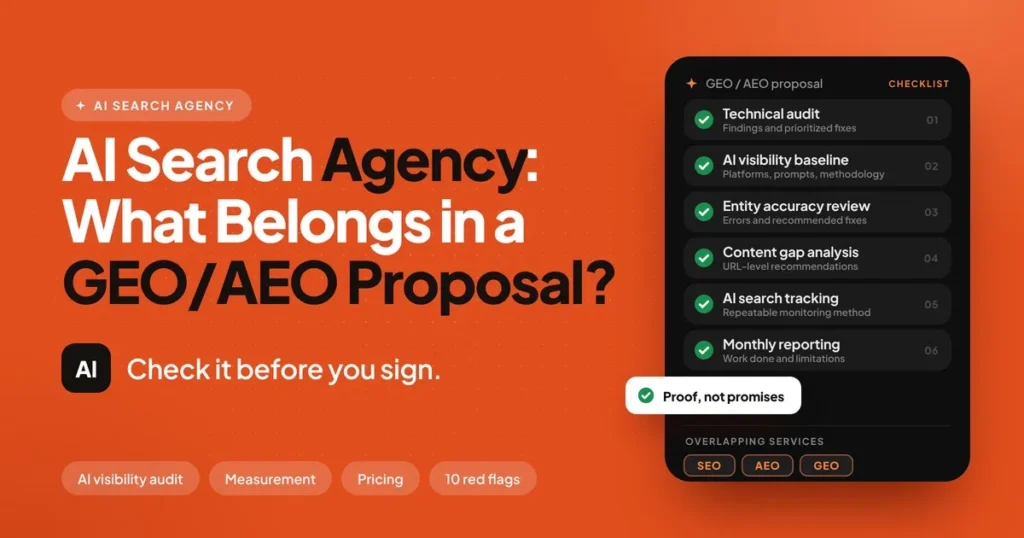
What a GEO/AEO Proposal Should Contain
- Objectives: defined services, US markets, customers and outcomes.
- Baseline: evidence, sample questions, competitor set and limitations.
- Scope: specific URLs, audits, content updates and implementation tasks.
- Ownership: who changes the website, approves content and manages accounts.
- Measurement: platform tests, frequency, lead definitions and attribution limits.
- Commercial terms: recurring fees, project fees, third-party costs and exclusions.
- Review process: milestones, reporting and how priorities are updated.
Ask for actual deliverable quantities where appropriate, but do not equate content volume with quality or promise a fixed number of AI citations.
How Much Does an AI Search Optimization Agency Cost?
Dexora Digital’s stated SEO service price band is $500–$2,500 per month. GEO/AEO activities can be incorporated into an agreed SEO scope. The following tiers are illustrative proposals, not confirmed fixed GEO packages.
| Proposed tier | Monthly fee | Potential scope |
|---|---|---|
| Starter | $500 | Foundational SEO and basic visibility assessment |
| Local Growth | $900 | Entity accuracy, local SEO and priority content |
| Growth | $1,250 | Ongoing technical/content work and monitoring |
| Pro | $1,800 | Broader service and market optimization |
| Advanced | $2,500 | Comprehensive technical, content and measurement program |
Major development, paid PR, premium monitoring tools, custom analytics and advertising may be separate. Dexora’s indicated website project range is $900–$2,000 and Google Ads management is $500–$900 monthly, excluding ad spend. These are optional complementary services, not requirements for AI inclusion.
Dexora Digital’s Proposed Six-Phase Approach
- Discover: confirm services, legitimate coverage, customers and available analytics.
- Audit: inspect technical accessibility, entity consistency and baseline visibility.
- Map: review commercial intent, existing pages, competitor gaps and overlap.
- Implement: improve agreed technical, content, linking and business information issues.
- Monitor: test documented prompts and review identifiable search and AI referrals.
- Report and refine: separate observed changes from attributable leads and adjust priorities.
Businesses should request a specific statement of work rather than assuming all phases receive equal effort in every price tier.
Industry Examples for United States Businesses
| Business | Typical concern | Priority evaluation |
|---|---|---|
| HVAC contractor | Local service discoverability | GBP accuracy, service pages, technical access |
| Roofing company | Provider comparison and trust | Repair/replacement differentiation and authentic proof |
| Law firm | Practice and attorney accuracy | Credentials, location, reliable legal content |
| Engineering firm | Specialized capabilities | Technical explanations and verified projects |
| Multi-location business | Consistent location representation | Eligible profiles and location governance |
| B2B services | Vendor evaluation | Capability pages, verifiable evidence and comparisons |
These are planning scenarios, not measured outcomes or case studies. An agency should validate real demand for each business.
What Counts as a Credible GEO Case Study?
Ask for the client’s initial situation, work performed, dates, measurement method, comparison period and limitations. An increase in organic impressions is not proof of AI recommendations; one ChatGPT screenshot is not proof of consistent visibility. Verified leads and revenue require reliable attribution. Review relevant Dexora case studies and ask which evidence matches your objectives; no specific results are asserted here.
Ten Warning Signs in an AI SEO Agency Proposal
- Guaranteed ChatGPT rankings or recommendations.
- Claims that a single schema type or llms.txt guarantees inclusion.
- No technical SEO or crawlability assessment.
- Generic mass-produced content with no editorial review.
- No documented prompt-testing methodology.
- Presenting every mention as a lead or sale.
- Fake citations, credentials, offices or reviews.
- No clear implementation responsibility.
- Vague monthly fees with no deliverables.
- The same strategy for every industry and location.
AI Search Optimization Agency FAQs
What does an AI search optimization agency do?
It assesses and improves business information, technical accessibility, content and relevant discoverability signals, then measures observable results with appropriate limitations.
What is the difference between SEO, AEO and GEO?
SEO focuses on organic discovery, AEO on clear answer-oriented information, and GEO on generative search discoverability; much of the underlying work overlaps.
Can an agency guarantee ChatGPT recommendations?
No. Platforms independently generate responses, which vary by prompt, context and time.
How much does GEO cost?
Dexora’s stated SEO range is $500–$2,500 monthly. GEO activities and exact deliverables must be agreed in the scope.
Is GEO necessary for small US businesses?
It may be worth evaluating, but sound technical SEO, accurate business details and useful service content remain priorities.
Is local AI SEO different from local SEO?
It may add AI answer testing and entity review, but it still depends heavily on accurate local business information and relevant website content.
Does schema guarantee citations?
No. Structured data can clarify information but cannot guarantee AI citations or recommendations.
Does an llms.txt file guarantee visibility?
No. Treat such files as optional and do not substitute them for crawlability, content quality or business accuracy.
Can GA4 track AI traffic?
Some referral visits may be identifiable; other AI-influenced visits may not be attributed reliably.
What should monthly GEO reports show?
Implemented changes, documented tests, observed mentions or citations, relevant traffic, leads where measurable, and methodological limitations.
Should I pay separately for SEO, AEO and GEO?
Not automatically. Ask for a deliverable-level breakdown so overlapping work is not charged twice without justification.
How long does AI optimization take?
Implementation timing can be planned, but AI response changes have no guaranteed timetable.
Should agencies publish a page for every AI question?
No. Group closely related questions into useful pages and create new URLs only for distinct intent.
What should a GEO proposal include?
Business objectives, baseline evidence, exact scope, responsibilities, measurement, reporting, fees, exclusions and ownership terms.
How do I compare AI SEO agencies?
Compare methodology, relevant expertise, implementation capacity, evidence, transparency and business-focused reporting.
Can GEO replace Google Ads?
No. Organic and paid discovery serve different purposes and can be complementary.
Do AI SEO agencies need website access?
Implementation often requires controlled access, while audits may need only read-only analytics and website inspection.
What makes a GEO case study credible?
Clear dates, documented work, a consistent method, appropriate comparison and honest attribution limitations.
What is the biggest red flag?
Promises to control or guarantee how independent AI platforms recommend your business.
How can Dexora assess my website?
Start with a site and business-information review to identify technical, content and AI discoverability opportunities.
Get an AI Search Optimization Proposal
Choose an agency that can explain what it will change, how it will test results and what it cannot guarantee. Explore ChatGPT SEO services or request a free SEO and AI search audit from Dexora Digital to discuss an appropriate US-focused strategy.
Editorial references: Google Search Central: AI features and your website; Google: creating helpful, reliable, people-first content; Google: structured data introduction. These resources describe relevant Google guidance; they do not establish guaranteed results on other AI platforms.