


Most businesses with a website think they have an SEO strategy. They don’t. They have a website.
Keentel Engineering, a specialist US electrical engineering firm, had exactly that in early 2025. A functional Duda site. Minimal organic presence. Zero domain authority worth speaking of. Zero keywords ranking. And a market full of engineering professionals who would have been perfect clients if they could only find the firm.
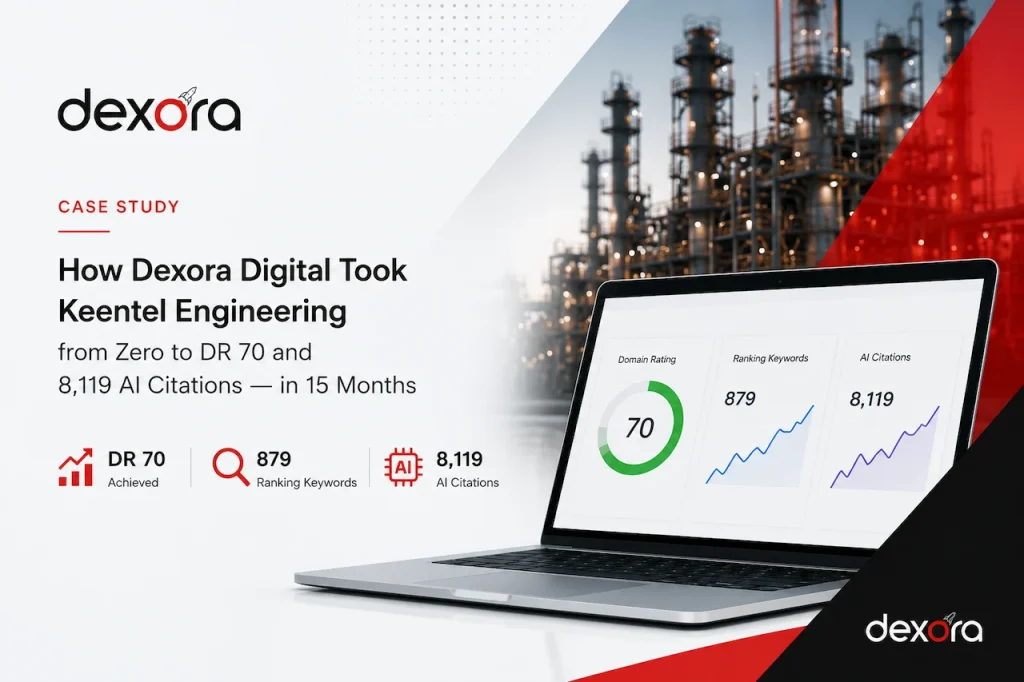
Fifteen months later, Keentel Engineering holds a Domain Rating of 70, 879 organic keywords ranking, 5,300 backlinks across 506 referring domains, and 8,119 AI citations in Bing Copilot alone giving it a 24.1% Share of Authority in its niche. The website now ranks in Google AI Overviews and appears cited by ChatGPT, Google AI Mode, and Gemini.
This is the story of how we did it, what we built, every decision we made, and what the results mean for B2B businesses trying to grow through search in 2026.



The Client: Keentel Engineering
Keentel Engineering is a US-based electrical engineering consultancy serving utilities, energy developers, industrial clients, and data centre operators. Their service lines cover power system studies, substation design, NERC O&P 693 compliance, POI interconnection engineering, and a deep catalogue of IEEE standards-based technical advisory work.
This is not a business where someone clicks an ad and buys. Engineering firms earn trust before they earn projects. A prospective client a utility procurement manager, a renewables project lead, a data centre engineer evaluates expertise before they evaluate price. They search. They read. They decide who knows what they’re talking about.
In March 2025, Keentel Engineering was invisible in that evaluation process. Their website existed. It did not demonstrate authority. It did not rank for the queries their ideal clients were running. It was not generating inbound leads through organic search.
The business had the expertise. The digital presence didn’t reflect it.
Our B2B SEO services for technical businesses
Where We Started: The March 2025 Baseline
Before building anything, we ran a full audit. The picture it returned was consistent with what we see across most B2B technical businesses: a site that had been built for aesthetics and basic information delivery, not for search performance or lead generation.
Request your own free SEO audit.
The Platform Problem
Keentel Engineering’s site was built on Duda. Duda is a capable website builder. It is not built for serious SEO work at scale. Structural limitations constrained our ability to implement full Schema markup, control canonical architecture, or optimise the technical foundations Google requires for competitive rankings in a specialist B2B niche.
The first and most significant decision of the engagement was to migrate the entire site to Next.js a React framework that gives complete technical control, server-side rendering for performance, and the infrastructure needed to support everything that followed.
See how website design and technical architecture affect SEO performance.
The Authority Gap
Ahrefs showed a Domain Rating that was effectively starting from zero. The backlink profile was minimal fewer than 100 links, most of low relevance. No referring domains with meaningful authority were linking to the site.
This mattered enormously. In a technical B2B niche where engineering firms like TRC Companies, Fauske & Associates, and national consultancies had been publishing expert content for years, any new ranking strategy had to contend with a significant authority deficit.
How our off-page SEO service builds the backlink profile that closes the authority gap.
The Content Gap
Keentel Engineering had no content strategy. The pages that existed were service descriptions — accurate, professional, and entirely generic. They didn’t answer the specific questions engineers actually search. They didn’t cover the IEEE standards, compliance requirements, or technical methodologies that dominate search intent in this space.
The result: zero organic traffic from anything beyond branded searches.
The Technical Foundation
No XML sitemap had been submitted. No Schema markup was present. Core Web Vitals had not been addressed. Internal linking was essentially non-existent — pages existed as isolated nodes rather than a coherent, crawlable architecture.
Our technical SEO service fixes exactly these foundations.
The Strategy: Five Workstreams, One Architecture
We structured the engagement around five interconnected workstreams. None of them is optional. Each one either enables or compounds the others. This is a complete picture of what was done and why each part mattered.
Workstream 1 — Site Migration from Duda to Next.js
We rebuilt the Keentel Engineering website from scratch on Next.js. This was not a redesign of an existing codebase. It was a ground-up rebuild with SEO architecture designed into every layer of the structure.
The new site included:
→ Server-side rendering for fast first-content loads and improved Core Web Vitals baseline
→ Full Schema markup control — Article, FAQ, Service, LocalBusiness, BreadcrumbList implemented site-wide
→ Clean URL architecture with keyword-relevant slugs throughout
→ Complete redirect mapping from all old Duda URLs — zero ranking loss during migration
→ XML sitemap built and submitted to Google Search Console from day one
→ Mobile-first responsive design — critical because Google indexes the mobile version first
The migration was completed without interrupting any existing rankings (minimal as they were) and without any indexation disruption. The redirect architecture and sitemap submission were managed as part of the build delivery, not as a post-launch fix.
How our website design service approaches SEO from the foundation.
Workstream 2 — Technical SEO Foundation
A fast, well-structured site is the baseline. Technical SEO is the discipline of ensuring Google can access, understand, and trust every part of it.
Our technical workstream addressed:
Crawlability: A full crawl using Screaming Frog identified every orphan page, every internal linking gap, and every URL that was either broken or returning incorrect status codes. We built a complete internal linking architecture before publishing a single piece of new content.
Indexation: We verified that no important pages were excluded from Google’s index through misconfigured noindex tags or robots.txt conflicts both common migration risks. Google Search Console was configured and monitored from the first week.
Schema Markup: Every service page received Article, FAQ, and Service schema. The homepage received LocalBusiness schema. Every blog post received Article and BreadcrumbList schema. FAQ sections on all major pages received FAQPage schema. This schema work is directly responsible for the AI Overview citations that now appear across Keentel Engineering’s most important queries.
Core Web Vitals: The LCP (Largest Contentful Paint) was addressed through image optimisation and loading priority flags in the Next.js codebase. CLS (Cumulative Layout Shift) was fixed through explicit dimension declarations on all images and embeds. These are active and ongoing improvements; the current scores reflect work in progress rather than a finished state.
See how our technical SEO service handles every layer of this foundation.
Workstream 3 — Authority Page Creation
Here is the core content investment. Keentel Engineering operates in a highly specialised field. Generic business content would not rank and would not convert engineering professionals. Every authority page we created was written at the level of depth the industry actually requires.
The content clusters we built:
Power System Studies Cluster
We created a pillar page covering power system studies broadly, with deep supporting articles on each specific study type: short-circuit analysis, arc flash analysis, load flow studies, harmonic analysis, and motor starting studies. Each article ran 2,500–3,500 words. Each included a FAQ section structured for featured snippet eligibility. Each used IEEE and OSHA standard references as authoritative citations.
Substation Engineering Cluster
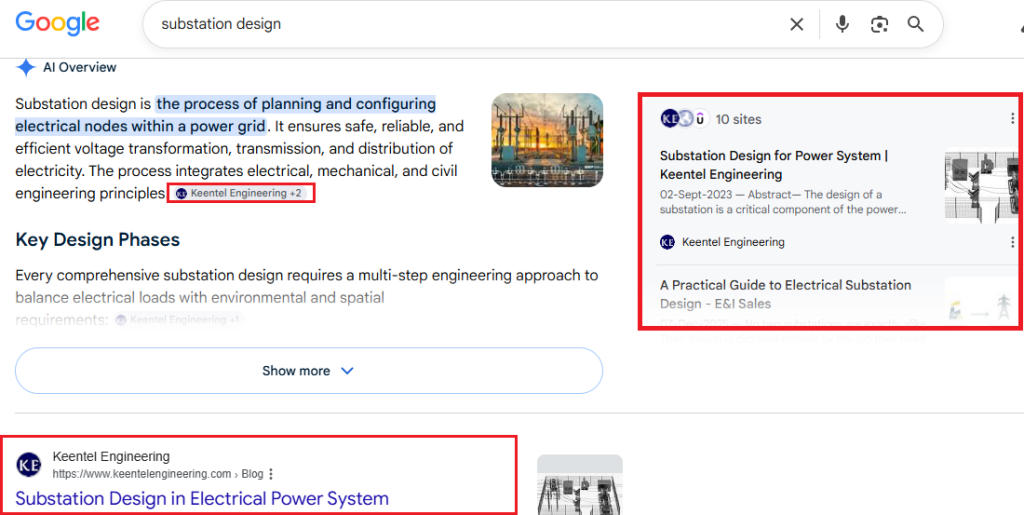
Comprehensive guides covering substation design methodology, single-line diagrams, equipment sizing, mechanical layout, grid integration requirements, and environmental compliance. Keentel Engineering now ranks as a primary cited source in Google AI Overviews for ‘substation design’ — a query that historically went to USDA.gov and major national firms.
NERC Compliance Cluster
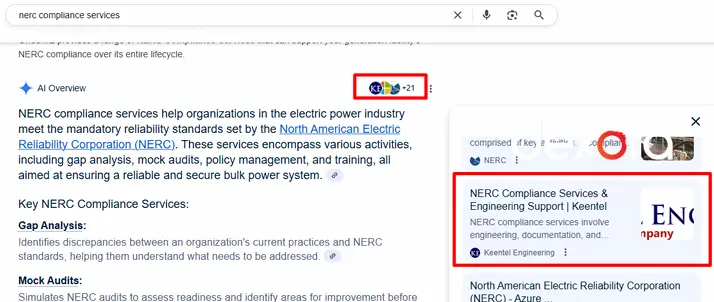
NERC O&P 693 compliance is a specialised regulatory discipline. We built content covering the compliance framework, mock audit preparation, CIP consulting, Reliability Standard Audit Worksheets (RSAWs), and staff augmentation services. The result: Keentel Engineering appears in the AI Overview for ‘nerc compliance services’ alongside hsi.com and Radian Generation.
POI Interconnection Engineering
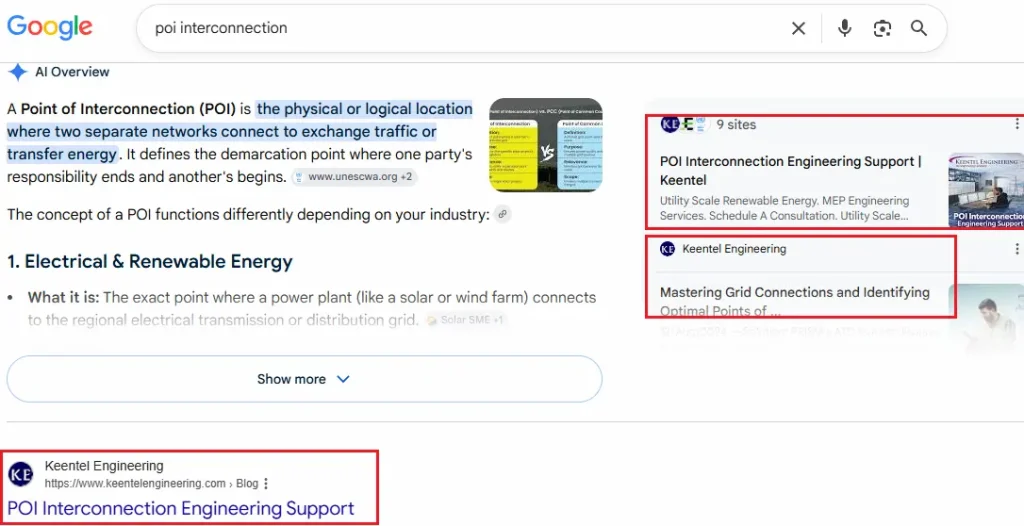
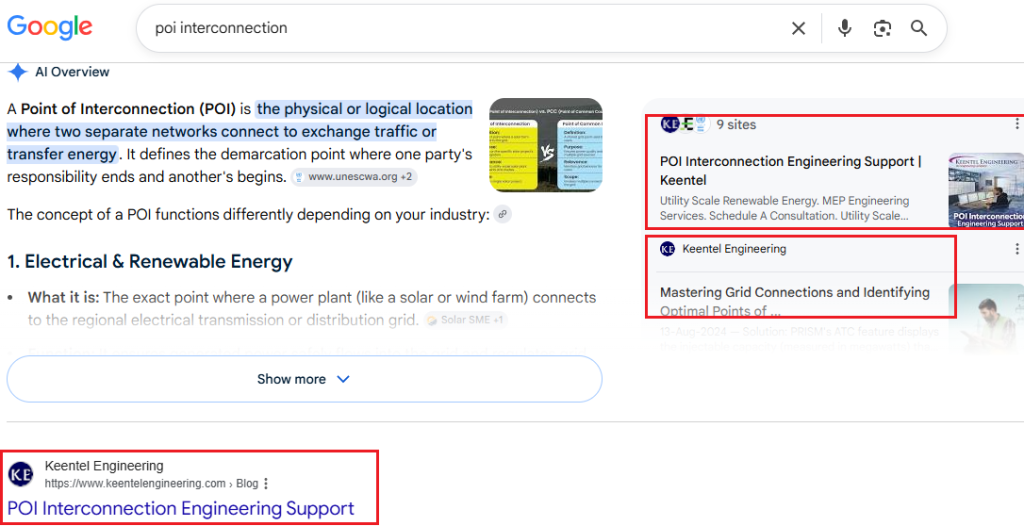
We created a definitive guide to Point of Interconnection engineering support covering grid integration studies, substation and switchyard design, utility coordination, and IEEE compliance. This page now ranks at position 1 on Google for ‘POI Interconnection Engineering Support’ and is cited in the AI Overview for that query.
IEEE and Software Standards Guides
We built dedicated pages for the IEEE standards most relevant to Keentel’s work: IEEE 1547-2018, IEEE C57.91, IEEE C37.91, and IEC 61439. We also created comprehensive guides for the specialist software tools used in the industry: PSCAD, PSS®E, ETAP, and SKM. These pages generate the bulk of the AI citations visible in the Bing Copilot data — the ieee 1547 page alone accounts for 309 citations with a 52% Share of Authority.
Workstream 4 — Blog Content and Topical Authority
Authority pages define what Keentel Engineering does. The blog cluster builds the topical depth that makes Google treat the domain as the expert source across the full breadth of related queries.
We published consistently across three broad clusters after the initial authority pages were live:
Regulatory and compliance guides: OSHA 1910.269, NFPA 70E, NERC CIP applicability matrices, bulk electric system definitions, IEEE standard update summaries.
Engineering methodology deep-dives: fault current analysis, transformer protection coordination, grounding system design, reactive power compensation, harmonics in industrial systems.
Technology and tool guides: PSCAD simulation best practices, PSS®E modelling tutorials, ETAP arc flash study workflows, SKM feeder analysis setup guides, data centre electrical design fundamentals.
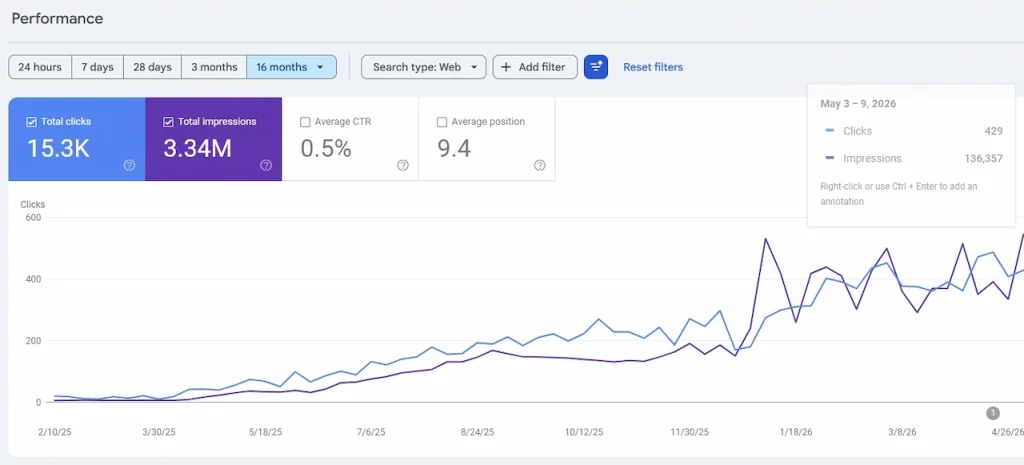
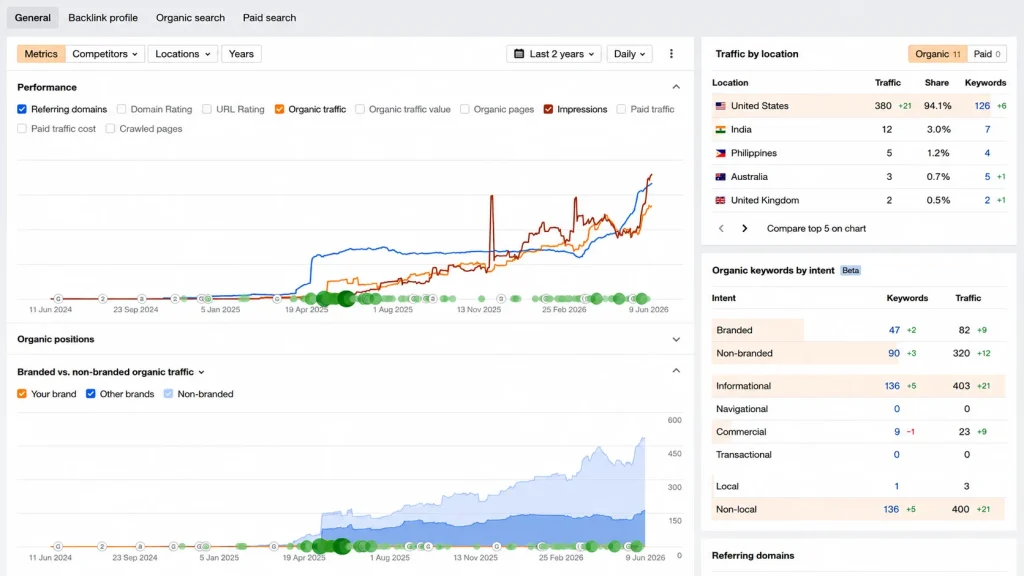
The publishing cadence was consistent and deliberate. The Ahrefs performance chart shows the organic traffic and impressions lines beginning their upward trajectory in April/May 2025 — the period when the first content cluster went live — and continuing without reversal. The chart’s steep growth from Q4 2025 onward represents the compound effect of topical authority accumulating across the domain.
See how topical authority content strategy works.
Workstream 5 — Conversion Architecture and Lead Generation
Traffic is only the first half of the equation. A website that earns 6,710 sessions in a month and converts none of them has failed the business regardless of its SEO metrics.
Every page we redesigned and every page we created was built with a conversion architecture:
→ Above-the-fold value statement: what Keentel Engineering does, for whom, and why they’re the right choice — in two sentences or fewer
→ Trust signals embedded in content: certifications, IEEE memberships, specific project types completed, named client industries served
→ Single focused CTA on every page: not a menu of options, a single clear next step
→ FAQ sections positioned before the CTA: answering the last objections before asking for the action
→ Minimal friction to contact: phone number, consultation form, and email visible without scrolling on mobile
The hotjar analytics data confirms the result. Visitors are spending real time on the site — 1.9 minutes of active engagement out of 6.5 minutes total session time, a strong signal for B2B technical content. The quick-backs rate (users returning to Google within seconds) is 6.08%, which is exceptionally low for a B2B technical site where most visitors arrive with genuine research intent.
The AI Search Dimension: Why This Case Study Is Different
Most SEO case studies stop at rankings and traffic. This one has a dimension that is increasingly defining what ‘search visibility’ actually means in 2026.
Keentel Engineering is not just ranking on Google. It is being cited by the AI tools that engineers use when they need to answer questions quickly. And those tools are now a genuine discovery channel.

What the AI Visibility Data Shows
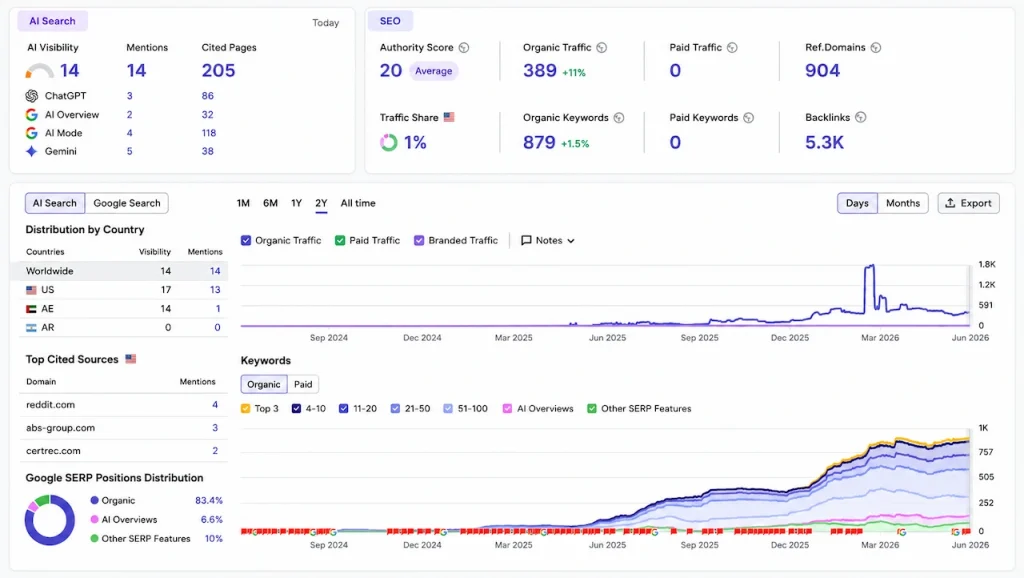
The SEMrush AI Visibility dashboard shows Keentel Engineering appearing across all four major AI search platforms: ChatGPT (3 mentions, 86 cited pages), Google AI Mode (4 mentions, 118 cited pages), Google AI Overview (2 mentions, 32 cited pages), and Gemini (5 mentions, 38 cited pages). 205 individual pages on the site are now cited by one or more AI tools.
The Bing AI Visibility dashboard powered by Microsoft Copilot data is even more striking. Keentel Engineering holds:
8,119 total citations across all queries tracked
24.10% Share of Authority — versus 75.90% for all other domains combined
52% Share of Authority for ‘ieee 1547 2018’ (309 citations)
41% for ‘ieee c57.91’ (64 citations)
40% for ‘pscad’ (128 citations)
35% for ‘bulk electric system’ (139 citations)
32% for ‘pscad model’ (87 citations)
These are not informational curiosity queries. These are the technical terms engineers and project managers search when they are actively working on a project — evaluating software, checking standards compliance, understanding grid requirements. Appearing as the recommended source in those moments is the highest-value form of digital visibility a specialist engineering firm can achieve.
See how our AI search optimisation service builds this kind of visibility.
How We Built the AI Citation Advantage
AI search optimisation and traditional SEO are not separate strategies. They are the same strategy executed correctly. The elements that make a page visible to ChatGPT, Perplexity, and Google AI are the same elements that make it rank well organically: genuine expertise, clear structure, direct answers, credible citations, and a trustworthy domain.
The specific tactics that generated Keentel Engineering’s AI visibility:
FAQ sections on every major page, structured with natural language questions exactly as an engineer would phrase them to an AI assistant. These FAQ sections use FAQPage schema markup, making them directly parseable by Google’s AI Overview system.
Direct-answer paragraph structure: every H2 section opens with a clear, specific answer to the implied question of the heading. AI tools extract and cite these paragraphs because they are the clearest, most extractable answer available.
First-person expertise markers: writing that demonstrates real engagement with the engineering work, not generic descriptions. AI tools are increasingly sophisticated at distinguishing depth of expertise from surface-level coverage.
Authoritative external citations: every technical claim is backed by a reference to IEEE, OSHA, NERC, or another standards body. This is both an E-E-A-T signal for Google and a credibility signal for AI citation.
Our AI search SEO services explain the full AEO and GEO framework
The Results: 15 Months of Compounding Growth
Search Rankings
The headline number: zero organic keywords ranking in March 2025. As of June 2026, 879 keywords ranking and growing at 1.5% month-on-month.
The keyword distribution tells the more interesting story. The SEMrush keyword position chart shows simultaneous growth across all ranking bands: Top 3 positions (yellow), positions 4-10, positions 11-20, and positions 21-50 are all expanding. This is the signature of topical authority building across an entire domain — not a few pages pushed to the top, but a broad base of rankings expanding from the bottom up.
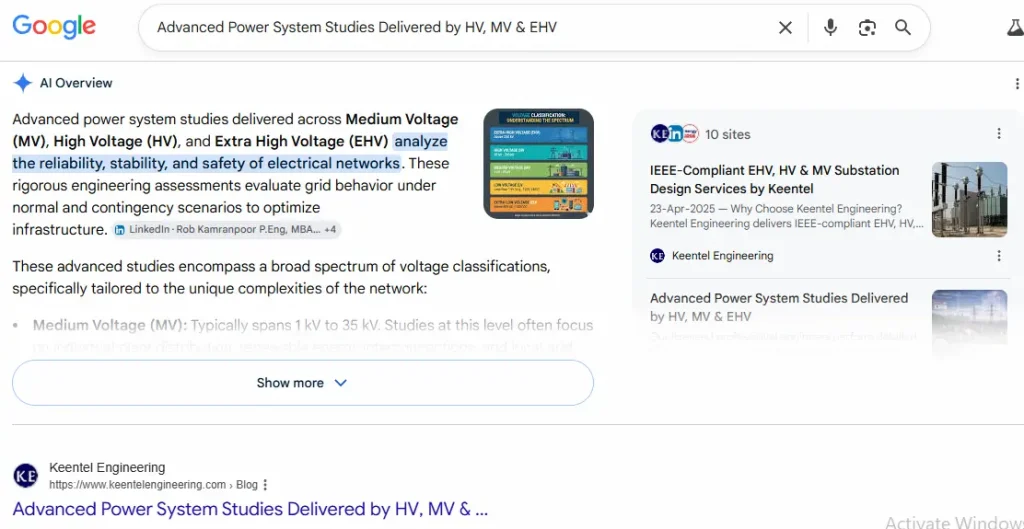
The AI Overviews citations for specific high-intent commercial queries confirm that some of the most valuable positions have been achieved:
Position 1 on Google for ‘POI Interconnection Engineering Support’ with AI Overview citation
AI Overview featured citation for ‘power system studies’
AI Overview primary source for ‘substation design’ alongside USDA.gov and E&I Sales
AI Overview for ‘nerc compliance services’ with Keentel logo displayed
Domain Authority Growth
Domain Rating rose from near zero to 70 in 15 months. For context: Ahrefs’ DR 70 represents the top 15% of all websites globally. To reach DR 70, a site must earn backlinks from a diverse base of credible, authoritative referring domains at sustained volume.
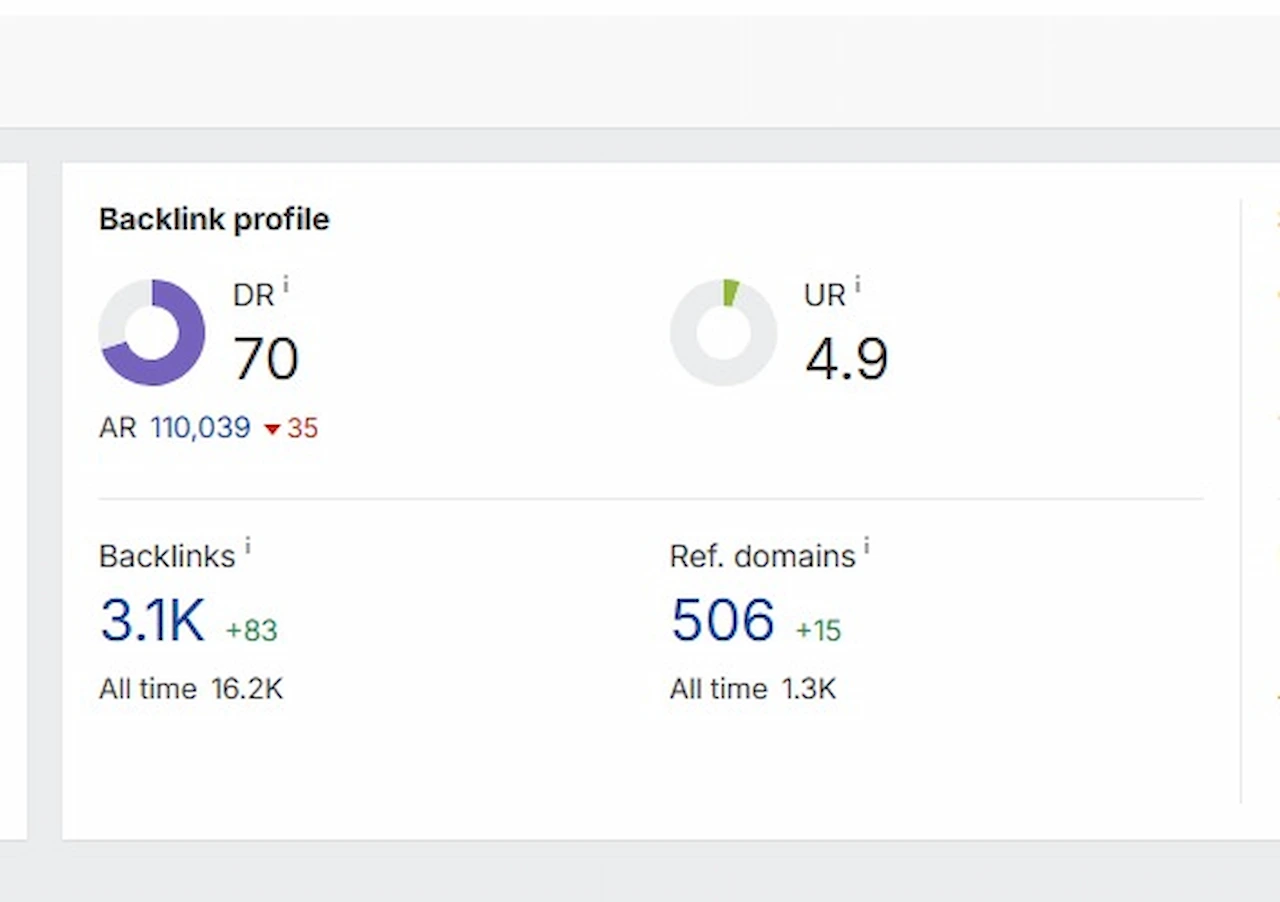
The backlink profile as of June 2026: 5,300 active backlinks across 506 referring domains, with a Universe Rating (UR) of 4.9. These are editorial links earned through content quality and digital PR, not purchased.
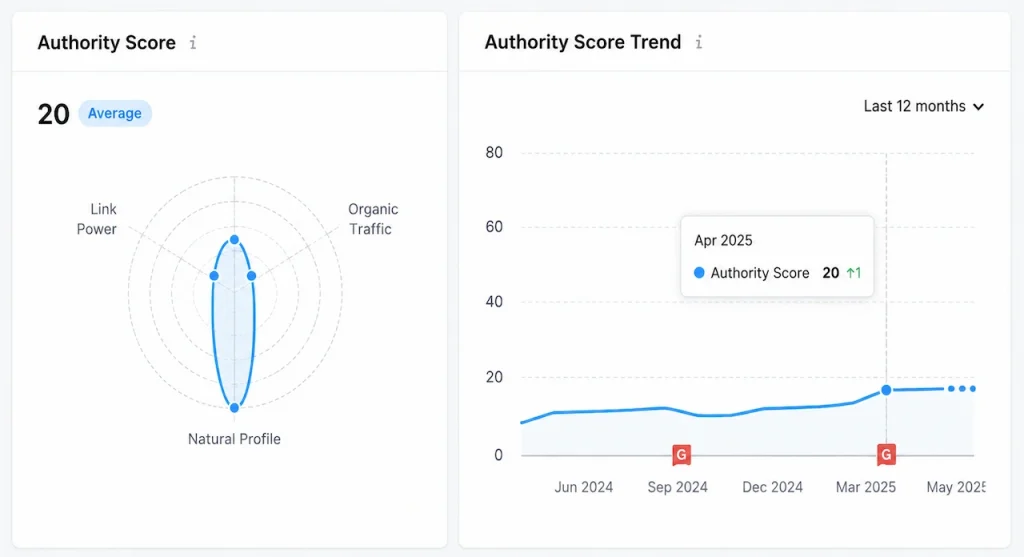
The SEMrush Authority Score shows the same trajectory: starting around 5, reaching 20 as of April/May 2026 with a +7 point jump in a single month the period when several high-authority pieces hit their ranking positions simultaneously.
Traffic and Engagement
Monthly organic sessions: 389 (+11% month-on-month). The referrer distribution confirms that Keentel Engineering now receives traffic from the full modern search ecosystem:
Google organic: 2,147 sessions
Direct navigation: 1,429 sessions — evidence of brand recall and return visitors
Bing: 535 sessions — driven by Bing Copilot AI citations
LinkedIn: 127 sessions — professional audience sharing content
ChatGPT: 59 sessions — direct AI referral traffic
Claude.ai: 42 sessions — AI assistant traffic
Gemini: visible in referrer data
Engagement metrics confirm the traffic is qualified: 2.25 pages per session, 1.9 minutes of active time, and a 6.08% quick-backs rate. These are strong indicators that visitors are arriving with genuine research intent and finding what they need.
The Visitor Journey: Where They Come From, What They Do
The audience breakdown shows a B2B technical site behaving exactly as designed. 80.92% new user sessions signals consistent top-of-funnel discovery — engineers finding Keentel Engineering for the first time. 19.08% returning users signals the beginning of brand loyalty — people who found the site useful coming back.
The top user by session count (79 sessions from Pakistan) is a strong indicator of active evaluation — a procurement or project team doing deep due diligence before an engagement decision.
What Made It Work: The Five Decisions That Determined the Outcome
Every successful engagement has a handful of decisions that, in retrospect, made the difference. For Keentel Engineering, these were the five.
Decision 1: Migrate First, Build Second
We could have tried to do everything on Duda. We would have been building SEO on a foundation that couldn’t support the weight of a serious authority strategy. Moving to Next.js before any content work began meant everything built afterward was built on a platform that could deliver it.
The lesson: platform choice is an SEO decision. A slow, technically constrained CMS limits what’s achievable regardless of how good the content is.
Our website design service is built around SEO-first architecture.
Decision 2: Write at the Level of the Industry
Generic content does not rank in specialist B2B niches. Engineering professionals searching for IEEE 1547-2018 compliance guidance or PSCAD simulation best practices know the difference between a surface-level overview and genuinely useful technical material.
We wrote content that engineers would find useful regardless of whether they found it through Google. That standard would this be worth reading if search engines didn’t exist? is the one that Google’s Helpful Content system rewards. It is also the one that AI tools cite.
Decision 3: Build Topical Authority Systematically, Not Episodically
We did not publish random articles. We mapped the complete topic landscape of electrical engineering services, identified every relevant cluster, and built systematic content coverage across all of them in a deliberate sequence.
The result: Google encounters Keentel Engineering as the consistent, comprehensive expert source across the entire topic area not as a site with a few strong individual pages surrounded by gaps.
Decision 4: Treat AI Search as a First-Class Objective
We built AI citation into the content architecture from day one. Every page has a FAQ section structured for AI extraction. Every technical claim is cited. Every section opens with a direct answer paragraph. Schema markup is comprehensive.
The Bing Copilot data — 8,119 citations and 24.1% Share of Authority is the direct result of treating AI visibility as a deliverable, not an afterthought.
Our AI search optimisation service delivers this exact framework.
Decision 5: Design Every Page to Convert
Ranking is the beginning. The website’s job is to turn searchers into leads. We designed every page with a clear conversion journey: establish credibility, answer objections, make the next step obvious.
A website is not a brochure. It is a salesperson who works 24 hours a day. We built it to behave like one.
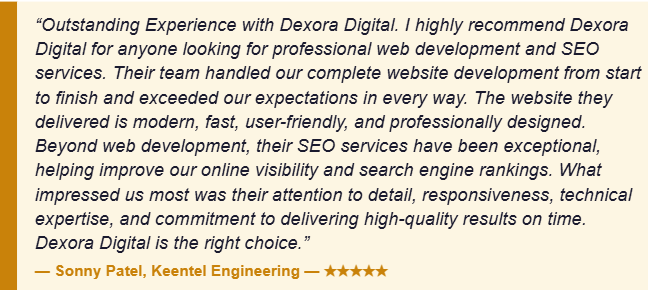
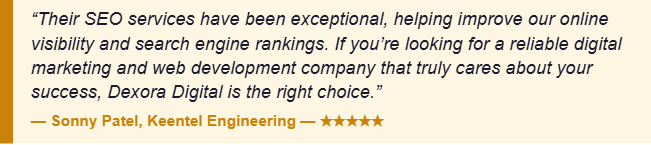
In the Client’s Own Words
Frequently Asked Questions About This Case Study
Q: How long did it take to see results from SEO for Keentel Engineering?
The first meaningful organic traffic movements appeared in months 3–4, corresponding to the completion of the Next.js migration and the first authority page cluster going live. Month-on-month growth in organic impressions was measurable from that point. The compound growth acceleration visible in the Ahrefs chart from Q4 2025 onward reflects 8–9 months of consistent content and link building reaching critical mass. For B2B technical businesses in specialist niches, 3–6 months for initial results and 9–12 months for significant growth is a realistic timeline.
Read our full guide on how long SEO takes to work.
Q: Was this purely SEO, or did other factors contribute to the growth?
The growth was driven by a complete digital marketing stack, not isolated SEO tactics. The website migration created the technical foundation. The authority content created the relevance signals. The link-building campaign created the authority signals. The conversion architecture turned traffic into leads. Each workstream reinforced the others. This is why the results compounded rather than plateauing and why approaches that address only one dimension (just content, just links, just technical fixes) rarely produce the same trajectory.
Q: How did you achieve AI Overview citations for such competitive queries?
The AI Overview citations came from three specific content practices applied consistently across every page: FAQ sections structured with natural language questions using FAQPage schema; direct-answer paragraph structure (every H2 section opens with the clearest possible answer to the question implied by that heading); and authoritative external citations within the content. Google’s AI Overview system and third-party AI tools like ChatGPT extract content from pages that are already ranking well and that provide the clearest, most structured answers. The technical and content foundation we built made the citations an inevitable consequence.
Our AI search SEO service explains the full AEO and GEO framework in detail.
Q: What was the biggest single factor in Keentel Engineering’s DR reaching 70?
The content quality. High domain authority is a backlink story, but backlinks follow content quality rather than preceding it. The IEEE standards guides, power system studies deep-dives, and NERC compliance resources we created were substantive enough that industry publications, engineering forums, and specialist directories linked to them organically. We supplemented this with active digital PR, but the content itself was the engine. You cannot build DR 70 through link schemes in 2026 the links that move domain authority are editorial, and editorial links follow genuinely useful content.
Q: Does this approach work for other technical B2B industries?
Yes — and we have applied the same framework to other specialist professional service businesses. The specific tactics (which IEEE standards to cover, which software guides to write) are sector-specific. The strategic architecture platform foundation, topical authority building, AI-optimised FAQ structure, conversion-focused page design is transferable across any B2B niche where trust precedes the transaction. Industries with high-intent technical search behaviour (engineering, legal, financial services, industrial manufacturing, specialist healthcare) are particularly well suited to this approach.
See our full range of SEO services for technical and professional service businesses.
Q: What does an engagement with Dexora Digital look like for a similar business?
A: We begin every engagement with a full audit technical health, keyword opportunity, competitive gap analysis, and current content quality assessment. From that audit, we build a structured roadmap: platform recommendation if needed, technical foundations, content architecture, link strategy, and conversion framework. The Keentel Engineering engagement was comprehensive from day one, which is why the results compounded as they did. We offer free initial audits so businesses can see exactly where they stand before committing to an engagement.
Request your free SEO audit today.
The Conclusion: A Website That Earns Its Place in Search
Keentel Engineering’s result is not a story about a single clever tactic. It is a story about what happens when every layer of a digital presence is built correctly, in the right order, to the right standard.
The technical foundation enabled the content to be found. The content depth enabled the authority to accumulate. The authority enabled the AI citations. The AI citations now create discovery at the moment of highest intent when an engineer is actively working on a project, asking a tool for the best answer, and getting Keentel Engineering as the recommendation.
That is the complete loop. And it compounds. Every month that passes with consistent content publishing, with the link profile growing, with the AI citation count increasing, makes the next month’s results stronger than the last.
The website is no longer a digital brochure. It is a lead generation engine that runs every hour of every day.

Related: More Client Results
Keentel Engineering is one of the businesses Dexora Digital has helped build genuine, compounding search visibility. Browse our full case studies library to see results across industries.
If you are a technical B2B business, professional service firm, or any company where trust precedes the transaction this is the approach that works. The tactics change by industry. The architecture does not.
Explore our full SEO service offering.
Explore local SEO for businesses with geographic target markets.
Explore our AI search visibility services.