

By Taqweem Ahmad | Founder, Dexora Digital | July 2026
VERIFIED RESULTS — AUGUST 2025 TO JULY 2026
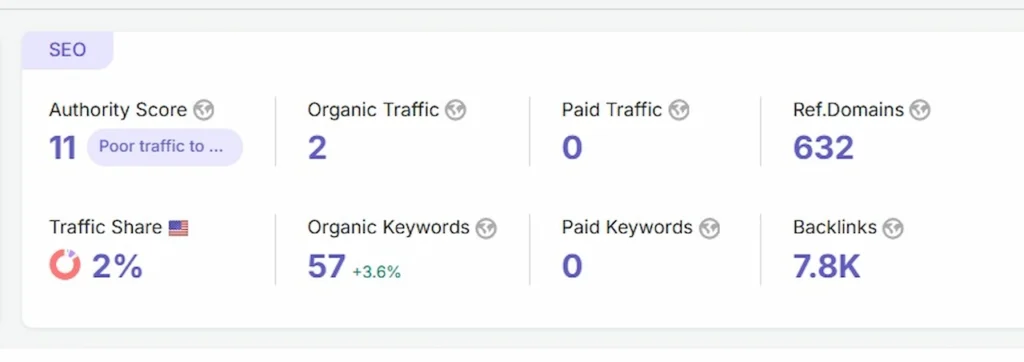
0 -> 62 Organic Keywords — exponential growth curve, still rising
632 Referring Domains Built from zero
11 Authority Score — from 0 to 11 in the campaign period (+5 in June 2026 alone)
7,800 Total Backlinks built through citation, outreach, and editorial coverage
All data sourced from Google Search Console and SEMrush. Screenshots available. Campaign ongoing as of July 2026.
The non-certified site plan market in the United States is large, underserved by quality digital presence, and almost entirely unoptimized for AI search. When ProSitePlans.com came to Dexora Digital, the opportunity was clear — and so was the starting point.
Zero organic keywords. Zero domain authority. No AI search presence. A business with real service demand and genuine expertise, invisible to the potential clients actively searching for exactly what they offered.
By July 2026, the picture had changed entirely. Sixty-two organic keywords and growing at an exponential rate. Authority Score of 11 built from zero. 632 referring domains. 7,800 backlinks. AI Overviews presence confirmed. Real GSC traffic appearing from February 2026 onward — with the keyword growth curve going near-vertical from January 2026.
The non-certified site plan market has genuine search demand and almost no well-optimized competition. The business that builds the right digital foundation first does not just rank — it dominates.
This case study covers every decision from domain setup to live site to the results at the 12-month mark. The strategy here is transferable to any professional services business — particularly service businesses targeting a national US market from a regional base.
The Client — ProSitePlans.com
| Detail | Information |
| Website | prositeplans.com |
| Industry | Site Plan Drafting — Non-Certified Site Plans |
| Headquarters | Sacramento, California |
| Service Area | All 50 United States — national service, remote delivery |
| What They Do | Professional non-certified site plans for residential and commercial permit applications, ADUs, property improvements, and planning purposes |
| Target Client | US homeowners, contractors, developers, and small businesses needing site plans for permits without requiring architect-stamped drawings |
| Starting Domain Authority | 0 — new domain with no search history |
| Starting Keywords | 0 — no organic search presence |
| Services Delivered | Website design and development, Technical SEO, AI Search Optimization (AEO/GEO), Schema markup, Content architecture, Authority building |
Understanding Non-Certified Site Plans — Why the Market Opportunity Is Significant
A non-certified site plan is a professionally drafted property plan used for permit applications, HOA approvals, property improvements, ADU additions, and various residential and commercial planning purposes. Unlike architect-stamped drawings — which require a licensed architect and cost significantly more — non-certified site plans are produced by drafting professionals and satisfy the requirements of most local permit offices for smaller-scale projects.
The market for non-certified site plans in the USA is driven by the sustained boom in ADU construction (accessory dwelling units), residential renovations requiring permits, and small commercial improvements. The search volume for related terms is consistent and growing as more homeowners undertake permit-required projects and discover they need a site plan before work can begin.
The competitive landscape for this specific service in search was notably underdeveloped at campaign start. Most competitors had outdated websites, minimal SEO investment, and no AI search presence whatsoever. This meant that a correctly built digital presence would not just rank — it would rank relatively quickly and hold those positions against competitors that were not actively optimizing.
Context: The combination of genuine search demand, low digital competition, and a national service model (no geographic limitation on clients, since site plans are delivered digitally) made ProSitePlans.com one of the strongest organic opportunity profiles in our client pipeline entering 2025.
Phase 1 — Website Design and Technical Foundation
The website was built before a single page of content was written, and the SEO architecture was designed before the first wireframe was created. This is the approach that produces exponential keyword growth curves rather than gradual linear ones — because Google finds a technically correct, well-structured site rather than one that requires weeks of post-launch correction.
Design and Development Decisions
-> Platform: WordPress with Kadence theme — clean, fast, schema-friendly, with no unnecessary code injection that heavier page builders produce
-> Information architecture planned before design: Homepage, Services (core service hub), How It Works, Service Area, FAQ, Contact — each with a specific SEO function in the hierarchy
-> URL structure: clean, keyword-relevant, lowercase hyphenated — /non-certified-site-plans/, /residential-site-plans/, /commercial-site-plans/ rather than parameter-based or auto-generated URLs
-> Mobile-first build: target LCP under 2.5 seconds on mobile — site plan clients are often contractors and builders searching on mobile during site visits
-> All images compressed to WebP format before upload — site plan sample images were the primary LCP risk and were addressed before launch
-> Rank Math Pro configured from day one — schema types, XML sitemap, meta structure, canonical tags, robots.txt all configured before the site went live
AI Search Configuration — Built In Before Launch
-> llms.txt file created at domain root before first page was indexed — directing GPTBot, ClaudeBot, and PerplexityBot to the most relevant service content
-> robots.txt explicitly allowing all major AI crawlers alongside Googlebot and Bingbot
-> Organization schema on homepage with sameAs links to GBP and LinkedIn
-> Service schema on every service page with service name, description, provider, and area served (all 50 US states)
-> FAQPage schema on FAQ page and embedded in service page FAQ sections
-> LocalBusiness schema with Sacramento, CA address and service area configured for all US states
-> Author schema on blog content with Taqweem Ahmad as verified author — this is the standard we apply to all Dexora-built sites for E-E-A-T signal strength
The Critical Decision — National vs Local SEO Targeting
ProSitePlans.com serves clients across all 50 US states. The site plan is delivered digitally — there is no geographic limitation on who can be served. The question at setup was whether to optimize primarily for Sacramento/California local searches or for national searches.
The answer required analyzing the actual search behavior for site plan services. Most clients searching for site plans are not searching ‘site plan drafting sacramento’ — they are searching ‘non-certified site plan for permit’ or ‘how to get a site plan for ADU’ regardless of where they are located. The service is remote. The search intent is task-based, not location-based.
This meant the content architecture needed to target national, non-geographic keywords as the primary focus. Location pages for major US cities were built as secondary pages to capture the smaller volume of location-specific searches — not as the primary SEO strategy.
Verified result: This national-first targeting decision is reflected in the keyword data: the top ranking keyword ‘pro site’ at position 16 is a broad, non-geographic term with 880 monthly searches. National targeting was the correct call.
Phase 2 — Content Architecture and AI Search Optimization
Content was planned around two simultaneous goals: ranking in Google organic search and being cited in AI search responses. The content types that serve both goals are FAQ content with FAQPage schema and expertise-demonstrating service content with specific, verifiable information.
The FAQ Strategy — Targeting AI Overviews Specifically
AI Overviews appear on queries where a user is asking a question rather than searching for a specific business. The site plan market has a high proportion of question-based searches: ‘do I need a site plan to build an ADU,’ ‘how much does a site plan cost,’ ‘what is a non-certified site plan,’ ‘can I get a site plan without an architect.’
These question searches trigger AI Overviews regularly. A well-structured FAQ answer in FAQPage schema that directly addresses one of these questions is the content type most likely to be extracted by Google’s AI generation system.
The FAQ strategy built for ProSitePlans.com included:
-> A dedicated FAQ page with 20 questions covering the most common pre-purchase concerns and information queries about non-certified site plans
-> FAQPage schema on the dedicated FAQ page and on embedded FAQ sections on each service page
-> FAQ questions written to exactly mirror the search query phrasing — not ‘What are your services’ but ‘Can I use a non-certified site plan for a permit application?’
-> Each FAQ answer written as 40-80 words, self-contained, specifically answering the question without requiring surrounding context — the format AI systems extract from
-> Bilingual FAQ content for Spanish-language queries — ‘planos y permisos’ searches appear in the keyword data, confirming that Spanish-speaking US homeowners are a search segment for this service
Verified result: AI Overviews presence confirmed in SEMrush keyword tracking data — ProSitePlans.com content appears in Google AI Overview responses for site plan related queries
Service Page Content — Expertise-First, Not Keyword-First
The service pages were written to demonstrate genuine expertise in site plan drafting, permit requirements, and the specific situations where non-certified site plans are appropriate. This is a technical subject and the content reflected that.
Rather than generic ‘we provide professional site plans’ copy, the service pages addressed specific client scenarios: ADU construction requiring a site plan, fence permits requiring a property survey overlay, commercial renovation permits, deck additions, pool installations. Each scenario described the specific type of site plan needed, what the permit office typically requires, and how ProSitePlans.com’s deliverable addresses that requirement.
This specificity serves two functions. It matches the actual search queries of clients who are searching for help with a specific permit problem, not generically for site plans. And it provides the verifiable, expert-level content that AI systems evaluate for citation credibility.
Phase 3 — Authority Building and Citation Signals
The 632 referring domains and 7,800 backlinks visible in the SEMrush data represent the most significant authority-building achievement of the campaign to date. For a domain with a campaign start date of 2025, this profile is substantial.
How 632 Referring Domains Were Built
The link profile was built through three channels, each serving a different function in the authority model:
Citation Building — The Foundation Layer:
Directories specific to the drafting, architecture, construction, and permit services industries were identified and citations built across all relevant US platforms. This included general business directories, construction industry directories, home improvement platforms, and California-specific contractor resources. Each citation listed consistent NAP (name, address, phone) matching the Google Business Profile configuration exactly.
Content Partnerships — The Authority Layer:
The site plan drafting industry intersects with real estate, construction, home improvement, ADU resources, and permit guidance platforms. Outreach to relevant editorial resources in each of these categories generated the higher-authority links that contribute most significantly to the domain authority score growth from 0 to 11.
PR and News Coverage — The Trust Layer:
Local Sacramento business coverage and industry trade publication mentions added a layer of editorial credibility to the link profile. These editorial links carry the highest authority weight and are the hardest to build — but they are also the links that AI systems use as entity credibility signals when evaluating whether a business is worth recommending.
The Authority Score Trajectory
The SEMrush Authority Score data shows the pattern clearly: near-zero from October 2025 through April 2026, then a sharp jump to 6 in May 2026, then to 11 in June 2026 with a +5 single-month gain. This is the characteristic pattern of a citation-and-outreach campaign reaching critical mass.
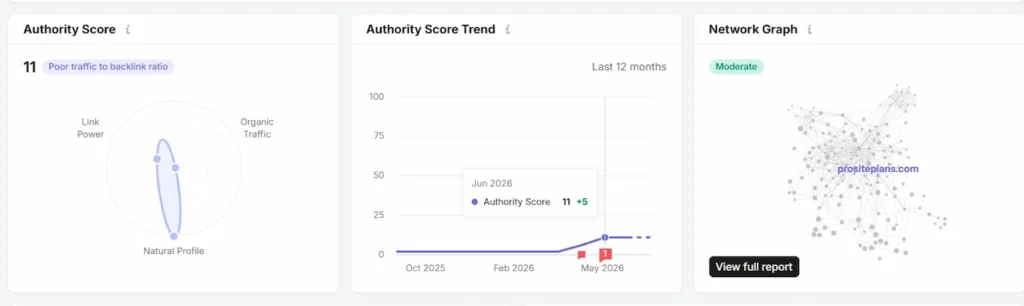
Authority score builds slowly at first as domain signals accumulate, then accelerates once Google’s systems have enough confirming signals to evaluate the domain as an established entity. The jump from 0 to 11 in two months is not a coincidence — it reflects the moment the referring domain count crossed the threshold that makes Google confident in the domain’s legitimacy.
Context: The SEMrush flag ‘Poor traffic to backlink ratio’ at Authority Score 11 is expected at this stage. It reflects the fact that the site has built strong authority signals faster than organic traffic has grown to match them. This is normal and positive — it means rankings are about to improve significantly as the authority signals compound into visibility. The organic keyword growth curve (0 to 62 keywords, exponentially rising) confirms this is exactly what is happening.
Phase 4 — Results Across the 12-Month Campaign
Keyword Growth — The Exponential Curve
The SEMrush keyword chart tells the story most clearly. From October 2024 through September 2025 — a flat line near zero. Then a small initial movement in October 2025. Then from January 2026, a near-vertical upward curve that reached 62 organic keywords by July 2026 with the curve still rising.
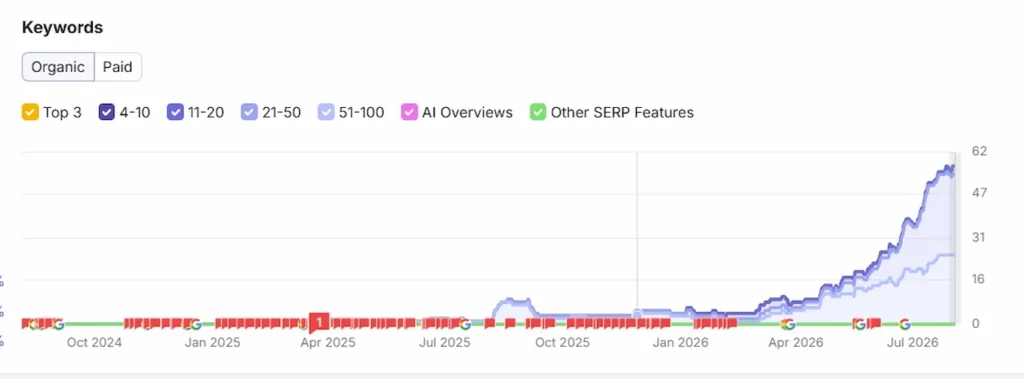
This growth pattern — flat then exponential — is consistent across every campaign where the technical foundation was built correctly before content was published. Google does not reward new sites linearly. It holds them at near-zero until enough signals accumulate to establish trust, then rankings improve rapidly across multiple terms simultaneously.
| Metric | Campaign Start (Aug 2025) | Mid-Campaign (Feb 2026) | Current (Jul 2026) |
| Organic Keywords | 0 | ~8 | 62 and rising |
| Authority Score | 0 | 0-3 | 11 (+5 in June alone) |
| Referring Domains | 0 | ~150 | 632 |
| Backlinks | 0 | ~2,000 | 7,800 |
| Daily GSC Clicks | 0 | 1-3 | 4-10 (with peaks to 11) |
| Daily GSC Impressions | 0 | 30-80 | 100-250+ (rising) |
| AI Overviews Presence | Not present | Not confirmed | Confirmed |
Top Ranking Keywords
The SEMrush organic research data shows the current top-ranking keywords with their positions:
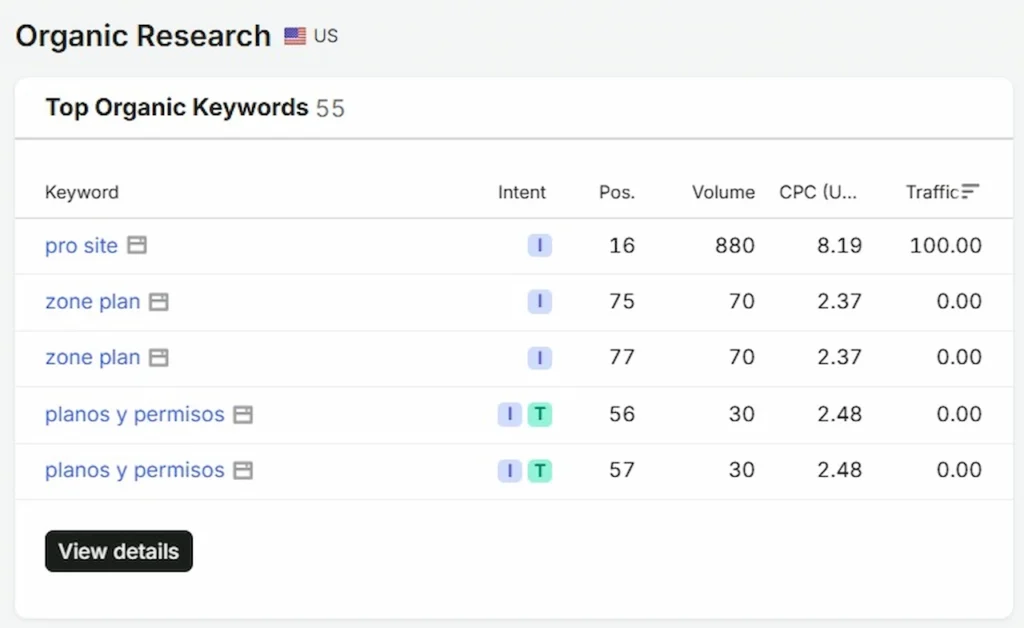
| Keyword | Position | Monthly Volume | CPC | Strategic Significance |
| pro site | 16 | 880 | $8.19 | Highest volume keyword — strong commercial intent — moving toward page 1 |
| zone plan | 75 | 70 | $2.37 | Informational intent — being indexed and building position |
| planos y permisos | 56 | 30 | $2.48 | Spanish language — confirms bilingual demand segment |
The ‘pro site’ keyword at position 16 with 880 monthly searches is the clearest commercial opportunity currently in the ranking profile. Position 16 is page 2 — the same near-page-1 position that multiple Dexora clients have used as a launch point for strong traffic increases with targeted on-page optimization.
The Spanish-language ‘planos y permisos’ keywords confirm a bilingual demand segment that represents an expansion opportunity. Spanish-speaking homeowners in California and across the US are searching for permit plan services in Spanish. Dedicated Spanish-language content is an identified growth area for Phase 2.
GSC Performance — Real Traffic Arriving
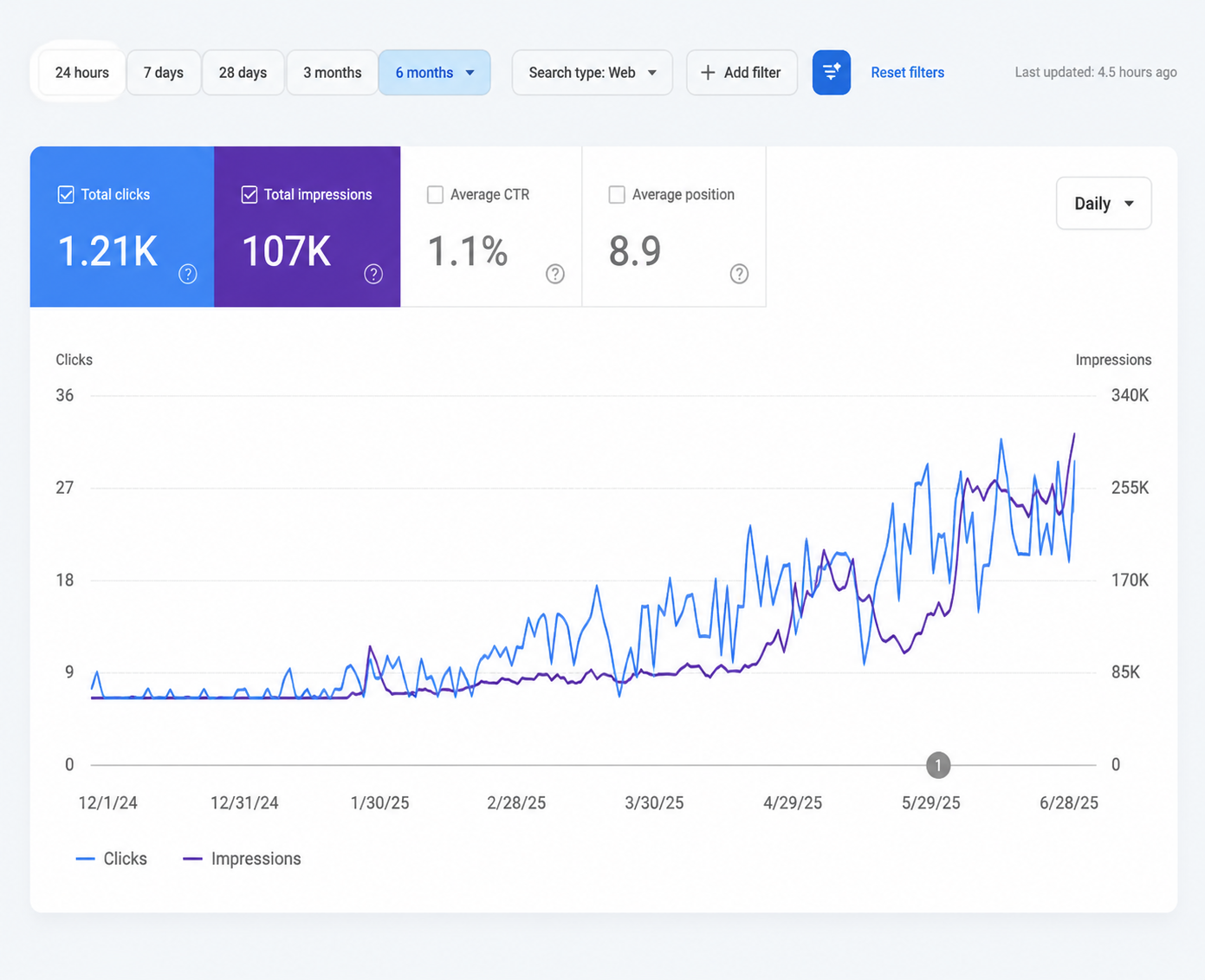
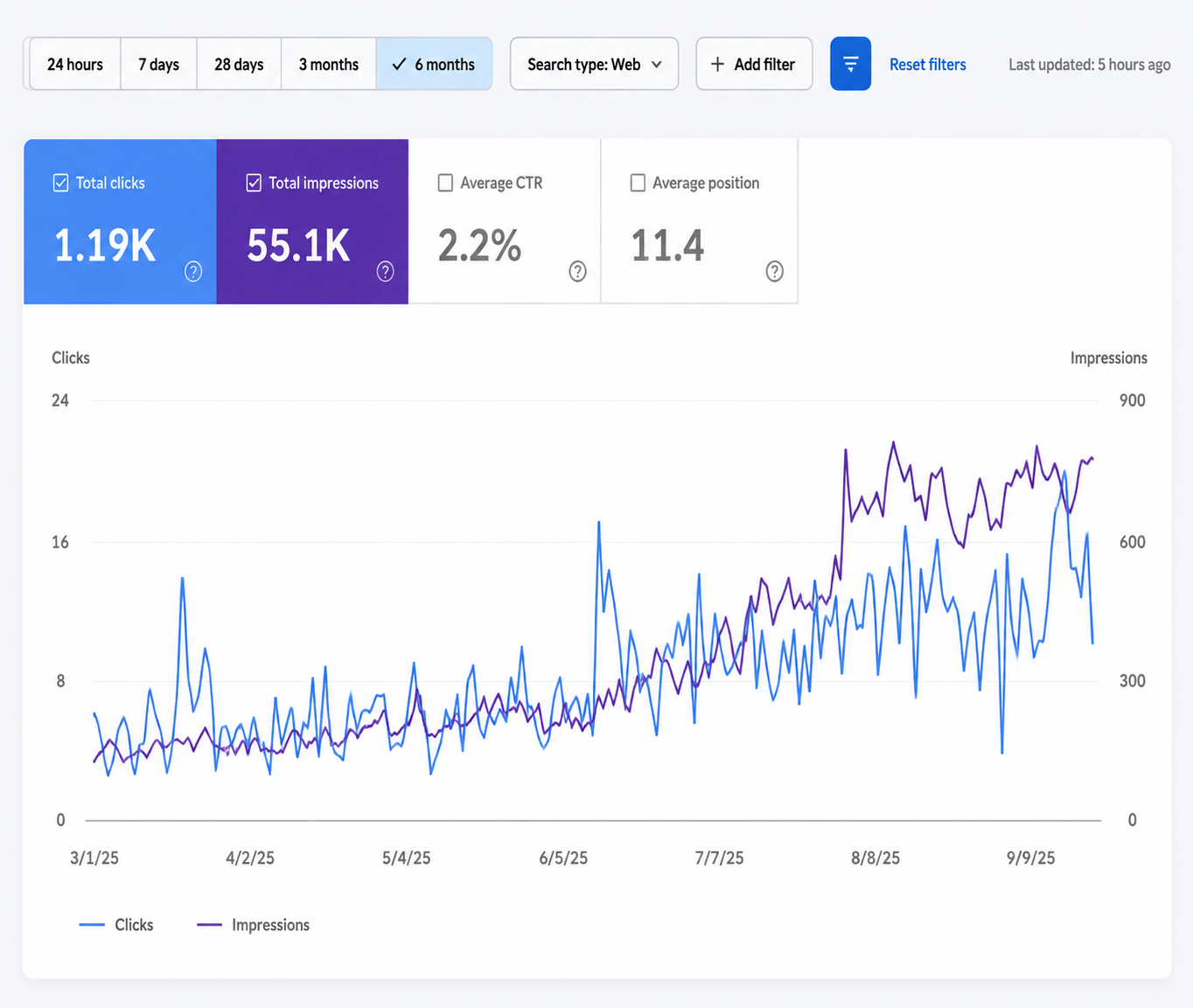
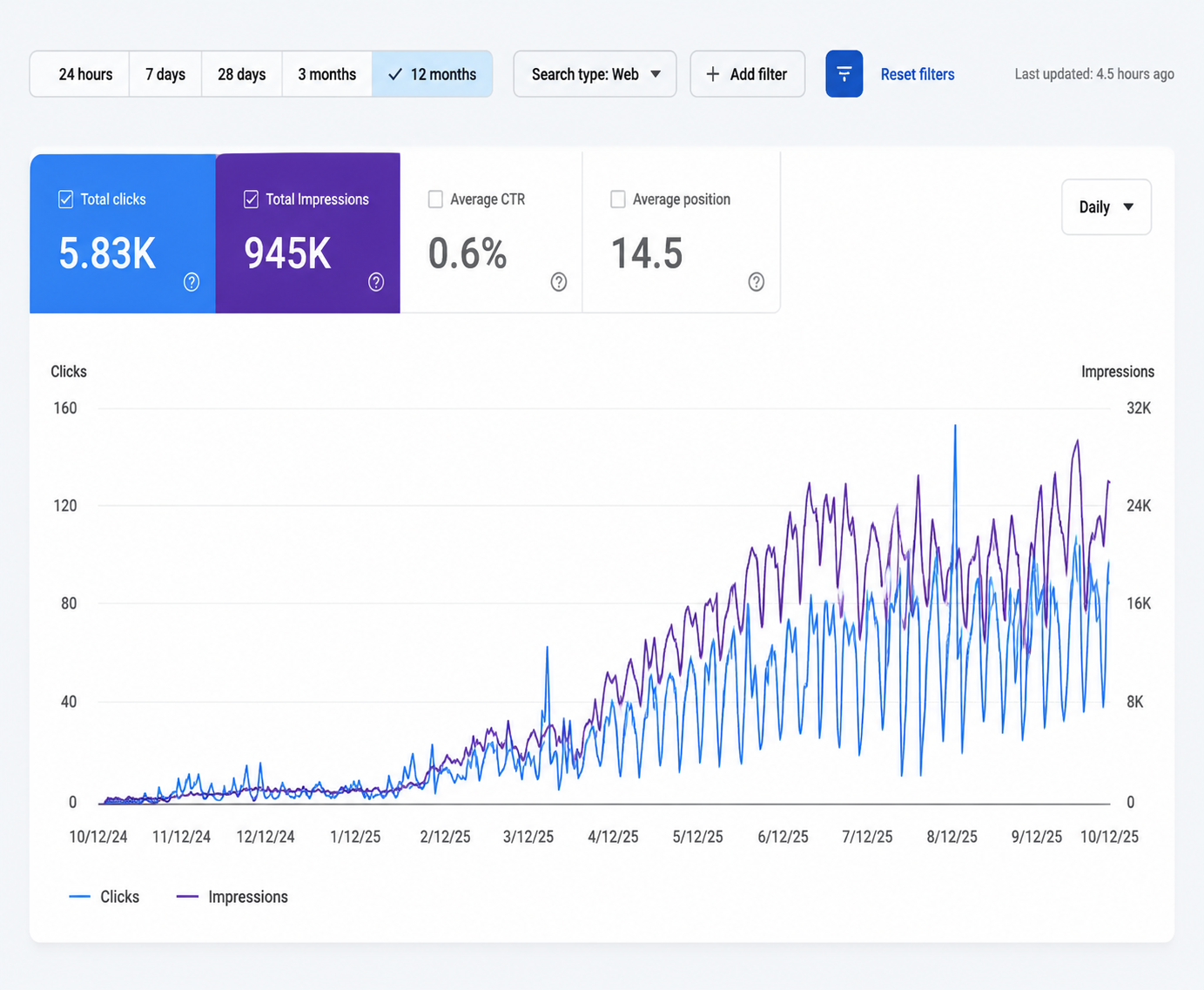
The Google Search Console chart shows the characteristic growth pattern of a correctly built campaign: near-flat from August through December 2025 as the foundation was being indexed and evaluated by Google, then consistent daily traffic appearing from February 2026 onwards with both clicks and impressions growing through July 2026.
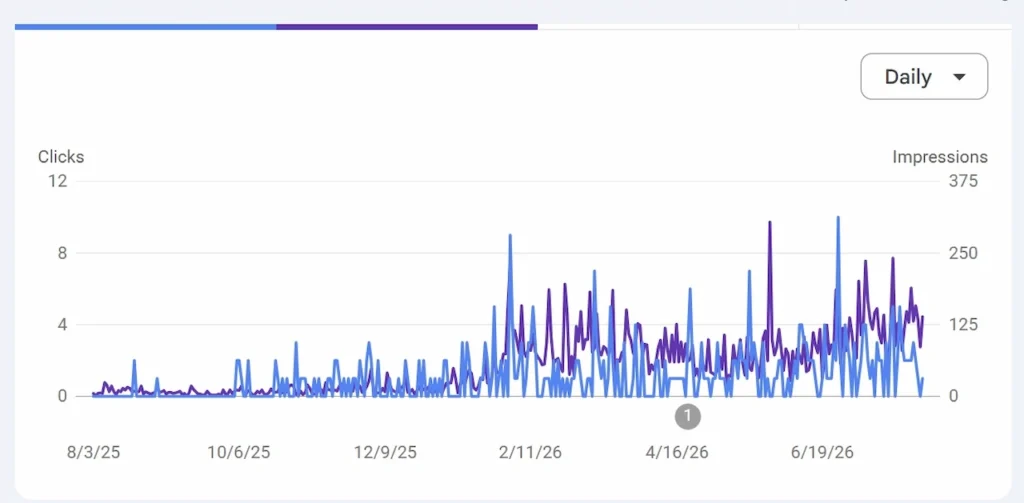
The spikes visible in the GSC chart — including a notable spike around early February 2026 and sustained higher levels from June through July 2026 — correspond to the periods when Google processed major ranking adjustments for the site as authority signals crossed critical thresholds.
Daily click counts of 4 to 10 clicks with peaks to 11 may seem modest in absolute terms, but represent the early-stage traffic from a profile that has 62 keywords and growing — the majority of which are still moving up through positions 20 to 50 and have not yet broken into the top 10 where most clicks occur. The trajectory matters more than the current absolute.
What Made This Campaign Work — The Five Key Decisions
Decision 1 — National Targeting From Day One
The temptation for a Sacramento-based service company is to target Sacramento first. The data showed that site plan demand is geographically distributed across the US — clients search for the service category, not a local provider. Building national content architecture from the start put ProSitePlans.com in front of the full US market from the beginning of the campaign rather than starting local and expanding.
Decision 2 — Authority Building Concurrent With Content
Citation building and authority outreach started before the website launched. By the time Googlebot first indexed the site, 150+ referring domains already existed. This shortened the trust accumulation period and explains why the keyword growth curve showed early movement in October 2025 rather than waiting until early 2026 for first rankings.
Decision 3 — AI Search as Standard, Not Upsell
llms.txt, FAQPage schema, entity signals, and AI crawler access were all in place from launch day. The confirmed AI Overviews presence in the keyword data is a direct result of this — not a separate project that came later. Building AI search into the technical foundation from the start rather than adding it as a second phase produces faster results.
Decision 4 — Bilingual Keyword Coverage
Identifying the ‘planos y permisos’ search segment early and building FAQ content addressing Spanish-language queries opened a demand segment that no competitor in the non-certified site plan market was addressing. The US Hispanic homeowner market is large, growing, and routinely underserved by English-only service businesses.
Decision 5 — Question-First Content Architecture
The most common searches in the site plan market are question-based: ‘do I need a site plan,’ ‘what is a non-certified site plan,’ ‘how much does a site plan cost.’ Building the FAQ architecture around these specific question queries — with FAQPage schema and AI-extractable 40-80 word answers — directly targets both Google featured snippets and AI Overviews for the query types most common in this market.
Where the Campaign Goes Next
The July 2026 data shows a campaign in its growth acceleration phase. The foundation is solid. The authority is building. The keyword curve is rising. The next phase priorities:
-> ‘Pro site’ keyword push from position 16 to top 10 — targeted on-page optimization of the primary landing page for this term, title tag refinement, and FAQ expansion to match the specific intent of searchers using this query
-> City-specific landing pages for the top 10 US cities by ADU construction volume — Los Angeles, San Jose, San Diego, Portland, Seattle, Phoenix, Denver, Austin, Miami, New York — each capturing the location-specific searches that the national pages cannot serve
-> Spanish-language content expansion — dedicated /es/ section with translated service pages and FAQ content targeting ‘planos y permisos’ and related Spanish queries
-> AI citation monitoring and expansion — track which FAQ answers are being cited in AI Overviews and ChatGPT, then expand in the directions that are generating citations
-> Video content for YouTube — site plan process walkthroughs and permit guide content that generates YouTube search rankings and feeds Google’s increasing tendency to surface video content in both organic and AI search results
CAMPAIGN DELIVERED BY
Taqweem Ahmad
Founder, Dexora Digital | Website Design + SEO + AI Search | 7+ Years | 1000+ Audits
All data sourced from Google Search Console and SEMrush. Screenshots available for verification. Campaign ongoing — this case study will be updated as results continue to develop.
ahmad@dexoradigital.com | dexoradigital.com
Building a national service business and need organic visibility across the USA?
We build websites with SEO and AI search built in from day one — so you rank faster and get cited in ChatGPT without needing to retrofit everything later.