



Your competitors aren't ranking because they're lucky they're ranking because they've published content that better matches what people are searching for. Every keyword they rank for that you don't represents a missed opportunity to attract qualified traffic, leads, and customers.A content gap analysis helps you uncover those opportunities by comparing your website with competing websites to identify missing topics, untargeted keywords, weak content, and search intent gaps. Instead of guessing what to publish next, you build your content strategy around proven search demand and real competitor data.
In this guide, you’ll learn how to perform a complete content gap analysis using Ahrefs, Semrush, Google Search Console, and free research methods. We’ll also show you how to prioritise opportunities, improve existing pages, build topical authority, and optimise your content for both Google Search and AI-powered search engines like ChatGPT, Gemini, and Perplexity.
What Content Gap Analysis Actually Is — And Why Most Businesses Skip It
Content gap analysis is the process of comparing your site’s keyword rankings against your competitors’ to identify keywords they rank for that you don’t. The gaps are your opportunities.
Most businesses never perform a proper content gap analysis because they assume keyword research alone is enough. In reality, keyword research tells you what people search for, while a content gap analysis shows exactly where competitors are winning traffic that your website is missing. It replaces assumptions with measurable opportunities backed by real search performance.
Without a structured gap analysis, content decisions are often driven by opinions, brainstorming sessions, or trending topics. While these approaches occasionally work, they rarely produce consistent organic growth. A competitor-driven strategy allows you to prioritise pages that already have proven demand, making every new article or content update far more likely to rank.
Content gap analysis replaces content guesswork with content strategy.
This guide walks through the exact process — tool-by-tool, step-by-step — for identifying content gaps, prioritising which ones to fill, and creating content that closes them.
Content Gap Analysis vs Keyword Research vs Content Audit
| Content Gap Analysis | Keyword Research | Content Audit |
|---|---|---|
| Compares your site with competitors | Finds keywords people search for | Reviews existing website content |
| Identifies missing topics | Discovers search opportunities | Improves existing pages |
| Uses competitor rankings | Uses keyword databases | Uses website performance data |
| Finds new and weak content | Finds new keyword ideas | Finds outdated or thin content |
| Builds topical authority | Expands keyword targeting | Improves content quality |
The Two Types of Content Gaps — Know Which You’re Looking For
Not all content gaps are the same. Before running any analysis, understand which type you are hunting.
Type 1: Keyword Gaps — Topics You Haven’t Covered
These are keywords your competitors rank for that you have zero content about. The topic does not exist on your site at all. This is the most common type of gap and the most straightforward to fix: you need to create the content.
Example: your competitors rank for ’emergency plumber Bristol’ and you have no page targeting that phrase. The gap is a missing service page or local landing page.
Type 2: Quality Gaps — Topics You’ve Covered Badly
These are keywords you are technically targeting but ranking poorly for — positions 15–40. Your competitors have more comprehensive, better-structured, or better-linked content on the same topic.
This gap is more nuanced but often higher value to fix — because you already have the page, you just need to improve it. Updating and expanding existing content is often faster and produces results sooner than creating new content from scratch.
Both types matter. A complete content gap analysis identifies both.
How to Run a Content Gap Analysis — Step by Step
There are two routes: the free method and the paid tool method. Both are worth knowing.
Step 1: Identify Your True Competitors
Your SEO competitors are not necessarily your business competitors. They are the sites that rank on page one for your target keywords — whether they offer your exact service or not.
Search five of your most important target keywords. Note which sites appear consistently in the top 5 across multiple searches. These are your SEO competitors for gap analysis purposes. Typically you want three to five sites to compare against.
Step 2: The Ahrefs or SEMrush Method (Paid Tools)
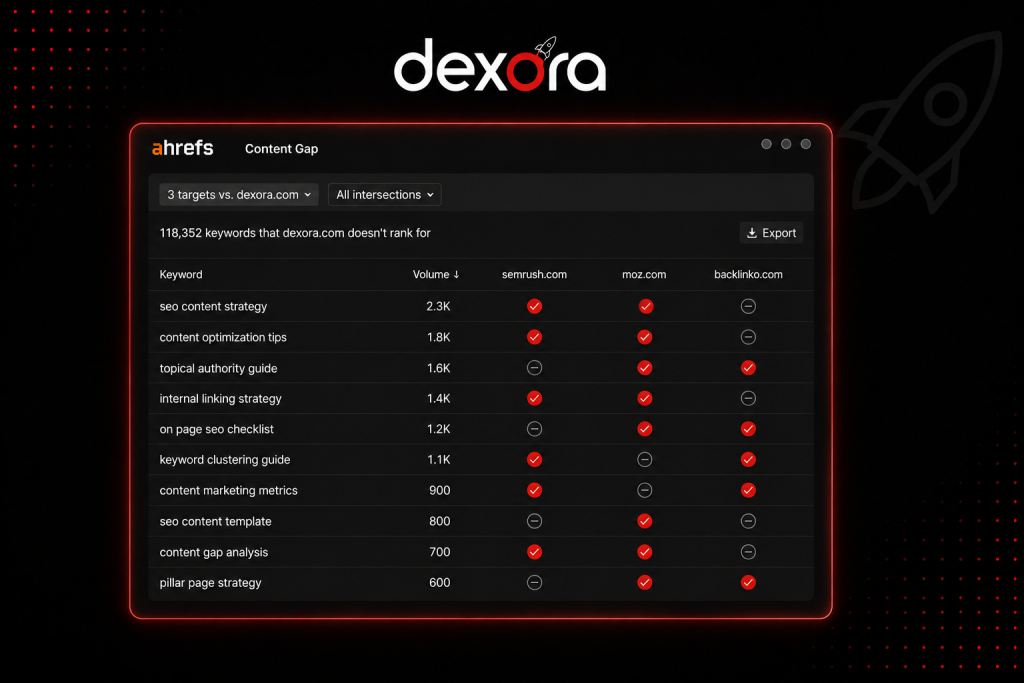
In Ahrefs: Site Explorer → enter your domain → Content Gap → enter competitor domains → run the analysis. The output shows all keywords your competitors rank for that your site does not. Filter by monthly volume, keyword difficulty, and intent to prioritise.
In SEMrush: Keyword Gap → enter your domain plus up to four competitors → run the analysis. The output is similar: keywords where competitors rank and you don’t.
Export the results to a spreadsheet. You now have a raw list of every keyword opportunity your competitors are capturing that you’re missing.
Ahrefs Content Gap tool — how to use it to identify your highest-priority keyword opportunities →
Step 3: The Free Method — Google Search Console + Manual Research
If you don’t have access to paid tools, a partial gap analysis is possible for free.
In Google Search Console: Performance → Pages → sort by impressions. Find your top 20 pages. Then look at which queries bring impressions to each page. For each, manually Google the query and see which competitors rank above you.
For competitor keyword intelligence without paid tools: type their domain into Google as ‘site:competitordomain.com keyword’ to see what content they have published on specific topics. It’s slower. It’s not comprehensive. But it identifies the most obvious gaps.
How to Prioritise Your Content Gaps — The Scoring Method
A content gap analysis for a competitive business might return 500 keyword gaps. You cannot fill all of them at once. Prioritisation is the critical skill.
The Four Dimensions of Gap Priority
Volume: how many people search this keyword per month? Higher is better — but be realistic about what your current authority can rank for.
Keyword difficulty: how hard will this keyword be to rank for? For most sites, prioritise gaps with KD under 20 first. Build authority through wins before targeting the harder terms.
Business relevance: does ranking for this keyword bring in your target customer? A high-volume keyword that attracts the wrong audience is a low-priority gap regardless of the volume.
Content type: is the gap a missing page (high effort to create) or a poorly performing existing page (lower effort to improve)? Improve-existing opportunities almost always produce faster results.
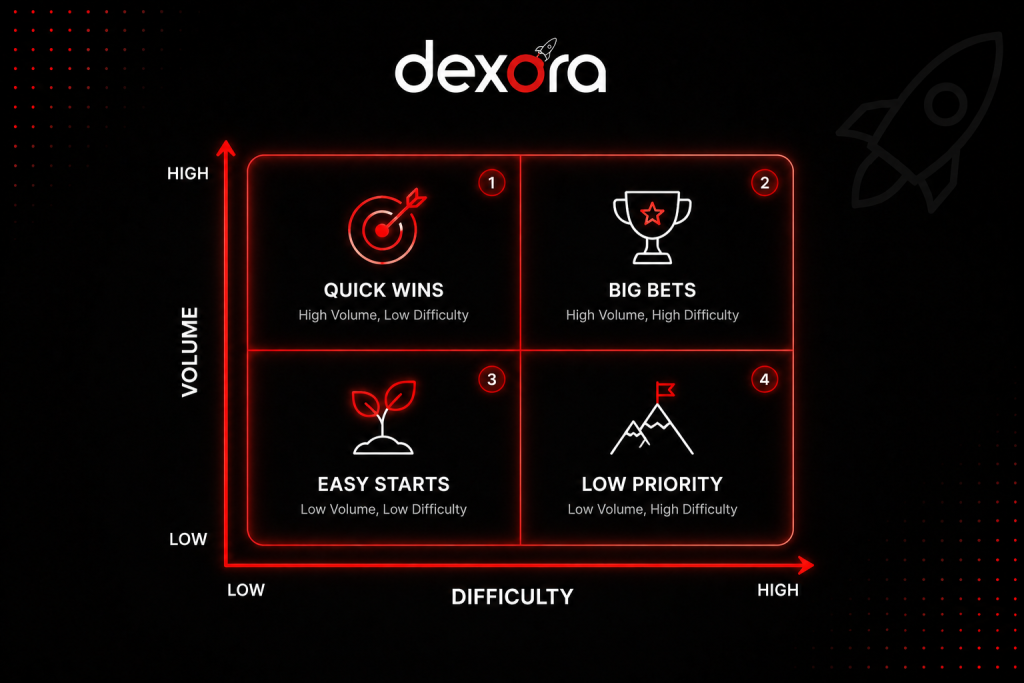
Building Your Prioritised Gap List
Score each gap keyword by combining these dimensions into a simple priority score. A formula I use: (Volume / Difficulty) × Business Relevance (1–5 scale) = Priority Score. The highest scores go at the top of your content plan.
Build the plan in a spreadsheet. Columns: keyword, monthly volume, KD, business relevance score, type (new content or improve existing), priority score, assigned writer, target publish date. This is your content gap action plan.
We run content gap analyses as part of every SEO audit →
How to Fill Content Gaps — The Creation Process
Finding the gap is the diagnosis. Filling it is the work. Here is exactly how.
For New Content (Keyword Gap — Topic Not Covered)
Build a content brief: the target keyword, search intent, competing articles to beat, required headings, internal links, and the specific questions to answer (drawn from People Also Ask for that keyword).
Write to beat the current top result — not just to match it. If the ranking page is 1,500 words, write 2,500 with more detail, better structure, and fresher examples. If it hasn’t been updated in two years, make your content current. The gap is an invitation to create the best version of that topic.
For Improving Existing Content (Quality Gap — Topic Covered Poorly)
This is often faster and higher ROI than new content creation. Start with a full rewrite of the introduction — the most impactful single change for both reader engagement and SEO. Then audit the headings: do they address the query comprehensively? Expand sections that are thin. Add examples, case studies, or data that the current version lacks. Add or improve the FAQ section. Update any outdated information.
In my experience, a well-executed content refresh on an existing page that ranks at position 12–25 can move it to position 3–8 within 4–8 weeks. No new backlinks. No technical changes. Just a dramatically better piece of content on the same URL.
Internal Linking for New Gap Content
Every new piece of gap content needs to be connected to your existing content architecture. Add internal links to it from related pages already published. Add internal links from it to relevant service pages and related articles.
Orphan content — new articles with no internal links pointing to them — receives no link equity from your existing pages and ranks slower as a result. Connect every new gap article into the cluster it belongs to.
A complete content strategy maps your gaps and fills them systematically →
Search Engine Journal — comprehensive guide to content gap strategy and implementation →
Advanced Content Gap Tactics — What Most Guides Miss
Most content gap guides stop at ‘find keywords, write content.’ Here is what they skip.
Gap Analysis for AI Search Visibility
AI tools like ChatGPT and Perplexity surface content in their answers based on similar signals to Google — authority, structure, and directness. A content gap analysis focused on question-based keywords (‘how do I…’, ‘what is the best way to…’) identifies the exact gaps most likely to win AI citation.
Prioritise gap keywords that are phrased as questions. These are most likely to win both featured snippets and AI search citations — and are often less competitive than head terms.
AI search content strategy is built on the same gap analysis as traditional SEO →
Seasonal and Trending Gap Analysis
Content gaps are not static. New questions emerge as industries change. New competitor content creates new gaps in your coverage. Run a gap analysis at least quarterly — not as a one-time project.
Additionally, watch for seasonal patterns. A plumbing business that runs a gap analysis in November will find different seasonal queries than the same analysis in May. Timing content creation to seasonal intent patterns — publishing before the demand peaks — earns rankings exactly when they are most valuable.
SERP Feature Gap Analysis
Beyond keywords, analyse which SERP features (featured snippets, PAA boxes, local packs, AI Overviews) your competitors are winning that you aren’t. Each of these is a gap — and each requires a slightly different content strategy to close.
A competitor consistently winning featured snippets for your target queries is beating you not just in rankings but in the most prominent position on the page. Structured content with direct, paragraph-length answers to specific questions is the fix.
Common Content Gap Analysis Mistakes
Mistake: Running the analysis once and treating it as permanent. Why it happens: it’s a significant effort. What it costs you: new gaps open constantly as competitors publish and search trends shift — a stale gap analysis produces a stale content strategy.
Mistake: Prioritising by volume alone and ignoring business relevance. Why it happens: volume is the most visible metric. What it costs you: content that attracts traffic irrelevant to your business — vanity impressions with no conversion value.
Mistake: Creating gap content without internal links. Why it happens: internal linking gets left for ‘later.’ What it costs you: new content that ranks slowly because it is isolated from your site’s link equity, and users who can’t navigate to related content or service pages.
Mistake: Treating all competitors equally in the analysis. Why it happens: it’s simpler to analyse all competitors at once. What it costs you: gaps that are valid opportunities against one competitor may be impossible against another. Focus on the competitors you can realistically close the gap on within your current authority level.
FAQ: Content Gap Analysis
Q: What is content gap analysis in SEO?
A: Content gap analysis is the process of identifying keywords that your competitors rank for that your site does not. These gaps represent topics where proven search demand exists but you have no content to capture it. A thorough analysis distinguishes between missing topics (new content needed) and poorly ranking topics (existing content needs improvement). It is one of the most data-driven methods of content planning in SEO.
Q: What tools do I need for a content gap analysis?
A: Paid tools (Ahrefs, SEMrush) have dedicated content gap features that automate the comparison. Free alternatives include Google Search Console (for your own keyword data), Google’s own search results (for manual competitive research), and Ahrefs’ free Webmaster Tools (limited but functional for your domain’s data). A complete analysis benefits from paid tools, but a useful partial analysis is possible with free resources.
Q: How often should I run a content gap analysis?
A: Quarterly at minimum. Monthly for active content operations. Content gaps change constantly — competitors publish new content, search trends shift, and seasonal patterns repeat. A gap analysis is not a one-time project; it is an ongoing intelligence process that should inform your content calendar continuously.
Q: What is the difference between a content gap and a keyword gap?
A: In practice, these terms are often used interchangeably. Technically, a keyword gap is a specific search term your competitors rank for that you don’t. A content gap is the broader topic area that keyword represents. Closing a keyword gap often means creating or improving a piece of content that covers the relevant topic (the content gap). The distinction is useful when prioritising: multiple keyword gaps in the same topic area should be closed with one comprehensive piece of content, not separate articles.
Q: Can content gap analysis help with AI search visibility?
A: Yes — specifically when the gap analysis prioritises question-based keywords. AI tools like ChatGPT and Perplexity answer natural language questions by drawing from authoritative web content. If your competitors are ranking for ‘how to’ and ‘what is’ queries that you haven’t covered, they are also more likely to be cited when AI tools answer those questions. Filling these gaps improves your visibility in both traditional and AI-powered search.
The Gap Is Not a Problem. The Gap Is the Opportunity.
Every keyword your competitor ranks for that you don’t is not a sign of your failure. It is a pre-identified opportunity with proven demand and a clear path to capturing it.
The businesses that grow fastest through content are the ones who spend less time creating content based on what feels interesting and more time creating content based on what they know people are already searching for. Content gap analysis is the discipline that bridges those two things.
Run the analysis. Build the list. Prioritise by what matters. Execute consistently. The gaps close one article at a time.
Technical SEO ensures newly published gap content gets indexed and ranked quickly →
Your competitors’ rankings are a map of your opportunities. All you have to do is read it.
Want us to run a content gap analysis for your site against your top competitors? We’ll identify your 50 highest-priority content opportunities and build the strategy to capture them.
Get Your Free Content Gap Audit →

Local SEO and AI Search (AEO & GEO) Specialist.
Building search visibility that converts into qualified demand.
Today, businesses need visibility on Google Maps and AI powered search and websites that actually convert visitors into leads. I am a Local SEO, AI Search & Conversion Rate Optimization (CRO) Specialist with 5+ years of hands on experience helping businesses turn underperforming websites into high converting growth engines. My work combines Local SEO, Technical SEO, Semantic SEO, GEO/AEO, and conversion focused landing page optimization to ensure brands are discoverable and profitable.
My Experience
I have delivered SEO and web growth projects across the US, UK, Australia, Canada, Finland, Germany, and the Czech Republic, working in industries such as local businesses (electrician, hvac, cleaning, Real estate, healthcare, B2B, eCommerce, SaaS, and environmental services.
Some Results
>> 200+ websites audited globally
>> specifically worked with 100+ local business (80% from USA)
>> 80+ websites improved through technical SEO & schema fixes
>> 20+ businesses featured in Google AI Overviews (SGE)
>> Multi million impression growth for eCommerce & SaaS brands
Book Free Consultation: calendly.com/dexora/30min