


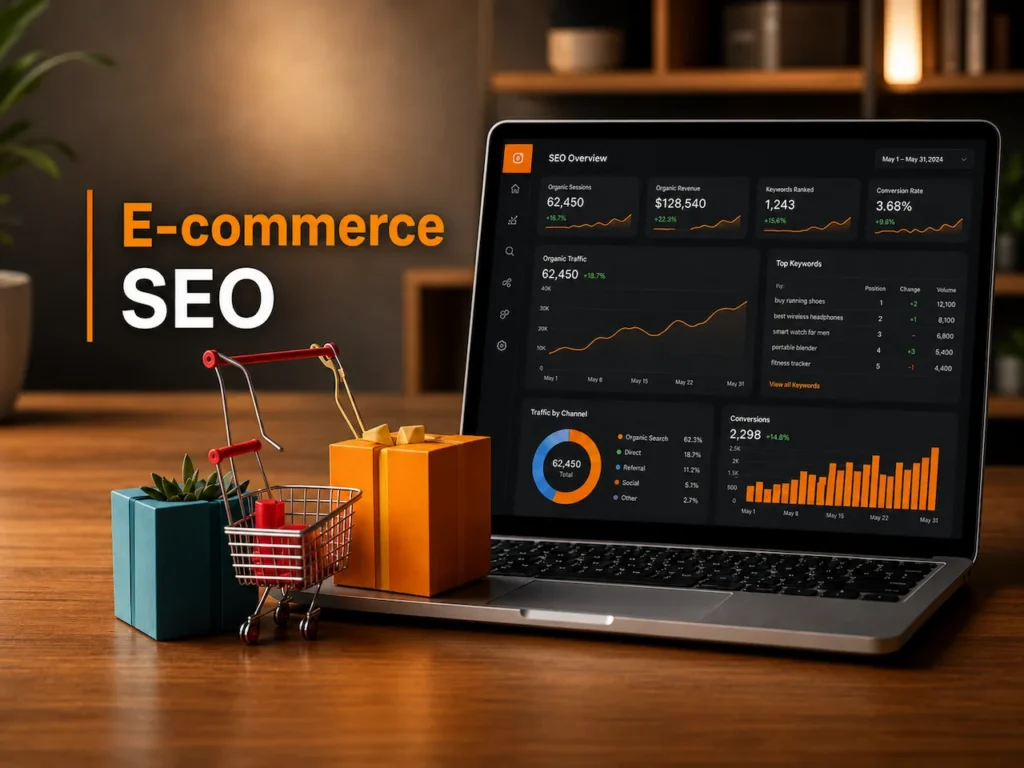
Most ecommerce SEO case studies show a traffic graph trending upward and ask you to trust the process. Here is the actual breakdown the audit findings, the strategy, and the numbers behind how we grew a Shopify brand to $1,080,000 in organic revenue within twelve months.
Executive Summary
| Metric | Starting Point | After 12 Months |
| Organic revenue | Under $90,000/year | $1,080,000/year |
| Ranking keywords | Under 200 | Over 2,000 |
| Indexed product pages | ~40% of catalog | 98% of catalog |
| Mobile page load time | 5.8 seconds | 1.9 seconds |
| Organic conversion rate | 0.9% | 2.4% |
This result did not come from a single tactic. It came from fixing a technical foundation that was actively blocking Google, then layering content and authority on top of a site that could finally be crawled, indexed, and ranked properly.
The Client
Our client is a Shopify apparel and accessories brand with roughly 1,400 SKUs, selling direct-to-consumer across the US. Before working with us, the business relied almost entirely on paid social and Google Ads, with rising acquisition costs and organic search generating only a small trickle of traffic.
The product had real market fit reviews were strong, repeat purchase rates were healthy. The site simply could not capture the search demand already sitting there.
What the Audit Found
The technical audit surfaced problems compounding across nearly every layer of the site.
- Faceted navigation generating infinite crawl paths — every filter combination created a new, uncanonicalized URL, wasting the majority of Google’s crawl budget
- Duplicate content across product variants, live on separate URLs with no canonical relationship
- Core Web Vitals failing on mobile — 5.8 second average load time from unoptimized images and render-blocking apps
- Orphaned product pages — collection pages linked only to a handful of “featured” items, leaving hundreds of pages with zero internal links
- No structured data anywhere on the site — no Product, Breadcrumb, or Review schema
- Roughly 180 ranking keywords total, with no blog, no buying guides, and no top-of-funnel content whatsoever
Individually, several of these were tolerable. Together, they told Google the site was not worth crawling efficiently which is exactly what the indexation and traffic data showed before we started. Crawl budget wasted on filter combinations meant new products sometimes took weeks to get discovered, and pages that already had real search demand were competing for the same limited crawl attention as thousands of near-duplicate filtered URLs.
The Strategy
We ran the engagement through our six-pillar DEXORA framework, adapted specifically for ecommerce.
Diagnose: We mapped every collection, filter, and product template to understand exactly how crawl budget was being spent, and pulled twelve months of Search Console data to find pages with existing impressions but poor click-through a faster win than starting from zero.
Engineer: We implemented canonical tags across every filter combination, consolidated duplicate product variants under single URLs, removed render-blocking apps, and deployed Product, Breadcrumb, and Organization schema sitewide. Mobile load time dropped to 2.3 seconds within six weeks.
eXamine: Every fix was re-crawled and validated against Search Console’s coverage report rather than assumed complete catching a misconfigured canonical tag and a stale sitemap within the same week they appeared.
Optimize: We rewrote product titles and metadata around real customer search language, rebuilt every collection page with unique supporting content, and launched a new content hub sizing guides, care instructions, and gift guides targeting the top-of-funnel searches the brand had never captured.
Report: Monthly reporting tracked organic revenue and conversion rate pulled directly from GA4 and Shopify analytics, not just traffic and rankings.
Accelerate: In the final phase, we structured content for AI search visibility FAQ schema on buying guides and clearer entity signals so the brand could be cited by AI Overviews and AI chat platforms, not just rank in traditional results.
How Results Built Over 12 Months
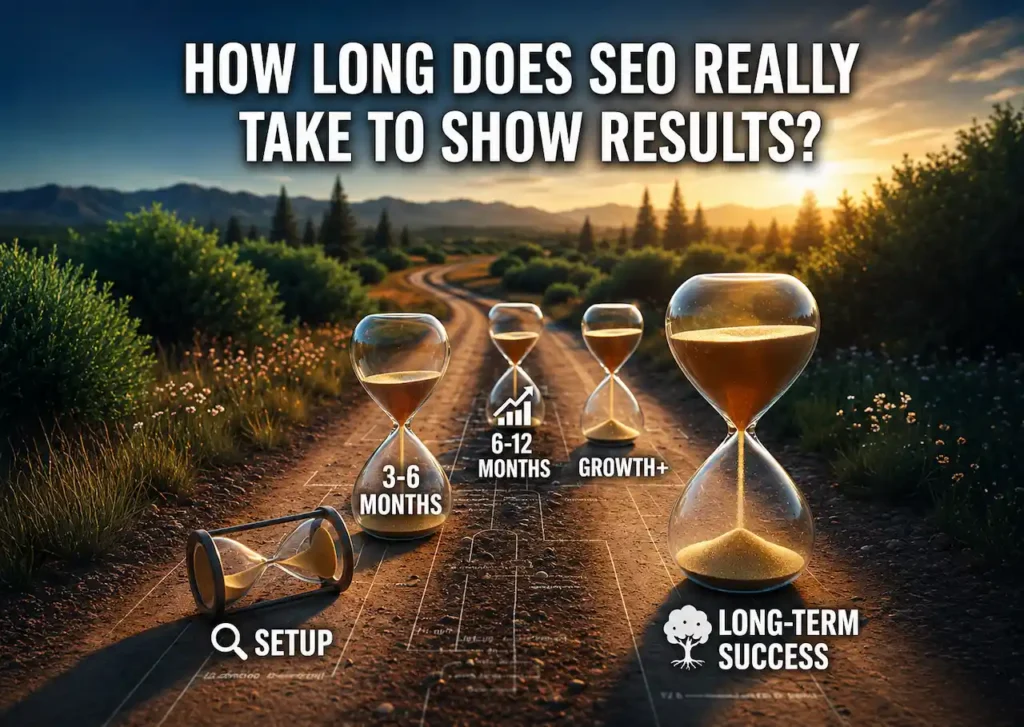
The first two months were almost entirely technical, with indexed pages climbing from roughly 560 to over 1,300 before traffic moved meaningfully. By months three and four, keywords with existing latent demand began moving into the top three positions, and organic revenue crossed $15,000 in a single month for the first time.
Months five through seven is when the new content hub started earning its own traffic sizing guides in particular ranked quickly due to genuinely low competition and converted well because they linked directly into relevant products. Ranking keywords crossed 900 by month seven.
We shifted into digital PR and link acquisition around month eight, once the content foundation gave outreach something genuinely worth citing. By the final quarter, organic revenue was outperforming the brand’s paid social spend on a cost-per-acquisition basis, and the twelve-month total reached $1,080,000 with the final quarter alone contributing more revenue than the first six months combined.
Why the Conversion Rate Mattered as Much as Traffic
Organic conversion rate nearly tripled over the engagement, from 0.9% to 2.4%. That matters because it means every additional visitor was worth more than double what they were at the start the same technical fixes that helped rankings (faster load times, clearer navigation, better product content) also improved the experience for every visitor, regardless of channel.
The non-branded organic revenue share climbing from 12% to 61% is the number we consider the clearest evidence of genuine growth. Branded search reflects demand that already existed. Non-branded growth reflects entirely new customers discovering the brand through search who did not know it existed before.
What This Means for Your Store
The specifics belong to this brand, but the pattern is common. Nearly every Shopify or WooCommerce store we audit shows the same combination of crawl issues, thin category content, and untapped top-of-funnel opportunity. If your store is spending heavily on paid acquisition while organic search sits mostly untouched, that is usually the clearest sign this same playbook applies.
Our ecommerce SEO services follow this exact framework audit, technical fix, content rebuild, authority building, and AI search readiness. You can browse our full case study library for results across other industries.
Why Choose Dexora Digital for Ecommerce SEO
- Full technical audits built specifically for ecommerce crawl and indexation behavior
- Content strategy covering transactional, category, and top-of-funnel intent together
- Direct access to the team executing the work, not a rotating account manager
- Monthly reporting tied to organic revenue and conversion rate, not vanity metrics
- A proven track record, including this exact result
Conclusion
This case study is proof that ecommerce SEO is not a slow, uncertain channel when the technical foundation is fixed first. The $1.08M in organic revenue came from clearing crawl and indexation blockers, then compounding content and authority on a site Google could finally read. If your store’s organic channel looks nothing like this, book a free strategy call and we will show you where the gap is.
Frequently Asked Questions
How long does ecommerce SEO take to produce measurable results?
Technical improvements such as indexation, crawlability, and page-speed gains can often be seen within four to six weeks. Meaningful growth in rankings, traffic, and organic revenue usually begins within three to four months and compounds over a longer engagement.
What are the most important ecommerce SEO issues to fix first?
The highest-priority issues usually include crawl-budget waste, duplicate URLs, poor canonicalization, slow page speed, orphaned products, weak internal linking, and missing structured data. Fixing these problems creates the technical foundation required for product, collection, and content pages to rank consistently.
How do ecommerce SEO services increase organic revenue?
Ecommerce SEO services increase revenue by attracting users who are actively searching for products, categories, buying guides, and solutions. The strategy also improves page speed, navigation, product content, and conversion paths, helping a larger percentage of organic visitors complete a purchase.
Does ecommerce SEO work for stores with smaller product catalogs?
Yes. Smaller ecommerce stores can benefit from the same technical SEO, structured data, internal linking, and content principles used for larger catalogs. With fewer products and collections, implementation may be faster and the site architecture can often be optimized more efficiently.
Is technical SEO more important than content for ecommerce websites?
Both are essential, but technical SEO should usually come first. Content cannot perform effectively when search engines struggle to crawl, index, or understand the website, while a technically strong store still needs optimized product, collection, and informational content to capture search demand.
How can Shopify stores prevent duplicate content problems?
Shopify stores should use accurate canonical tags, control faceted-navigation URLs, consolidate unnecessary product variants, and avoid indexing duplicate collection paths. Product descriptions, collection copy, metadata, and internal links should also be unique and aligned with the page’s primary search intent.
What role does page speed play in ecommerce SEO performance?
Page speed affects both organic rankings and conversion rates, especially on mobile devices. Faster pages reduce abandonment, improve Core Web Vitals, help search engines crawl the site more efficiently, and make it easier for shoppers to browse products and complete purchases.
Why are collection pages important for ecommerce SEO?
Collection pages target broader, high-value commercial searches and help organize related products into clear categories. Optimized collection pages can rank for competitive non-branded keywords while distributing internal authority to individual product pages within the category.
Can ecommerce SEO reduce dependence on paid advertising?
Ecommerce SEO can reduce reliance on paid acquisition by building a consistent source of non-branded organic traffic and revenue. Paid campaigns may still remain valuable, but stronger organic visibility can lower blended acquisition costs and provide long-term growth without paying for every click.
How does AI search optimization support ecommerce growth?
AI search optimization helps product guides, category pages, and educational content become easier for AI systems to understand and cite. Clear entity signals, structured FAQs, schema markup, authoritative content, and well-organized product information can improve visibility across AI Overviews and conversational search platforms.
Ready to Grow Your Ecommerce Revenue?
Discover the SEO, content, and conversion gaps limiting your store’s organic growth.

Local SEO and AI Search (AEO & GEO) Specialist.
Building search visibility that converts into qualified demand.
Today, businesses need visibility on Google Maps and AI powered search and websites that actually convert visitors into leads. I am a Local SEO, AI Search & Conversion Rate Optimization (CRO) Specialist with 5+ years of hands on experience helping businesses turn underperforming websites into high converting growth engines. My work combines Local SEO, Technical SEO, Semantic SEO, GEO/AEO, and conversion focused landing page optimization to ensure brands are discoverable and profitable.
My Experience
I have delivered SEO and web growth projects across the US, UK, Australia, Canada, Finland, Germany, and the Czech Republic, working in industries such as local businesses (electrician, hvac, cleaning, Real estate, healthcare, B2B, eCommerce, SaaS, and environmental services.
Some Results
>> 200+ websites audited globally
>> specifically worked with 100+ local business (80% from USA)
>> 80+ websites improved through technical SEO & schema fixes
>> 20+ businesses featured in Google AI Overviews (SGE)
>> Multi million impression growth for eCommerce & SaaS brands
Book Free Consultation: calendly.com/dexora/30min