


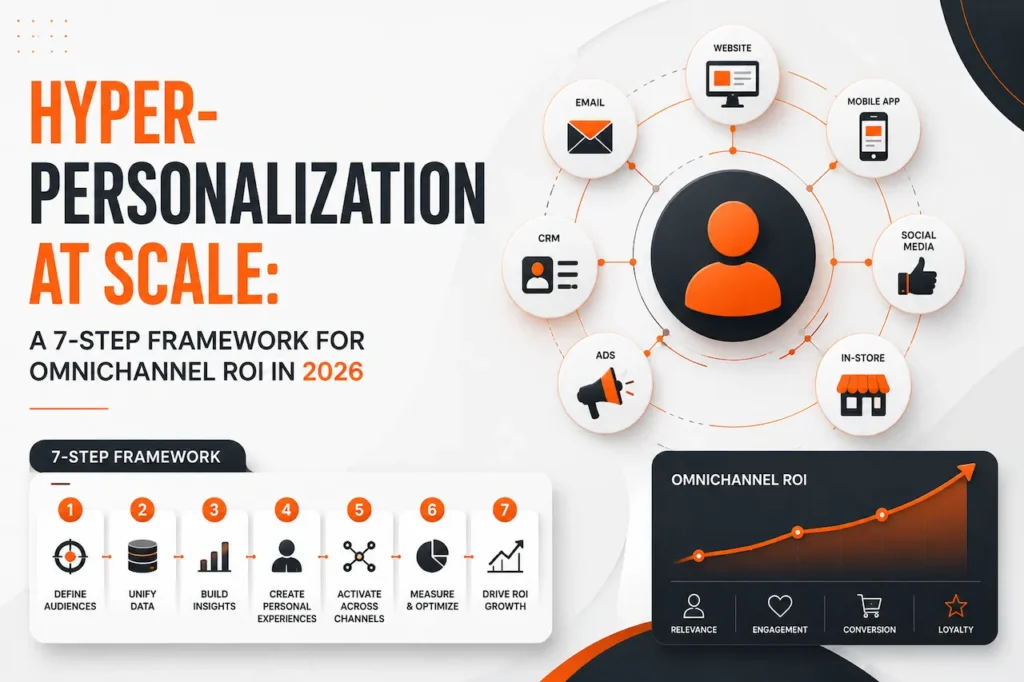
The marketing landscape of 2026 runs on one core principle: customers no longer tolerate generic messaging or fragmented experiences across channels. They expect content, offers, and journeys tailored to their preferences, behavior, and real-time context, regardless of where they’re interacting with a brand.
For enterprises pursuing measurable ROI from omnichannel strategy, hyper-personalization has moved from a nice-to-have to a genuine strategic requirement. Combining AI, real-time analytics, and a unified customer data strategy lets brands anticipate needs rather than react to them after the moment has passed.
Why Hyper-Personalization Is a 2026 Priority
Customers now interact with brands across multiple devices, platforms, and touchpoints within a single buying journey, and that behavior has raised the baseline expectation for relevance. Poorly orchestrated, fragmented campaigns don’t just underperform they actively create disengagement and churn, because customers notice the disconnect between channels even when they can’t articulate exactly why an experience felt generic.
We’ve seen this pattern consistently across client engagements: organizations that invest in real-time analytics and unified data infrastructure tend to see stronger revenue per customer and better retention than those still running channel-by-channel campaigns with no shared customer view. The gap between brands personalizing effectively and those still treating each channel as separate continues to widen, which makes earlier adoption a genuine competitive advantage rather than a marginal optimization.
Step 1: Unify Customer Data and Real-Time Intelligence
Hyper-personalization starts with data unification. Fragmented customer data spread across CRM systems, web analytics, and transactional platforms is consistently the single greatest barrier to scalable personalization we encounter in client audits.
Organizations need to integrate every touchpoint into one genuine source of truth, enabling real-time insight into customer behavior, intent, and engagement history rather than a fragmented view rebuilt manually for each campaign. Advanced analytics platforms, AI-powered customer data platforms, and real-time dashboards help identify patterns and deliver contextually relevant experiences instead of generic segment-based messaging.
Why Hyper-Personalization Is a 2026 Priority
Step 2: Build Dynamic Micro-Segments, Not Static Personas
Traditional static personas fall short of what 2026 customer expectations require. AI-driven micro-segmentation lets brands define dynamic personas that adapt in real time based on actual behavior, preferences, and engagement history rather than a fixed profile created once and left unchanged for a year.
Combining predictive analytics with historical data lets marketing teams anticipate customer needs and align content across every channel. Micro-segmentation done well does not just improve relevance it improves timing, which is often the decisive factor in whether a message converts.
Step 3: Orchestrate AI-Driven Content and Offers
Content needs to be personalized at scale without sacrificing brand consistency, which is a genuinely difficult balance to strike manually. AI-powered systems can automate content creation, offer recommendations, and adaptive messaging tailored to a user’s current context, freeing creative teams to focus on the strategic direction rather than manual variation production.
Dynamic creative optimization lets email, push notifications, social content, and web experiences adjust automatically based on engagement signals and predictive modeling. This is where genuinely relevant, high-impact messaging becomes achievable at a scale manual processes simply can’t match.
Step 4: Synchronize Channels for Journey Continuity
Omnichannel marketing only works when customer journeys feel genuinely seamless. Messaging needs to stay consistent across email, web, social, mobile, and offline touchpoints, or the disconnect becomes obvious to the customer even if no single channel is performing poorly on its own.
A centralized orchestration approach allows real-time adjustments across channels simultaneously, so a customer moving from app to website to in-store experience encounters one coherent narrative rather than three disconnected ones. This consistency does more to build trust than any single channel’s optimization ever could on its own.
Step 5: Deploy Real-Time, Behavior-Based Triggers
Reactive marketing campaigns planned weeks in advance and deployed on a fixed schedule no longer keep pace with how customers actually behave. Real-time, behavior-based triggers based on specific events and behavioral signals let brands respond to intent at the moment it happens, not days later.
Cart abandonment alerts, location-based notifications, and dynamic recommendation engines are practical examples of this in action. The goal is delivering a relevant intervention at the exact moment a customer is genuinely close to converting, rather than a generic follow-up sent on a fixed timeline regardless of where that customer actually is in their decision.
Step 6: Build Closed-Loop Measurement and Attribution
Hyper-personalization requires rigorous measurement to actually understand what’s driving performance across every touchpoint involved. Closed-loop attribution models paired with AI-powered analytics help identify which specific actions drive conversions, repeat purchases, and long-term customer value, rather than crediting a single last-click channel for a much longer journey.
Feeding these insights back into the personalization engine continuously rather than reviewing performance once a quarter is what actually compounds ROI over time. A free SEO audit can be a useful complementary starting point here too, since search behavior data often reveals customer intent signals that feed directly into a broader personalization strategy.
Step 7: Align the Organization Around the Framework
None of the previous six steps holds up without genuine alignment between marketing, data, and IT teams. Cross-functional collaboration is what makes personalization initiatives scalable and repeatable rather than a one-off campaign that can’t be replicated without heroic manual effort.
Leadership needs to actively champion data literacy and organizational agility, giving teams the confidence to adopt new tools, interpret analytics correctly, and act on insights without waiting for lengthy approval chains. Organizations that achieve this kind of operational alignment consistently see the strongest results from personalization work, because the technology alone was never the actual bottleneck.
The Technology Stack Behind This Framework
A few core components consistently show up in effective hyper-personalization stacks: AI-powered customer data platforms, real-time analytics tools, marketing automation systems, and dynamic creative optimization technology. Selecting and properly integrating these pieces matters more than chasing the newest individual tool, since a disconnected stack recreates the same data fragmentation problem the framework is meant to solve.
Privacy and Governance Can’t Be an Afterthought
Compliance with privacy regulations like CCPA, GDPR, and FTC marketing guidelines needs to be built into personalization work from the start, not addressed after a campaign is already live. Ethical AI use, data security, and transparent consent mechanisms belong in the foundation of every personalization initiative, particularly as customer data collection becomes more central to how these systems function.
Common Risks and How to Mitigate Them
A handful of risks show up consistently across hyper-personalization implementations. Over-reliance on full automation without human oversight can quietly erode brand voice over time, since AI-generated variations drift from brand guidelines in ways that are easy to miss at scale. Data silos remain one of the most persistent problems fragmented data reduces accuracy across every downstream personalization decision built on top of it.
Compliance failures are a real risk when governance isn’t built in from the start, making regular audits essential rather than optional. Scalability challenges also emerge when operational processes weren’t designed to support growth across additional channels or regions, which is often where a well-designed framework breaks down in practice even when the underlying strategy was sound.
FAQ
What is hyper-personalization at scale?
It’s the use of AI, analytics, and real-time data to deliver individualized experiences to large customer bases across every touchpoint, rather than segment-level generic messaging.
Why does omnichannel synchronization matter so much?
Consistency across channels ensures customers experience one coherent journey rather than a disjointed set of separate interactions, which directly affects trust and conversion.
How does AI actually improve content personalization?
AI analyzes customer behavior and context to dynamically generate relevant content, recommend products, and adjust messaging in real time based on engagement signals.
What metrics should marketers track for this kind of initiative?
Conversion rate, engagement level, repeat purchase frequency, customer lifetime value, and attribution accuracy across the full customer journey.
Is hyper-personalization only relevant for large enterprises?
No. Smaller businesses can apply the same principles at a smaller scale, particularly around data unification and channel consistency, without needing enterprise-level tooling from day one.
What’s the biggest barrier organizations face implementing this?
Fragmented customer data across separate platforms, which prevents the real-time, unified view that hyper-personalization depends on.
How long does it typically take to see results from this framework?
Data unification and initial segmentation work usually takes several months, with measurable ROI improvements building progressively as the closed-loop measurement step feeds back into optimization.
Does more personalization always mean better results?
No. Over-automated personalization without human oversight can feel intrusive or inconsistent with brand voice, which actively hurts trust rather than building it.
How does privacy regulation affect personalization strategy?
It shapes what data can be collected and how it can be used, making consent management and governance a foundational requirement rather than a later addition.
What’s the first practical step for a business starting this work?
Auditing current data infrastructure to identify where customer information is fragmented across systems, since unification has to come before any of the later steps can work properly.
Why Choose Dexora Digital
We help organizations connect personalization strategy to the search and content infrastructure that often already holds valuable customer intent data.
- Data unification guidance that identifies where fragmentation is actually occurring
- Customer journey mapping that connects search behavior to broader personalization strategy
- Governance-first implementation that builds privacy compliance in from day one
- Ongoing measurement frameworks designed around closed-loop learning, not one-time reporting
If you’d like to see how your current data and content strategy support this kind of framework, you can start with a free SEO audit to identify the gaps.

Local SEO and AI Search (AEO & GEO) Specialist.
Building search visibility that converts into qualified demand.
Today, businesses need visibility on Google Maps and AI powered search and websites that actually convert visitors into leads. I am a Local SEO, AI Search & Conversion Rate Optimization (CRO) Specialist with 5+ years of hands on experience helping businesses turn underperforming websites into high converting growth engines. My work combines Local SEO, Technical SEO, Semantic SEO, GEO/AEO, and conversion focused landing page optimization to ensure brands are discoverable and profitable.
My Experience
I have delivered SEO and web growth projects across the US, UK, Australia, Canada, Finland, Germany, and the Czech Republic, working in industries such as local businesses (electrician, hvac, cleaning, Real estate, healthcare, B2B, eCommerce, SaaS, and environmental services.
Some Results
>> 200+ websites audited globally
>> specifically worked with 100+ local business (80% from USA)
>> 80+ websites improved through technical SEO & schema fixes
>> 20+ businesses featured in Google AI Overviews (SGE)
>> Multi million impression growth for eCommerce & SaaS brands
Book Free Consultation: calendly.com/dexora/30min