
Every few months, the same message shows up in a client’s inbox: traffic dropped overnight, and nobody on the team changed anything. Nine times out of ten, the answer isn’t a mystery it’s Google.
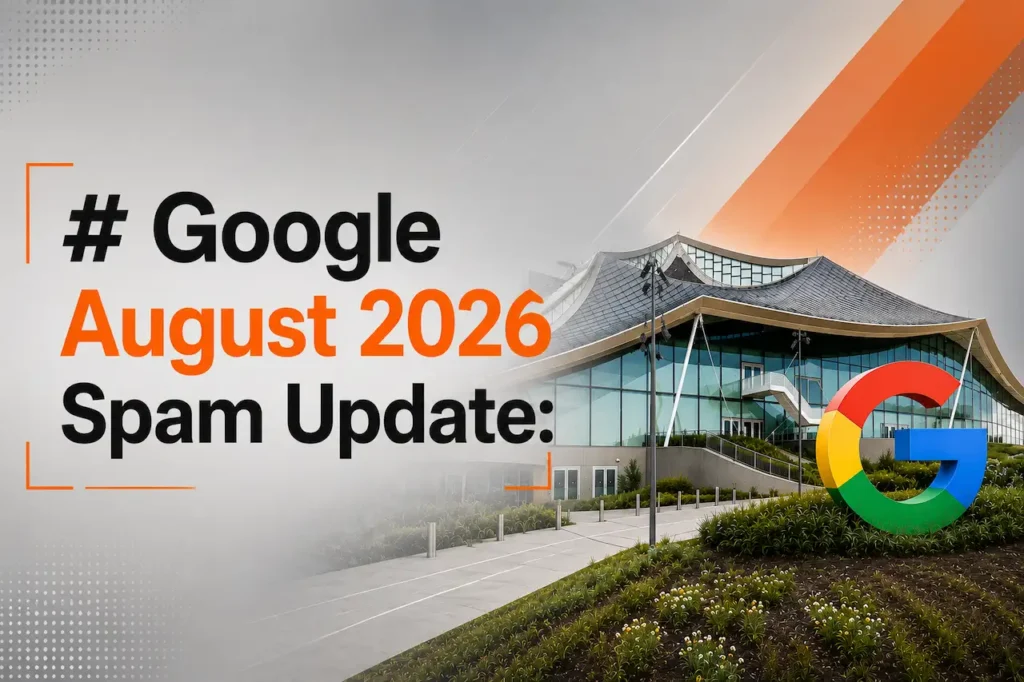
On August 18, 2026, Google released its third spam update of the year, following updates in March and June. It’s a global rollout, live across every language, and Google says it should finish within a few days.
What the update actually does
This is what Google calls a “normal” spam update a refinement to SpamBrain, its AI-based spam detection system, rather than a response to one specific tactic. It targets sites violating Google’s search spam policies broadly: things like scaled content abuse, cloaking, and other manipulative techniques designed to game rankings rather than earn them.
Two things it explicitly does not target: link spam and the site reputation abuse policy (the “parasite SEO” problem, where a legitimate site hosts low-quality third-party content to borrow its authority). Those get their own, separate updates when Google decides to act on them.
If your traffic dropped this week
First: check whether the drop lines up with August 18. Google Search Console’s Performance report will show it clearly if it does. A complete SEO audit can also help identify technical, content, or spam-related issues that may be affecting performance.
Second: don’t assume the worst. Most sites see no change at all from a spam update it targets a defined set of manipulative practices, not the general ranking algorithm. If you weren’t spamming, this almost certainly isn’t why your numbers moved.If your rankings were already declining before the update, it may be worth looking at the broader reasons why your website is not ranking on Google.
If you were hit, Google’s own guidance is straightforward: review the spam policies, fix what’s violating them, and wait. Recovery isn’t instant. Google has said it can take several months for its systems to recognize a site has cleaned up and reflect that in rankings. There’s no resubmission button that speeds it up.
One exception worth knowing: if you were relying on link-based tactics, cleaning them up won’t necessarily bring back the rankings those links generated. Once Google’s systems discount the effect of spammy links, any ranking benefit they created is gone not paused, gone.
The pattern worth noticing
This is the third spam update in eight months. March 2026 rolled out and completed in a single day. June 2026 took about two days. History suggests these are becoming more frequent and faster to deploy a sign Google’s automated detection is getting more confident, not less.
That’s the real takeaway, more than any single update. Understanding how Google’s algorithm works and what its systems are designed to reward makes it easier to build an SEO strategy that doesn’t depend on short-term tactics. The sites that never think about spam updates are the ones already doing what these updates reward: real content, real signals, nothing built to be gamed. If a spam update is something you dread every few months, that’s usually a sign the underlying SEO strategy needs a harder look not just a wait-and-see approach until the next one hits.
FAQ
When did the August 2026 spam update roll out?
Google announced it on August 18, 2026, at approximately 12:30 PM ET. Google said the rollout would take a few days to complete globally.
What does the August 2026 spam update target?
General violations of Google’s search spam policies, enforced through its SpamBrain AI system. It does not specifically target link spam or the site reputation abuse policy those are handled by separate, dedicated updates.
How long does it take to recover from a Google spam update?
Google has said recovery can take several months, since its systems need time to confirm a site is consistently complying with spam policies before restoring rankings. There’s no fast-track process.
Is this the same as a core update?
No. Core updates adjust how Google evaluates and ranks content broadly. Spam updates specifically target sites violating spam policies a narrower, more targeted enforcement action.
How many spam updates has Google released in 2026?
This is the third: March 2026, June 2026, and now August 2026.
By Taqweem Ahmad | Founder, Dexora Digital
Traffic dropped after the August Spam Update?
Get an SEO audit to identify the issue and plan your recovery.

Local SEO and AI Search (AEO & GEO) Specialist.
Building search visibility that converts into qualified demand.
Today, businesses need visibility on Google Maps and AI powered search and websites that actually convert visitors into leads. I am a Local SEO, AI Search & Conversion Rate Optimization (CRO) Specialist with 5+ years of hands on experience helping businesses turn underperforming websites into high converting growth engines. My work combines Local SEO, Technical SEO, Semantic SEO, GEO/AEO, and conversion focused landing page optimization to ensure brands are discoverable and profitable.
My Experience
I have delivered SEO and web growth projects across the US, UK, Australia, Canada, Finland, Germany, and the Czech Republic, working in industries such as local businesses (electrician, hvac, cleaning, Real estate, healthcare, B2B, eCommerce, SaaS, and environmental services.
Some Results
>> 200+ websites audited globally
>> specifically worked with 100+ local business (80% from USA)
>> 80+ websites improved through technical SEO & schema fixes
>> 20+ businesses featured in Google AI Overviews (SGE)
>> Multi million impression growth for eCommerce & SaaS brands
Book Free Consultation: calendly.com/dexora/30min