


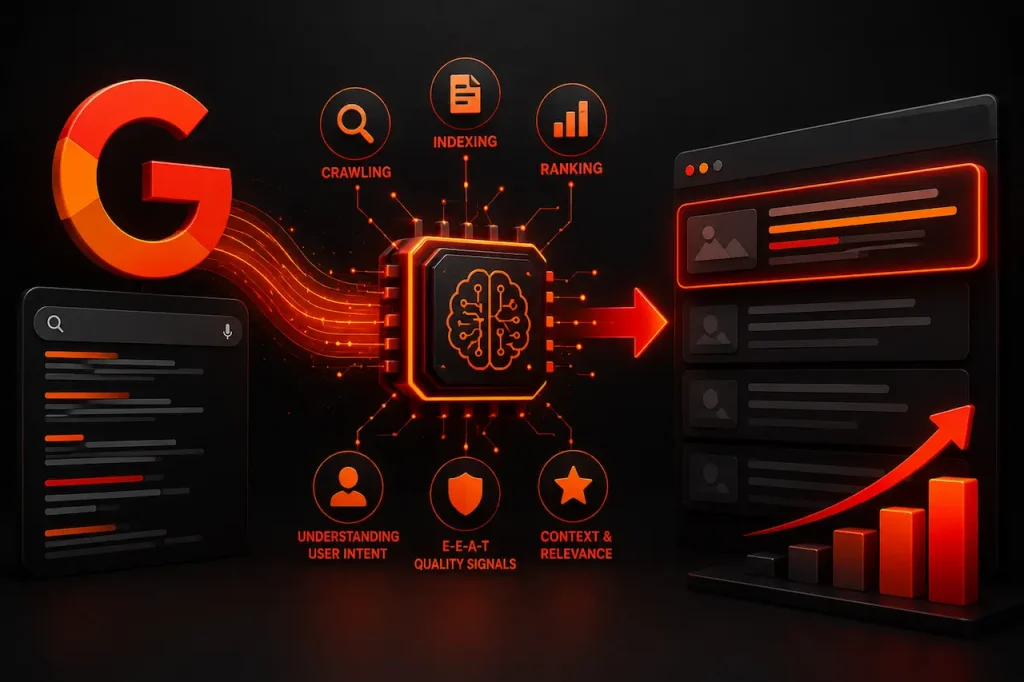
Google changes its algorithm over 5,000 times a year. Most of those changes are invisible. A handful reshape the entire SEO landscape.
The businesses that survive every update — that rank consistently regardless of which signals Google tweaks — all share one thing: they understand what Google is fundamentally trying to do. Not which specific signals it measures. What it is trying to achieve.
This article explains how Google’s algorithm actually works in 2026 — the mechanics underneath the surface and the principles that determine who wins every search.
technical SEO ensures your site works with Google’s algorithm, not against it →
The Goal Google Never Changes — Even When Everything Else Does
Every algorithm update, every signal adjustment, every new feature — all of it serves one consistent objective: return the most useful, trustworthy result for any given search query.
This sounds obvious. Most businesses still optimise as though Google’s goal were something else — as though it were trying to rank pages with the most keywords, or the most backlinks, or the most Schema markup. Those are signals. The goal is usefulness.
When you understand the goal, every algorithm update makes sense. The Helpful Content Update wasn’t random. It demoted content that existed to rank rather than to help. Panda wasn’t random. It demoted thin, low-quality content mills. Every major update is Google improving its ability to achieve the same goal it has always had.
Google doesn’t change what it wants. It gets better at finding it.
Google’s own explanation of how Search works and what it values →
Stage One: How Google Finds Your Pages — Crawling
Before Google can rank your page, it has to find it. Googlebot — Google’s automated crawler — navigates the web by following links. Every time it finds a link to a new page, it queues that page for crawling.
The speed and completeness of crawling depends on several factors. How many internal links point to a page determines how quickly Googlebot finds it. Your site’s load speed affects how many pages Googlebot crawls per visit. Your robots.txt file tells Googlebot which areas of your site to access and which to skip.
Crawl Budget — The Resource Allocation You Need to Know About
Googlebot does not have infinite resources. It allocates a crawl budget to each site — a ceiling on how many pages it will crawl within a given period. For small sites (under 500 pages), this is rarely a constraint. For large sites, it matters significantly.
Wasted crawl budget — from duplicate content, parameter URLs, soft 404 pages, or infinite pagination — means less budget for your important content. Technical SEO addresses this by ensuring Google’s crawl resources are directed toward the pages that deserve to rank.
Stage Two: How Google Processes What It Finds — Indexing
Crawling discovers pages. Indexing is the decision of whether to store them. Google reads each crawled page and decides whether to add it to its index — the database of pages it considers for search results.
Pages can be excluded from the index for many reasons: noindex tags (intentional), thin or duplicate content (Google’s judgment), canonicalisation pointing Google to a preferred version, or pages Google evaluates as low-quality.
The Helpful Content System — Why Low-Quality Content Now Hurts Your Whole Site
Since 2022, Google has operated a site-wide Helpful Content signal. It evaluates not just individual pages but the overall helpfulness of a site’s content. Sites where a significant proportion of content is thin, AI-generated without genuine expertise, or clearly written to rank rather than to help — receive a site-wide suppression that can drag down even their good pages.
This is why content strategy matters at the domain level, not just the page level. A site with 200 excellent pages and 300 thin ones has a problem. The 300 undermine the 200.
Stage Three: How Google Decides Who Ranks — The Ranking Algorithm
For any given query, Google’s ranking algorithm evaluates thousands of indexed pages and determines which to show, in what order. This is where the hundreds of ranking factors come into play.
Google has never published a complete list of ranking factors. What is known comes from patents, public statements, leaked documents, and the collective research of the SEO industry. What follows is a synthesis of the best-established signals.
Relevance Signals — Does This Page Answer the Query?
Keyword signals remain foundational. The presence of the query term (and semantic variations) in the title tag, headings, URL, and body content signals relevance. But keyword presence alone no longer wins — Google now evaluates whether the content actually addresses the underlying need the query represents.
Natural language processing (NLP) and the BERT and MUM language models allow Google to understand the meaning behind queries, not just the words. A page about ‘pipe leak solutions’ that never uses the phrase ‘leaking pipe’ can still rank for that query if the content is semantically relevant and comprehensive.
Quality Signals — Is This Page Worth Reading?
This is where E-E-A-T lives. Experience, Expertise, Authoritativeness, and Trustworthiness are evaluated through multiple signals: author credentials, factual accuracy, depth of coverage, citation of credible sources, and the overall quality standard of the site.
Google uses human Quality Raters — real people who evaluate search results against its guidelines — to train and validate its quality detection algorithms. What Quality Raters flag as low-quality, the algorithm learns to deprioritise.
Authority Signals — Does Anyone Else Vouch for This Page?
PageRank — the original Google innovation of using links as votes — remains a significant ranking factor, now far more sophisticated than in 2010. The quality, relevance, and diversity of the sites linking to you contributes to both page-level and domain-level authority.
Google has also incorporated brand authority signals. A site that appears frequently in branded searches, generates direct traffic, and is mentioned across the web (not just through links) accumulates trust as an authoritative entity.
User Experience Signals — What Happens After the Click?
Google has access to enormous amounts of user behaviour data. Click-through rate from search results. Time on page. Bounce rate back to search results. Pages per session. These signals tell Google whether searchers found what they were looking for.
A page that ranks third but earns a higher CTR than the pages above it because its meta description is more compelling will, over time, receive ranking credit for that signal. A page that ranks second but sends most visitors back to Google immediately — because it doesn’t actually answer the query — will gradually decline.
AI search engines like ChatGPT use similar quality signals to Google — here’s what that means →
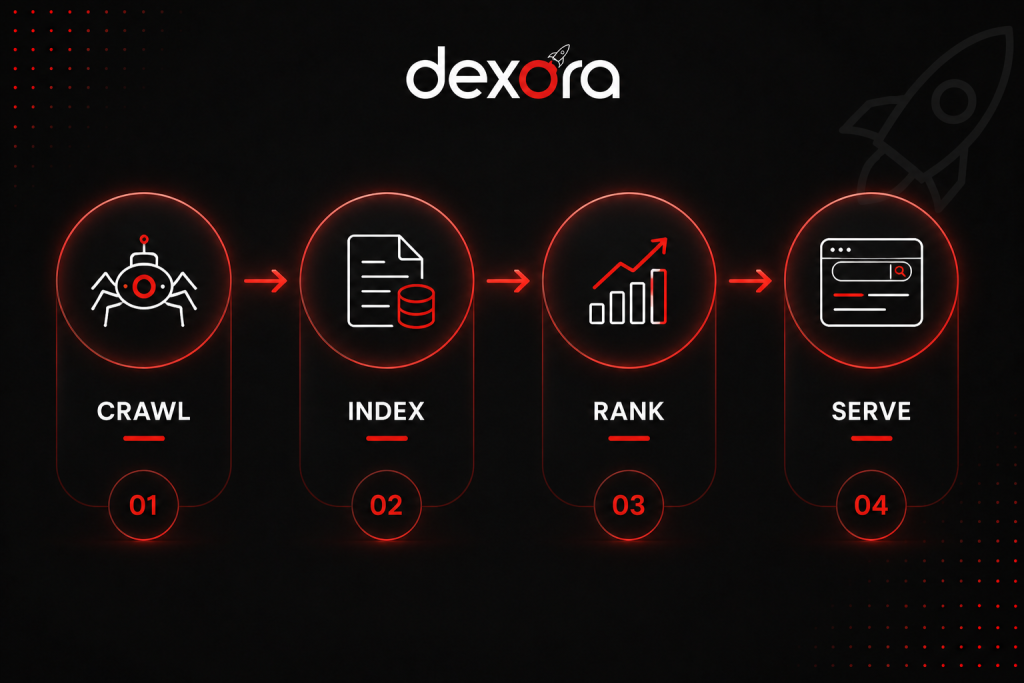
The Updates That Changed Everything: 2022–2026
Three algorithm updates since 2022 have collectively reshaped the ranking landscape more than any comparable period since the original Penguin and Panda updates.
The Helpful Content Update (August 2022 onwards)
Google introduced a site-wide signal designed to identify and demote content created primarily to rank in search rather than to genuinely help users. The key evaluative question: if the search engine didn’t exist, would anyone write this content? Or is it purely a vehicle for SEO traffic?
Sites hit hard by this update had large volumes of content that technically covered keywords but provided no genuine depth, expertise, or unique value. The recovery path required deleting, merging, or significantly improving this content — not just publishing new articles.
Core Updates and the Quality Rater Framework
Google’s broad core updates — multiple per year — recalibrate how it weighs its quality signals. Sites that decline after a core update typically haven’t done anything ‘wrong’ — their competitors have gotten better and the baseline for ‘good enough’ has risen.
The consistent pattern: sites that demonstrate genuine E-E-A-T, have clean technical foundations, and serve user intent accurately tend to be stable across core updates. Sites built on keyword density and link manipulation are increasingly volatile.
AI-Powered Ranking and AI Overviews (2024–2026)
Google’s integration of generative AI into search — through AI Overviews and AI-generated answers — has created a new layer in the search results. For many informational queries, users receive a direct answer before seeing any organic results.
The pages cited in AI Overviews are consistently high-authority, well-structured, and directly answer specific questions. Optimising for AI citation requires the same foundation as traditional SEO — plus schema markup, clear FAQ sections, and first-person authoritative voice.
Search Engine Land’s ongoing coverage of Google algorithm updates and analysis →
What Google’s Algorithm Cannot Be Gamed — The Durable Truth
Every year, new techniques emerge that claim to exploit some aspect of Google’s algorithm. Some work briefly. None work long-term. The pattern is always the same: Google identifies the pattern, closes the gap, and the sites that relied on the shortcut fall.
The sites that rank consistently across years — across algorithm updates, across changing signals — share one thing: they are genuinely the best answer to their target queries. Not the most optimised. The best answer.
Real expertise. Real depth. Real external validation. A genuinely trustworthy site. These things are not a strategy you layer on top of weak content. They are what the content has to be, in order to withstand what Google’s algorithm keeps getting better at detecting.
What This Means Practically
It means write content that would be worth reading if search engines didn’t exist. It means build a site technically so that Google never has a reason to trust it less. It means earn links through being genuinely good at what you do, not through manipulation.
This is not idealism. It is the only strategy with a durable track record.
an SEO strategy aligned with how Google’s algorithm actually works →
Common Misconceptions About How Google’s Algorithm Works
Misconception: More keywords means better rankings. What actually happens: Google identifies keyword stuffing as a spam signal. Natural keyword placement in semantically relevant content outperforms forced density.
Misconception: Google penalises AI-generated content. What actually happens: Google penalises low-quality content, regardless of how it was produced. Human-written thin content ranks poorly. AI-generated expert-reviewed content can rank well. The quality is the variable, not the method of creation.
Misconception: Backlinks are becoming less important. What actually happens: low-quality links are becoming less important — and can now actively harm rankings. High-quality editorial backlinks from authoritative sources remain one of the strongest ranking signals.
Misconception: Google is the only search engine worth optimising for. What actually happens: in 2026, AI tools (ChatGPT, Perplexity, Gemini) are genuine discovery platforms. They pull from the web and use similar quality signals to Google. SEO and AEO are increasingly the same discipline.
FAQ: How Google’s Algorithm Works in 2026
Q: How often does Google update its algorithm?
A: Google makes over 5,000 changes to its algorithm every year. Most are minor, daily adjustments that are never announced. The major ‘broad core updates’ happen several times a year and can significantly shift rankings across entire industries. Google announces significant core updates — these are the ones worth monitoring via tools like Search Engine Land or Semrush’s Sensor.
Q: What are Google’s most important ranking factors?
A: Google has confirmed that its most important ranking signals include: relevance of content to the search query, the quality and authority of backlinks pointing to the page, page experience signals (load speed, mobile usability, Core Web Vitals), and content quality (E-E-A-T). No ranking factor works in isolation — it is the combination that determines position.
Q: Does Google penalise websites directly for poor SEO?
A: Google uses two types of penalties. Algorithmic penalties are automatic — your rankings drop because your site doesn’t meet quality standards. Manual penalties are applied by human reviewers for deliberate violations of Google’s guidelines (buying links, cloaking, keyword stuffing). Manual penalties appear in Google Search Console and require a reconsideration request after the issue is resolved.
Q: How does Google’s AI affect organic rankings?
A: Google’s AI systems (BERT, MUM, and the AI Overviews feature) have made the algorithm better at understanding natural language queries and evaluating content quality without relying solely on keyword signals. AI Overviews answer many informational queries directly, which reduces click-through to organic results for those queries. However, the sources cited in AI Overviews are the same high-authority, well-structured pages that rank well organically.
Q: Can you recover from a Google algorithm penalty?
A: Yes — but recovery depends on correctly diagnosing what triggered the penalty. For Helpful Content Update impacts (thin or unhelpful content): the fix is substantively improving or removing low-quality content, which can take months to be re-evaluated. For link-based penalties: disavowing toxic links and removing any purchased links. For Core Update impacts: these often require longer-term quality improvements rather than quick fixes. Recovery timelines range from 2 weeks to 12+ months.
The Algorithm Is a Test. The Answer Is Always the Same.
Google has updated its algorithm thousands of times since 2000. The businesses that rank today, as they ranked five years ago and will rank five years from now, are the ones that understood from the beginning what Google was actually testing for.
Not keywords. Not links. Not technical tricks. Trustworthiness. Usefulness. Expertise that earns its place in a search result.
Optimise for that — and the algorithm updates become irrelevant.
Every algorithm update is Google getting better at the same test. Study the test, not the answers.
Want to know how your site currently performs against Google’s quality signals? →
We run a full technical and quality audit against Google’s stated criteria — and show you exactly what to fix.
Get Your Free Algorithm-Ready Audit →

Local SEO and AI Search (AEO & GEO) Specialist.
Building search visibility that converts into qualified demand.
Today, businesses need visibility on Google Maps and AI powered search and websites that actually convert visitors into leads. I am a Local SEO, AI Search & Conversion Rate Optimization (CRO) Specialist with 5+ years of hands on experience helping businesses turn underperforming websites into high converting growth engines. My work combines Local SEO, Technical SEO, Semantic SEO, GEO/AEO, and conversion focused landing page optimization to ensure brands are discoverable and profitable.
My Experience
I have delivered SEO and web growth projects across the US, UK, Australia, Canada, Finland, Germany, and the Czech Republic, working in industries such as local businesses (electrician, hvac, cleaning, Real estate, healthcare, B2B, eCommerce, SaaS, and environmental services.
Some Results
>> 200+ websites audited globally
>> specifically worked with 100+ local business (80% from USA)
>> 80+ websites improved through technical SEO & schema fixes
>> 20+ businesses featured in Google AI Overviews (SGE)
>> Multi million impression growth for eCommerce & SaaS brands
Book Free Consultation: calendly.com/dexora/30min