


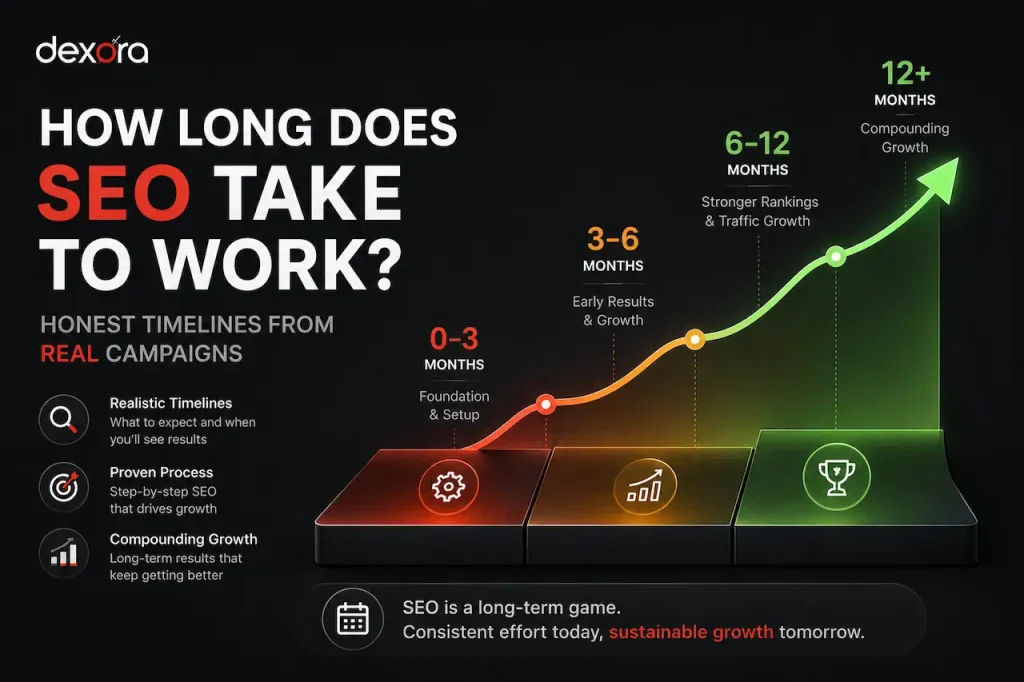
Your competitor is not waiting. Their SEO agency published three articles this week while you are still asking whether it is worth starting.
That is the real cost of the question ‘how long does SEO take?’ — not the answer itself, but the months that pass while you look for a more convenient one.
I am going to give you honest, specific timelines based on working with dozens of businesses across different industries and starting points. No promises I can’t back up. No ranges so wide they’re useless.
before timelines, your technical SEO foundation determines how fast things move →
The Real Reason People Ask How Long SEO Takes
Most people aren’t really asking about timelines. They are asking whether SEO is worth it.
They have heard it takes 6 months. They have a budget. They want permission to invest — or a reason not to.
Here is the honest framing: SEO is the only marketing channel where the work you do this month still generates returns 24 months from now. Paid ads stop the moment you stop paying. Content ranks indefinitely when built correctly.
The question is not how long it takes. The question is what it costs to keep ignoring it.
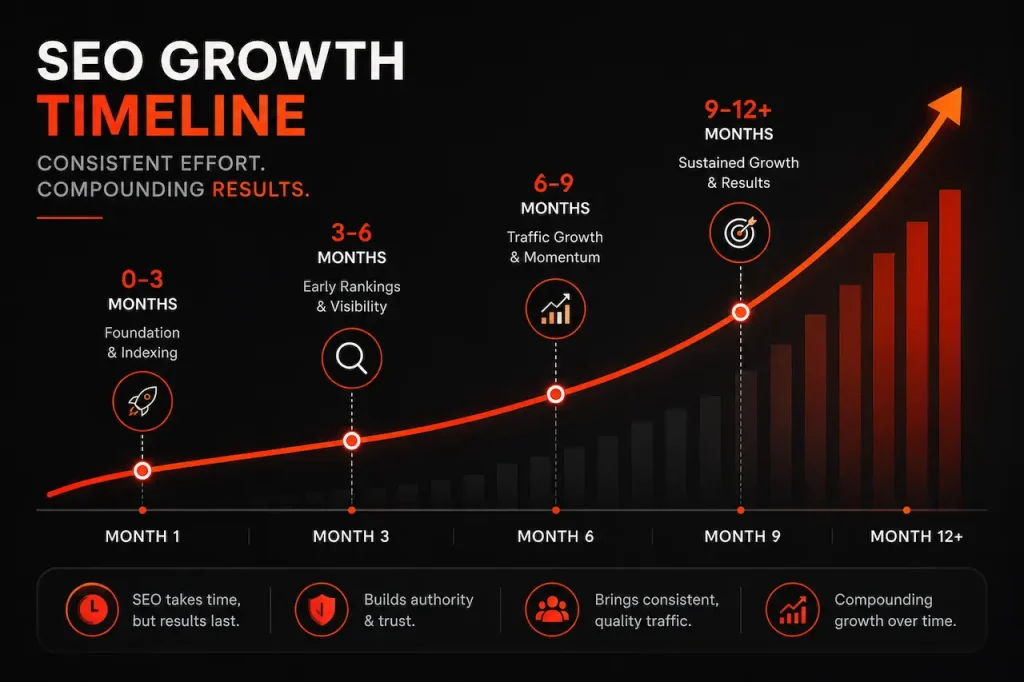
A study by Ahrefs found that fewer than 6% of pages rank in the top 10 for a keyword within a year of being published. The other 94% either didn’t qualify or didn’t put in the work to compete. Timelines are real. But they are also within your control.
Ahrefs study on how long it takes pages to rank in the top 10 →
The Four Factors That Control Your SEO Timeline
There is no universal answer. But there are universal variables. Your timeline is largely determined by where you start on these four dimensions.
Factor 1: Domain Age and Existing Authority
A five-year-old domain with 200 backlinks and 50 indexed pages has a head start that a brand-new site doesn’t. Google trusts established domains because they have a track record.
For a new domain: add 3–6 months to any estimate. For an established domain with decent fundamentals: subtract 2–3 months.
Factor 2: Competition Level in Your Niche
‘Plumber in rural Montana’ is a different race than ‘SEO agency London.’ Both are legitimate SEO goals. One takes months; one takes years.
Before setting a timeline, look at the top 10 ranking pages for your target keywords. What is their domain authority? How many backlinks do they have? How long and detailed is their content? That is the bar you need to clear.
Factor 3: Content Quality and Publishing Frequency
Businesses that publish one high-quality, deeply researched article per week consistently outperform businesses that publish ten thin articles in a burst and then go quiet. Consistency signals to Google that you are actively maintained and authoritative.
Quality matters more than quantity. But quality combined with consistency is what actually compounds.
Factor 4: Technical SEO Health
A site with indexing errors, slow load times, and broken links will not rank — regardless of content quality. Before expecting timelines to apply, your technical foundation must be sound.
I have seen businesses spend six months publishing great content only to discover that half their site wasn’t being indexed because of a misconfigured robots.txt file. Technical health comes first.
find out if technical issues are slowing your SEO results →
Realistic SEO Timelines by Starting Point
Here are the actual timelines I work with, by scenario. These assume consistent execution — not occasional effort.
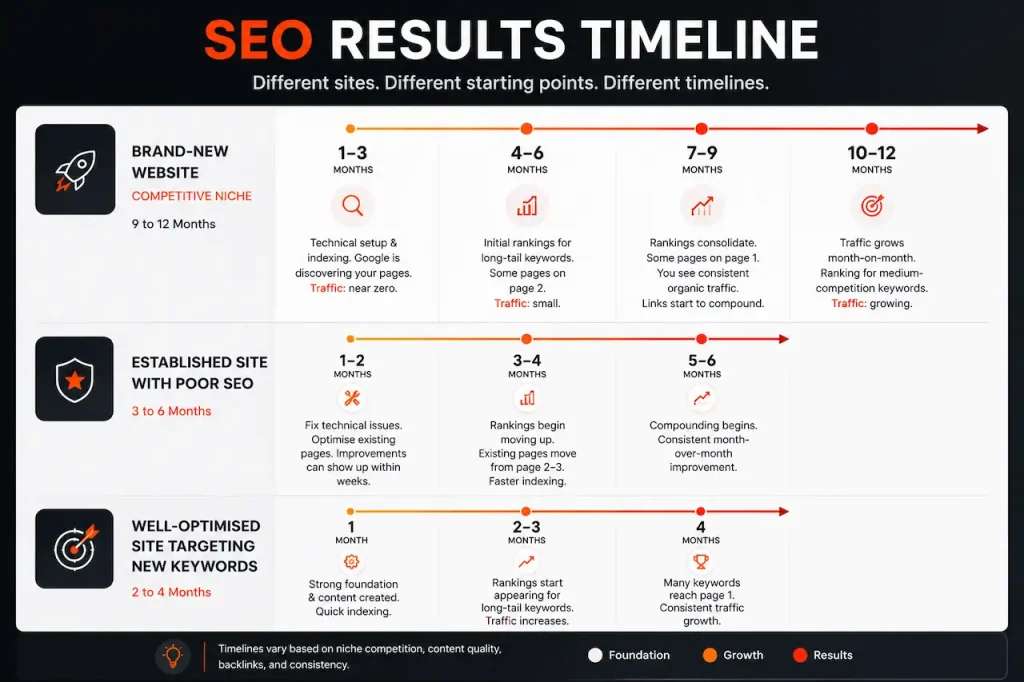
Brand-New Website, Competitive Niche — 9 to 12 Months
Months 1–3: Technical setup. Crawlability, sitemap, schema, site speed, mobile optimisation. Google is discovering and indexing your pages. Traffic: near zero.
Months 4–6: Initial keyword rankings begin appearing — mostly long-tail, low-competition terms. Some pages may hit page 2. Traffic: small but measurable.
Months 7–9: Rankings consolidate. A handful of pages are on page 1. You see consistent organic traffic for the first time. Link-building begins to compound.
Months 10–12: If you have been consistent, traffic is growing month-on-month. You are starting to rank for medium-competition keywords.
Established Site with Poor SEO — 3 to 6 Months
This is actually the best starting position. There is already domain age, existing backlinks, and Google trust. You are fixing problems rather than building from scratch.
Months 1–2: Fix technical issues. Optimise existing pages. Rewrite thin content. Improvements can show up within weeks.
Months 3–4: Rankings begin moving. Existing pages that were ranking on page 2–3 start climbing. New content starts indexing faster thanks to established domain trust.
Months 5–6: Compounding begins. If the work was done correctly, you should see consistent month-over-month improvement.
Well-Optimised Site Targeting New Keywords — 2 to 4 Months
If your technical foundation is strong, your domain has authority, and you know how to write content that ranks — new keyword targets can move quickly. I have seen clients hit page 1 in 6–8 weeks for long-tail keywords with this profile.
Your starting point changes everything. The work is the same; the timeline is different.
What Happens in Each Month — A Realistic Breakdown
Most SEO guides skip this. They give you a range and leave. Here is what is actually happening inside a typical 12-month campaign.
Month 1 — Foundation
Technical audit. Keyword research. Content strategy. Fixing the issues Google is already penalising. This month feels slow because it is. But skipping it means building on sand.
Month 2–3 — Infrastructure
Core service pages optimised. Blog content publishing begins. Internal linking structure built. Google starts crawling more frequently as content volume grows. You may see a small ranking bump on branded terms.
Month 4–6 — First Real Results
Long-tail keyword rankings appear. Some pages hit page 2. Organic impressions in Google Search Console start climbing. This is often where impatient businesses quit — just before it gets interesting.
Month 7–9 — Compounding Begins
Page 2 results start moving to page 1. Traffic from long-tail terms brings in qualified leads. Blog content from months 2–4 starts ranking and driving supplementary traffic.
Month 10–12 — Sustainable Growth
A healthy, well-executed SEO campaign at month 12 looks like this: consistent organic traffic, multiple page-1 rankings, and a pipeline of content compounding in the background. From here, the question shifts from ‘when will it work’ to ‘how do we scale it.’
For businesses targeting local customers, local SEO timelines can be faster →
The Mistakes That Make SEO Take Much Longer
Most SEO timelines go wrong for predictable reasons. Here are the five I see most often.
Mistake: Publishing thin content and hoping volume compensates. Why it happens: it feels productive. What it costs you: Google deprioritises sites with many weak pages, which drags down the rankings of your strong ones.
Mistake: Ignoring technical SEO until month six. Why it happens: content feels more tangible. What it costs you: months of ranking delay because Google can’t properly crawl or index your work.
Mistake: Stopping after month three because ‘it isn’t working.’ Why it happens: the results curve is non-linear — slow at the start, steep later. What it costs you: you restart from zero while your competitor’s month-four work starts compounding.
Mistake: Chasing high-volume keywords with a new site. Why it happens: big numbers are exciting. What it costs you: you spend energy competing against sites you cannot beat yet, while low-competition keywords go unclaimed.
Mistake: Not tracking correctly. Why it happens: tracking takes setup time. What it costs you: you can’t see what’s working, so you can’t double down on it.
Google’s guidance on how to evaluate SEO results and timelines →
FAQ: How Long Does SEO Take?
Q: How long does SEO take to show results for a new website?
A: Most new websites begin to see meaningful organic traffic between months 6 and 12, assuming consistent content creation, proper technical setup, and active link building. The first three months are often invisible — not because nothing is happening, but because Google’s trust is being built before rankings climb.
Q: Can SEO work faster with more budget?
A: Budget accelerates the work — more content, more link building, faster technical fixes. But it cannot buy Google’s trust, which accrues over time. You can publish more content with a bigger budget. You cannot make 12 months pass faster. The compounding timeline is partially fixed regardless of investment level.
Q: How long does local SEO take to work?
A: Local SEO typically moves faster than national SEO because competition is more limited and Google Business Profile optimisation can produce visible results in 4–8 weeks. Full local pack dominance for competitive niches typically takes 3–6 months of consistent effort.
Q: What is a realistic timeline to get to page 1 of Google?
A: For long-tail, low-competition keywords: 2–4 months with a well-optimised site. For medium-competition keywords: 6–9 months. For high-competition head terms: 12–24 months minimum for a site building authority from scratch. Most businesses should target long-tail first and work their way up as authority builds.
Q: Is it possible to rank faster using shortcuts or black-hat SEO?
A: Yes. And most shortcuts result in Google penalties that take months or years to recover from. Manual penalties can drop your site completely out of search results. The businesses I have seen recover from algorithmic penalties say it took longer to recover than it would have taken to do it right from the start.
The Only Timeline That Matters
Here is the real answer to ‘how long does SEO take’: it takes exactly as long as it takes for you to become genuinely more useful, credible, and well-structured than the competitors currently outranking you.
That’s not a fixed number. It is a moving target defined by your starting point and your competition.
The one thing I know with certainty: the businesses sitting at the top of Google’s results didn’t get there by asking how long it takes. They got there by starting before they were ready and getting better as they went.
See what a full SEO campaign looks like and what results are realistic for your industry →
The best SEO timeline for your business is the one that starts today.
read real case studies from businesses who built their rankings from scratch →
Search Engine Journal — SEO timeline research and case studies →
Want to know where your site stands right now? We’ll audit your existing SEO, identify the exact bottlenecks holding back your timeline, and tell you honestly what’s realistic for your industry.

Local SEO and AI Search (AEO & GEO) Specialist.
Building search visibility that converts into qualified demand.
Today, businesses need visibility on Google Maps and AI powered search and websites that actually convert visitors into leads. I am a Local SEO, AI Search & Conversion Rate Optimization (CRO) Specialist with 5+ years of hands on experience helping businesses turn underperforming websites into high converting growth engines. My work combines Local SEO, Technical SEO, Semantic SEO, GEO/AEO, and conversion focused landing page optimization to ensure brands are discoverable and profitable.
My Experience
I have delivered SEO and web growth projects across the US, UK, Australia, Canada, Finland, Germany, and the Czech Republic, working in industries such as local businesses (electrician, hvac, cleaning, Real estate, healthcare, B2B, eCommerce, SaaS, and environmental services.
Some Results
>> 200+ websites audited globally
>> specifically worked with 100+ local business (80% from USA)
>> 80+ websites improved through technical SEO & schema fixes
>> 20+ businesses featured in Google AI Overviews (SGE)
>> Multi million impression growth for eCommerce & SaaS brands
Book Free Consultation: calendly.com/dexora/30min