


The worst SEO content ever written is probably sitting on your website right now.
Not because the writer was bad. Because they were writing for a search engine instead of a person. And the result is the same every time: technically correct, strategically sound on paper, and completely useless to the actual human who lands on it.
This guide covers the exact process for writing content that ranks in 2026 built for real readers first and optimised for search as a function of that quality, not as a substitute for it.
Why Most SEO Content Fails — The Uncomfortable Diagnosis
I audit a lot of websites. The content problem I see most consistently is not bad writing. It is content written from the keyword out rather than from the reader in.
The process looks like this: find a keyword, insert it into a template, pad to 1,200 words, publish, wonder why it doesn’t rank. Then repeat 50 times.
Google has become genuinely good at detecting this pattern. The Helpful Content system evaluates content from the perspective of a real reader: does this page actually help someone? Does it demonstrate real knowledge? Would someone read this even if they found it through a source other than Google?
The pages that answer yes to those questions — consistently, across an entire site are the ones that rank and stay ranked.
SEO content doesn’t rank because of SEO. It ranks because it’s actually the best answer.
Step 1: Start With the Reader, Not the Keyword
Before you type a word, answer this question: who is reading this, what problem brought them to this page, and what do they need to leave with?
Be specific. Not ‘business owners interested in SEO.’ A 42-year-old who runs a plumbing company in Bristol, who has tried Yell.com and Facebook ads with disappointing results, who heard that SEO works long-term and is now researching whether it’s worth the investment. What does that person need to read to walk away with clarity?
That specificity changes how you write. You stop writing for a general audience and start writing for one person with a specific problem. The content becomes immediately more useful — and usefulness is what the algorithm rewards.
The Three Questions Every Piece of Content Must Answer
What is this person trying to find out? (The information need behind the keyword.)
What do they probably believe right now that might be wrong? (The misconception to address — this is where E-E-A-T value lives.)
What do they need to do or decide after reading this? (The actionable outcome — the reason the content exists.)
Run every article brief through these three questions before writing begins. If you cannot answer all three, you do not yet know what you are writing.
Step 2: Research Before You Write — The Competitive Gap Method
Open Google and search your target keyword. Read the top three ranking articles. Not to copy them. To understand what they cover and more importantly what they miss.
Make two lists. List one: topics every top-ranking article covers. These are the table stakes — you must cover them too, or your article fails the basic relevance test. List two: topics none of them cover well, or questions they leave unanswered. This is where you win.
The Sources That Separate Good Research From Great Research
Beyond competitor articles, use three additional sources.
Google’s People Also Ask boxes. Every question in PAA is a real searcher question. If your article answers all of them, you have covered the full scope of what searchers actually want to know.
Reddit, Quora, and niche forums. This is where your potential reader’s actual language lives. The exact phrases they use. The specific frustrations they express. The misconceptions they hold. Write to address these — in their language — and your content instantly resonates differently.
Your own client or customer conversations. If you have worked with people facing this problem, the patterns you have seen and the things that actually helped them are your most powerful content material. That is the first-person experience that E-E-A-T rewards.
Google’s guide to creating helpful, reliable content — the standard your articles must meet →
Step 3: Structure the Article Before Writing a Word
Most writers write their way into a structure. That produces articles that are hard to read, harder to navigate, and invisible to Google.
Build the skeleton first. One H1 the exact title. Six to eight H2 headings the major sections. H3 headings within sections where depth requires it. Every heading should read as a benefit statement — not a label.
The Difference Between a Label Heading and a Benefit Heading
Label heading: ‘Internal Linking.’ Benefit heading: ‘How internal linking distributes authority to the pages that need it most.’
Label heading: ‘Keyword Research.’ Benefit heading: ‘How to find the keywords your customers actually search — before writing a word.’
The benefit heading tells the reader what they will learn from that section. The label heading tells them only the topic. Readers and Google both prefer the benefit heading.
Planning Your Keyword Placement in the Structure
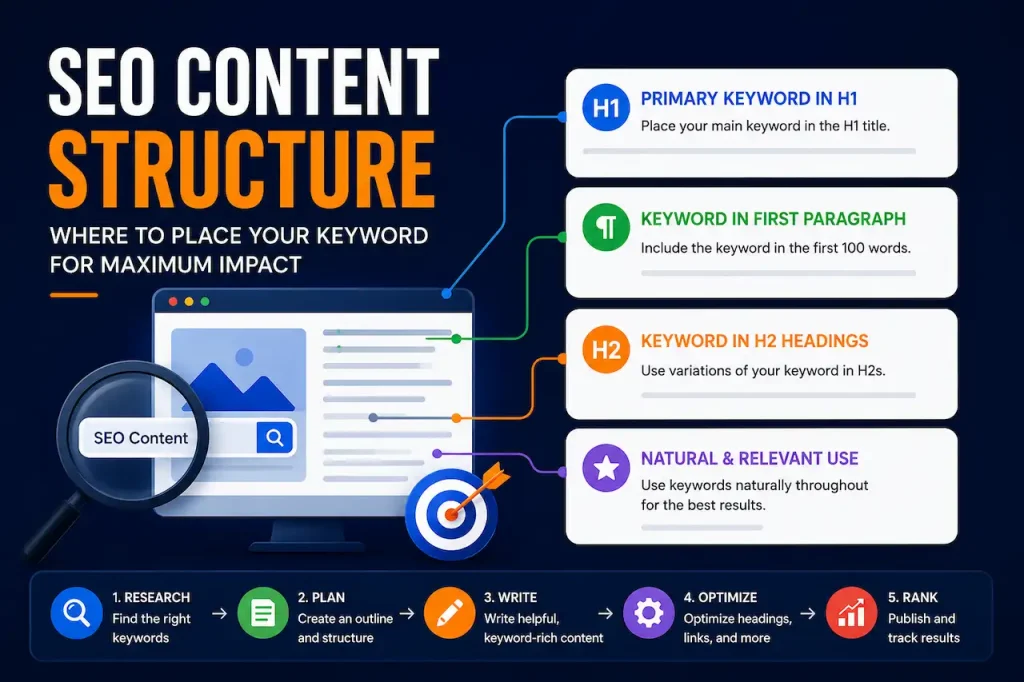
Before writing, mark in your outline where your primary keyword will appear: in the H1, in the first 100 words, in at least two H2 headings, and in the conclusion. Mark where secondary keywords will appear in H3 headings. Mark where internal links will be placed (one in the introduction, at least four more distributed through the body).
This is not keyword stuffing. This is deliberate placement so that organic SEO requirements are met as part of the structure rather than retrofitted into finished prose.
SEO content strategy built around keyword intent and structure →
Step 4: Write Like a Person Who Knows What They’re Talking About
This is the step where most SEO writers fail. They produce content that is technically correct, structurally sound, and completely devoid of the human voice that makes it worth reading.
Strong SEO content reads like it was written by someone who has actually done the thing. Not researched it. Done it.
The First-Person Experience Rule
At least once per article, write from direct experience. Not ‘businesses often find that…’ but ‘I have seen this exact problem in three client audits this year, and each time the cause was the same.’
Specific client scenarios — even hypothetical but realistic ones — demonstrate the kind of ground-level knowledge that generic content cannot replicate. This is what E-E-A-T is rewarding when it rewards experience.
Short Sentences. Short Paragraphs. Real Emphasis.
Most SEO content is written in blocks of text that nobody reads. The format should reflect how people actually read on screen: quickly, scanning for relevance, stopping where something catches their eye.
Sentences under 20 words. Paragraphs of 1–3 sentences. After every three to four paragraphs: one single-line statement that stands on its own. A truth. An insight. The kind of line a reader forwards to someone else.
This is not stylistic preference. It directly affects time-on-page. Higher time-on-page is a user behaviour signal that Google weighs in rankings.
The Banned Phrase Test
Before submitting any article, search for these phrases: ‘in today’s digital landscape,’ ‘it is important to note,’ ‘without further ado,’ ‘leverage,’ ‘synergy,’ ‘cutting-edge.’ If any appear, delete them and rewrite. They are the fingerprints of content written for keyword density rather than genuine communication.
Step 5: Build in SEO Requirements as You Write — Not After
Retrofitting SEO into finished content produces awkward, over-optimised prose. Build the requirements in as you go.
Primary Keyword Placement — The Non-Negotiables
H1: must include primary keyword naturally. First 100 words: primary keyword appears once. Two H2 headings: include primary keyword or close variation. Conclusion: primary keyword appears once. Meta title and description: primary keyword included, under 60 and 155 characters respectively.
That is it. Everything else is natural distribution of secondary keywords and LSI terms — not a checklist to tick mechanically.
Internal Links — Placed Contextually, Not Arbitrarily
Every internal link should make genuine sense to the reader. If someone reading a paragraph about technical SEO would logically benefit from visiting your technical SEO services page, link it. If the link feels forced or interruptive, it will hurt engagement rather than help it.
Aim for three to five internal links per article. One in the introduction. The rest distributed naturally through the body. Each with descriptive anchor text that tells the reader and Google what the destination page is about.
External Links — Credibility Through Citation
Citing credible external sources does two things: it demonstrates you have done real research (E-E-A-T signal), and it provides readers with a path to verify claims that matter. Use two to three external links per article. Major industry publications, government sources, academic research, or established tools. Never a direct competitor.
FAQs — For Featured Snippets, PAA, and AI Citation
Every article should conclude with a FAQ section of four to six questions. These should be written in natural search language exactly how a real person would type the question into Google or speak it to an AI assistant. Answers of three to five sentences each. Direct. Specific.
FAQ sections are the primary vehicle for winning People Also Ask boxes, featured snippets, and AI search citations. They are not optional padding they are the section most likely to generate organic visibility beyond your target keyword.
Optimising content for AI search citation requires the same approach as featured snippets →
Semrush content marketing study on what factors correlate with top-ranking content →
Step 6: Review Against Both Your Reader and Google
Before publishing, review the article twice: once as the reader it was written for, and once as a structured SEO checklist.
The Reader Review
Does the introduction make the reader stop? Does every section deliver on what its heading promised? Are there any paragraphs that could be cut without losing anything? Is the conclusion worthy of the content that preceded it?
If you skip the reader review and only do the SEO checklist, you will publish technically optimised content that real people don’t finish reading. That is exactly the low-engagement signal that gradually erodes rankings.
The SEO Checklist
Primary keyword in H1 ✓. Primary keyword in first 100 words ✓. Primary keyword in two H2s ✓. Secondary keywords in three headings ✓. Three to five internal links with descriptive anchors ✓. Two to three external links to credible sources ✓. Two image placements with keyword-relevant alt text ✓. Meta title under 60 characters ✓. Meta description 150–160 characters ✓. FAQ section with FAQPage schema flag ✓.
Every item needs to pass. Not most of them. All of them.
Backlinko data on what top-ranking pages have in common — content length, structure, and engagement factors →
Common SEO Content Writing Mistakes
Mistake: Writing to the keyword instead of the searcher intent. Why it happens: keyword research delivers a phrase, not a reader profile. What it costs you: content that includes the keyword but doesn’t serve the actual question high bounce rate, poor rankings.
Mistake: Publishing without an FAQ section. Why it happens: FAQs feel like a format, not substance. What it costs you: missing the featured snippet and PAA opportunities that FAQs specifically unlock and AI tools cite.
Mistake: Every paragraph the same length, every section the same structure. Why it happens: templates feel safe. What it costs you: monotonous, skip-worthy content that produces low time-on-page signals.
Mistake: Over-optimising forcing keywords into places they don’t fit. Why it happens: fear of not meeting keyword density. What it costs you: unnaturally phrased content that reads robotically, drives users away, and signals keyword manipulation to Google.
Mistake: Treating the conclusion as a summary instead of a synthesis. Why it happens: running out of energy at the end. What it costs you: a weak final impression the last thing the reader sees before deciding whether your site is worth bookmarking.
FAQ: How to Write SEO Content That Ranks
Q: How long should SEO content be to rank in 2026?
A: Length should match the depth the topic requires — not a target word count. Comprehensive topics genuinely need 2,500–4,000 words to cover adequately. Simpler topics may be fully addressed in 1,200–1,800 words. Google does not reward length; it rewards completeness. The practical outcome is that thorough coverage of most informational topics results in content over 2,000 words naturally. Thin content under 800 words consistently underperforms in competitive niches.
Q: How often should I use my keyword in an SEO article?
A: A practical guideline is once per 200 words for the primary keyword, with secondary keywords and semantic variations distributed throughout. The more useful test is whether each use sounds natural to a reader. If you find yourself noticing the keyword while reading — it appears too often. Google’s NLP systems can identify keyword relevance from semantic context, so natural language wins over mechanical density.
Q: Does AI-generated content rank on Google in 2026?
A: Google’s stated position is that content quality matters, not production method. AI-generated content that demonstrates genuine expertise, first-person experience, and depth can rank. AI-generated content that is generic, experience-free, and produced at scale to target keywords without genuine value is exactly what the Helpful Content system is designed to demote. The distinguishing factor is quality and genuine usefulness — not whether a human or AI generated the words.
Q: What is the most important part of an SEO article?
A: The introduction is the highest-stakes section. If the first 150 words don’t compel the reader to continue, all the work that follows is invisible. Google’s engagement signals — time on page, bounce rate back to search — are most influenced by what happens in the first minute. A strong hook that speaks directly to the reader’s specific situation and promises something worth their time is the highest-ROI writing investment in any article.
Q: How do I write SEO content for AI search tools like ChatGPT?
A: AI search tools prioritise the same signals as Google: authoritative content, clear structure, direct answers to specific questions, and trustworthy domain signals. Practically: use structured headings, include a FAQ section with natural language questions and direct answers, write in first person with genuine expertise, and ensure your domain has strong off-page authority. Content optimised for Google’s featured snippets is almost identical to content AI tools cite in their responses.
Write Less Like a Content Producer. Write More Like an Expert.
The shift that changes SEO content quality in my experience — is not a change in technique. It is a change in who the writer is performing for.
Content produced to satisfy a keyword, a brief, or a content calendar sounds like it was produced to satisfy a keyword, a brief, or a content calendar. Readers feel it. Google measures it.
Content written because the writer genuinely knows something worth sharing — has seen the problem, solved it, can explain the nuance — reads completely differently. It earns time on page. It earns return visits. It earns links from other people who recognise genuine expertise when they read it.
Be the second type of writer. Every article. Every time.
Technical SEO and content quality work together — a fast site helps great content rank faster →
The content that ranks isn’t the most optimised. It’s the most useful — and that’s not an accident.
Get an audit of your existing content against Google’s quality criteria →
We review your top pages, identify quality gaps, and give you specific rewrites that improve rankings.