
I have run technical SEO audits on hundreds of websites. The single most consistently underused ranking lever — across sites large and small — is internal linking.
Not backlinks. Not content quality. Not technical speed. Internal linking. The free, entirely controllable, immediately impactful mechanism that tells Google which pages on your site matter and how they relate to each other.
Most sites treat internal links as an afterthought. The sites at the top of Google treat them as architecture.
Technical SEO services include a full internal link audit →
What Internal Links Actually Do — The Three Mechanisms
Internal links serve three distinct purposes in SEO. Understanding all three changes how you approach them.
They Distribute PageRank (Link Equity)
PageRank — Google’s measure of a page’s importance — flows through links. When a high-authority page on your site links to another page, it passes some of its authority to that page.
This means the structure of your internal links directly determines which pages on your site have the highest authority signal and therefore the best chance of ranking.
Most sites distribute this authority randomly, based on where links ended up rather than where they should go. Strategic internal linking deliberately routes authority toward the pages that most need it to rank.
They Help Google Understand Your Site Structure
When Google crawls your site, it follows links. The pages that receive the most internal links are understood to be the most important. Pages that receive no internal links — orphan pages — may not be crawled regularly, if at all.
Internal links are the map that tells Google’s bots where to go and what to prioritise.
They Guide Users Through Your Site
Internal links that make sense for the reader — not just for Google — reduce bounce rate and increase pages-per-session. Both are engagement signals that Google uses to evaluate whether your site is actually useful.
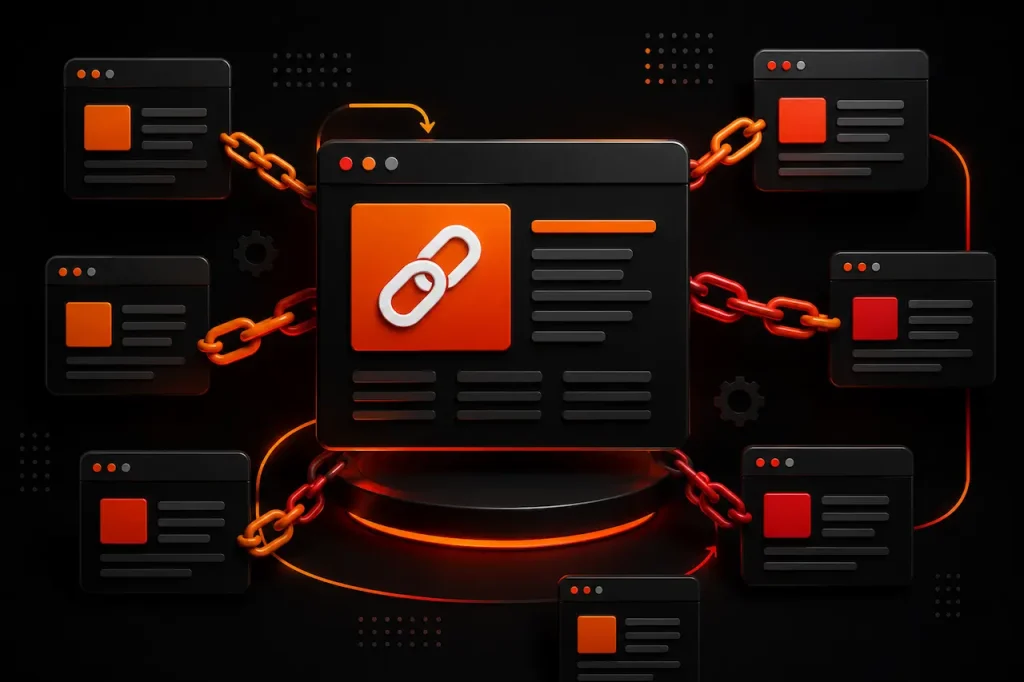
!['internal linking seo pagerank flow diagram']](https://dexoradigital.com/wp-content/uploads/2026/06/image-2026-06-10T180945.560-1024x683.webp)
Your internal link structure is not a design decision. It is a ranking decision.
The Architecture That Makes Internal Linking Work
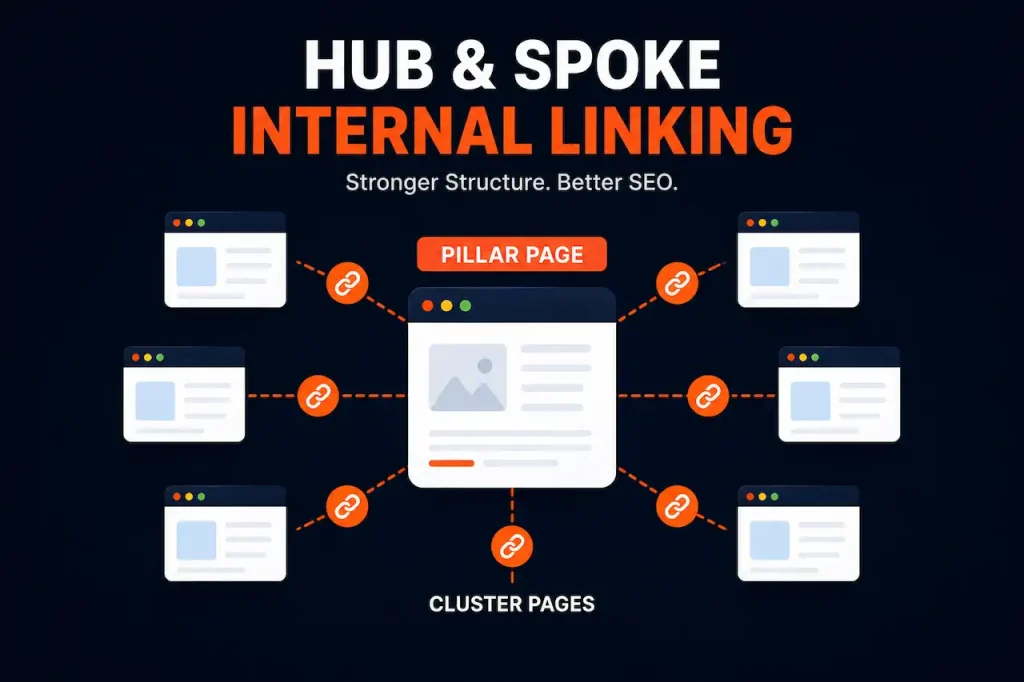
The best internal linking structure follows a hub-and-spoke model. Your most important service and topic pages are the hubs. Blog posts, case studies, and supporting content are the spokes.
Hubs link to spokes. Spokes link back to hubs. Related spokes cross-link to each other where genuinely relevant. This creates a web of authority that concentrates power in your most important pages while distributing crawlability across everything.
How Deep Is Too Deep?
The depth of a page — how many clicks it takes to reach from the homepage — affects how much authority it receives and how frequently Google crawls it.
Most important pages should be no more than 3 clicks from the homepage. If a page takes 5+ clicks to reach, it is receiving very little link equity and may be crawled infrequently.
Audit your important pages: can you reach them in 3 clicks from the homepage? If not, reorganise your site structure or add links from shallower pages.
Google’s documentation on how Googlebot follows links to discover and index content →
The Rules of Good Internal Link Anchor Text
Anchor text the clickable text of a link carries semantic meaning. Google uses it to understand what the linked page is about.
Descriptive Anchor Text: The Standard
Good anchor text describes the content of the destination page. ‘See our guide on technical SEO services’ is good anchor text for a link to your technical SEO page. ‘Click here’ or ‘read more’ tells Google nothing.
Keyword-Rich Anchors: Use With Proportion
Linking to your technical SEO page with the anchor text ‘technical SEO services’ is ideal. Linking to it with the same anchor text from 50 different pages on your site creates an over-optimisation signal. Vary your anchor text naturally across different links to the same page.
Contextual Relevance of the Surrounding Text
The text around the link also matters. Google reads the paragraph containing a link to understand its context. Placing a link within a passage that discusses the destination page’s topic strengthens the relevance signal.
Moz explanation of how PageRank flows through links and how internal linking distributes equity →
Practical Steps to Improve Your Internal Linking
Step 1: Audit Your Orphan Pages
Orphan pages are pages on your site that no other page links to. They receive no internal link equity and may barely be crawled. Run a crawl of your site (Screaming Frog is the best free/affordable tool for this) and identify pages with zero internal links pointing to them.
Make a list. Every orphan is a page that could be improved by adding it to your linking architecture — or a page that should be redirected and removed.
Step 2: Identify Your Most Linked Pages (Wrongly)
Often, the page that receives the most internal links on a site is the Contact page or the Homepage. These already have authority — they don’t need 50 internal links pointing at them.
Identify which pages receive disproportionate internal link equity and redistribute it toward your most important commercial or ranking pages.
Step 3: Add Links From High-Traffic Pages to Important Pages
Find the pages on your site with the most organic traffic (Google Search Console, Analytics). These pages carry the most authority. Add internal links from these pages to the pages you most want to rank.
Step 4: Link From Every New Blog Post to Service Pages
Every piece of content you publish should contain at least one contextual internal link to a relevant service page. Not every article about SEO needs to link to your SEO services page, but if the article is about local SEO, the local SEO services page should be linked.
Step 5: Build Links Within Content Clusters
Every article in a content cluster should link to the cluster’s pillar page. Related articles within the cluster should cross-link where the topics genuinely overlap. This creates the interconnected cluster structure that Google recognises as topical authority.
Common Internal Linking Mistakes
Mistake: Not linking between clusters at all. Why it happens: it’s easy to treat each article as independent. What it costs you: fragmented topical authority that never consolidates into rankings.
Mistake: Only linking within the main navigation. Why it happens: navigation links are automatic. What it costs you: contextual, in-content links are worth more for authority distribution than navigation links.
Mistake: Using the same anchor text for all links to the same page. Why it happens: it feels consistent. What it costs you: over-optimisation signals to Google and a less natural link profile.
Mistake: Adding links without checking they actually make sense for the reader. Why it happens: internal linking gets treated as a technical task. What it costs you: bad user experience, higher bounce rate, and lower engagement metrics.
Ahrefs guide to internal linking strategy with actionable structure advice →
FAQ: Internal Linking for SEO
Q: How many internal links should a page have?
A: There is no fixed maximum, but best practice is 3–5 contextual internal links per piece of content. Navigation links don’t count toward this. Each link should be genuinely useful for the reader and relevant to the surrounding content. Excessive internal links (20+ on a page) dilute the authority passed by each one.
Q: Do internal links help with Google rankings?
A: Yes — internal links distribute PageRank (link equity) across your site, signal to Google which pages are most important, and help Google discover and regularly crawl your content. A well-structured internal linking architecture is one of the most consistently impactful technical SEO improvements a site can make.
Q: What is the difference between internal links and backlinks for SEO?
A: Internal links connect pages within your own domain. Backlinks come from other domains. Both pass authority (PageRank), but backlinks carry significantly more weight because they represent external validation. Internal links are important for distributing the authority earned through backlinks and for helping Google understand your site’s structure.
Q: What are orphan pages and why are they bad for SEO?
A: Orphan pages are pages on your site that no other page links to. Without internal links pointing to them, they receive no link equity, Google may crawl them infrequently, and they often rank poorly. Every page on your site that you want to rank should be linked to from at least one other page — ideally from several related pages.
Q: Should I add internal links to old blog posts?
A: Absolutely — and this is one of the highest-ROI quick wins in SEO. Adding internal links from existing content to new pages, or between existing pages that should be linked but aren’t, can improve rankings without publishing any new content. This is often one of the first things I do when starting work on a new client’s site.
Internal Links Are the Connective Tissue of Your Site
The best content in the world, published on a site with poor internal linking structure, underperforms. The same content, on the same site, with thoughtfully constructed internal links, outperforms.
Internal linking is free. It is entirely within your control. And it is consistently one of the most impactful changes I implement on client sites not because it is a secret, but because almost nobody does it systematically.
Build the architecture first. Add the links deliberately. Review and improve it quarterly. That is the whole discipline.
A full SEO strategy includes internal linking as a core structural element →
Internal links are not navigation. They’re the evidence of a strategy.
An SEO audit shows exactly which pages are orphans and where link equity is being wasted →
We audit and rebuild internal link structures as part of every technical SEO engagement.

Local SEO and AI Search (AEO & GEO) Specialist.
Building search visibility that converts into qualified demand.
Today, businesses need visibility on Google Maps and AI powered search and websites that actually convert visitors into leads. I am a Local SEO, AI Search & Conversion Rate Optimization (CRO) Specialist with 5+ years of hands on experience helping businesses turn underperforming websites into high converting growth engines. My work combines Local SEO, Technical SEO, Semantic SEO, GEO/AEO, and conversion focused landing page optimization to ensure brands are discoverable and profitable.
My Experience
I have delivered SEO and web growth projects across the US, UK, Australia, Canada, Finland, Germany, and the Czech Republic, working in industries such as local businesses (electrician, hvac, cleaning, Real estate, healthcare, B2B, eCommerce, SaaS, and environmental services.
Some Results
>> 200+ websites audited globally
>> specifically worked with 100+ local business (80% from USA)
>> 80+ websites improved through technical SEO & schema fixes
>> 20+ businesses featured in Google AI Overviews (SGE)
>> Multi million impression growth for eCommerce & SaaS brands
Book Free Consultation: calendly.com/dexora/30min