

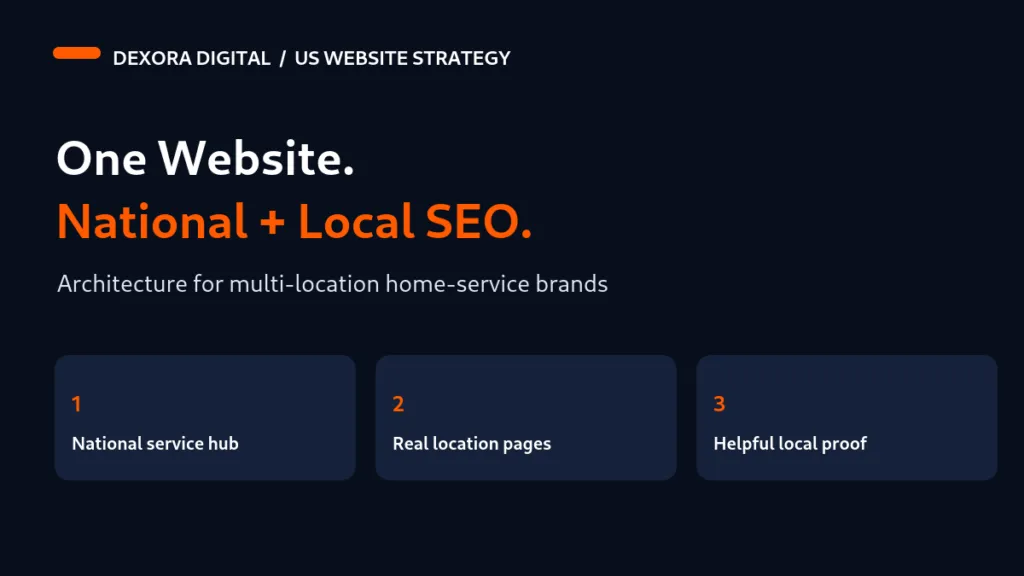
A home-service brand that serves several US markets needs one clear website architecture, not dozens of interchangeable city pages. The goal is to explain what the company offers nationally, where it actually serves customers, and why each relevant service and location page deserves to exist. This guide shows how to connect website design, nationwide SEO, local SEO and conversion tracking without confusing Google or visitors.
Who this guide is for: HVAC, plumbing, roofing, electrical, pest control and similar businesses with multiple crews, branches, franchises or genuine service territories across the United States. It also helps marketing teams planning a multi-location website redesign.
National SEO and local SEO solve different customer questions
National commercial searches are often research-focused: “commercial HVAC maintenance company,” “multi-location plumbing services,” or “best website design for contractors.” Local searches indicate an immediate geographical need, such as “emergency AC repair near me.” Your site should help visitors move from broad service information to an authentic, relevant local provider.
| Page type | Primary purpose | Good content to include |
|---|---|---|
| National homepage | Introduce the business and route visitors to its services and real markets | Core services, verified coverage, brand proof, simple contact routes |
| Service hub | Explain one commercial service across eligible markets | Scope, use cases, process, FAQs, related service links |
| Actual branch or market page | Help customers decide whether they can book that location’s team | Genuine service coverage, local hours where applicable, contact and service proof |
| Educational guide | Answer a substantial research question before a purchase | Useful explanations, examples, clear sources and service links |
| Case study or project | Demonstrate a verified outcome or completed work | Real client context, evidence, dates and measured outcomes when permitted |
A five-layer website architecture that can scale across US markets
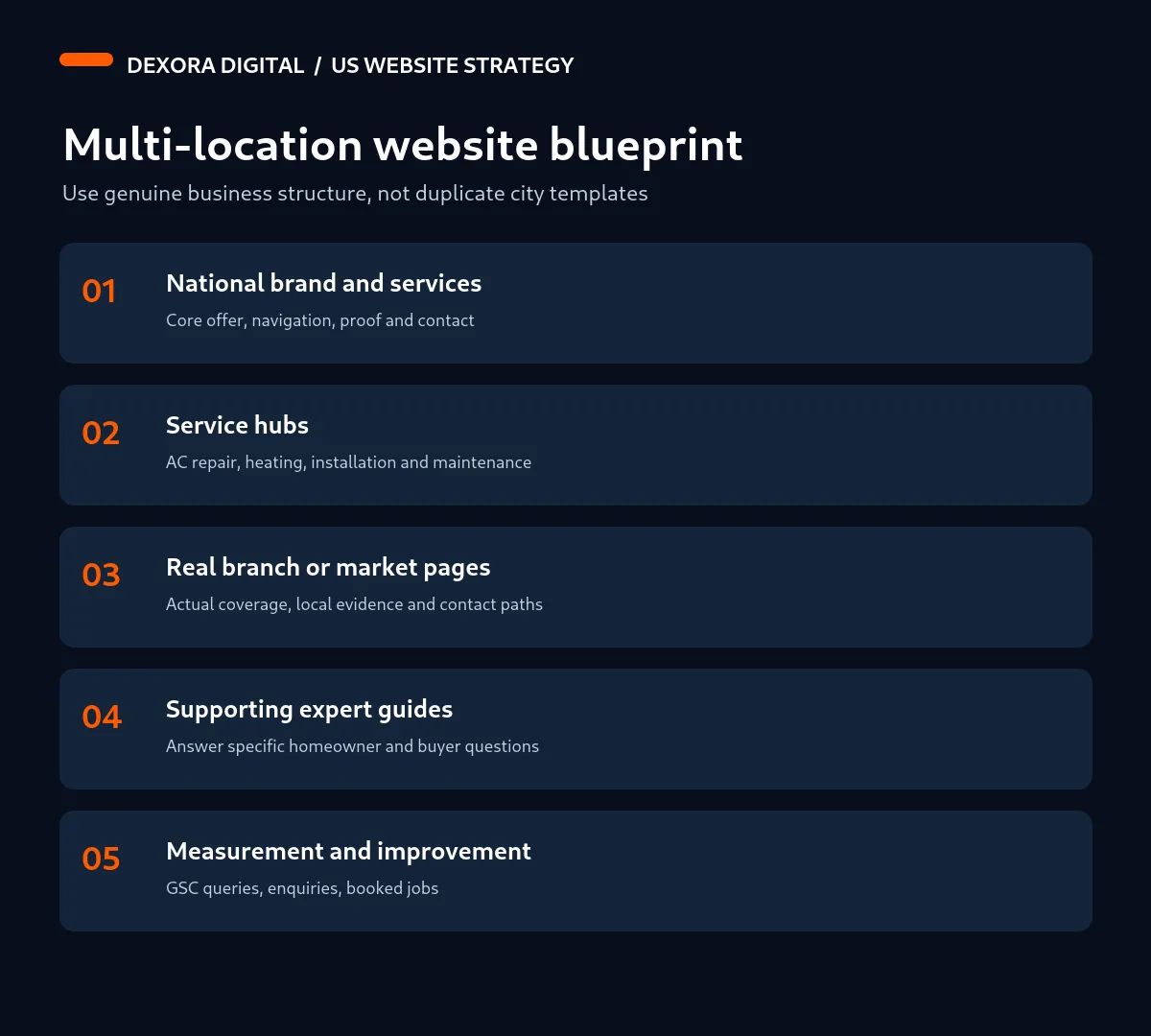
Layer 1: A national brand hub
The homepage should immediately explain the business category and who it serves. If a company operates throughout the United States, explain that scope without implying that every city has a physical office. Direct visitors toward the services, locations and customer-support routes they need. Maintain one consistent brand identity rather than turning the homepage into a list of hundreds of city names.
Layer 2: Service hubs organized around buyer intent
Give major services distinct, substantive pages. An HVAC company might need separate pages for air-conditioning repair, heating-system replacement, preventive maintenance and commercial service contracts. Not every keyword variation requires its own URL. Choose pages by meaningful differences in the buyer’s question, service process and conversion objective.
Service pages should link naturally to one another when useful. An AC repair page might point to maintenance and replacement information for customers comparing repair costs against a new system. Supporting guides should link back to the relevant service hub rather than indiscriminately pointing at the homepage.
Layer 3: Location and service-area pages with genuine differences
Use a specific city or territory page when there is a real operational reason to serve that market and enough information to help users. Examples include a staffed location, confirmed crews covering the territory, documented service eligibility, a distinct booking path, local photos or examples, and market-specific questions.
Don’t publish 100 thin pages that replace only city names. A page that adds no useful detail may be unhelpful even if the company can travel there. The important distinction is between genuine market coverage and manufactured local relevance.
Layer 4: Expert guides and supporting evidence
Educational articles answer questions that do not belong on a conversion-focused service page. For example: how homeowners compare repair and replacement, what to check before hiring an electrician, or how to plan maintenance for commercial air conditioning. Where appropriate, these articles can link to real service pages, credible outside references and case studies with verified evidence.
Original photographs, process diagrams, demonstrations and infographics can improve comprehension. Do not invent rankings, project outcomes, testimonials or cost savings to make a page look authoritative.
Layer 5: Measurement that joins search visibility to business results
Google Search Console tracks Google Search exposure; analytics helps show website behavior; a CRM or call-tracking workflow helps distinguish enquiries from booked jobs. These sources measure different stages, so do not treat impressions, clicks, form completions and revenue as interchangeable outcomes.
Internal linking: practical rules for national and local services
- Link the national homepage to the primary service hubs and a useful location directory, not every city URL.
- Link a market page to the services genuinely available in that territory.
- Link a guide to its closest matching service page and to complementary articles only when context helps the reader.
- Link case studies to relevant services, and link service pages to appropriate proof where the relationship is genuine.
- Use descriptive anchor text such as “air-conditioning installation services” instead of repeating exact-match city keywords unnaturally.
- Make sure important pages are reachable through standard HTML links and are not available only through a search widget.
Website design and conversion rate optimization for multi-location brands
Good information architecture will not help if a homeowner cannot find the correct crew or submit an enquiry. Make location selection clear on mobile, show the service coverage plainly, and minimize the steps between identifying a service and contacting the right team.
If the business has multiple branches, avoid sending all calls and leads to an unqualified destination without routing rules. Confirm which service areas each team covers and make form follow-up auditable. For national lead-generation campaigns, use location qualification within the lead process rather than implying an installer can serve every ZIP code.
A simple lead-routing checklist
| User question | Recommended website response |
|---|---|
| Do you serve my address? | Show supported cities or ZIP coverage without overstating it |
| Which work can I book? | Explain available services and relevant limitations |
| Who will respond? | State the contact route or branch handling the enquiry |
| Can I trust the team? | Display verifiable business facts, project evidence and clear policies |
| What happens next? | Set a realistic contact or estimate process without invented turnaround guarantees |
Google Business Profile eligibility is not the same as national website coverage
A US business can legitimately market services nationwide without being entitled to a Google Business Profile in every state. Google’s published Business Profile guidelines require genuine eligibility. Service-area businesses generally represent a real operating location, and virtual offices do not qualify simply because an address can be rented. Multiple locations need separate eligible operating situations, not automatically generated addresses.
Structured data should also reflect actual facts. Google’s LocalBusiness structured-data documentation describes how to mark up eligible real locations; adding markup does not create a location or guarantee a rich result. For a national service company without verified physical branches, avoid fabricated location schemas, opening hours or geo coordinates.
How to prioritize optimization with Google Search Console
Review nonbranded queries and actual landing pages by country, service and date range. A page with impressions but little engagement needs interpretation: average position 80 is typically not a snippet-copy problem, while an established page in the top ten with relevant impressions may benefit from a clearer title and a more helpful answer. Use page-level intent and technical health before changing copy.
- Confirm that the page is indexable, canonical and linked internally.
- Compare US impressions, clicks and average position over meaningful periods, accounting for data lag.
- Group queries by task: informational, local transactional or national commercial.
- Choose one primary URL for each intent cluster; don’t split useful coverage across near duplicates.
- Improve the content or conversion path that best answers the query, then record the change date.
- Measure subsequent traffic and qualified leads; do not claim uplift before results are observed.
Frequently asked questions
Should a nationwide home-service company create a page for every US city?
No. Create location pages only where there is genuine service coverage and enough unique, useful information for customers. Thin duplicate pages with swapped place names do not make a website more helpful.
What is the difference between national SEO and local SEO?
National SEO usually addresses broad commercial and informational intent without requiring the searcher to be in one neighborhood. Local SEO focuses on geographically relevant searches, authentic nearby services and eligible business-location signals. The strategies can support each other.
Can one website serve several branches and service territories?
Yes. A clearly organized site can connect the main brand, distinct service hubs and genuinely useful location pages. Branch-specific contact details and service availability should be accurate.
Do AI search engines need separate AI-optimized city pages?
No special set of mass-generated pages is required. Clear, accessible, well-supported content and accurate business information help multiple search and retrieval systems understand the company, but AI citation or recommendation is not guaranteed.
How should we measure whether the website architecture works?
Use Search Console for Google Search exposure, analytics for organic visitor behavior, and lead or booking records for business impact. Review the same URL groups and search intents after changes.
Build a website that supports national growth and real local demand
The strongest next step is to audit the existing site before generating another city template. Map actual service lines, genuine markets, existing high-performing URLs and conversion paths. Dexora Digital provides website design, website redesign, SEO services, local SEO and AI search optimization for businesses throughout the United States. Contact Dexora Digital to discuss your site architecture and growth priorities.