


Quick answer: Choosing between an SEO consultant and an SEO agency is not a question of which label sounds more impressive. The right choice depends on the work your website needs, who will execute it, how decisions are measured, and how much coordination your team can manage. For US businesses evaluating search engine optimization consultants, this guide offers a practical buying framework rather than a list of unsupported promises.
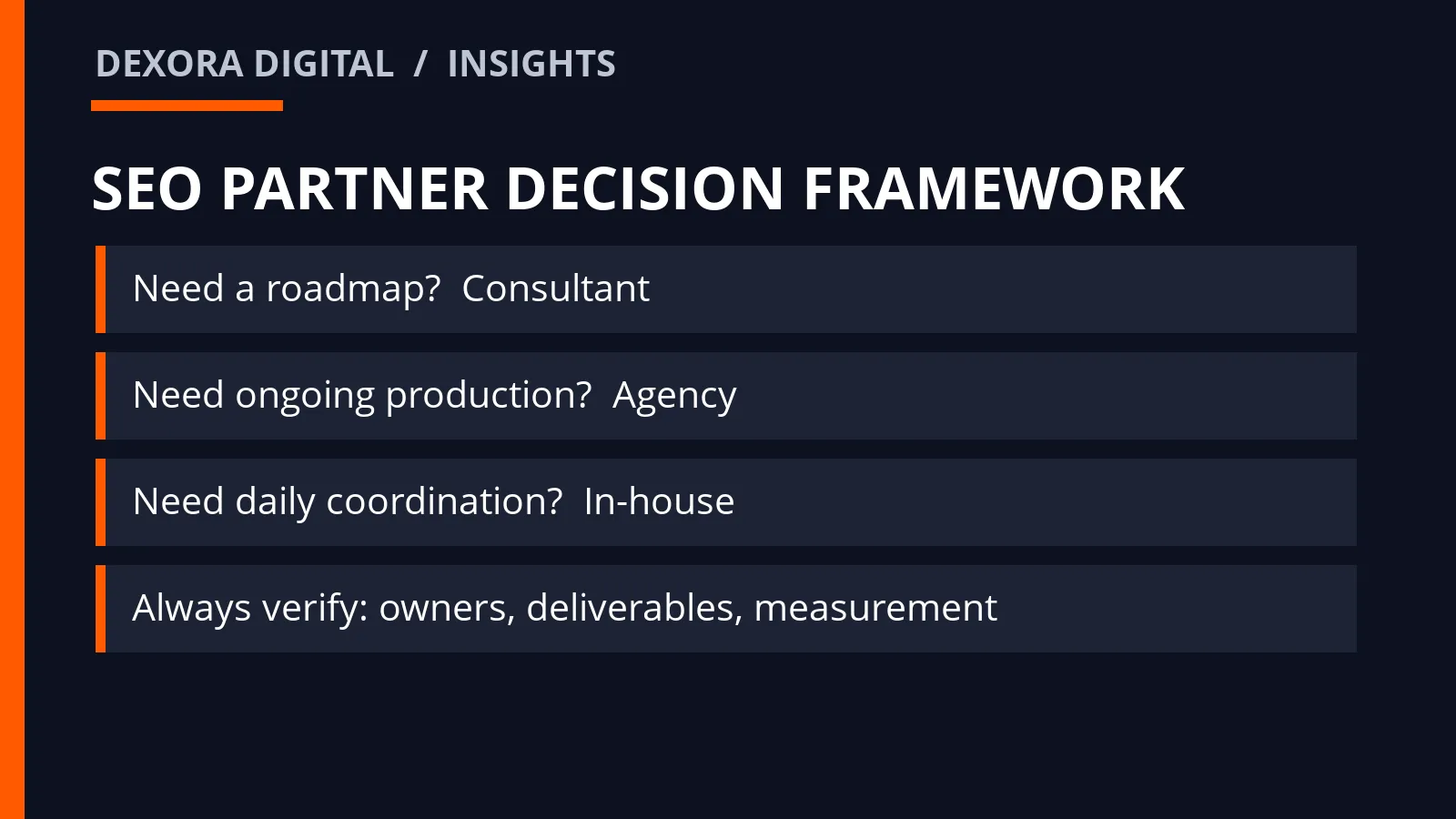
SEO consultant vs. SEO agency: the essential difference
An SEO consultant is typically a specialist who diagnoses search problems, builds a roadmap, advises internal teams, and sometimes executes changes directly. An SEO agency usually coordinates multiple specialists across technical SEO, content, local SEO, digital PR, analytics, design, and development. Both models can succeed. The important distinction is accountability for deliverables, not headcount.
Some consultants operate as full-service teams, while some agencies outsource nearly everything. Ask who will actually access your website, prepare recommendations, implement fixes, review results, and respond when an experiment fails.
When hiring an SEO consultant makes sense
A consultant can be the right fit when you have developers or content writers in-house but need senior-level direction. Typical engagements include technical audits, migration planning, site architecture, Google Search Console diagnostics, keyword mapping, structured data reviews, and training your team to make better decisions.
The strongest consulting relationship turns recommendations into an implementation queue with owners, priorities, dependencies, and acceptance criteria. A 70-page audit that nobody can act on is not a successful outcome.
When an SEO agency is the better fit
An agency may be preferable when the business needs sustained production across several disciplines: service-page development, internal linking, local landing pages, editorial research, Google Business Profile management, conversion tracking, and ongoing reporting. The advantage is operational capacity, provided the agency has a clear strategy and named owners for each task.
A multi-location service company may need local page templates, accurate location data, review processes, and reporting by market. A national B2B business may need technical content reviewed by subject-matter experts. These are different programs, even if both vendors call them SEO.
Comparison: consultant, agency, and in-house SEO
| Decision factor | Consultant | Agency | In-house |
| Best fit | Strategy, audits, oversight | Ongoing multi-skill execution | Continuous internal coordination |
| Primary risk | Limited execution capacity | Unclear ownership or generic work | Hiring and tooling overhead |
| What to request | Prioritized roadmap and implementation support | Named team, deliverables, QA process | Role scope, budget, reporting cadence |
Seven questions to ask before signing an SEO contract
- Which business outcomes will we measure: qualified leads, booked calls, revenue, or assisted conversions?
- Which URLs and query groups will you prioritize, and why?
- Who performs technical fixes and who approves production changes?
- How will you use Google Search Console and analytics without mistaking impressions for sales?
- How will you prevent keyword cannibalization and thin location pages?
- What happens when rankings fluctuate or a Google update changes search behavior?
- Can you show examples with clearly dated, attributable evidence rather than guaranteed results?
What SEO consulting services should include in 2027
Technical SEO and indexation
Start with crawling and indexability: HTTP status codes, canonicals, redirects, sitemap quality, robots directives, mobile rendering, internal link depth, structured data consistency, and Core Web Vitals. Prioritize problems by their effect on discoverability and business-critical pages. A clean audit should distinguish confirmed defects from hypotheses.
Keyword strategy and search intent
Group queries by intent and assign each cluster to the most suitable URL. For example, search engine optimization consultants and SEO consulting companies usually express provider-evaluation intent, while how does SEO work is educational. Avoid creating separate near-duplicate pages for every wording variation. Relevance and useful differentiation matter more than keyword repetition.
Local SEO and Google Business Profile
For eligible businesses, accurate business details, relevant categories, legitimate reviews, service pages, and location-specific evidence help customers evaluate nearby options. Google local rankings are influenced by relevance, distance, and prominence. No provider can guarantee a particular Maps position across all searchers.
AI search readiness, AEO and GEO
AI-powered search adds a discovery surface, but the foundation remains crawlable, useful, verifiable content. Clear entity relationships, accessible sources, original expertise, descriptive headings, and honest structured data can improve machine understanding. No schema type or llms.txt file guarantees a citation in ChatGPT, Google AI Overviews, or other answer engines.
Conversion rate optimization and measurement
Traffic is not the final objective. Track form submissions, qualified calls, appointment requests, and CRM outcomes with appropriate consent and privacy controls. Separate organic-search traffic from paid campaigns, branded demand, and AI referral sources where attribution is available. Report what was implemented and what changed, without assuming correlation proves causation.
How to compare SEO proposals fairly
Request the same scope from each provider: target audience and market, baseline data, critical URLs, proposed deliverables, implementation responsibility, review cadence, and a realistic timeline. A low monthly price can be expensive if it buys only generic reports. A high retainer is not justified unless the work and accountability are clear.
Compare the first 90 days in detail. Month one should establish baselines, investigate technical issues, and agree on priorities. Month two should implement high-impact changes and validate them. Month three should evaluate early signals and adjust. Results often require more time, especially for competitive non-branded queries.
Common warning signs
- Guaranteed number-one rankings or guaranteed AI Overview inclusion.
- Promises of hundreds of links without explaining quality and editorial relevance.
- Reporting only rankings or impressions, with no lead-quality measurement.
- Publishing dozens of near-identical city pages with no genuine local value.
- No clear approval process for changing titles, canonicals, templates, or redirects.
- Case studies that mix estimated third-party traffic with verified analytics conversions.
A practical selection framework for US businesses
Choose a consultant when the bottleneck is strategic clarity and your team can execute. Choose an agency when the bottleneck is production capacity across SEO, content, design, development, and analytics. Choose an in-house lead when search is a core business function requiring daily cross-team coordination. Hybrid arrangements are common: an experienced consultant can oversee a specialist agency or internal team.
Before committing, request a focused review of one high-value page and its search queries. Ask the provider to explain what they would change, what they would leave alone, how they would validate the work, and which assumptions remain unproven. The quality of this reasoning is more useful than a generic pitch deck.
What a useful SEO audit deliverable looks like
A decision-ready audit should identify the affected URL or template, the evidence supporting the issue, the business impact, the proposed fix, implementation owner, estimated effort, and a validation step. For example, a canonical problem is not resolved merely because it appears in a spreadsheet. Someone must correct the template, confirm the rendered canonical, request recrawling where appropriate, and watch the affected indexation patterns. This makes consulting output measurable and prevents low-value recommendations from piling up.
Example: choosing support for a service-area business
Imagine a plumbing company with a working website, a Google Business Profile, and a small marketing team. If the main issue is uncertainty about which service pages to improve, a focused consultant may be sufficient. If the company needs twenty service-page revisions, conversion tracking, local profile work, and development capacity, an agency or hybrid team may be more practical. The deciding factor is not a promise to rank for plumber near me. It is the ability to deliver useful work and measure qualified customer enquiries.
Example: choosing support for a technical B2B website
An engineering firm may need an expert to map complex service terminology, evaluate indexation and information architecture, and coordinate reviews with engineers. A consultant who can translate technical expertise into search intent may lead the strategy, while an agency supplies editorial production and development. The content must be reviewed by real subject-matter experts, particularly when claims involve safety, engineering standards, or regulated services.
What to include in your first-month reporting
A good report identifies the reporting window and data source, separates branded from non-branded queries where possible, shows priority page performance, lists completed work, and records outstanding dependencies. Google Search Console clicks and impressions can indicate discovery, but they should be read alongside GA4 events, call records, form submissions, and CRM outcomes. Third-party traffic estimates should be labeled as estimates rather than presented as verified conversions.
A realistic contract checklist
Confirm access ownership, publishing permissions, content review, analytics configuration, reporting frequency, cancellation terms, and whether work products remain available if the engagement ends. Ask how the provider handles security, backups, redirects, and testing before changes go live. A well-run SEO engagement protects the website while improving it.
Frequently asked questions
Is an SEO consultant cheaper than an agency?
Not necessarily. Pricing depends on experience, scope, implementation responsibility, and market. Compare the cost of completed, reviewed work rather than only the monthly fee.
Can an SEO consultant manage AI search optimization?
Yes, if they understand technical SEO, entity clarity, content quality, and measurement limitations. Ask for a method and evidence, not guaranteed AI citations.
How long should an SEO engagement run?
An audit can be short, but implementation and measurement often require several months. Agree on checkpoints and deliverables rather than fixed ranking promises.
Should a local business choose a local SEO specialist?
A business that depends on nearby customers should seek experience with Google Business Profile, local landing pages, reputation management, and lead tracking, regardless of whether the provider is physically nearby.
Get a tailored SEO roadmap
Dexora Digital supports US businesses with technical SEO, local SEO, AI search readiness, website design and redesign, and conversion-focused implementation. Explore our SEO services, SEO audits, semantic SEO consultant guide, and request a consultation to discuss the right operating model for your business.
Editorial note: This guide explains vendor-selection considerations. It does not claim that any provider can guarantee specific rankings, leads, or AI recommendations.