
A website that looks beautiful but loads slowly gets beaten by an ugly site that loads in under a second. A site with perfect content but no backlinks gets beaten by a weaker site that has dozens of links from trusted sources.
SEO has three distinct components. Most businesses that struggle with rankings are missing at least one of them. Often two.
This article explains exactly what on-page, off-page, and technical SEO are — and more importantly, how to know which one your site needs most right now.
Get a technical SEO audit to find out what’s holding back your rankings →
Why SEO Has Three Pillars — And Why Splitting Them Matters
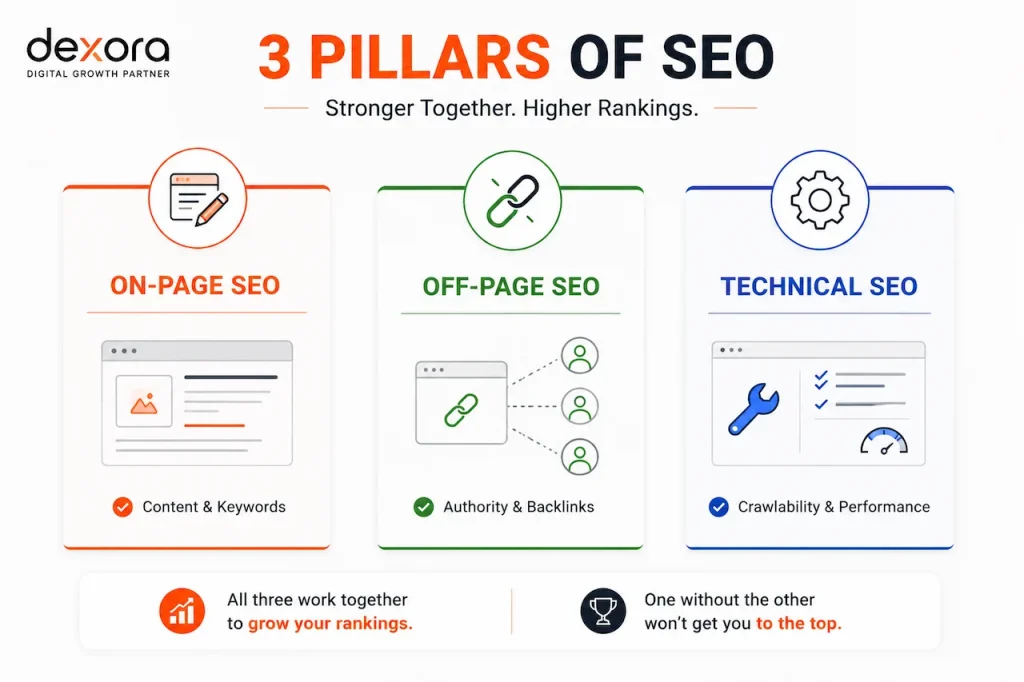
The simplest way to think about SEO is this: Google evaluates your site from three angles.
What does the page actually say and how well is it structured? That is on-page SEO.
Who else on the internet thinks this page is worth reading? That is off-page SEO.
Can Google actually access, crawl, and understand the page in the first place? That is technical SEO.
All three need to be working. A page that scores perfectly on one but poorly on the others will not reach its ranking potential.
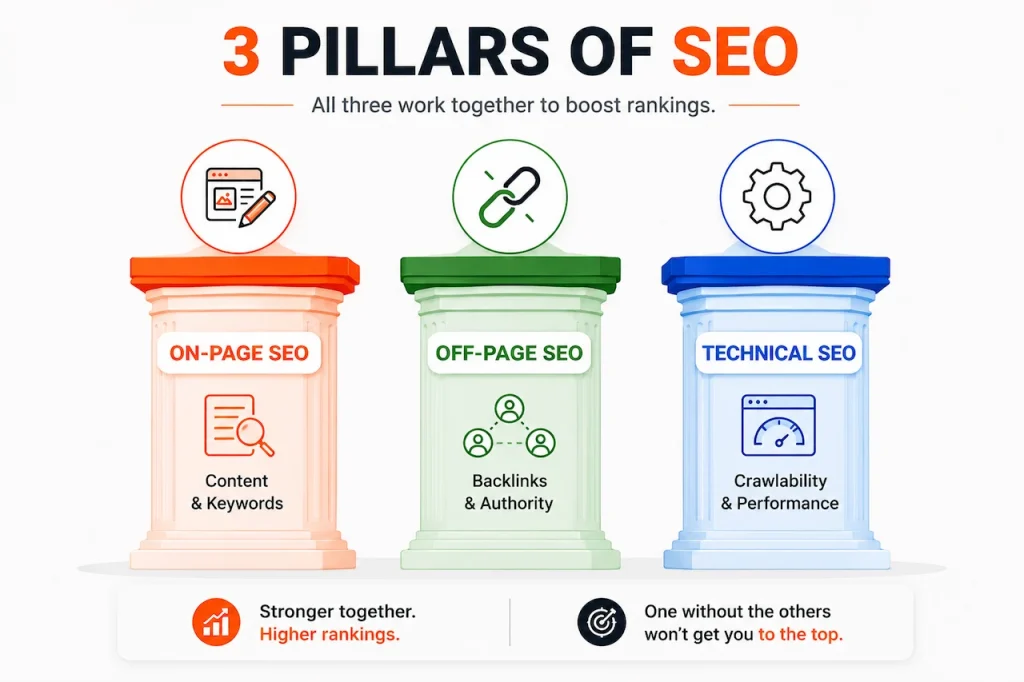
You cannot write your way past a broken foundation.
On-Page SEO — What Happens Inside Your Pages
On-page SEO is everything you control directly on the page itself. It is the most immediate lever — changes show up in rankings faster than the other two pillars because they are entirely within your control.
The Elements That Matter Most in On-Page SEO
Title tags. These appear in browser tabs and search results. Google reads them as one of the strongest relevance signals. Include your primary keyword near the start. Keep them under 60 characters.
Meta descriptions. These do not directly affect rankings, but they determine your click-through rate from search results. A well-written meta description is free advertising copy.
Headings (H1, H2, H3). Your H1 is the page’s declared topic. Use it once. H2s structure the content into sections and should include secondary keywords where natural. Headings are how both Google and humans navigate the page.
Content depth and relevance. This is where most businesses underinvest. A 400-word service page cannot compete with a 2,500-word page that comprehensively answers every question a potential customer has. Depth is a ranking signal.
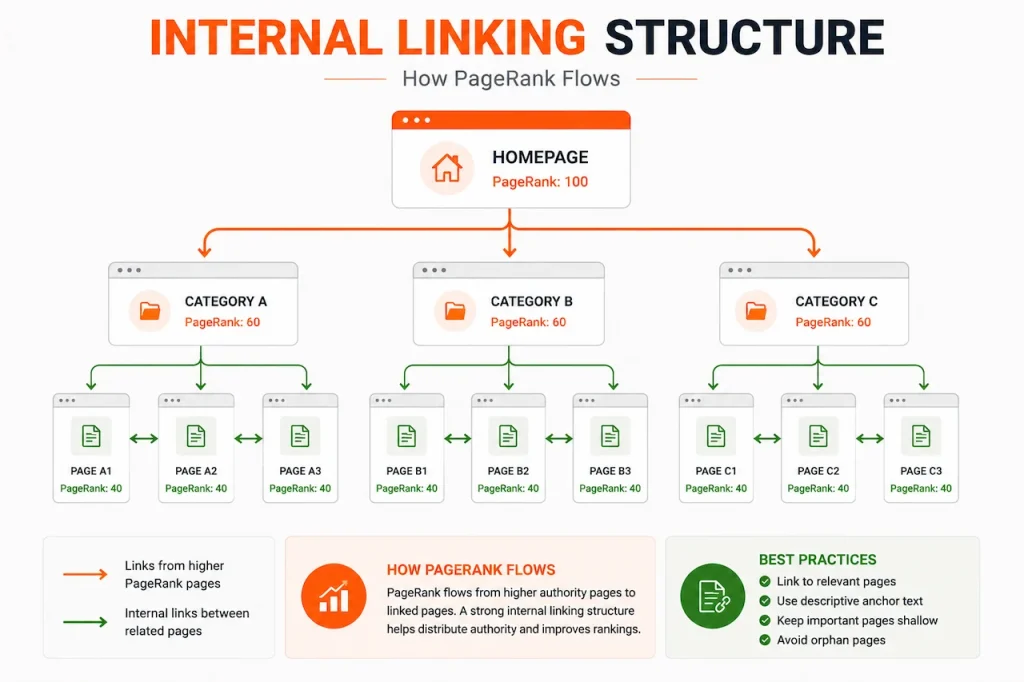
Internal linking. Linking between your own pages tells Google which pages are important and how your content is related. It also distributes authority across your site. In our experience, fixing internal linking structure alone has moved pages from position 15 to position 5 without any other changes.
Keyword placement. Your primary keyword should appear in the H1, within the first 100 words, in at least two H2 headings, and naturally throughout the body. Never forced. Never stuffed.
Image optimisation. Every image needs descriptive alt text that includes relevant keywords where natural. Compressed file sizes matter for page speed — which connects to technical SEO.
Google’s official guidance on creating helpful, reliable content →
Off-Page SEO — What Happens Away From Your Site
Off-page SEO is everything that happens on other websites, platforms, and corners of the internet that influences how Google perceives your site’s authority and trustworthiness.
Backlinks — The Foundation of Off-Page Authority
A backlink is when another website links to yours. Google treats this as a vote of confidence. If the BBC links to your site, that is an extraordinary endorsement. If a spammy directory links to you, it may hurt more than help.
The quality of backlinks matters infinitely more than the quantity. One link from a relevant, high-authority industry publication is worth more than 100 links from generic directories.
How do you earn quality backlinks? Through content worth linking to. Original research. Detailed guides. Unique data. Tools and resources. The single most effective long-term off-page strategy is creating content so genuinely useful that other sites link to it naturally.
Brand Mentions and Digital PR
Google is increasingly sophisticated at recognising brand mentions even without a link. Being featured in press coverage, industry roundups, or mentioned in expert discussions builds perceived authority.
Digital PR getting featured in publications your audience reads serves double duty: it builds brand awareness and generates the kind of authoritative backlinks that move rankings.
Reviews and Social Proof
For local businesses especially, Google Business Profile reviews and third-party review platforms are a form of off-page SEO. They signal trust and relevance within a geographic area.
See how our off-page SEO services build the kind of links that actually move rankings →
Moz’s explanation of domain authority and how backlinks affect rankings →
Technical SEO — The Foundation Everything Else Sits On
Technical SEO is the invisible work. Nobody sees it. Clients rarely ask for it by name. And it is responsible for a shocking number of SEO failures I have diagnosed over the years.
The Technical Elements That Affect Rankings
Site speed. Google uses Core Web Vitals — real-world speed metrics — as a ranking factor. Pages that load in under 2 seconds significantly outperform slow pages. This is non-negotiable.
Mobile optimisation. Google indexes the mobile version of your site first. If your mobile experience is poor, your rankings suffer regardless of how good your desktop site is.
Crawlability. If Google’s bots cannot access your pages — due to robots.txt errors, noindex tags on important pages, or broken links — those pages will not rank. Period.
Indexation. Being crawlable and being indexed are different things. Your XML sitemap helps Google understand which pages to index. Duplicate content confuses Google and can result in no version of a duplicated page ranking well.
Structured data (schema markup). Adding schema code to your pages helps Google understand what the content is about and can result in rich snippets — star ratings, FAQs, and other visual enhancements in search results that increase click-through rate significantly.
HTTPS. Secure sites (https://) are a baseline ranking requirement. Any site still on http:// is at a fundamental disadvantage.
A technical SEO audit identifies every issue holding back your rankings →
Ahrefs guide to technical SEO fundamentals →
How to Diagnose Which Pillar Your Site Needs Most
Most businesses know they need SEO but don’t know where to start. Here is the diagnostic I use.
If your pages are indexing and ranking but at position 15–30: on-page SEO is likely the issue. Your content isn’t comprehensive enough or isn’t structured as well as the pages above you.
If your pages have good content but are stuck at position 5–15 despite months of work: off-page SEO is likely the gap. Your domain doesn’t have enough authoritative backlinks to reach the top.
If your rankings fluctuate wildly, or if many of your pages simply aren’t appearing in Google at all: technical SEO is likely the culprit. Crawl errors, indexation problems, or speed issues are blocking your visibility.
You can’t fix what you can’t see. Get a proper audit before assuming which pillar needs work.
Common Mistakes Across All Three Pillars
Focusing only on on-page SEO while neglecting link building. The most perfectly written page will rarely rank in competitive niches without external authority.
Buying low-quality backlinks to accelerate off-page SEO. This is the fastest way to earn a Google penalty. The short-term ranking gains are almost always wiped out — along with rankings you had legitimately.
Assuming technical SEO is a one-time job. Sites break, plugins conflict, redirects accumulate. Technical health requires regular auditing — not a set-it-and-forget-it approach.
Ignoring the interaction between all three. On-page content that earns backlinks because it is genuinely useful — and is built on a technically sound, fast-loading site — is what creates durable, high-ranking pages.
See how a full SEO service addresses all three pillars systematically →
FAQ: On-Page vs Off-Page vs Technical SEO
Q: What is more important — on-page or off-page SEO?
A: Neither is more important in isolation. On-page SEO determines if your page is relevant enough to rank. Off-page SEO (backlinks) determines if your domain is authoritative enough to rank. Without both, even strong content may plateau at positions 5–20. For brand-new sites, on-page comes first; off-page becomes the bottleneck as the site matures.
Q: Can a website rank without backlinks?
A: Yes — for low-competition, long-tail keywords. A well-optimised page on an established domain can rank for specific queries with few or no backlinks. However, for competitive head terms or in competitive industries, backlinks are unavoidable. No major industry keyword is won without meaningful off-page authority.
Q: What are the most important technical SEO factors?
A: The five most impactful technical factors are: site speed (Core Web Vitals), mobile optimisation, crawlability (ensuring key pages are accessible to Google), indexation (ensuring important pages are indexed), and structured data (schema markup that enhances how your content appears in search results).
Q: How often should technical SEO be audited?
A: At minimum, quarterly. More frequently if the site is actively growing, undergoing development changes, or if rankings suddenly change. Even small plugin updates on WordPress sites can introduce technical issues that affect crawlability or page speed.
Q: Where should a new website start — on-page, off-page, or technical?
A: Technical first — always. A site with technical issues will underperform regardless of content or link quality. Once the technical foundation is sound, on-page SEO (content and structure) comes second. Off-page (link building) comes third, after the site has content worth linking to.
The Three Pillars Work Together — Not Separately
On-page, off-page, and technical SEO are not competing disciplines. They are interdependent. A technically perfect site with great content but no backlinks will plateau. A heavily linked site with poor content will lose rankings as Google gets smarter. A site with great content and links but poor technical health will leak ranking potential constantly.
The businesses I have seen build genuinely durable search visibility are the ones who understand that all three pillars need regular attention not the ones who mastered one and ignored the others.
Local businesses need all three pillars — but local signals add a fourth dimension →
Average SEO fixes one pillar. Great SEO builds all three — and the interaction between them.
Not sure which pillar is holding your site back? We’ll run a full audit covering all three areas and give you a prioritised list of what to fix first, second, and third.