



Most small business websites look fine and still fail to generate leads, and the reason is rarely the color palette. We have rebuilt dozens of small business sites, and the pattern is consistent: structure, speed, and trust signals decide whether a visitor calls, fills out a form, or leaves.
This guide walks through the specific elements of small business website design services that move the needle on leads in 2026, not just aesthetics. We prioritize a strategy that treats design as a conversion tool first and a branding exercise second, and we will show you exactly where most small business sites lose visitors.
Why “Nice-Looking” Websites Still Fail to Convert
A polished homepage means little if the visitor cannot find pricing, service areas, or a phone number within seconds. We have seen firsthand how a visually appealing site with a confusing navigation path loses more leads than a plainer site with a clear path to contact.
Lead generation depends on a handful of measurable factors: page speed, mobile usability, calls-to-action placement, and trust signals like reviews and credentials. Every one of these is controllable through design decisions made before a single line of copy is written.
Website Structure That Converts
Small business websites convert best with a shallow, intuitive structure: homepage, core service pages, an about page, and a contact page reachable within one or two clicks from anywhere on the site. Deep navigation menus and buried contact information are two of the most common issues we find in site audits.
Each service page should answer one question clearly: what does this business do, for whom, and how do they get started. We always advise clients to avoid combining multiple services onto a single page, since it dilutes both the user experience and the page’s ability to target a specific keyword.
- Keep the main navigation to five or six items maximum
- Place a phone number and contact link in the header on every page
- Give each core service its own dedicated page, not a shared catalog page
- Add a clear breadcrumb trail so users always know where they are on the site
Page Speed and Core Web Vitals
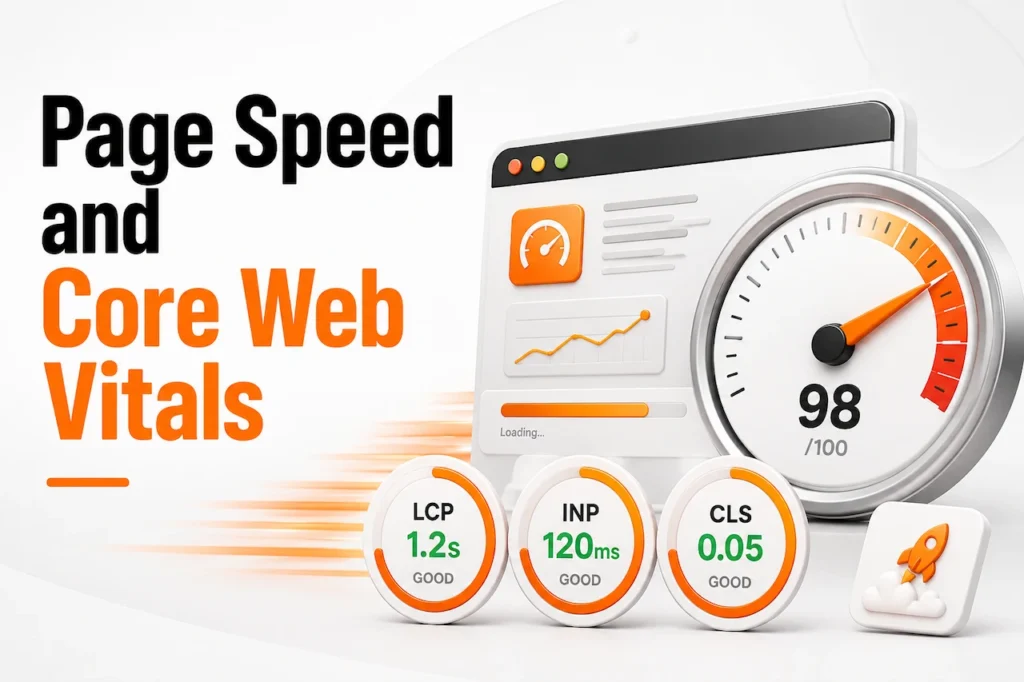
Site speed is both a ranking factor and a conversion factor, and small business sites are frequently the worst offenders because of unoptimized images and bloated plugins. A homepage that takes more than three seconds to load loses a meaningful share of visitors before they see any content.
We prioritize compressing hero images, minimizing third-party scripts, and choosing hosting that supports fast server response times for every small business site we design. These fundamentals matter more for lead generation than any visual trend, a point we cover in more depth in our breakdown of Core Web Vitals for local service sites.
Mobile-First Design
The majority of local searches for small businesses happen on mobile devices, which makes mobile-first design a requirement rather than an option. A site that was designed for desktop and adapted for mobile almost always shows cramped buttons, oversized text blocks, or forms that are difficult to complete on a phone.
Design for the smallest screen first, then scale up. Tap targets need enough spacing to avoid mis-clicks, forms need to autofill correctly, and click-to-call buttons should be visible without scrolling. These details determine whether a mobile visitor converts or bounces back to search results.
Trust Signals and Social Proof
Small businesses compete against larger, more established brands for the same searches, and trust signals close that gap. Visible reviews, certifications, years in business, and real photos of the team or work do more to convert a skeptical visitor than additional design polish.
- Display review scores and a handful of specific testimonials near the top of key pages
- Show licenses, certifications, or association memberships where relevant to the industry
- Use real photos of the business, team, or completed work instead of generic stock imagery
- Include recognizable client logos or case study results if available
We have seen firsthand how adding verified reviews above the fold on a homepage measurably increases contact form submissions within weeks of launch.
Clear Calls-to-Action
Every page on a small business website needs one primary action for the visitor to take, whether that is calling, booking, or requesting a quote. Competing calls-to-action on the same page dilute conversions, because visitors default to doing nothing when faced with too many choices.
Place the primary CTA above the fold, repeat it at the bottom of longer pages, and use direct language like “Get a Free Quote” or “Schedule a Call” instead of vague phrasing like “Learn More.” Button color, size, and contrast matter less than clarity of message and consistency across the site.
SEO-Ready Foundations
A website that looks great but is not built on a solid technical foundation will struggle to attract organic traffic regardless of design quality. Clean URL structures, proper heading hierarchy, optimized meta titles, and schema markup should be part of the build, not an afterthought added later.
Local business schema in particular helps search engines understand service areas, business hours, and reviews, which directly supports visibility in local search results. We cover the technical requirements in detail in our schema markup guide, and every site we design includes a technical SEO audit before launch.
Local SEO Integration
For most small businesses, the website and local SEO strategy need to work as one system rather than two separate projects. Location pages, embedded maps, consistent NAP (name, address, phone) information, and service-area content all need to be built into the site architecture from the start.
We have designed sites for plumbers, electricians, and HVAC companies where the difference between a generic template and a locally optimized structure was the deciding factor in whether the site ranked in the map pack. A website built without local SEO in mind almost always requires costly rework later.
Small Business Website Checklist
| Element | Why It Matters | Common Mistake |
| Shallow navigation | Faster path to contact | Deep, cluttered menus |
| Page speed under 3s | Reduces bounce rate | Unoptimized images |
| Mobile-first layout | Matches search behavior | Desktop-first adaptation |
| Visible trust signals | Builds credibility fast | Buried or missing reviews |
| Single clear CTA | Increases conversions | Competing calls-to-action |
| Local schema markup | Supports map pack visibility | No structured data |
How to Choose a Website Design Partner

Not every web design service understands lead generation for small businesses, and many treat the website as a standalone creative project disconnected from SEO or conversion strategy. We ask prospective clients to evaluate any partner against three questions.
- Does the team measure success by leads generated, not just design approval?
- Is technical SEO built into the design process, or handled separately after launch?
- Can they show real results from similar small business or local service projects?
A partner who cannot answer these clearly is likely to deliver a site that looks good in a portfolio but underperforms once it goes live. Results like the ones documented in our Florida website design and local SEO case study come from treating design and SEO as a single, connected process from day one.
Why Choose Dexora
We build small business websites around lead generation first, combining conversion-focused design with the technical SEO foundation that gets sites found in local search.
- Mobile-first design built around clear calls-to-action and fast load times
- Local SEO and schema markup integrated into every build, not added afterward
- Trust-signal placement based on what measurably increases conversions
- Direct experience across plumbing, electrical, HVAC, roofing, dental, and legal service sites
- Documented results, including a first lead in 40 days for a local service client
If you want a website built to generate leads rather than just look presentable, our website design services team can walk through your current site’s gaps.
Conclusion
A small business website drives leads when its structure, speed, trust signals, and calls-to-action all work toward one goal: making it easy for a ready visitor to take action. Design choices that ignore these fundamentals cost leads regardless of how polished the site looks. Build for conversion first, and the visual design will follow naturally from clear priorities.
FAQs
What makes small business website design services effective for lead generation?
Effective services treat the website as a conversion tool, prioritizing clear navigation, fast load times, and visible calls-to-action over visual trends alone. The best small business website design services also integrate local SEO and schema markup into the build rather than adding them after launch. This combination is what consistently drives measurable leads.
How much does small business website design typically cost?
Costs vary widely based on the number of pages, custom design work, and whether local SEO is included in the build. A basic informational site costs less than a fully custom, conversion-optimized site with integrated SEO. We recommend evaluating the full scope, including ongoing support, rather than comparing quotes on price alone.
How long does it take to design and launch a small business website?
Most small business websites take four to eight weeks from initial planning to launch, depending on the number of pages and content readiness. Sites that include custom photography, extensive copywriting, or complex local SEO structures can take longer. Clear communication of content and feedback timelines is the biggest factor in staying on schedule.
Does website design affect SEO rankings?
Yes, design decisions directly affect technical SEO factors like page speed, mobile usability, and crawlability, all of which influence rankings. A site built without SEO in mind often requires expensive rework later to fix structural issues. Building SEO into the design process from the start avoids this cost entirely.
Should a small business website include a blog?
A blog helps small businesses target additional keywords, build topical authority, and give search engines fresh content to crawl regularly. Businesses that rely primarily on local, service-based searches may prioritize service and location pages first and add blogging as a secondary strategy. The right approach depends on the competitiveness of the target market.
What is the biggest mistake small businesses make with website design?
The most common mistake is prioritizing visual design over conversion structure, resulting in sites that look professional but bury contact information and calls-to-action. Another frequent issue is skipping mobile-first design, which alienates the majority of local searchers using phones. Both mistakes are avoidable with a conversion-focused design process.
Do small business websites need local SEO built in from the start?
Yes, retrofitting local SEO onto an existing site is more expensive and time-consuming than building it into the original site architecture. Location pages, schema markup, and consistent business information are far easier to implement correctly during the initial build. This is especially important for service-area businesses competing in the local map pack.
How important are customer reviews on a small business website?
Reviews are one of the strongest trust signals a small business website can display, often directly influencing whether a visitor converts. Placing review scores and specific testimonials near the top of key pages consistently improves contact form and call conversions. Reviews also support local SEO signals when structured with proper schema markup.
Can an existing small business website be redesigned without losing SEO rankings?
Yes, but only with careful planning around URL preservation, 301 redirects, and maintaining existing content that already ranks well. Rankings are typically lost during a redesign when pages are removed or restructured without proper redirects in place. A technical SEO audit before redesign helps identify what needs to be preserved.
What should a small business look for in a website design portfolio?
Look for evidence of results, not just visual style, including case studies that show lead generation or ranking improvements after launch. A strong portfolio should also demonstrate experience with businesses in similar industries or service areas. Design quality matters, but proof of measurable outcomes matters more for a lead-generation-focused website.

Local SEO and AI Search (AEO & GEO) Specialist.
Building search visibility that converts into qualified demand.
Today, businesses need visibility on Google Maps and AI powered search and websites that actually convert visitors into leads. I am a Local SEO, AI Search & Conversion Rate Optimization (CRO) Specialist with 5+ years of hands on experience helping businesses turn underperforming websites into high converting growth engines. My work combines Local SEO, Technical SEO, Semantic SEO, GEO/AEO, and conversion focused landing page optimization to ensure brands are discoverable and profitable.
My Experience
I have delivered SEO and web growth projects across the US, UK, Australia, Canada, Finland, Germany, and the Czech Republic, working in industries such as local businesses (electrician, hvac, cleaning, Real estate, healthcare, B2B, eCommerce, SaaS, and environmental services.
Some Results
>> 200+ websites audited globally
>> specifically worked with 100+ local business (80% from USA)
>> 80+ websites improved through technical SEO & schema fixes
>> 20+ businesses featured in Google AI Overviews (SGE)
>> Multi million impression growth for eCommerce & SaaS brands
Book Free Consultation: calendly.com/dexora/30min