


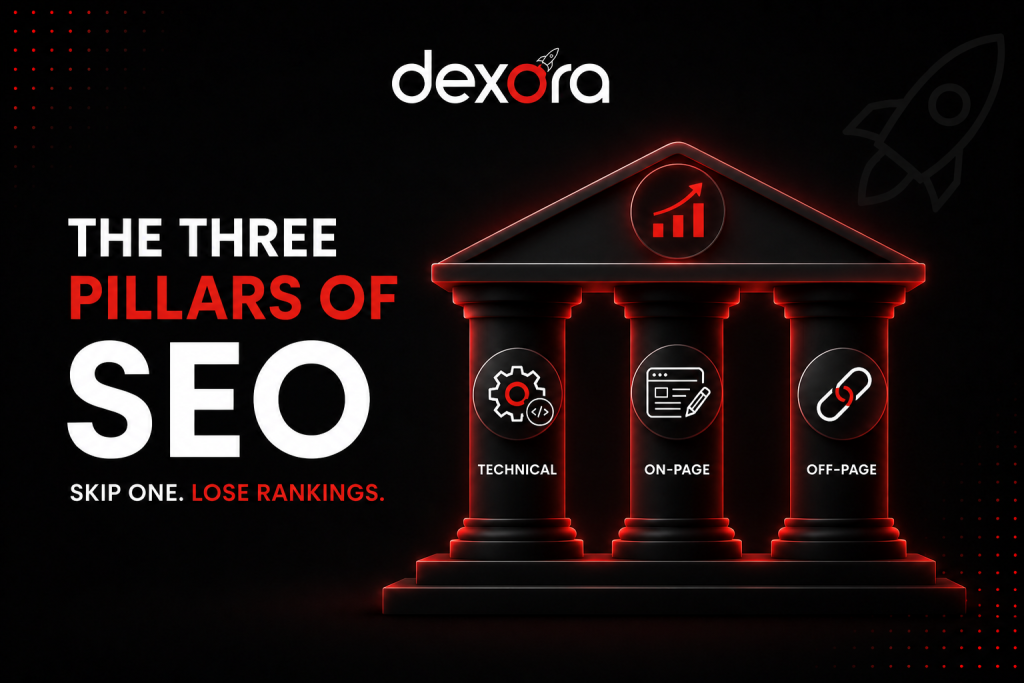
Every business that has ever failed at SEO failed at the same thing: they got one pillar right and ignored the other two.
They published brilliant content — but the site loaded in 8 seconds and Google couldn’t index half the pages. Or they had a technically perfect site — but the content was thin and nobody linked to it. Or they earned impressive backlinks — but the pages those links pointed to answered the wrong questions.
The three pillars of SEO are not three options. They are three requirements. This article explains what each one does, why it works, and — crucially — what breaks when you neglect any of them.
see how technical SEO forms the foundation that everything else depends on →
Why SEO Has Three Distinct Pillars — The Logic Behind It
Google has one job: give searchers the most useful, trustworthy result for any given query. To make that judgment, it evaluates every page from three angles.
First: Can I actually access this page, understand its content, and trust the site it lives on? That is the technical question.
Second: Is this page the best possible answer to the query? Does the content match what the searcher needs? Is it structured clearly? That is the on-page question.
Third: Does the wider internet agree this page is worth reading? Do credible sources link to it? Is the domain trusted? That is the off-page question.
All three questions need affirmative answers before Google feels confident putting your page in front of a searcher. Nail two of three and you will rank — but not as well as you should. Neglect one entirely and the other two cannot compensate.
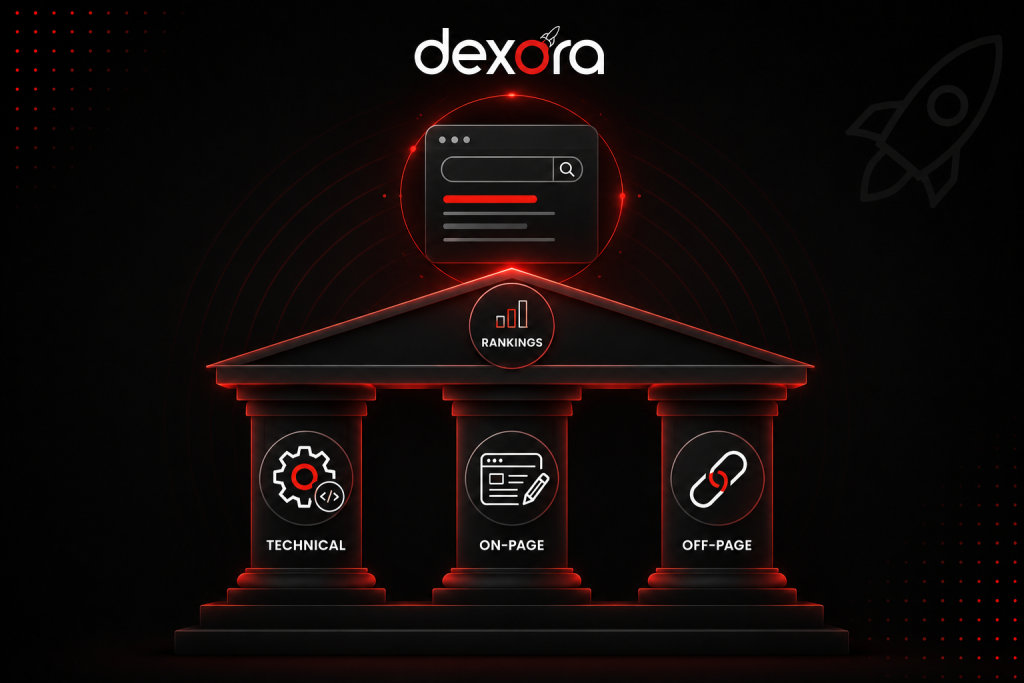
SEO is not a single discipline. It is three disciplines that only work when they work together.
Pillar One: Technical SEO — The Foundation Your Rankings Sit On
Technical SEO is everything that determines whether Google can find, crawl, understand, and index your website. It is invisible to the average visitor. It is foundational to everything else.
I have diagnosed dozens of sites where the business spent months creating good content that ranked nowhere — because a misconfigured robots.txt file was blocking Google from crawling half the site. All that effort, none of that ranking. Technical SEO failure.
Crawlability — Can Google Get In?
Googlebot navigates websites by following links. If your site has orphan pages with no internal links, Googlebot may never find them. If your robots.txt file accidentally blocks important directories, entire sections of your site can be invisible to Google.
Crawl budget is a real concept for larger sites. Google doesn’t crawl infinitely. If it wastes its crawl budget on low-value pages (duplicate content, parameter URLs, soft 404s), your important pages get crawled less frequently.
Indexability — Does Google Keep What It Finds?
Crawling and indexing are different. Google crawls a page and reads it. Indexing means Google stores it and considers it for rankings. A page can be crawled but excluded from the index for many reasons: thin content, duplicate content, noindex tags, or canonicalisation errors.
Check your Google Search Console Coverage report regularly. ‘Crawled — Currently Not Indexed’ is the most alarming status. It means Google visited your page and decided not to keep it.
Page Speed and Core Web Vitals
Google uses Core Web Vitals — Largest Contentful Paint (LCP), Interaction to Next Paint (INP), and Cumulative Layout Shift (CLS) — as ranking signals. Pages that load slowly, respond sluggishly to interactions, or shift their layout during loading receive a ranking disadvantage.
For mobile users, this matters even more. The majority of searches now happen on mobile devices, and Google indexes the mobile version of your site first.
Structured Data and Schema Markup
Schema markup is code you add to your pages that helps Google understand their content — not just read it. FAQ schema enables rich snippets in search results. LocalBusiness schema helps Google present your business in Maps. Review schema displays star ratings. These enhancements increase click-through rate without changing your rankings directly.
Google Search Central — official documentation on technical SEO fundamentals →
Pillar Two: On-Page SEO — The Relevance Signal That Wins Queries
On-page SEO is everything on the page itself that tells Google and the reader — what the page is about and why it is the best answer to a specific query.
It is the pillar most businesses start with. And it is the one most businesses do only partially right.
Keyword Research and Intent Alignment
On-page SEO begins before you write a word. Keyword research identifies what your target audience is searching for. But understanding the intent behind that keyword is what determines the content format.
Someone searching ‘how to fix a leaking pipe’ wants a step-by-step guide. Someone searching ’emergency plumber Bristol’ wants a service page with a phone number. Serving the wrong content type for the intent — even with the right keyword — results in a high bounce rate and poor rankings.
Title Tags, Meta Descriptions, and Headings
The title tag is one of Google’s strongest on-page relevance signals. Include your primary keyword near the beginning, keep it under 60 characters, and write it to earn the click — not just to satisfy a keyword requirement.
Headings (H1, H2, H3) structure your content for both readers and crawlers. Your H1 is the declared topic. Your H2s are the sub-sections — each should be a benefit statement that answers a specific aspect of the query.
Content Depth and Topical Coverage
Thin content — pages with fewer than 500 words covering a topic that competitors cover in 3,000 — is one of the most common on-page failures I see. Google doesn’t just want the keyword. It wants the answer. The full answer. Every reasonable question a searcher might have after reading your page should be addressed on the page.
This is why topical authority matters: a site that covers a subject comprehensively signals more expertise than a site that has one standalone page on it.
Internal Linking Within Pages
Every page should link strategically to related pages on your site. Internal links distribute authority, help Google understand your site’s architecture, and guide users to the next logical step in their journey.
Moz Beginner’s Guide to On-Page SEO — the foundational reference →
Pillar Three: Off-Page SEO — The Trust Signal You Can’t Fake
Off-page SEO is the external evidence that your site deserves to rank. Primarily backlinks. Also brand mentions, digital PR, and for local businesses — directory citations and reviews.
It is the pillar that most businesses underinvest in because it requires earning something from other people. You can write content and fix technical issues entirely under your own control. Backlinks require someone else to decide you’re worth linking to.

Backlinks — Why External Votes Still Drive Rankings
A backlink is a link from another website to yours. Google treats it as a vote of confidence. The quality and relevance of that vote matters enormously.
A backlink from a major industry publication in your sector is worth dramatically more than 100 links from generic directories. Google has become extremely sophisticated at evaluating the authority, relevance, and editorial nature of links.
How to Earn Off-Page Authority Legitimately
The most durable off-page strategy is creating things worth linking to. Original research earns citations. Comprehensive guides become reference resources. Free tools get recommended. Genuine expertise earns press coverage.
Digital PR — getting featured in publications your customers read — serves double duty: brand visibility and authoritative backlinks from the same effort.
Local Off-Page Signals
For local businesses, off-page SEO includes NAP consistency (Name, Address, Phone) across directories, Google Business Profile authority, and review signals. A plumber with consistent citations across 50 local directories and 200 genuine Google reviews has strong local off-page signals.
our off-page SEO service builds the editorial links that move competitive rankings →
Ahrefs — the data behind why backlinks still determine who ranks →
How the Three Pillars Interact — The Compound Effect
The three pillars don’t just work in parallel. They compound each other.
Strong technical SEO means Google crawls your content faster and more completely. More complete indexation means your on-page optimisation reaches more of its potential. Better on-page content earns more backlinks organically — which strengthens your off-page pillar without active outreach.
The reverse is also true. Weak technical SEO means Google sees your content inconsistently — so even excellent on-page work underperforms. Great backlinks pointing to thin content don’t convert into rankings because on-page relevance is missing. And impressive on-page content on a technically broken site simply doesn’t get indexed properly.
The three pillars don’t add up. They multiply.
The Most Common Pillar Imbalance I See
In my experience auditing over 50 client sites, the most common failure pattern is this: a business invests heavily in on-page content (often through a content marketing agency), builds reasonable off-page authority, but never addresses the technical foundation.
The result: rankings that plateau at positions 8–20. Content that is genuinely good but can’t break through because technical issues — slow load times, poor mobile experience, canonicalisation errors — are suppressing the page’s ranking potential.
Fixing the technical pillar alone, in these cases, often produces visible ranking improvements within 4–8 weeks. No new content required. No new backlinks. Just removing the ceiling.
Which Pillar Should You Fix First?
This question has a clear answer: technical always comes first.
There is no point investing in on-page content improvements if Google cannot properly access and index your pages. There is no point building backlinks if they point to pages with slow load times that frustrate users into bouncing immediately.
The sequence is: (1) Fix technical foundation. (2) Optimise existing on-page content. (3) Build off-page authority. (4) Create new on-page content. This sequence is the only one that doesn’t waste effort.
How to Diagnose Your Weakest Pillar
Technical: Run a crawl with Screaming Frog. Check your GSC Coverage report. Look for indexation errors, slow pages in the CWV report, and mobile usability issues.
On-page: Compare your top pages against the content that outranks them. Are you shorter? Are their headings covering questions you don’t address? Is their content more specific and detailed?
Off-page: Check your Domain Rating or Domain Authority and compare it to the top-ranking competitors for your target keywords. If there is a significant gap and your technical and on-page work is sound — that gap is your off-page problem.
a full SEO strategy addresses all three pillars in the right sequence →
Common Three-Pillar Mistakes That Cost Rankings
Mistake: Treating on-page SEO as the whole of SEO. Why it happens: content is visible and feels impactful. What it costs you: rankings that plateau despite good content because technical or off-page gaps are holding back the domain.
Mistake: Building backlinks before fixing technical SEO. Why it happens: backlinks feel like the ‘real’ SEO work. What it costs you: off-page authority flowing to pages Google can’t index properly — wasted link equity.
Mistake: Assuming technical SEO is done once and stays done. Why it happens: it’s not the visible work. What it costs you: technical debt accumulates over time — plugin conflicts, broken redirects, speed degradation — and quietly suppresses rankings.
Mistake: Fixing one pillar and expecting immediate results on the others. Why it happens: impatience plus misunderstanding of how the pillars interact. What it costs you: abandoning the right strategy before it has time to compound.
FAQ: The Three Pillars of SEO
Q: What are the three pillars of SEO?
A: The three pillars of SEO are technical SEO, on-page SEO, and off-page SEO. Technical SEO ensures Google can find, crawl, and index your site. On-page SEO ensures your content is relevant, well-structured, and matches what searchers need. Off-page SEO builds external authority through backlinks and brand signals. All three are required — strong performance in two pillars while neglecting the third consistently results in rankings that underperform their potential.
Q: Which pillar of SEO is most important?
A: Technical SEO comes first in priority because the other two pillars cannot perform without it. You cannot rank with great content if Google cannot index your pages. However, once the technical foundation is sound, off-page SEO (backlinks and authority) tends to be the most impactful lever for climbing from page 2 to page 1 in competitive niches. The honest answer: all three matter and all three have ceilings without the others.
Q: Can I do SEO without building backlinks?
A: For low-competition, long-tail keywords — yes. A well-optimised page on a technically sound site can rank for specific niche queries with few or no backlinks. For competitive head terms or in competitive industries — no. You need off-page authority to outrank established competitors. Most businesses underestimate how much of their ranking plateau is a backlink problem rather than a content problem.
Q: How do I know which SEO pillar my site is weakest on?
A: Use a three-step diagnostic. For technical: run your site through Screaming Frog (free up to 500 URLs) and check Google Search Console for indexation errors and Core Web Vitals failures. For on-page: search your target keywords and compare your content depth, heading structure, and keyword alignment against the top 3 results. For off-page: use Ahrefs Webmaster Tools (free) to check your domain rating versus competing sites.
Q: How do the three SEO pillars apply to AI search and AEO?
A: The three pillars translate directly to Answer Engine Optimisation. Technical SEO ensures your content is accessible and structured (schema markup is critical for AI citation). On-page SEO ensures your content directly answers specific questions with clarity (featured snippet and PAA optimisation). Off-page SEO ensures your domain is trusted enough for AI tools to cite it. Sites that AI tools recommend are almost always sites with strong performance across all three pillars.
Q: What is the fastest way to improve SEO across all three pillars?
A: Start with a professional audit. In our experience, most sites have a primary bottleneck in one pillar that, once fixed, unlocks progress in the others. Fixing technical indexation errors can immediately improve rankings on existing content. Adding internal links from existing high-traffic pages costs nothing. Auditing and improving the top 10 pages’ on-page elements can move rankings within weeks. There are always quick wins in each pillar — you need the audit to find them.
Build All Three — Not Just Your Favourite
The businesses I have seen build durable, compounding search visibility over years are the ones who treated all three pillars as ongoing disciplines — not one-time projects.
They had a technical SEO review every quarter. They updated and deepened content regularly. They pursued off-page authority consistently, even when rankings were going well.
The businesses that stalled always did the same thing: they mastered one pillar, neglected the others, and then wondered why their rankings stopped improving.
Pick your weakest pillar. Fix it. Then raise the floor on the next one. That is the compounding loop that builds rankings that last.
The strongest SEO isn’t built on one brilliant pillar. It’s built on three that hold each other up.
Not sure which pillar is holding your site back? We audit all three — technical health, on-page quality, and off-page authority — and give you a prioritised roadmap with clear quick wins.
Get Your Free Three-Pillar SEO Audit →

Local SEO and AI Search (AEO & GEO) Specialist.
Building search visibility that converts into qualified demand.
Today, businesses need visibility on Google Maps and AI powered search and websites that actually convert visitors into leads. I am a Local SEO, AI Search & Conversion Rate Optimization (CRO) Specialist with 5+ years of hands on experience helping businesses turn underperforming websites into high converting growth engines. My work combines Local SEO, Technical SEO, Semantic SEO, GEO/AEO, and conversion focused landing page optimization to ensure brands are discoverable and profitable.
My Experience
I have delivered SEO and web growth projects across the US, UK, Australia, Canada, Finland, Germany, and the Czech Republic, working in industries such as local businesses (electrician, hvac, cleaning, Real estate, healthcare, B2B, eCommerce, SaaS, and environmental services.
Some Results
>> 200+ websites audited globally
>> specifically worked with 100+ local business (80% from USA)
>> 80+ websites improved through technical SEO & schema fixes
>> 20+ businesses featured in Google AI Overviews (SGE)
>> Multi million impression growth for eCommerce & SaaS brands
Book Free Consultation: calendly.com/dexora/30min