
There is a version of your website that your customers never see.
Not because your design is bad or your content is thin. But because the AI systems that are increasingly recommending businesses, answering questions, and driving purchase decisions simply cannot find you.
This is the AI discoverability problem. And most business owners have no idea it exists until they notice that competitors are appearing in ChatGPT responses, Google AI Overviews, and Perplexity recommendations while they are nowhere to be found.
This article explains exactly what AI discoverability is, why it matters more every month, how to check whether your website has it, and what to do if it does not.
What Is AI Discoverability
AI discoverability is the degree to which AI systems can find, access, read, and use your website content when generating responses, recommendations, and search results.
It is different from traditional search visibility in one fundamental way.
Traditional SEO is about whether Google’s ranking algorithm decides to show your page when someone searches a keyword. AI discoverability is about whether AI systems can physically access your content at all and whether that content is structured in a way that AI can extract and use it.
A website can rank on page one of Google for its main keywords and still be completely invisible to AI systems. This happens all the time and it is becoming a more serious problem as AI-powered search captures a larger share of how people find information and businesses.
Think of it this way. Traditional search is like a librarian who reads the index of your book to decide whether to recommend it. AI search is like a researcher who actually reads your book, understands its content, and decides whether to cite it when answering a question. If the researcher cannot get into the library your book is irrelevant regardless of how good it is.
AI discoverability is about making sure the researcher can get into your library, read your content, and find what they need.
Why AI Discoverability Matters More Every Month
Search behavior is changing faster right now than at any point in the last decade. Here is what that change actually looks like in numbers.
Google AI Overviews now appear for an estimated 15 to 20 percent of all searches and that figure is growing every quarter. These AI-generated summaries appear above organic results, above the map pack, and above everything else on the page. If your website is not in the sources that Google AI Overviews draws from you are invisible to a significant and growing percentage of searches for your keywords.
ChatGPT reached 400 million weekly active users in early 2026 and a significant portion of those users are now using ChatGPT to find and evaluate local businesses, service providers, and products. When someone asks ChatGPT to recommend an HVAC company in Atlanta or a personal injury lawyer in Los Angeles the recommendations it gives come from websites it can access and content it can read. If yours is blocked or unreadable you will never appear.
Perplexity AI is processing millions of searches per day and specifically positions itself as a research and recommendation engine. Its entire model is built on crawling and citing web sources in real time. Businesses that appear in Perplexity citations are getting meaningful referral traffic. Businesses that are blocked from Perplexity crawlers get nothing.
The pattern is consistent across every AI search platform. The businesses benefiting are the ones whose websites are structured for AI discovery. The businesses being left behind are the ones that optimized for how search worked five years ago and have not adapted.
The Three Components of AI Discoverability
AI discoverability is not a single thing. It has three distinct components that each need to be addressed separately.
Component 1 — AI Crawler Access
Before any AI system can use your content it needs to be able to crawl your website. This access is controlled primarily by your robots.txt file which tells crawlers what they are and are not allowed to do on your site.
The problem is that many websites were built before AI crawlers existed as a category. Their robots.txt files were configured to block unknown bots as a security measure. This made sense at the time but it means that GPTBot, ClaudeBot, PerplexityBot, and other AI crawlers are being blocked without the website owner ever making a deliberate decision to exclude them from AI search.
There are eight major AI crawlers that matter for your discoverability right now:
GPTBot — OpenAI’s crawler that powers ChatGPT’s web browsing and search capabilities. If GPTBot is blocked your business will not appear in ChatGPT search results or recommendations.
ChatGPT-User — A separate OpenAI crawler used specifically when ChatGPT users ask it to browse the web in real time. Blocking this prevents real-time ChatGPT recommendations about your business.
ClaudeBot — Anthropic’s crawler for Claude AI. As Claude becomes more widely used for research and recommendations blocking ClaudeBot removes you from this growing platform entirely.
anthropic-ai — A secondary Anthropic crawler. Both ClaudeBot and anthropic-ai should be allowed for complete Claude AI visibility.
PerplexityBot — Perplexity’s crawler. Perplexity is the fastest growing AI search engine in the world right now and it is heavily used by researchers, professionals, and consumers making purchasing decisions. Blocking PerplexityBot is a significant missed opportunity.
Google-Extended — Google’s crawler specifically for AI training and Gemini AI capabilities. Separate from Googlebot which handles traditional search. You can rank in traditional Google search while being completely invisible to Google’s AI systems if Google-Extended is blocked.
Applebot-Extended — Apple’s AI crawler for Siri, Apple Intelligence, and Apple’s AI-powered search features. As Apple Intelligence expands its reach this crawler is becoming increasingly important for businesses targeting iOS users.
meta-externalagent — Meta’s AI crawler powering Meta AI across Facebook, Instagram, and WhatsApp. With billions of active users across these platforms Meta’s AI recommendations represent a significant and largely untapped visibility channel.
To check whether these crawlers can access your website you need to examine your robots.txt file. You can view it by typing your domain followed by /robots.txt into your browser. For example dexoradigital.com/robots.txt.
What you are looking for is any Disallow rule that might be blocking these specific user agents. A rule that says User-agent: * Disallow: / blocks everything including all AI crawlers. Individual disallow rules targeting specific bots will show you which crawlers are restricted.
The fastest way to check all eight crawlers simultaneously is to use the Dexora Digital AI Visibility Tool which parses your robots.txt and checks every major AI crawler in under 60 seconds.
Component 2 — AI Agent Accessibility
Allowing AI crawlers through your robots.txt is the first step. The second step is making sure that when those crawlers arrive at your website they can actually navigate it, read your content, and understand what your business does.
This is called AI agent accessibility and it is more nuanced than simple crawler access.
AI agents do not browse your website the way a human does. They do not see your design, your images, or your visual layout. They read text, follow links, and extract structured information. If your website is built in a way that makes this difficult you will have low AI agent accessibility even if all crawlers are technically allowed.
The most common AI agent accessibility problems are:
Slow page load times. AI agents have timeout thresholds. If your page takes more than a few seconds to load the agent may time out before it can read your content. This is particularly common on websites with large images, heavy JavaScript, or unoptimized hosting. Your Core Web Vitals scores are a reasonable proxy for AI agent accessibility. If your LCP is above 4 seconds you likely have accessibility issues.
JavaScript-dependent content. Many modern websites load their main content through JavaScript rather than serving it directly in the HTML. AI agents do not execute JavaScript the same way browsers do. If your key content including your services, your contact information, and your about text only appears after JavaScript executes it may be invisible to AI agents even when they visit your page.
Poor navigation structure. AI agents navigate your website by following links. If your navigation is complex, deeply nested, or relies on JavaScript dropdowns that agents cannot interact with they may be unable to reach your key pages. A clean, simple navigation structure with clear text links to your main service and contact pages dramatically improves AI agent accessibility.
Missing or thin text content. AI agents extract information from your text. If your pages are primarily visual with minimal written content there is nothing for the agent to read or use. This is a common problem on portfolio sites, restaurant websites, and service business sites that rely heavily on imagery and minimal copy.
Component 3 — Contact Findability
The third component of AI discoverability is specifically relevant to local businesses and service providers and it is the one that most people overlook completely.
Contact findability is whether an AI agent can locate your business contact information, specifically your phone number, email address, or contact form, within one click from your homepage.
Here is why this matters. When an AI system like ChatGPT or Perplexity recommends a business to a user it is not just citing a name. It is extracting actionable information. Business name. What they do. Where they are. How to contact them. If the AI cannot find your contact information it cannot give a complete and useful recommendation. In many cases the AI will simply recommend a competitor whose contact information is immediately accessible.
The contact findability problem is more common than you might expect. Many websites bury their contact information deep in a dedicated contact page that is only accessible through a multi-click navigation path. Some websites put phone numbers in images rather than text, making them invisible to AI systems that cannot read image content. Others put their main contact options inside JavaScript widgets or popups that AI agents cannot access.
The fix is straightforward. Your phone number or primary contact method should appear as text in your header or above the fold on your homepage. Your contact page should be accessible from your main navigation with a single click. If you use a contact form it should be present on a page that does not require JavaScript to load.
How to Check Your AI Discoverability Score
There are several ways to check your AI discoverability ranging from manual to automated.
Manual Method — robots.txt Check
Go to (yourdomain) https://dexoradigital.com/robots.txt and look for these user agents in your file:
GPTBot
ChatGPT-User
ClaudeBot anthropic-ai
PerplexityBot
Google-Extended
Applebot-Extended
meta-externalagent
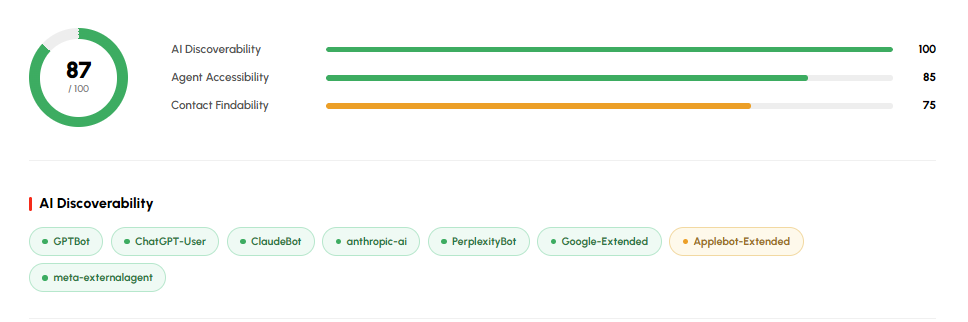
If you see any of these listed under a Disallow rule they are being blocked. If you see User-agent: * Disallow: / everything is blocked including all of these crawlers.
This tells you about crawler access but it does not tell you about agent accessibility or contact findability.
Manual Method — Page Speed and Content Check
Go to Google PageSpeed Insights and test your homepage. If your mobile LCP is above 4 seconds you likely have AI agent accessibility issues. Check whether your main content loads without JavaScript by disabling JavaScript in your browser settings and reloading your homepage. If your content disappears or is significantly reduced you have a JavaScript accessibility problem.
Check your homepage for a visible phone number or contact link in the above the fold area. Count how many clicks it takes to reach a contact form from your homepage. More than one click is a contact findability issue.
Automated Method — AI Visibility Tool
The fastest and most comprehensive way to check all three components simultaneously is to use the Dexora Digital AI Visibility Tool.
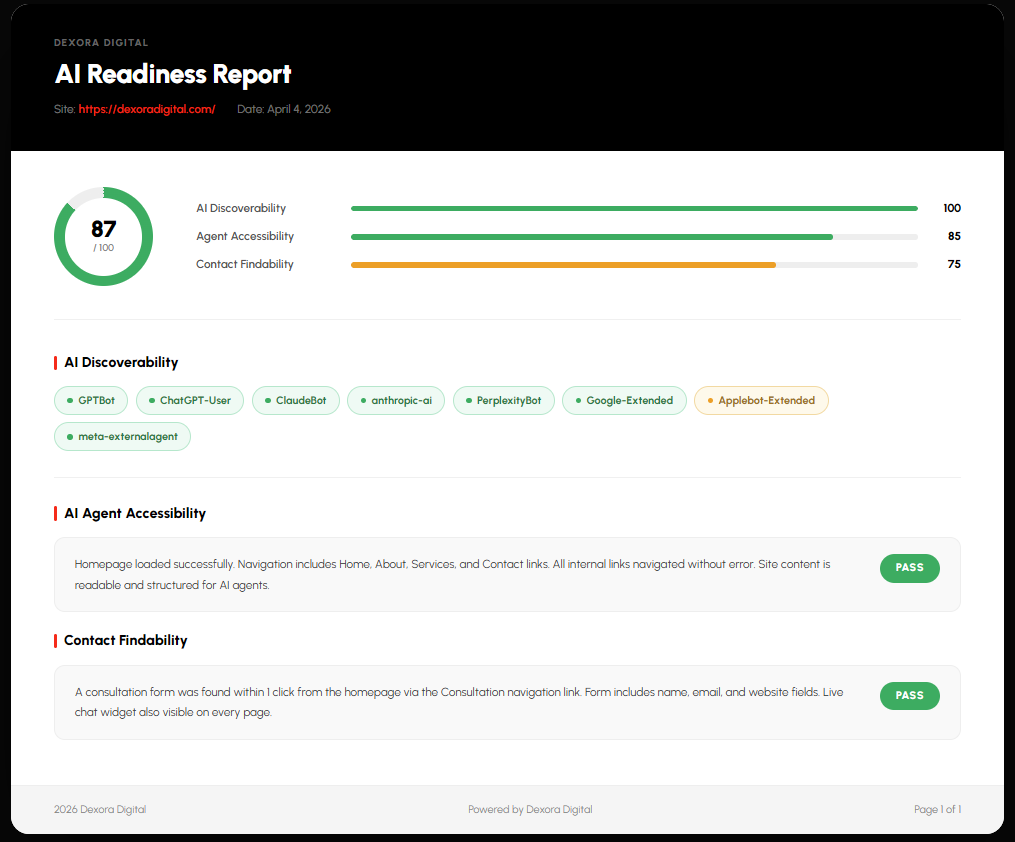
Enter your website URL, click Run Audit, and within 60 seconds you receive a complete AI Readiness Score out of 100 with individual scores for AI Discoverability, Agent Accessibility, and Contact Findability.
The tool checks all eight major AI crawlers by name, sends a real AI agent to navigate your website and verify accessibility, and checks whether your contact information is findable within one click. You also get a branded PDF report you can download and share instantly.
It is completely free. No signup required. No credit card.
What Your AI Discoverability Score Means
Score 90 to 100 — Excellent All major AI crawlers can access your site. Your content is readable and navigable by AI agents. Your contact information is immediately findable. You are well positioned for AI search visibility across all major platforms.
Score 75 to 89 — Good With Gaps Most AI crawlers can access your site but one or two may be partially restricted. Your agent accessibility or contact findability has minor issues that are reducing your AI search visibility. These gaps are worth fixing because they are typically quick wins that improve your positioning across multiple AI platforms simultaneously.
Score 50 to 74 — Significant Issues Multiple AI crawlers are blocked or restricted. You have accessibility or contact findability problems that are materially reducing your AI search visibility. Businesses in this range are likely missing meaningful traffic and recommendations from AI-powered search platforms. Fixing these issues should be a priority.
Score Below 50 — Critical Problems Major AI crawlers are blocked. Your website may be largely or completely invisible to AI search systems. If competitors in your market have good AI discoverability scores they are capturing recommendations and traffic that should be going to you. This requires immediate attention.
How to Improve Your AI Discoverability
Once you have checked your score here are the specific actions to take based on what the audit found.
If AI crawlers are blocked in your robots.txt:
Open your robots.txt file and add explicit allow rules for the blocked crawlers. The safest approach is to add individual user agent entries for each AI crawler you want to allow rather than using a blanket allow all rule which would also allow potentially unwanted bots.
Here is the correct format to allow the major AI crawlers:
User-agent: GPTBot Allow: /
User-agent: ChatGPT-User Allow: /
User-agent: ClaudeBot Allow: /
User-agent: anthropic-ai Allow: /
User-agent: PerplexityBot Allow: /
User-agent: Google-Extended Allow: /
User-agent: Applebot-Extended Allow: /
User-agent: meta-externalagent Allow: /
Add these to your robots.txt file and save. You can verify the change took effect by revisiting yourdomain.com/robots.txt and checking that the rules appear correctly.
For a complete guide to creating and optimizing your llms.txt file which helps AI systems understand your content structure read our guide on how to create an llms.txt file.
If your agent accessibility score is low:
Start with page speed. Use Google PageSpeed Insights to identify your biggest performance issues and fix them in order of impact. Compressing images, enabling caching, and minimizing JavaScript are typically the fastest wins.
Audit your content for JavaScript dependency. If critical content is only visible with JavaScript enabled work with your developer to ensure the same content is also present in the static HTML that AI agents can read.
Simplify your navigation. Ensure every key page including your services, about, and contact pages is accessible through a simple text link in your main navigation.
If your contact findability score is low:
Add your phone number as visible text in your website header. Ensure it is present on every page not just the contact page. Add a Contact link to your primary navigation. Check that your contact page loads completely without JavaScript.
If you want comprehensive AI search optimization across all three components our AI Search Optimization Services and Technical SEO Services address every layer of AI discoverability as part of a complete optimization campaign.
AI Discoverability vs Traditional SEO — What Is the Difference
It is worth being clear about how AI discoverability relates to the SEO work you are probably already doing.
Traditional SEO focuses on ranking signals. Keywords, backlinks, page authority, content relevance, user engagement signals. These tell Google’s ranking algorithm where to position your page in organic results.
AI discoverability focuses on access and structure. Can AI crawlers get to your content at all. Can AI agents navigate and read it. Can they extract the key information about who you are and how to contact you.
The two are related but they are not the same thing and improving one does not automatically improve the other.
A site can have excellent traditional SEO rankings while being completely invisible to AI systems because its robots.txt blocks AI crawlers. A site can have poor traditional SEO rankings but excellent AI discoverability because it is structured clearly for AI agents to read and use.
The businesses that will have the strongest search visibility over the next two to three years are the ones that optimize for both simultaneously. Traditional search rankings for the customers who search the old way. AI discoverability for the growing number of customers who are asking AI systems for recommendations.
For a deeper understanding of how AI search and traditional SEO work together and where they differ read our guide to AI Search Optimization Services and our existing breakdown of SEO, AEO, and GEO explained.
The AI Discoverability Opportunity Window
Here is the honest reality of where things stand right now.
Most businesses have not thought about AI discoverability at all. They are running on robots.txt files that were configured years ago, on websites that were built for human browsers not AI agents, and with contact information that is perfectly visible to human visitors but completely inaccessible to AI systems.
This means there is a genuine window of competitive advantage available right now for businesses that move first.
If you are a plumber in Houston and your three main competitors all have their AI crawlers blocked while you optimize your AI discoverability you will be the business that appears when someone asks ChatGPT or Perplexity to recommend a reliable plumber in Houston. Your competitors will not appear at all.
That window will not stay open indefinitely. As awareness of AI discoverability grows more businesses will fix their crawler access, improve their agent accessibility, and optimize their contact findability. The businesses that move now will have established authority and presence in AI search systems before the competition catches up.
The first step is checking where you stand. Run your free AI Discoverability Check and get your score in under 60 seconds. No signup. No credit card. Just your current AI Readiness Score and a clear picture of what to fix first.
Frequently Asked Questions
What is AI discoverability?
AI discoverability is whether AI systems like ChatGPT, Perplexity, Claude, and Google AI can find, access, read, and use your website content when generating responses and recommendations. It covers three areas: whether AI crawlers are allowed in your robots.txt, whether AI agents can navigate and read your content, and whether your contact information is findable within one click.
How do I check if my website has AI discoverability?
The fastest way is to use the Dexora Digital AI Visibility Tool at dexoradigital.com/ai-labs. It checks all eight major AI crawlers, tests agent accessibility, and verifies contact findability in under 60 seconds. You also receive a full PDF report. It is completely free with no signup required.
Which AI crawlers should my website allow?
The eight most important AI crawlers to allow are GPTBot, ChatGPT-User, ClaudeBot, anthropic-ai, PerplexityBot, Google-Extended, Applebot-Extended, and meta-externalagent. Each powers a different AI platform and blocking any of them reduces your visibility on that platform.
Can I have good Google rankings but poor AI discoverability?
Yes. Traditional Google rankings and AI discoverability are separate things. Your robots.txt can allow Googlebot for traditional search while blocking AI crawlers like GPTBot and ClaudeBot. Many websites that rank well in traditional search are completely invisible in AI-powered search results.
How long does it take to fix AI discoverability issues?
Most AI discoverability fixes are quick. Updating your robots.txt to allow blocked crawlers takes less than 30 minutes. Adding an llms.txt file can be done in a few hours. Improving agent accessibility through page speed and navigation improvements may take a few days to a few weeks depending on how significant the issues are.
Will fixing AI discoverability affect my traditional SEO rankings?
Allowing AI crawlers in your robots.txt does not negatively affect traditional search rankings. Improving page speed and content structure for AI agent accessibility typically improves traditional SEO performance as well since these are also factors in Google’s traditional ranking algorithm.
What is the difference between AI discoverability and AI search optimization?
AI discoverability is the foundation. It ensures AI systems can access your content at all. AI search optimization goes further by structuring your content to be cited, featured, and recommended by AI systems. You need AI discoverability before AI search optimization can work. Think of discoverability as getting through the door and AI search optimization as making a compelling case once you are inside.

Local SEO and AI Search (AEO & GEO) Specialist.
Building search visibility that converts into qualified demand.
Today, businesses need visibility on Google Maps and AI powered search and websites that actually convert visitors into leads. I am a Local SEO, AI Search & Conversion Rate Optimization (CRO) Specialist with 5+ years of hands on experience helping businesses turn underperforming websites into high converting growth engines. My work combines Local SEO, Technical SEO, Semantic SEO, GEO/AEO, and conversion focused landing page optimization to ensure brands are discoverable and profitable.
My Experience
I have delivered SEO and web growth projects across the US, UK, Australia, Canada, Finland, Germany, and the Czech Republic, working in industries such as local businesses (electrician, hvac, cleaning, Real estate, healthcare, B2B, eCommerce, SaaS, and environmental services.
Some Results
>> 200+ websites audited globally
>> specifically worked with 100+ local business (80% from USA)
>> 80+ websites improved through technical SEO & schema fixes
>> 20+ businesses featured in Google AI Overviews (SGE)
>> Multi million impression growth for eCommerce & SaaS brands
Book Free Consultation: calendly.com/dexora/30min
