
If you have spent any time reading about digital marketing in 2026, you have come across three acronyms that did not exist together five years ago: SEO, AEO, and GEO.
Most articles treat them as interchangeable terms for the same thing, or worse, as competing strategies where you have to pick one. Neither is true.
SEO, AEO, and GEO are three distinct disciplines targeting three distinct search channels. They share a technical foundation but serve different purposes, require different signals, and produce different types of visibility. A business that only does one of the three is missing the visibility that the other two channels produce.
This article explains exactly what each one is, how they differ from each other, which your business needs right now, and what implementing all three looks like in practice — with verified results from real client campaigns.
200M+ weekly ChatGPT users actively searching for products and services — OpenAI, 2026
20%+ of US Google searches now show AI Overviews above all organic results — Google Search Central, 2026
77% of Australians use AI tools monthly to find services — Telsyte Australian AI Study, 2026
15% of businesses have any AI search strategy — the other 85% are invisible — Profound AI Search Report, 2026
What Is SEO — And What It Actually Does
SEO — Search Engine Optimization — is the practice of making your website visible to people who type queries into a search engine and click on results. It is the oldest of the three disciplines and, despite everything written about its decline, still the highest-volume search channel available to most businesses.
When someone searches ’emergency plumber Phoenix’ on Google and clicks one of the ten blue links on the results page, that is SEO producing a result. The website that appears in the top three positions earns the majority of clicks. The websites below position three share what is left.
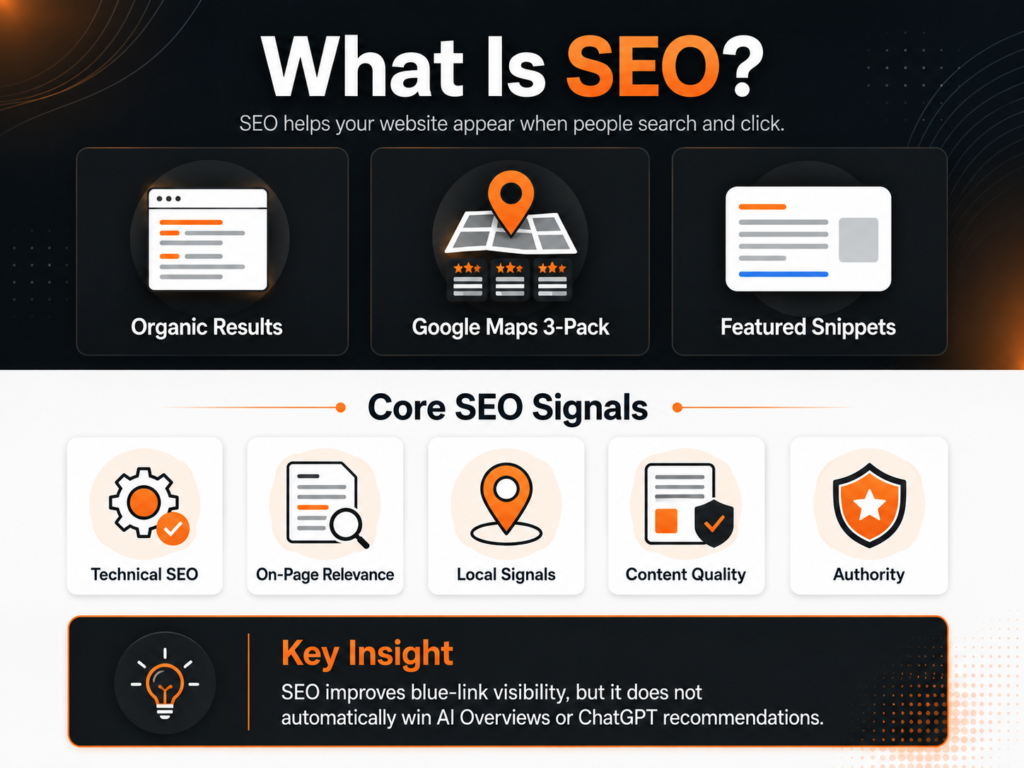
What SEO Optimizes For
Traditional SEO produces three types of visibility:
→ Organic search results — the ten blue links that appear below paid ads and AI-generated content
→ Google Maps 3-pack — the three businesses that appear in the map section for local queries
→ Featured snippets — the boxed answers that appear above organic results for specific informational queries
The Core SEO Signals
Google uses over 200 signals to rank pages. The ones that move rankings most significantly in 2026 are:
→ Technical foundation: Core Web Vitals (LCP under 2.5 seconds, CLS under 0.1, INP under 200ms), crawlability, correct indexation, mobile-first performance
→ On-page relevance: H1 structure, meta titles, keyword alignment, internal linking, schema markup
→ Local signals: Google Business Profile optimization, review velocity, NAP consistency across directories
→ Content quality: Depth, accuracy, specificity, and how fully the page satisfies the intent behind the search query
→ Authority: Backlinks from relevant, authoritative sources that transfer ranking signals to your pages
What SEO Cannot Do
This is where the conversation about AEO and GEO becomes relevant. SEO optimizes for the blue links. It does not optimize for the AI-generated content that now appears above them.
Key insight
A page that ranks position 1 in Google organic results does not automatically appear in Google AI Overviews. A business that dominates Google Maps does not automatically get recommended by ChatGPT. These channels require different signals. That is what AEO and GEO are for.
What Is AEO — Answer Engine Optimization
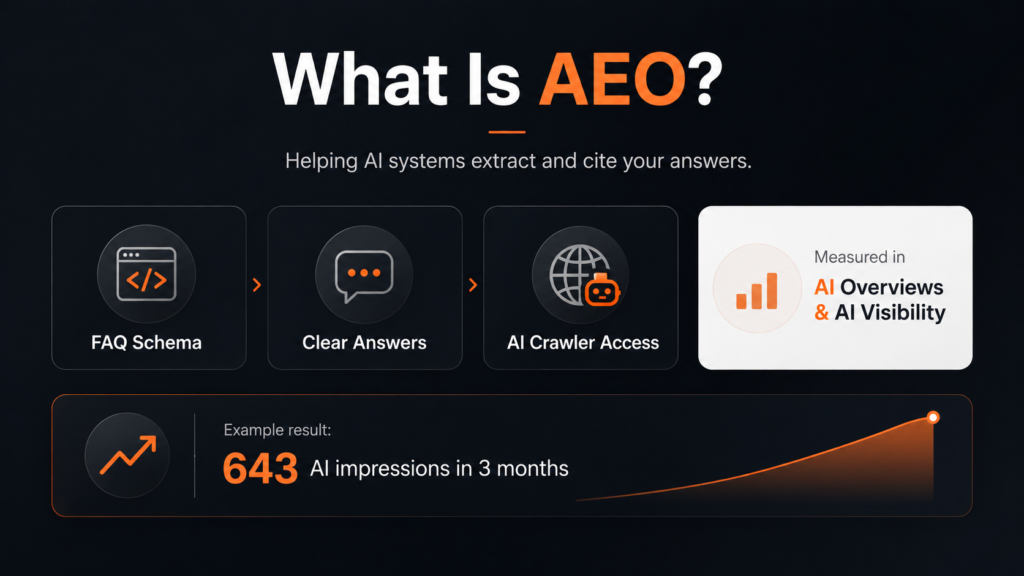
AEO — Answer Engine Optimization — is the practice of structuring your content so that AI systems can extract specific answers from it and use those answers in AI-generated responses.
When someone asks Google ‘how much does HVAC repair cost?’ and Google generates an AI Overview at the top of the results — a purple box with a direct answer above all the blue links — the websites whose content appears inside that AI Overview are benefiting from AEO.
AEO is about getting your content cited, not your business recommended. The distinction matters. An AI Overview might cite three different sources when answering a question about HVAC repair costs, attributing facts or quotes to each. The websites cited are receiving visibility they would not receive from organic rankings alone — because the AI Overview sits above position.
Why AEO Emerged as a Distinct Discipline
The shift began in 2023 when Google started testing AI-generated overviews in search results. By 2026, AI Overviews appear on more than 20% of all US Google searches. [1] For informational queries — ‘how to’, ‘what is’, ‘why does’, ‘how much does’ — the rate is significantly higher.
The problem for businesses: Google’s algorithm for selecting what appears inside an AI Overview is not the same as the algorithm for ranking blue links. A page can rank position 1 in organic results and not be cited in the AI Overview for the same query. A page can rank position 7 and be the primary citation inside the AI Overview. The signals are different.
The Core AEO Signals
→ FAQPage schema: JSON-LD markup identifying question-and-answer pairs on your pages. AI systems prioritize content in self-contained Q&A format with explicit schema markup. This is the single highest-impact AEO signal available.
→ Self-contained answers: Each answer on your page should be complete without requiring the reader to understand surrounding context. An answer that only makes sense if you read the preceding paragraph is harder for AI systems to extract.
→ Specific and verifiable claims: Generic marketing copy is not cited. Specific, credible, verifiable statements with clear attribution are extracted far more often.
→ AI crawler access: GPTBot, PerplexityBot, and Googlebot must be permitted in your robots.txt. If they are blocked, your content cannot be crawled for AI-generated responses.
→ llms.txt: A file at your domain root that tells AI crawlers what content exists on your site and how to prioritize it. Without it, AI crawlers make their own indexing decisions.
How AEO Is Measured
The primary tool for measuring AEO results is Google Search Console’s Generative AI features report (currently in Beta). This report shows how many times your content appeared inside Google’s AI-generated search features — AI Overviews and AI Mode — over a selected time period. It breaks down by page, country, and device.
For non-Google AI systems, SEMrush AI Visibility tracks citation counts across ChatGPT, Google AI Mode, AI Overviews, and Gemini. We use both tools in every client campaign because each captures data the other misses.
AEO result
ProSitePlans.com grew from near-zero Generative AI impressions to 643 in 3 months, reaching 20-30 new impressions per day by month 3. Source: Google Search Console Generative AI features report.
See full case study
What Is GEO — Generative Engine Optimization
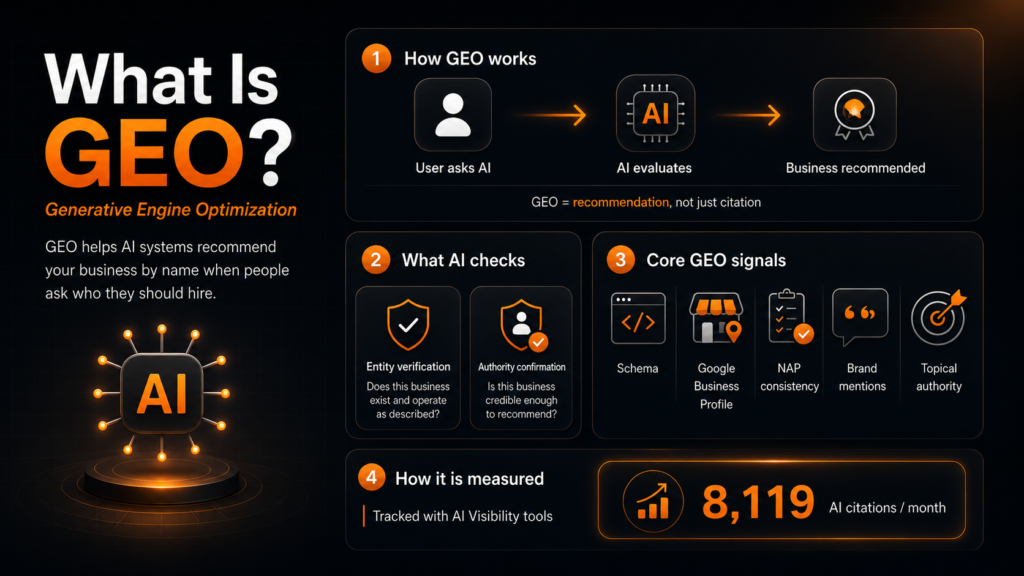
GEO — Generative Engine Optimization — is the practice of building the entity signals and brand authority that cause AI systems to recommend your specific business by name when users ask for recommendations.
When someone asks ChatGPT ‘who should I hire for HVAC repair in Phoenix?’ and ChatGPT responds with specific business names — that is GEO. The businesses it names have built the entity consistency, content authority, and digital footprint that makes AI systems confident enough to recommend them by name in a response a user will act on.
GEO is about brand recommendation, not content citation. The distinction from AEO: AEO gets your words cited in an AI answer. GEO gets your business name recommended as the answer.
Why GEO Is Different From Both SEO and AEO
In traditional SEO, ranking is determined primarily by relevance and authority. In AEO, citation is determined primarily by content structure and schema. In GEO, recommendation is determined primarily by entity verification.
AI systems making recommendation queries need to answer two questions before they name a specific business:
→ Does this business exist and operate as described? (Entity verification)
→ Is this business credible enough that recommending it will be a good response for my user? (Authority confirmation)
Entity verification uses signals that are distinct from both traditional SEO ranking signals and AEO content signals. These include Organization schema with sameAs links, Google Business Profile consistency, NAP consistency across directories, brand mentions on authoritative external sites, and the depth of your business’s digital footprint.
The Core GEO Signals
→ Organization or LocalBusiness schema: JSON-LD on your homepage that explicitly identifies your business name, address, services, and links to authoritative external profiles through the sameAs property. This is the primary entity confirmation signal for AI systems.
→ Google Business Profile: For local businesses, GBP is the most authoritative entity signal available. AI systems actively cross-reference GBP data when generating local recommendation responses. A well-optimized GBP dramatically increases the likelihood of AI recommendation for local searches.
→ NAP consistency: Name, address, and phone number must match exactly across your website, GBP, and all directory listings. Inconsistencies reduce AI system confidence in your business entity.
→ Brand mentions on external authoritative sites: When credible third-party sites reference your business by name, in context, this increases AI systems’ confidence that your business is real and worth recommending.
→ Topical authority: AI systems are more likely to recommend businesses that have demonstrated consistent expertise in their category through deep, specific content that answers the questions their target clients ask.
How GEO Is Measured
GEO results are measured through SEMrush AI Visibility, which tracks the number of times your business domain is cited across AI platforms including ChatGPT, Google AI Mode, Google AI Overviews, and Gemini. The report shows total citation count, which pages are cited, and citation growth trend over time.
Manual testing — asking ChatGPT directly for recommendations in your category and location — provides qualitative data but is not reliable for trending because AI responses vary by session, user context, and recent content updates.
GEO result
Keentel Engineering grew from zero AI search presence to 8,119 AI citations per month across ChatGPT, Google AI Mode, AI Overviews, and Gemini over 15 months of systematic AEO and GEO implementation. Source: SEMrush AI Visibility + Google Search Console Generative AI features.
See full case study
AEO vs GEO vs SEO — The Complete Comparison
The most common mistake in thinking about these three disciplines is treating them as alternatives. They are not. They target different channels. A business investing in all three gains visibility across all three places where its potential customers are searching.
| Dimension | SEO | AEO | GEO |
| Full Name | Search Engine Optimization | Answer Engine Optimization | Generative Engine Optimization |
| Primary Goal | Rank in organic results and Google Maps | Get content cited in AI-generated answers | Get business recommended by name in AI responses |
| Example Query | ‘plumber near me’ | ‘how much does plumbing repair cost?’ | ‘who should I hire for plumbing in Phoenix?’ |
| Where Visibility Appears | Blue links, Google Maps 3-pack | AI Overviews, AI Mode answers, ChatGPT responses | ChatGPT, Perplexity, Google AI Mode recommendations |
| Primary Technical Signal | Core Web Vitals, schema, site speed | FAQPage schema, content structure | Organization schema, sameAs links |
| Content Signal | Keyword relevance, search intent match | Self-contained Q&A answers, verifiable claims | Topical authority, expert credibility |
| Local Signal | GBP, citations, review velocity | Location-specific FAQ content | GBP entity verification, NAP consistency |
| Measurement Tool | Google Search Console (organic), GBP Insights (Maps) | GSC Generative AI features report | SEMrush AI Visibility |
| Results Timeline | 3-6 months for competitive keywords; 4-8 weeks for technical fixes | 4-8 weeks for first AI impressions; 3-6 months for meaningful volume | 8-12 weeks for first citations; compounds over 6-12 months |
| Who Needs It | Every website | Every website losing clicks to AI Overviews | Every business whose clients use AI to find providers |
| Can You Do Without It? | No — organic search is still the primary search channel | Increasingly no — 20%+ of searches show AI Overviews | Increasingly no — 200M+ weekly ChatGPT users |
The businesses that rank position 1 in Google organic, appear in AI Overviews, and get recommended by name in ChatGPT have complete search visibility. The businesses that only invest in one channel are handing the other channels to their competitors.
What SEO, AEO, and GEO Share — The Common Foundation
Despite their differences, all three disciplines build on the same technical and content foundation. This is why investing in all three simultaneously is more efficient than investing in each separately.
The Shared Technical Foundation
→ Fast, crawlable website: Google, GPTBot, ClaudeBot, and PerplexityBot all need fast, accessible pages. Core Web Vitals optimization improves all three channels simultaneously.
→ Correct robots.txt: Allowing both Googlebot and AI crawlers (GPTBot, ClaudeBot, PerplexityBot) in your robots.txt is a prerequisite for all three disciplines.
→ Schema markup: While each channel has its preferred schema types, implementing the full schema stack — LocalBusiness, Service, FAQPage, Author, BreadcrumbList — serves all three simultaneously.
→ Quality content: Content that fully satisfies search intent for SEO is also the content AI systems cite for AEO and draw on for GEO authority signals. Good content serves all three channels.
→ llms.txt: While this is specifically an AI signal, creating it forces you to audit and document all your valuable content — a process that benefits SEO content strategy as well.
The Shared Content Foundation
The content format that works best for all three channels is specific, verifiable, structured content written for genuine expertise. Generic marketing copy performs poorly on all three channels. Expert content that addresses specific questions with specific answers performs well on all three.
Key insight
This is why building SEO, AEO, and GEO on the same content strategy is not only possible — it is the correct approach. You do not need three separate content teams. You need one content strategy that produces expert, structured, specific content, and then you add the schema and signals that make each channel read it correctly.
Which Does Your Business Need — AEO, GEO, SEO, or All Three?
The honest answer for most businesses is all three. But the priority order depends on your current situation. Here is how to think about it.
Start With SEO If:
✓ Your website has no organic rankings for your primary service keywords
✓ Your Google Business Profile is not appearing in the local 3-pack for your primary city
✓ You have never had a technical SEO audit — most unaudited sites have 15-40 suppressing issues
✓ Your website scores below 50 on Google PageSpeed Insights mobile
✓ You are a new website or domain with no domain authority
Technical SEO and local SEO form the foundation that makes AEO and GEO more effective. A website with crawl errors and missing schema will underperform in AI search regardless of how much AEO or GEO work is done on top of it.
Add AEO Immediately If:
✓ Your organic rankings are established but you are losing clicks because AI Overviews absorb query results
✓ You run a service business where clients research prices, processes, and qualifications before hiring — these are exactly the queries AI Overviews answer
✓ You check your GSC Generative AI features report and see zero impressions
✓ Competitors appear in AI Overviews for your primary service queries and you do not
✓ You have existing FAQ content on your site but no FAQPage schema
Add GEO If:
✓ Clients in your category are already asking AI systems for business recommendations
✓ You have a strong SEO presence but are not appearing when clients ask ChatGPT to recommend a provider
✓ You have existing authority signals (GBP, directory listings, brand mentions) that need to be consolidated into a coherent entity signal
✓ You want to appear in AI search recommendations before competitors establish first-mover citation authority
Important
There is no scenario where a business benefits from doing only GEO without SEO or AEO. GEO entity signals build on the same technical foundation as SEO and AEO. A business with no website SEO foundation will have poor GEO results because AI systems partially draw on website authority when making recommendation decisions.
AEO and GEO Results From Live Campaigns
These examples are from active client campaigns. Numbers are verified from Google Search Console and SEMrush AI Visibility. Screenshots are available on request.
Engineering Firm, USA: 8,119 AI Citations Per Month
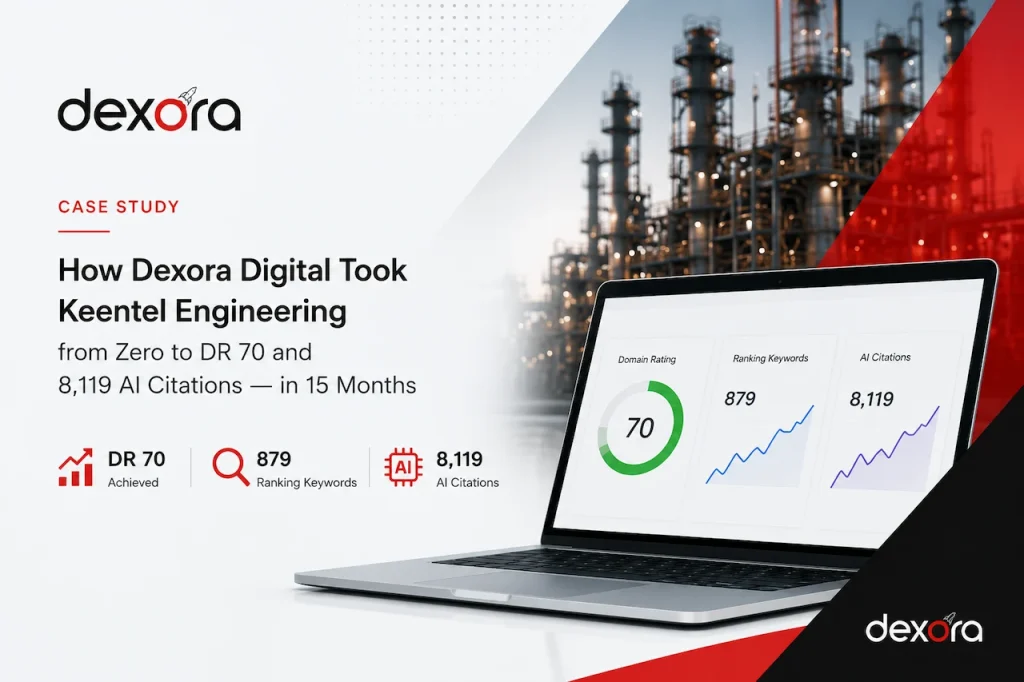
Starting point: A US-based engineering firm with an established website and strong domain authority. Zero AI search presence. No llms.txt. No FAQPage schema. GPTBot partially blocked in robots.txt.
What we did: Month 1 — full technical SEO audit, robots.txt AI crawler fix, llms.txt creation, Organization schema with sameAs links to GBP and LinkedIn. Month 2 — FAQPage schema on all 12 service pages (10 questions each), content restructuring for AI extraction. Month 3 — content depth expansion on primary service pages, entity signal building, citation monitoring implementation.
Result over 15 months: 81 organic keywords grew to 1,100+. AI citations grew from zero to 8,119 per month across ChatGPT, Google AI Mode, Google AI Overviews, and Gemini. 120,000 Generative AI impressions confirmed in GSC in 3 months alone.
The SEO + AEO + GEO combination
Traditional SEO expanded keyword rankings. AEO signals (FAQPage schema, content restructuring) drove 120K GSC Generative AI impressions. GEO signals (Organization schema, entity consistency) drove 8,119 monthly ChatGPT and Gemini citations. All three channels running simultaneously.
Property Management, Paso Robles, California: 8 ChatGPT Pages, 15% Maps CTR

Starting point: An established California property management company with decent organic rankings but low Google Maps CTR and zero AI search presence.
What we did: Phase 1 — Google Business Profile deep optimization (category precision, photo volume, review velocity strategy, service section completion). Phase 2 — FAQPage schema on all service pages, location-specific FAQ content for Paso Robles searches, Organization schema with GBP sameAs link. Phase 3 — Content authority building, citation monitoring.
Result over 3 years: 15% Google Maps click-through rate against an industry average of 2-5%. Position 1 for all primary commercial keywords. 8 pages now cited in ChatGPT for local property management recommendation queries. 19,800 organic clicks. 255 ranking keywords.
The local SEO + GEO combination
Local SEO drove Maps CTR to 15% (7.5x industry average). GBP entity optimization fed into GEO, producing 8 ChatGPT-cited pages without a separate GEO campaign — because the entity signals were built correctly as part of the Maps optimization.
New Domain, Tampa Storage, Florida: First AI Citations in 6 Weeks
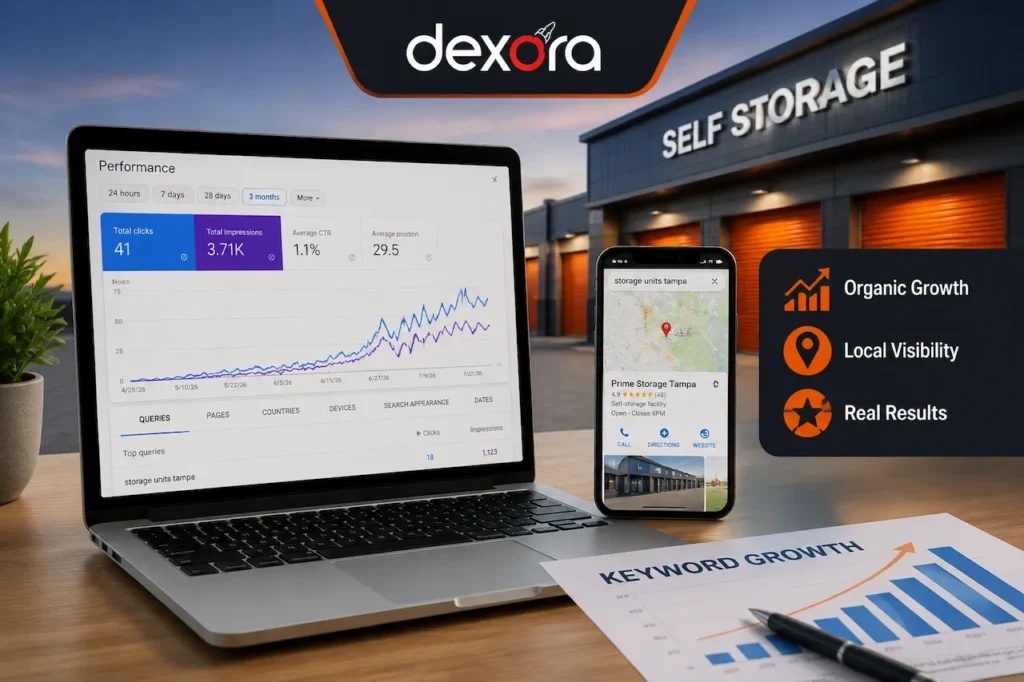
Starting point: A brand new domain with zero history, zero keywords, and zero authority. Needed to establish organic search presence and AI search visibility simultaneously.
What we did: Built the entire website with AEO and GEO signals in place before launch. llms.txt created before any page was published. FAQPage schema on all 5 service pages from day one. AI crawler access verified. Organization schema with sameAs links from launch.
Result in 8 weeks: 0 to 114 organic keywords. AI Overviews citations confirmed in GSC within 6 weeks of domain going live. First organic leads arriving within 2 months of launch.
Why starting with AEO/GEO from day one matters
Building AI search signals into the website before launch — rather than retrofitting them later — produced AI citations within 6 weeks. Most websites that retrofit these signals take 3-4 months longer to see equivalent results.
How to Start — Your AEO, GEO, and SEO Action Plan
The most common question after understanding these three disciplines is: where do I start? Here is the correct sequence.
Step 1 — Technical Foundation (Week 1-2)
Before any AEO or GEO work, establish the technical foundation that makes all three channels effective:
→ Run Google PageSpeed Insights on your homepage and primary service pages — mobile tab. Fix anything scoring below 70.
→ Check Google Search Console Coverage report. Identify any pages flagged as not indexed, not crawled, or returning errors.
→ Check your robots.txt at yourdomain.com/robots.txt. Verify GPTBot, ClaudeBot, and PerplexityBot are not disallowed.
→ Create llms.txt at your domain root. List all service pages, blog content categories, and FAQ sections with brief descriptions.
Step 2 — AEO Implementation (Week 2-4)
→ Write 10-15 FAQ questions for each service page. Each answer: 60-80 words, self-contained, specific to your service and location.
→ Implement FAQPage JSON-LD schema on all service pages. Validate with Google’s Rich Results Test.
→ Submit updated pages to Google Search Console URL Inspection and request indexing.
→ Check GSC Generative AI features report weekly. Document your baseline impressions before and after implementation.
Step 3 — GEO Signals (Week 3-6)
→ Add Organization or LocalBusiness JSON-LD schema to your homepage with sameAs links to your GBP profile, LinkedIn page, and any other authoritative external profiles.
→ Audit your Google Business Profile: primary category should be the most specific category applicable to your primary service. Services section should list every individual service. Description should include your city and service explicitly.
→ Run a NAP consistency audit: your exact business name, address, and phone must match on your website, GBP, Yelp, Facebook, and all major directory listings. Inconsistencies confuse entity verification.
→ Set up SEMrush AI Visibility tracking for your domain. Document baseline citation count before AEO/GEO work begins.
Step 4 — Monitor and Compound (Month 2+)
→ Monthly: Check GSC Generative AI features impressions. Are they growing? Which pages are cited most?
→ Monthly: Check SEMrush AI Visibility citation count. Which AI platforms are citing you? Is the number growing?
→ Monthly: Publish 2-4 new pieces of content structured for AEO extraction with FAQPage schema on each.
→ Quarterly: Update llms.txt to include all new content published since last update.
Key insight
AI citation growth is not linear. The first 4-8 weeks typically show modest impressions. Weeks 8-16 typically show accelerating growth as AI systems increase their confidence in your content. Months 4-6 typically show the compound growth rate. Patience and consistency are more important than any individual tactic.
The 5 Most Common Mistakes Businesses Make With AEO and GEO
Mistake 1 — Treating AEO and GEO as Replacements for SEO
The most persistent misconception. Some businesses, reading about the declining click-through rates on organic results, conclude that SEO is dying and invest entirely in AI search. This is wrong. SEO still drives the majority of search traffic for most businesses. AI Overviews and AI recommendations do not eliminate organic search — they add a layer above it. Abandoning SEO to focus on AEO or GEO is like stopping to water your lawn because it might rain.
Mistake 2 — Adding FAQ Content Without FAQPage Schema
Many businesses add FAQ sections to their service pages as a conversion element — a sensible practice. But without FAQPage JSON-LD schema, those FAQ sections are invisible to AI extraction systems. Google’s Rich Results Test will not register them. GPTBot and ClaudeBot cannot identify them as structured Q&A content. The content is there. The machine-readable signal is not.
Mistake 3 — Blocking AI Crawlers in robots.txt
This is the single most common technical error in AI search. Security plugins like Wordfence, iThemes Security, and others frequently add broad bot-blocking rules to robots.txt as a security measure. These rules often block GPTBot, ClaudeBot, and PerplexityBot. A website blocked to AI crawlers cannot appear in AI search results regardless of content quality. Check your robots.txt today.
Mistake 4 — Inconsistent Business Name or Address Across Platforms
Entity verification fails when AI systems find inconsistent information about your business across platforms. If your website says ‘Southwest Plumbing Solutions’ but your GBP says ‘SW Plumbing Solutions LLC’ and your Yelp listing says ‘Southwest Plumbing’, you have three different entities in the AI system’s perspective — none of which it can confidently recommend as a verified business.
Mistake 5 — Expecting AI Search Results in 2-4 Weeks
The timeline for AEO and GEO results is longer than for traditional Google Ads and similar to traditional SEO. First AI impressions typically appear in GSC 4-8 weeks after correct implementation. Meaningful citation volume takes 3-6 months. Compound growth — where AI systems increase recommendation frequency based on established citation history — takes 6-12 months. Businesses that abandon AI search after 30 days miss the compound phase entirely.
AEO vs GEO vs SEO — Frequently Asked Questions
Q: What is the difference between AEO and GEO?
A: AEO — Answer Engine Optimization — focuses on getting your content cited when AI systems generate answers to informational questions. When Google AI Overviews answers ‘how much does HVAC repair cost?’ using content from your service page, that is AEO. GEO — Generative Engine Optimization — focuses on getting your business recommended by name when AI systems answer recommendation queries. When ChatGPT names specific HVAC companies in response to ‘who should I hire for HVAC in Phoenix?’, that is GEO. AEO is about content citation. GEO is about brand recommendation. Both require the same technical foundation but optimise different signals.
Q: Is SEO still relevant in 2026 with AI Overviews?
A: Yes, unambiguously. Despite AI Overviews appearing on 20%+ of US Google searches, organic search remains the primary search channel for most businesses. AI Overviews appear above organic results — they do not replace them. For queries where AI Overviews appear, the three organic links that appear below the AI Overview still receive clicks from users who want to verify information or explore further. Google confirmed in its May 2026 AEO guide that traditional SEO best practices ‘remain relevant and foundational to success with generative AI features.’ SEO is the foundation. AEO and GEO are built on top of it.
Q: What is the most important signal for AEO?
A: FAQPage schema combined with self-contained answer format is the single most impactful AEO signal. When a service page has 10-15 FAQ questions with answers in the 60-80 word self-contained format, implemented with FAQPage JSON-LD schema validated by Google’s Rich Results Test, that page is significantly more likely to be cited in AI-generated responses than the same content without schema. The second most important signal is AI crawler access: GPTBot, ClaudeBot, and PerplexityBot must be permitted in your robots.txt. Content that crawlers cannot reach cannot be cited.
Q: What is the most important signal for GEO?
A: Organization or LocalBusiness schema with sameAs links is the primary GEO signal. When your homepage has JSON-LD schema that explicitly identifies your business name, location, services, and links to authoritative external profiles — Google Business Profile, LinkedIn, and others — through the sameAs property, AI systems have a verified entity they can confidently recommend. The second most important GEO signal is Google Business Profile completeness: for local businesses, GBP is the most authoritative local entity signal AI systems use when generating local recommendation responses.
Q: Can a website rank position 1 in Google and still be invisible in AI search?
A: Yes, and this is one of the most common situations we encounter in client audits. Google’s organic ranking algorithm and its AI citation algorithm are different systems that use partially different signals. A page that ranks position 1 for ‘plumber Phoenix’ because it has strong backlinks and excellent on-page optimization may not appear in AI Overviews for the same query if it lacks FAQPage schema, has its content in a format that is difficult for AI systems to extract, or is blocked to AI crawlers in robots.txt. Organic ranking authority and AI citation eligibility are related but not identical.
Q: How long does it take to see results from AEO and GEO?
A: AEO results — measured by GSC Generative AI features impressions — typically begin appearing 4 to 8 weeks after correct FAQPage schema implementation and AI crawler access verification. GEO results — measured by SEMrush AI Visibility citation counts — typically begin appearing 8 to 12 weeks after Organization schema and entity signal implementation. Both compounds: each subsequent month tends to produce more citations than the previous month as AI systems increase their confidence in your content and entity. The Tampa storage business we worked with saw first AI Overviews citations in GSC within 6 weeks. Keentel Engineering reached 8,119 monthly citations after 15 months.
Q: Do I need a separate content strategy for AEO vs SEO?
A: No. The content that works for AEO is the same content that works for SEO: specific, expert, well-structured content that fully answers the questions your target clients ask. The difference is format. For SEO, that content is optimized for keyword relevance and search intent. For AEO, the same content is additionally structured as self-contained Q&A pairs with FAQPage schema. You do not need two separate content teams or two separate editorial calendars. You need one content strategy that produces expert content, and then you add the AEO-specific formatting and schema on top.
Q: What is llms.txt and is it required for AEO or GEO?
A: llms.txt is a plain text file placed at your domain root — yourdomain.com/llms.txt — that tells AI crawlers what content exists on your site and how to prioritize it. It is not strictly required for AEO or GEO to work, but its absence means AI crawlers make their own indexing decisions — which frequently results in important service pages being missed while less important pages are indexed. Most websites that implement llms.txt see measurable improvement in GSC Generative AI features impressions within 4 to 8 weeks. We create it as standard for every client because the cost is low (30 minutes to create) and the benefit to AI content discovery is consistent and documented.
Q: How do I check if my website is currently invisible in AI search?
A: Three checks will tell you your current AI search position. First: open Google Search Console, go to Performance, and look for Generative AI features in the left navigation. This report shows your current GSC AI impressions. If it shows zero or very low numbers, your content is not currently being cited in Google AI features. Second: go to yourdomain.com/robots.txt in your browser and check whether GPTBot, ClaudeBot, or PerplexityBot are listed under Disallow rules. Third: if you have a SEMrush subscription, open AI Visibility in the left sidebar. It will show your current citation count across AI platforms. Together, these three checks give you a complete picture of your current AI search visibility.
Q: Which AI systems should I optimize for — ChatGPT, Google AI, or Perplexity?
A: All three, because they share the same foundational signals. llms.txt helps GPTBot (ChatGPT), ClaudeBot, and PerplexityBot simultaneously. FAQPage schema helps Google AI Overviews and Google AI Mode. Organization schema with sameAs links helps all AI systems verify your entity. The only platform-specific signal is Google Business Profile, which primarily benefits Google’s local AI recommendations. The practical approach: implement the shared foundation (llms.txt, robots.txt, FAQPage schema, Organization schema, GBP) and you are optimized for all major AI search platforms simultaneously.
Q: Can I do AEO and GEO myself, or do I need an agency?
A: The technical implementation — creating llms.txt, writing FAQPage schema, implementing Organization schema — requires either developer knowledge or a CMS like WordPress with Rank Math, which provides a Custom Schema field. A technically comfortable business owner can implement the basics themselves in 4 to 6 hours. The parts that are harder to do without expertise are writing 10-15 high-quality, self-contained FAQ answers for each service page, building the full entity signal stack across platforms, and interpreting the monthly GSC and SEMrush AI Visibility data to identify what is working and what needs adjustment. Most businesses do better working with a specialist for implementation and monitoring while handling content production in-house.
Q: Does Google’s official AEO guide change how we should approach optimization?
A: Yes. In May 2026, Google published its first official guide to optimizing for generative AI features in Google Search, authored by John Mueller and published on Google Search Central. [2] The guide confirmed several important points: valuable, unique, non-commodity content is prioritized; traditional SEO best practices ‘remain relevant and foundational’; and specific content types — local, shopping, video, and image content — have specific optimization paths for AI features. The guide also included a mythbusting section on AEO and GEO misconceptions, signaling that these terms are now mainstream enough to warrant official clarification. The guide validates the foundational approach we have been applying: strong traditional SEO as the foundation, with AEO and GEO signals layered on top.
Q: How is GEO different for local businesses vs national businesses?
A: Local businesses have a significant GEO advantage that most do not know about: Google Business Profile is one of the most authoritative local entity signals available. When a user asks ChatGPT for a business recommendation in a specific city, the AI prioritizes businesses with strong entity consistency — matching information across GBP, website, and directory listings — combined with FAQPage schema addressing location-specific questions. For local businesses, GBP optimization is simultaneously a local SEO action, a GEO action, and an entity signal. National businesses, without a GBP presence, must rely more heavily on website entity signals, brand mentions, and topical authority to achieve equivalent GEO results.
Q: Is there a risk of being penalized for AEO or GEO optimization?
A: No. AEO and GEO optimization uses schema markup, structured content, and entity signals — all of which are recommended by Google’s official documentation. There is no equivalent of a Google penalty for implementing FAQPage schema or Organization schema correctly. The only risk is implementing schema incorrectly, which can result in rich result eligibility being revoked, or creating low-quality FAQ content that provides a poor user experience, which could negatively affect overall content quality signals. Both are easily avoided by following Google’s schema implementation guidelines and writing genuine, expert FAQ content rather than thin or duplicate material.
Q: What is the relationship between E-E-A-T and AEO/GEO?
A: E-E-A-T — Experience, Expertise, Authoritativeness, Trustworthiness — is Google’s content quality framework and one of the primary factors influencing which content appears in AI-generated responses. Content that demonstrates genuine experience (case studies, verified results, first-hand knowledge), real expertise (specific technical claims, accurate industry data), authoritativeness (author credentials, brand mentions, external citations), and trustworthiness (accurate information, transparent sourcing, verifiable claims) is significantly more likely to be cited in AI-generated responses than content that is generic, unattributed, or difficult to verify. Author schema — explicitly identifying the author with credentials and a link to their public professional profile — is the technical implementation of E-E-A-T signaling for AI search purposes.
Q: How should I prioritize AEO vs GEO vs SEO with a limited budget?
A: With a limited budget, the correct priority order is: technical SEO foundation first, then AEO, then GEO. The reason is compound returns: fixing technical SEO issues (Core Web Vitals, crawlability, schema) immediately benefits all three channels. AEO implementation (FAQPage schema, content structure, llms.txt) builds the content signals that make GEO more effective. GEO signals (Organization schema, entity consistency, brand mentions) work best when the technical and content foundation is already established. The businesses that try to implement GEO without an AEO and SEO foundation typically see weaker citation growth and longer timelines than businesses that build in the correct sequence.
Q: How often should AEO and GEO signals be updated?
A: FAQPage schema and content should be reviewed when you add new services, when common customer questions change, or when you notice specific AI-generated responses attributing incorrect information about your category to competitors. Organization schema and GBP should be updated whenever your business details change — address, phone, service areas, hours. llms.txt should be updated whenever you publish significant new content — new service pages, new blog sections, or new FAQ pages. Monthly monitoring of GSC Generative AI features and SEMrush AI Visibility data tells you whether your signals are producing results and what specifically needs adjustment. An agency or specialist typically handles monthly monitoring and quarterly signal reviews as part of an ongoing retainer.
Related reading
- NERC, IEEE, and the Standards Language Engineering Buyers Actually Search
- SEO Automation vs Manual SEO: What 7 Years in the Industry Actually Taught Me
- The PDF Portfolio Problem: Why Your Best Engineering Projects Are Invisible to AI Search
Want help putting this into practice? See our AI search optimization services or book a free consultation.