
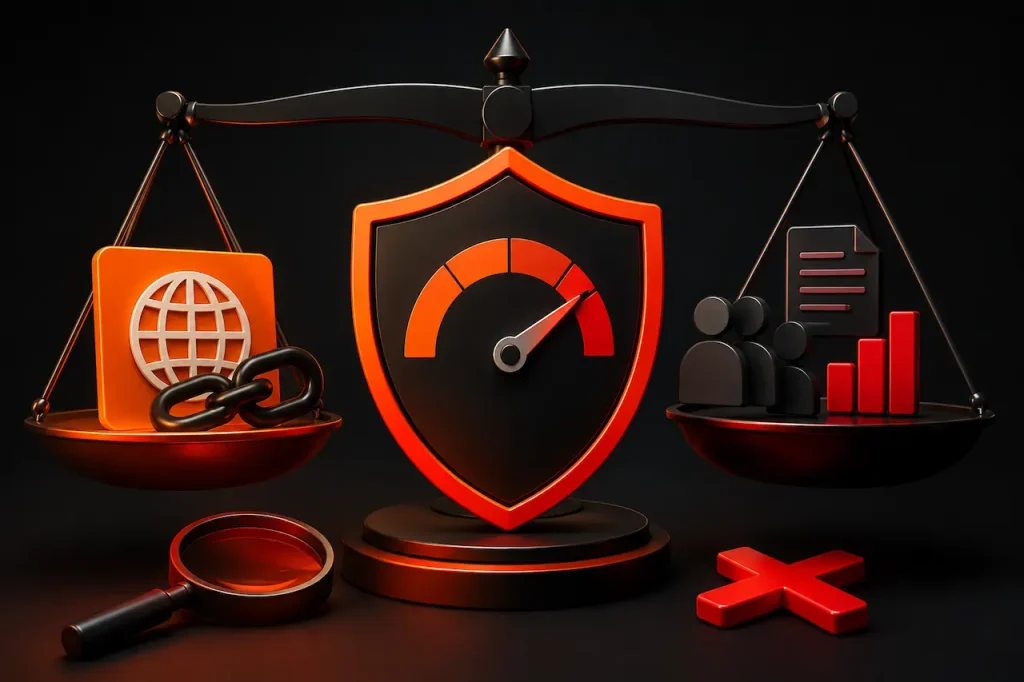
Every week, someone asks me to help them ‘improve their domain authority.’ And every week, I have to explain that domain authority is not a Google metric.
It was invented by Moz. It is a useful proxy. But treating it as a ranking target rather than a diagnostic signal is a mistake that wastes genuine SEO effort.
Here is what domain authority actually is, what it is useful for, and — more importantly — what you should be doing instead of chasing a number that Google doesn’t directly care about.
Building genuine off-page authority is what drives rankings, not the number →
What Domain Authority Is — And What It Isn’t
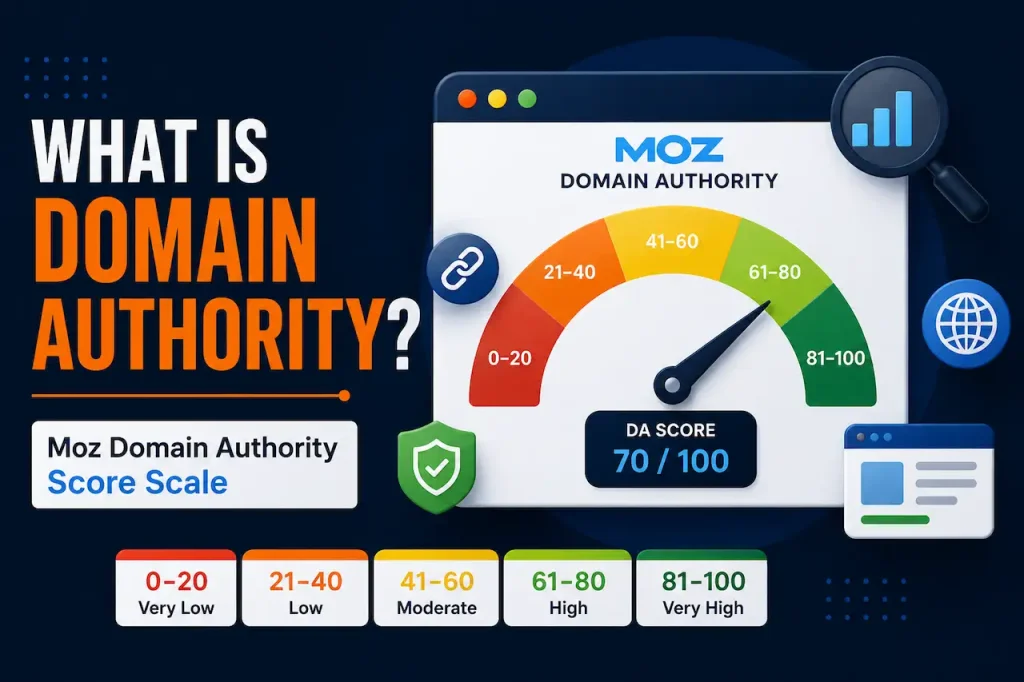
Domain Authority (DA) is a metric created by Moz, a software company, to predict how likely a website is to rank in search results. It is scored from 1 to 100. Higher is better.
Ahrefs has its own version called Domain Rating (DR). SEMrush has Authority Score. These are all third-party metrics proxies developed by tool companies to approximate what Google’s algorithm might think of a domain. None of them is an official Google metric.
Google has confirmed multiple times that it does not use domain authority, domain rating, or any equivalent score as a ranking factor.
Domain authority is a map of the territory. Not the territory itself.
Moz explanation of how Domain Authority is calculated and what it does and doesn’t predict →
What Domain Authority Does Predict
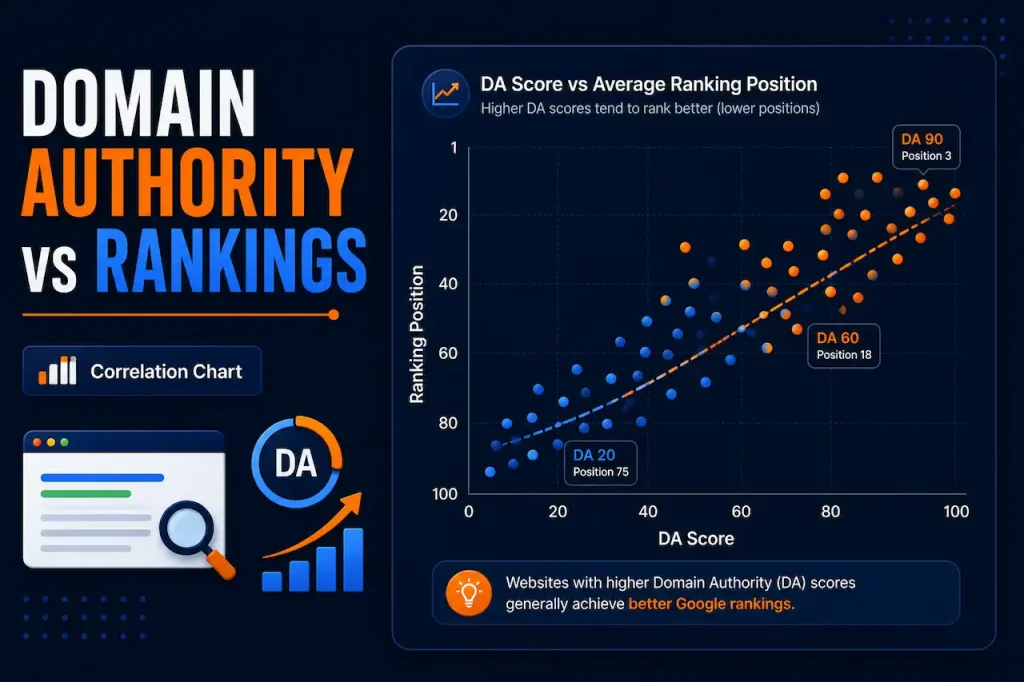
Despite not being a Google metric, DA and DR are useful because the things that drive them up are real ranking factors. High domain authority generally correlates with many high-quality backlinks, which Google does factor into rankings.
A site with DA 70 tends to rank more easily than a site with DA 20 — not because of the DA score, but because a DA 70 site almost certainly has a stronger backlink profile, more trusted content, and a longer track record with Google.
What Actually Affects Your Domain’s Ranking Power
Since domain authority is a proxy, let’s talk about what it’s proxying — the actual factors that make a domain powerful in search.
The Quantity and Quality of Referring Domains
How many unique domains link to you? Backlinks from 500 different, relevant, credible sites are worth dramatically more than 5,000 links from 10 low-quality sites. Referring domain diversity is the core signal.
The Trustworthiness of Linking Sites
Links from government sites (.gov), educational institutions (.edu), major national news outlets, and established industry publications carry far more weight than links from generic blogs or directories.
The Relevance of Your Backlink Profile
Links from sites in your industry or topic area tell Google that experts in your field vouch for you. A plumbing company with backlinks from home improvement publications, contractor associations, and local business directories has a highly relevant link profile.
The Age and Consistency of Your Link Acquisition
Domains that have been earning links consistently for years are more trusted than domains that acquired 200 links in a short burst. Sustainable link-building pace matters.
Ahrefs comparison of Domain Rating vs Domain Authority and what each measures →
How to Improve Your Site’s Actual Ranking Power
If you want to improve what domain authority is approximating — rather than the metric itself — here is what actually works.
Build Genuine Editorial Backlinks
Get featured in publications your target audience reads. Create content so useful that other sites reference it naturally. Do digital PR. Earn local business directory listings and industry association memberships.
Each referring domain from a credible, relevant source strengthens the underlying authority that DA is trying to measure.
Publish Content That Earns Links Over Time
The sites with the highest domain authority have often had it compound slowly over years through consistent, quality publishing. Original research, definitive guides, free tools — these earn links consistently, which builds authority consistently.
Remove or Disavow Toxic Links
A backlink profile full of spammy, irrelevant, or manipulative links can suppress your domain authority. A backlink audit identifies these. Toxic links can be disavowed using Google’s Disavow tool — telling Google to ignore them when evaluating your site.
Build Internal Authority Through Smart Linking
Internal links distribute the authority your backlinks bring in across the pages of your site. A strong internal linking structure means the authority from your best backlinks reaches your most important pages.
Technical SEO ensures authority from backlinks is properly distributed across your site →
The Domain Authority Mistakes That Waste SEO Effort
Mistake: Treating DA improvement as a goal rather than a byproduct. Why it happens: it’s a clear number that appears to measure progress. What it costs you: you focus on the metric instead of the underlying activity that matters.
Mistake: Buying links to quickly improve DA. Why it happens: it works temporarily. What it costs you: Google penalties that drop your rankings far below where you started, plus the potential for a manual action.
Mistake: Comparing your DA to competitors and thinking it directly explains the ranking gap. Why it happens: DA is the visible metric. What it costs you: you miss the actual factors — content quality, technical health, relevance — that are often more important than the DA gap.
Mistake: Accepting a low DA as a permanent ceiling. Why it happens: improving domain authority feels like a long, slow process. What it costs you: missing the fact that a new site can rank above much higher DA sites for the right long-tail keywords, especially in local markets.
Search Engine Journal on the limitations of domain authority as an SEO metric →
FAQ: Domain Authority
Q: What is a good domain authority score?
A: ‘Good’ is relative to your competition. A local business with a DA of 20–30 can rank well for local and niche keywords. A national brand competing in high-competition verticals may need DA 50+. The meaningful comparison is not against an absolute scale — it is against the DA of sites currently outranking you for your target keywords.
Q: How long does it take to increase domain authority?
A: Meaningfully improving domain authority typically takes 6–12 months of consistent link-building activity. Gains are initially slow (DA has a logarithmic scale — moving from 10 to 20 is easier than moving from 50 to 60) and then compound as your link-building activity accumulates over time. Quick jumps in DA are often artificial and short-lived.
Q: Does domain authority affect Google rankings directly?
A: No. Domain Authority is a third-party metric created by Moz — not a Google ranking factor. However, the underlying signals it approximates (backlink profile quality, referring domain diversity, trustworthiness of linking sites) are genuine Google ranking factors. A site with high domain authority generally ranks better because of what caused the high DA, not because of the score itself.
Q: Why is my domain authority different in Moz vs Ahrefs?
A: Moz’s Domain Authority and Ahrefs’ Domain Rating are different metrics calculated by different companies using different methodologies and different indexes of the web. They measure similar things — the strength of a domain’s backlink profile — but use different data and formulas. Both are useful as directional indicators; neither is more ‘correct’ than the other.
Q: Should I worry about a competitor’s domain authority being much higher than mine?
A: Contextually, yes — but not as a direct obstacle. A competitor with DA 60 vs your DA 15 has a genuine authority advantage. However, you can still outrank them for specific long-tail and niche queries by having better content relevance, stronger topical authority in your specific niche, or better technical SEO. Closing the DA gap is a long game; competing smartly in the meantime is also viable.
Build the Thing Domain Authority Measures — Not the Number
Domain authority is telling you something true about a website’s standing in the ecosystem of links and trust that underpins Google.
Chase the thing it is measuring — real backlinks from credible sources, consistent quality content, genuine authority in your field — and domain authority follows as a byproduct.
Chase the number itself, and you’ll find clever ways to temporarily inflate a metric that Google doesn’t use while ignoring the actual work that would have moved your rankings.
| [IL-2: a complete SEO strategy builds genuine domain authority the right way → /seo-services/] |
A high domain authority score is the result of being trustworthy — not the cause of it.
| [IL-4: find out how your domain authority compares to your top competitors → /seo-audit/] We’ll benchmark your current authority against the sites outranking you and show you the gap to close. [CTA: Get Your Free Competitor Analysis → /seo-audit/] |

Local SEO and AI Search (AEO & GEO) Specialist.
Building search visibility that converts into qualified demand.
Today, businesses need visibility on Google Maps and AI powered search and websites that actually convert visitors into leads. I am a Local SEO, AI Search & Conversion Rate Optimization (CRO) Specialist with 5+ years of hands on experience helping businesses turn underperforming websites into high converting growth engines. My work combines Local SEO, Technical SEO, Semantic SEO, GEO/AEO, and conversion focused landing page optimization to ensure brands are discoverable and profitable.
My Experience
I have delivered SEO and web growth projects across the US, UK, Australia, Canada, Finland, Germany, and the Czech Republic, working in industries such as local businesses (electrician, hvac, cleaning, Real estate, healthcare, B2B, eCommerce, SaaS, and environmental services.
Some Results
>> 200+ websites audited globally
>> specifically worked with 100+ local business (80% from USA)
>> 80+ websites improved through technical SEO & schema fixes
>> 20+ businesses featured in Google AI Overviews (SGE)
>> Multi million impression growth for eCommerce & SaaS brands
Book Free Consultation: calendly.com/dexora/30min