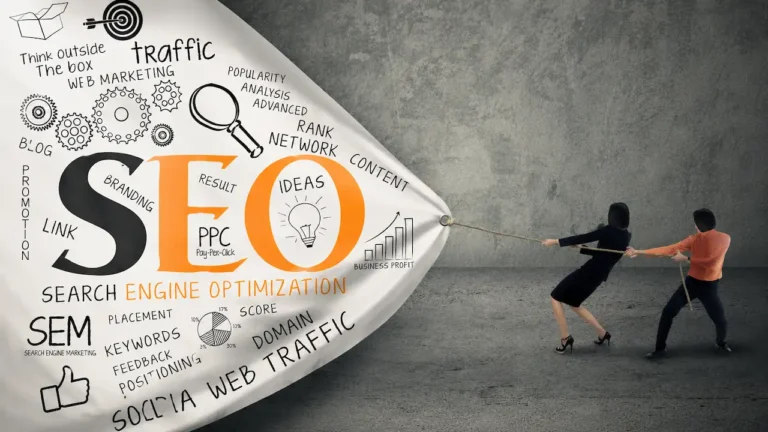

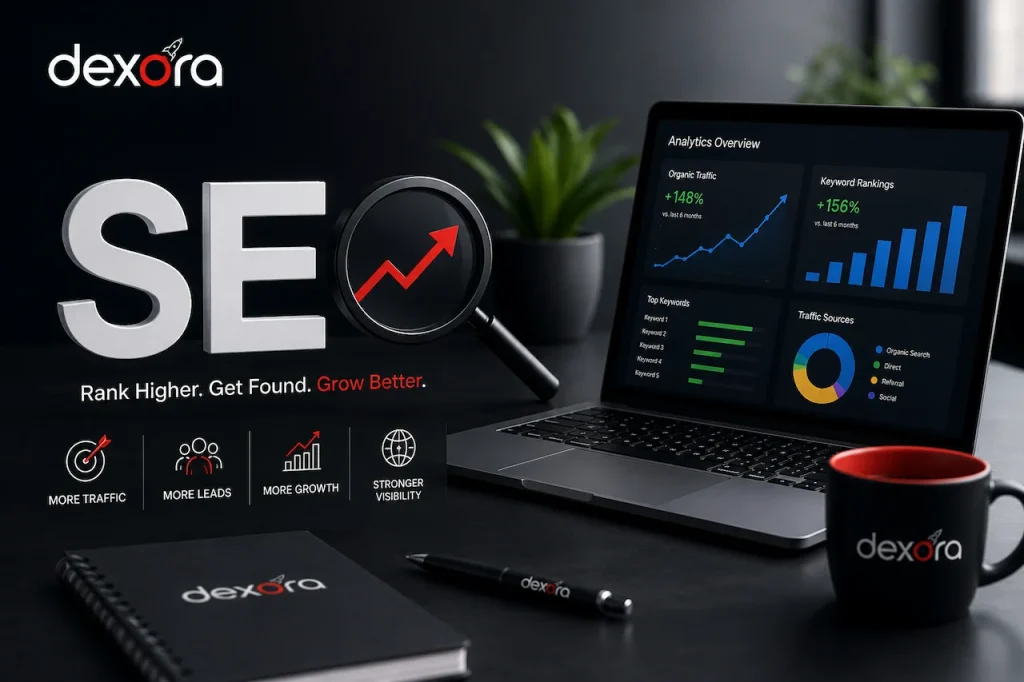
Nobody clicks to page two. That sentence is the entire business case for SEO.
If your website doesn’t appear on the first page of Google when your ideal customer searches for what you sell, you are invisible. Not slow. Not struggling. Invisible. That is the problem SEO exists to solve.
In this article, I am going to explain what SEO actually is in plain language, why it matters more — not less — in 2026, and what separates businesses that grow through organic search from the ones that throw budget at it and wonder why nothing sticks.
Learn how local SEO services bring customers to your door →
Why Most Businesses Get SEO Wrong from the Very First Day
I have worked with small businesses, national brands, and solo consultants. The story is almost always the same.
Someone builds a website. They publish it. They wait. Then they pay someone to ‘do SEO.’ Three months later, nothing has changed, and they decide SEO doesn’t work.
The problem was never the tactic. The problem was the expectation.
SEO is not a campaign. It is a compounding asset.
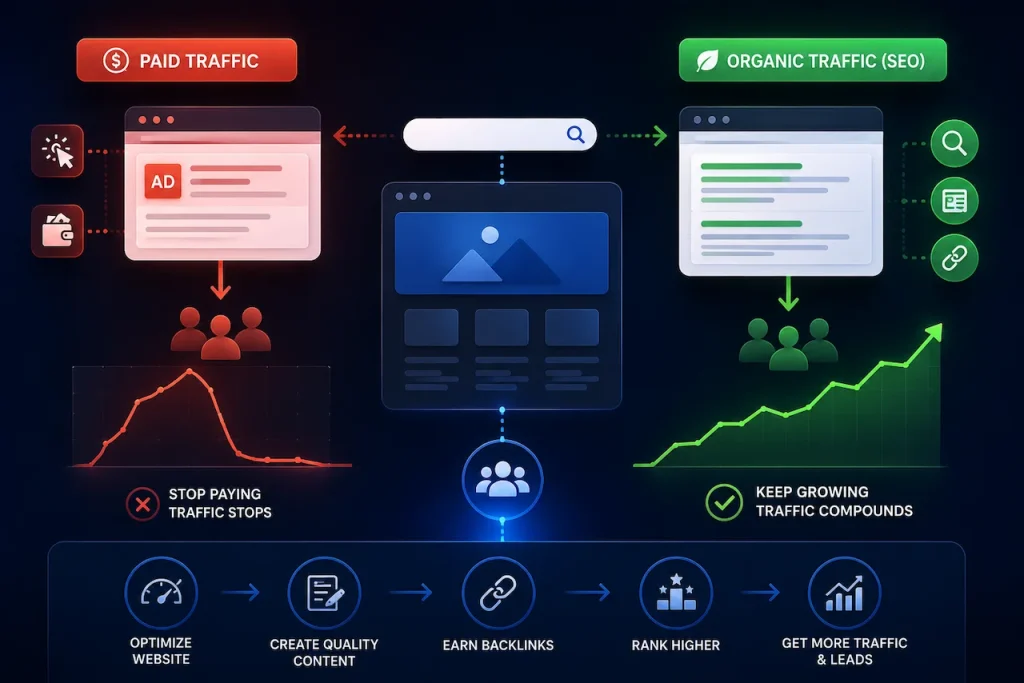
Most businesses treat SEO like advertisin you spend money, something happens immediately, you stop spending, nothing happens. That is not how this works. SEO is closer to a pension. Small, consistent deposits. Slow growth at first. Then the compounding kicks in and the returns dwarf what you put in.
According to BrightEdge, organic search drives 53% of all website traffic across industries. Paid search drives around 15%. If you are only investing in paid, you are fighting for the smaller slice.
Google Search Central — how Google Search works →
What SEO Actually Is — No Jargon, No Fluff
Search Engine Optimisation is the process of making your website more likely to appear — and rank well — when people search for things related to your business.
That is it. Everything else is a tactic in service of that goal.
When someone types ’emergency plumber Bristol’ into Google, a machine crawls the entire internet, evaluates thousands of pages, and decides which 10 to show. SEO is the work you do to influence that decision.
How Search Engines Work — The Three Steps That Decide Your Fate
Google does three things: crawl, index, rank.
Crawling means Google sends bots (called crawlers or spiders) to discover your pages by following links. If your site structure is poor, key pages won’t get crawled.
Indexing means Google reads and stores the content it finds. If your page has no content, thin content, or duplicate content, it might be indexed poorly — or not at all.
Ranking means Google scores your indexed pages against search queries and decides where to put them. Rankings are based on hundreds of factors: relevance, authority, speed, user experience, and increasingly — trust.
You can’t rank what Google can’t find. You can’t win trust you never built.
The Three Types of SEO — And Why You Need All Three
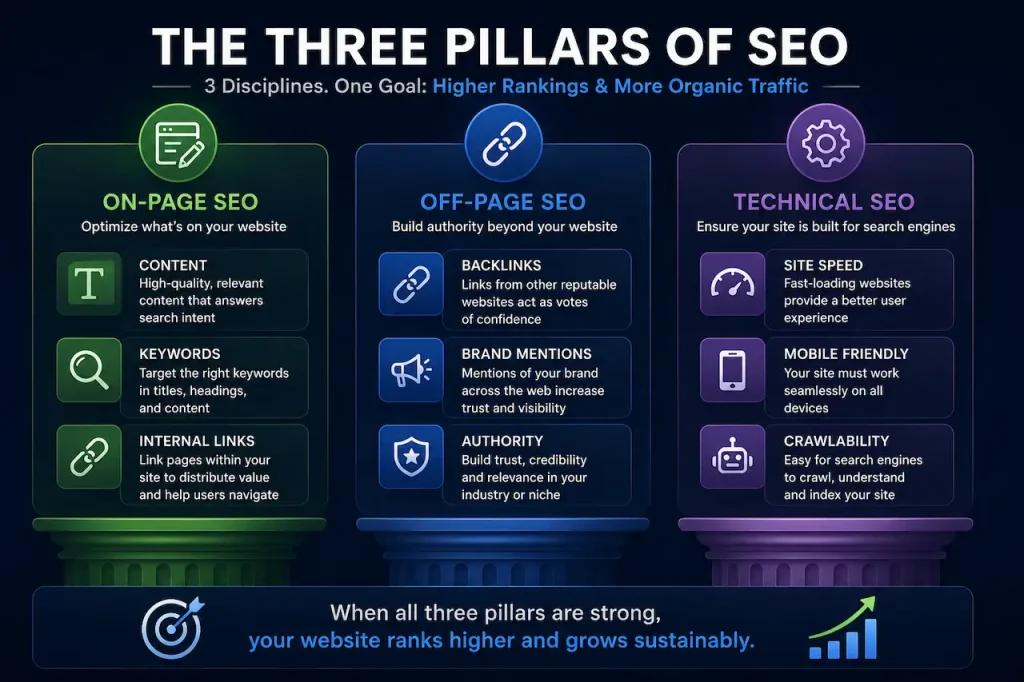
SEO splits into three disciplines. Most businesses neglect at least one of them.
On-page SEO covers everything on the actual page: the words, the headings, the keyword placement, the internal links, the metadata. This is where most beginners start — and most of them stay here, which is a mistake.
Off-page SEO is everything that happens away from your site. Backlinks from other websites. Brand mentions. Social signals. This tells Google that other parts of the internet vouch for you.
Technical SEO is the infrastructure. How fast your site loads. Whether it works on mobile. Whether Google can crawl and index it without friction. A beautiful website with terrible technical SEO is like a store with no front door.
See how technical SEO fixes the foundations your rankings depend on →
Why SEO in 2026 Is Different — And More Important Than Before
The landscape has shifted twice in two years. And both shifts favour businesses that invest in genuine, useful content.
First, Google AI Overviews now answer simple queries directly in the search results. That sounds like bad news for SEO. It is actually an opportunity — because the sources Google cites in AI Overviews are the same authoritative sites that rank well organically.
Second, ChatGPT, Perplexity, and other AI tools are now genuine discovery engines. People ask them questions and act on their recommendations. Those tools pull from the web too. If your site is not authoritative and well-structured, you are invisible to both Google and AI search.
The websites that win in 2026 are built for trust, not tricks.
SEO and AI Search Are Not Competing — They Are the Same Race
I see businesses ask whether they should optimise for Google or for AI assistants. The answer is yes to both — and the strategy is almost identical.
Great content. Clear structure. Real expertise. External validation through backlinks and brand mentions. These things make you rank on Google. They also make you the source AI tools cite.
The sites getting recommended by ChatGPT and cited in Google AI Overviews share one thing: they have built genuine authority over time.
how AI search optimisation works for your business →
What SEO Is Not — The Myths That Cost Businesses Real Money
Before I explain what works, I need to clear the air on what doesn’t.
Myth 1: SEO is about stuffing keywords into every paragraph
Google has been penalising keyword stuffing since 2011. It still happens. I have reviewed sites where the phrase ‘plumber London’ appeared 47 times in a 600-word article. It does not help. It hurts.
Myth 2: SEO is a one-time job
You don’t optimise a site once and move on. Search is a moving target. Competitors publish new content. Google updates its algorithm. You update your service. SEO requires ongoing maintenance — not a set-and-forget sprint.
Myth 3: A new website can rank quickly with the right tricks
There are no tricks. There are best practices and there is patience. A new site can start picking up traffic in 3–6 months with the right strategy. But ‘right strategy’ means consistent, high-quality content and technical excellence not shortcuts.
This is the moment I am probably supposed to soften the message. I won’t. If someone promises you page-one rankings in 30 days, they are lying or they are about to get your site penalised.
Moz Beginner’s Guide to SEO — the most widely referenced introduction to SEO →
The Five Factors That Determine Your SEO Rankings
Google uses hundreds of signals. But five categories account for the vast majority of ranking differences between sites.
1. Content Relevance — Do You Actually Answer the Question?
Google is trying to match search queries to the most useful answer. Your content must actually answer what the searcher is asking — not just contain the keywords they used. These are different things.
A page about ‘plumber Bristol’ that only lists your services is less useful to a searcher than a page that explains what to expect, how pricing works, how to handle an emergency, and why your team is qualified. Depth wins.
2. Domain Authority — Does the Internet Vouch for You?
Authority is built through backlinks — other websites linking to yours. Each link is a vote of confidence. But not all votes are equal. One link from a respected industry publication is worth more than 100 links from random, low-quality directories.
This is why off-page SEO matters. You can have the best content on the internet and still rank poorly if no one links to it.
3. Technical Health — Can Google Actually Use Your Site?
Slow pages. Missing sitemaps. Broken internal links. Poor mobile experience. Duplicate content. These are technical issues, and they all erode your ability to rank regardless of how good your content is.
4. User Experience — What Happens After Someone Clicks?
Google watches what happens after someone visits your site. If they click your result and immediately bounce back to Google, that tells Google your page wasn’t what they were looking for. Engagement matters.
5. E-E-A-T — Experience, Expertise, Authoritativeness, Trust
Google introduced E-E-A-T guidelines to combat misinformation and low-quality content. It now evaluates whether your content is written by someone with real experience and expertise. For any topic that affects health, wealth, or safety — the bar is high.
In our work with clients across industries, this is the factor most frequently underestimated. A technically perfect website with generic content will lose to a scrappier competitor who clearly knows what they are talking about.
Search Engine Land — Google’s E-E-A-T guidelines explained →
FAQ: What Is SEO in 2026?
Q: What is SEO in simple terms?
A: SEO (Search Engine Optimisation) is the process of improving your website so it appears higher in search engine results when people search for topics related to your business. It combines content quality, technical website health, and external reputation signals like backlinks. The goal is organic, unpaid visibility that builds over time.
Q: Is SEO still worth it in 2026 with AI search taking over?
A: More than ever. AI search tools like ChatGPT and Perplexity pull from the same authoritative web sources that rank on Google. Building strong SEO fundamentals — quality content, clear site structure, genuine backlinks — makes you visible in both traditional search and AI-driven discovery. They are the same investment, not competing ones.
Q: How long does it take for SEO to work?
A: New websites typically begin seeing meaningful organic traffic in 6–12 months. Established sites with poor SEO can see improvements in 3–6 months with targeted work. The timeline depends heavily on your competition, content quality, technical health, and link-building pace. There are no legitimate shortcuts.
Q: What is the difference between SEO and paid advertising?
A: Paid advertising (PPC) places your site at the top of search results immediately, but the moment you stop paying, the traffic disappears. SEO builds organic rankings that persist and compound over time. Organic results also receive around 70% of all clicks versus 15% for paid results — searchers trust organic results more.
Q: Do I need an agency to do SEO, or can I do it myself?
A: The fundamentals of SEO — keyword research, content creation, basic on-page optimisation — can be learned and implemented by a motivated business owner. However, technical SEO, link building, and competitive analysis at scale require specialist knowledge and tools. Most businesses see a better return on hiring experienced help than trying to learn everything from scratch.
Q: What is the difference between local SEO and regular SEO?
A: Regular SEO targets national or global search results. Local SEO focuses specifically on appearing in geographically targeted searches — ‘plumber near me,’ ‘dentist in Bristol,’ and especially Google Maps results. Local SEO involves optimising your Google Business Profile, building local citations, and earning reviews in addition to standard SEO practices.
The Bottom Line on SEO in 2026
SEO is not magic. It is not a shortcut. It is not something you do once and forget.
It is the discipline of making your business findable by the people already searching for what you offer. When it works — and it does work — the traffic it delivers is more qualified, more consistent, and more sustainable than almost any other marketing channel.
Start with the fundamentals. Build genuine authority. Create content that actually helps people. Do it consistently.
Get a free SEO audit and find out where your site stands today →
The businesses that win in search aren’t the ones with the biggest budgets. They’re the ones that started building before everyone else.
Ready to build organic visibility that lasts? We audit your current SEO position, identify your biggest opportunities, and build a clear roadmap. No jargon. No vanity metrics. Just a plan that makes sense for your business.