

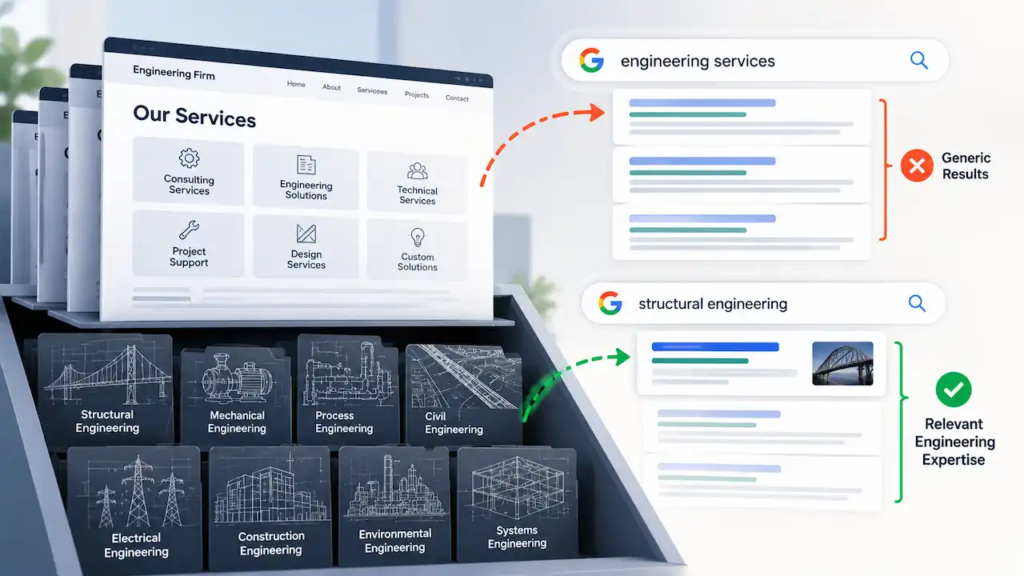
An engineering firm may have experienced technical teams, specialized capabilities, and a strong record of completed projects, yet remain difficult to find when prospective clients search for its services. The problem is often not a lack of expertise. It is how that expertise appears on the firm’s website.
A civil engineering consultancy might offer stormwater management, roadway design, and land development engineering, but describe everything under one broad heading: Engineering Services. That description may be technically accurate, yet it gives potential clients little information about the firm’s specific capabilities. For engineering principals and business development directors, this creates a visibility problem that can affect qualified project discovery.
Why Generic Engineering Service Pages Struggle in Search
Engineering buyers rarely evaluate firms based on the word “engineering” alone. They often search around a technical requirement, facility type, project challenge, or geographic market. A developer may need a stormwater drainage consultant. An industrial facility may require an electrical power system study. A building owner may be evaluating structural assessment services.
If an engineering website describes all these capabilities through general statements about technical excellence, it may fail to communicate the services buyers are researching.
Technical Accuracy Does Not Automatically Create Search Relevance
Engineering terminology serves an important professional purpose. However, the language used internally by engineers does not always match the language used by project owners, developers, procurement teams, or facility managers.
For example, a firm might describe its expertise as “hydrologic and hydraulic analysis.” A prospective client may search for “stormwater drainage engineering services.”
Both descriptions can relate to similar work, but they reflect different levels of technical familiarity. Effective SEO for engineering firms connects accurate professional terminology with the questions and service descriptions prospective clients use during research. That does not mean replacing technical language with simplified marketing claims. It means explaining specialized services clearly enough for both technical and nontechnical decision-makers.
Poor Service Structure Can Hide Valuable Specializations
A single services page may be appropriate for a firm with a narrow offering. For a multidisciplinary practice, however, combining unrelated specialties can make individual capabilities difficult to discover. A structural engineering firm offering forensic investigations, existing building assessments, and structural design should evaluate whether those services deserve distinct explanations.
When specialized work is buried in short paragraphs, prospective clients may struggle to determine whether the firm handles their particular project. This can weaken the website’s role in early vendor research and leave business development teams more dependent on referrals.
How Engineering Firms Should Structure Their Service Pages
Improving engineering website SEO begins with organizing services around actual capabilities and buyer requirements.
Audit the Existing Service Taxonomy
Start by reviewing every service listed on the website. Compare those descriptions with the firm’s current offerings, project experience, and target sectors. Identify broad categories that contain several distinct services. Then determine which specialties have enough unique scope, relevant expertise, and client demand to justify dedicated pages.
For example, an MEP engineering consultancy might organize electrical engineering under a main service category, with more specific information about power distribution design, lighting systems, and electrical studies where appropriate. The structure should reflect real service distinctions rather than creating separate pages for every keyword variation.
Connect Technical Services With Project Types
Engineering buyers often evaluate expertise within a particular project environment. A geotechnical engineering page, for instance, may be more useful when it explains the firm’s relevant work for commercial developments, transportation projects, or industrial facilities.
Project examples can demonstrate where the service applies, what engineering responsibilities are involved, and which challenges the firm is equipped to address. This relationship between service, sector, and project type helps prospective clients evaluate suitability before requesting qualifications or initiating a discussion.
Use Searchable Language Without Sacrificing Technical Precision
Service headings should describe recognizable engineering capabilities. A page titled “Our Solutions” provides less immediate context than one titled “Structural Engineering Services.” Supporting headings can then explain specific applications, technical considerations, and relevant project requirements. Use the correct terminology throughout the page, but clarify specialized concepts where necessary. A well-structured service page should answer:
- What engineering service does the firm provide?
- Which project types or industries does it support?
- What technical responsibilities fall within its scope?
- Where does the firm provide these services?
- How can a prospective client begin an evaluation?
Avoid adding unsupported claims about certifications, approvals, or project results. Engineering buyers need credible evidence, not exaggerated positioning.
Avoid Thin Pages and Overlapping Service Content
Creating more pages does not automatically improve search visibility. Publishing separate pages for nearly identical services can create duplication, confuse visitors, and spread useful information across weak URLs. Similarly, repeating the same description for every city does not demonstrate meaningful geographic expertise.
Each specialty page should provide distinct information about the service, its applications, relevant qualifications, and buyer considerations. When the content cannot support a meaningful standalone page, a detailed section within a broader service page may be more appropriate.
Measure Engineering Search Visibility Against Business Opportunities
Engineering services search visibility should be evaluated through relevant search demand rather than overall traffic alone. Google Search Console can help identify which technical queries generate impressions and clicks. Firms can compare those queries with their priority services and investigate specialties receiving little relevant visibility.
Website analytics and inquiry records provide additional context. They can help determine whether visitors reach the appropriate service pages, review supporting project information, and initiate contact. A practical evaluation should distinguish general research traffic from inquiries involving relevant project scopes, target industries, and geographic markets.
Because engineering procurement can involve lengthy evaluations, RFPs, and multiple stakeholders, the website’s contribution may extend beyond direct form submissions.
Where Dexora Digital Fits
Dexora Digital can help engineering firms assess how their technical expertise is represented across search and website content.
Through SEO services, content strategy, and website optimization, the agency can evaluate service taxonomy, keyword relevance, page structure, and opportunities to connect specialized capabilities with appropriate buyer searches.
Conclusion
Engineering firms do not need to simplify their expertise to become more discoverable. They need to present it through service pages that connect technical accuracy with recognizable project requirements and buyer language. A focused review of service structure, specialty content, and search performance can reveal where valuable capabilities are difficult to find and which improvements deserve priority.
Request an engineering SEO opportunity review. If your firm’s specialized services are buried within generic website pages, Dexora Digital can evaluate how those capabilities are described, organized, and discovered through search. The review can help identify practical opportunities to improve service visibility and support qualified project inquiries.
Frequently Asked Questions
Why is my engineering firm’s website not ranking for specialized services?
Possible reasons include generic service descriptions, weak technical content, unclear page headings, limited internal navigation, or insufficient relevance to specific searches. Technical indexing issues and competition may also contribute. An SEO audit should examine these factors before attributing poor visibility to any single cause.
Should engineering firms create separate pages for every service?
Not necessarily. Dedicated pages are useful when services have distinct technical scopes, buyer requirements, and sufficient supporting information. Closely related services may work better together on a detailed parent page. The goal is to make genuine capabilities understandable, not generate pages for every keyword variation.
How can engineering firms use technical terminology for SEO?
Use professionally accurate terminology alongside the language prospective clients use when searching. For example, a page discussing hydrologic analysis may also explain its relevance to stormwater management projects. This approach maintains technical credibility while making the service easier for different decision-makers to understand.
How long does SEO take to improve engineering service visibility?
There is no universal timeline. Results depend on the website’s existing condition, competition, technical accessibility, content quality, and the queries being targeted. Firms should establish a performance baseline and monitor relevant impressions, clicks, inquiries, and qualified opportunities over time.