




Read the homepage of most engineering firms and you’ll find some version of the same sentence: “We provide quality, innovative engineering solutions tailored to your needs.”
Nobody searches that. Nobody has ever typed “quality engineering solutions” into Google or asked ChatGPT for one. What they actually type — or ask — is specific: “arc flash study requirements,” “NERC compliance consultant,” “IEEE 1547 interconnection engineer,” “Phase I ESA cost,” “who does PLC programming for food manufacturing.”
The gap between how engineering firms describe themselves and how their buyers search is gap two of the five structural gaps behind almost every invisible engineering site — and one of the most fixable, because closing it is a rewrite, not a rebuild.
Why generic language fails twice
Generic marketing copy fails a search engine and an AI system for slightly different, compounding reasons, and it’s worth separating the two, because the fix looks different depending on which one you’re solving for.
The search engine problem is a matching problem. A traditional search engine can’t match a vague sentence to a specific query with any confidence — “quality engineering solutions” has no meaningful keyword or semantic overlap with “arc flash study,” so the page simply never surfaces for it, however well the page ranks for the firm’s own name.
The AI system problem is an extraction problem, layered on top of the matching problem. Even in the rare case an AI system’s retrieval process somehow surfaces a generic page, there’s no specific, quotable statement inside it to pull into an answer. “We provide quality solutions” answers nothing a buyer actually asked. This is the extraction problem at the center of most AI search optimization work — content can be technically crawlable, indexed, even ranking modestly, and still functionally invisible in an AI answer if there’s nothing specific enough in it to cite word for word.
Standards-based language fixes both problems at once, because the same sentence that matches a real search query is also specific enough to be lifted directly into an AI answer.
What standards-based content actually looks like, by discipline
This isn’t about stuffing acronyms onto a page for keyword density. It’s about writing the way your own engineers actually talk about the work when they’re explaining it to a colleague — in public, in writing, where it can be found.
Electrical & power: arc flash study, substation design, NERC compliance, IEEE 1547 interconnection, power system studies, protective relay coordination.
Civil & site development: site plan for permit, stormwater management design, grading plan, land development engineering, erosion control plan.
Structural: structural inspection, foundation repair engineer, seismic retrofit design, forensic engineering, structural peer review.
MEP: MEP design services, HVAC load calculation, energy modeling, fire protection design, plumbing system design for commercial buildings.
Environmental & geotechnical: Phase I Environmental Site Assessment, geotechnical report, soil testing, environmental permitting, groundwater investigation.
Manufacturing & industrial: product design engineering, controls and automation, process engineering, PLC programming, industrial equipment design.
A firm doesn’t need to cover every term in every discipline — only the ones that map to services they actually offer. But within those, using the real term, not a softened or generalized version of it, is what makes the content findable and quotable at the same time. A term like “arc flash study” cannot be paraphrased as “electrical safety assessment” without losing the exact match a buyer is searching for. This list mirrors the full discipline breakdown on our AI SEO for engineering firms page, built from the actual long-tail terms buyers use across each specialty.
Where this content should live
Not scattered into a blog “for SEO reasons” — built directly into the actual service pages a buyer would land on. A firm offering arc flash studies needs a page that says “arc flash study” in the heading, explains what the study involves, references the relevant standard, and states clearly what a client gets at the end of it. That page does double duty: it’s the page a human decision-maker reads to confirm competence, and it’s the page an AI system pulls a specific answer from.
This is also exactly the content that should replace, or absorb, any generic combined services page — a single “Services” page covering four disciplines at once is gap one of the same five-gap framework, and splitting it apart is usually the first structural move that gives this language work somewhere real to live.
Blog content still has a role — going deeper on a single standard, walking through a methodology, answering a specific compliance question that doesn’t belong on a service page — but it supports the service page, it doesn’t replace it. And once a service page exists using this language, the natural next step is turning the projects behind it into standalone, standards-referenced proof rather than leaving them buried in a capabilities PDF.
The “five rules” for content that actually gets cited
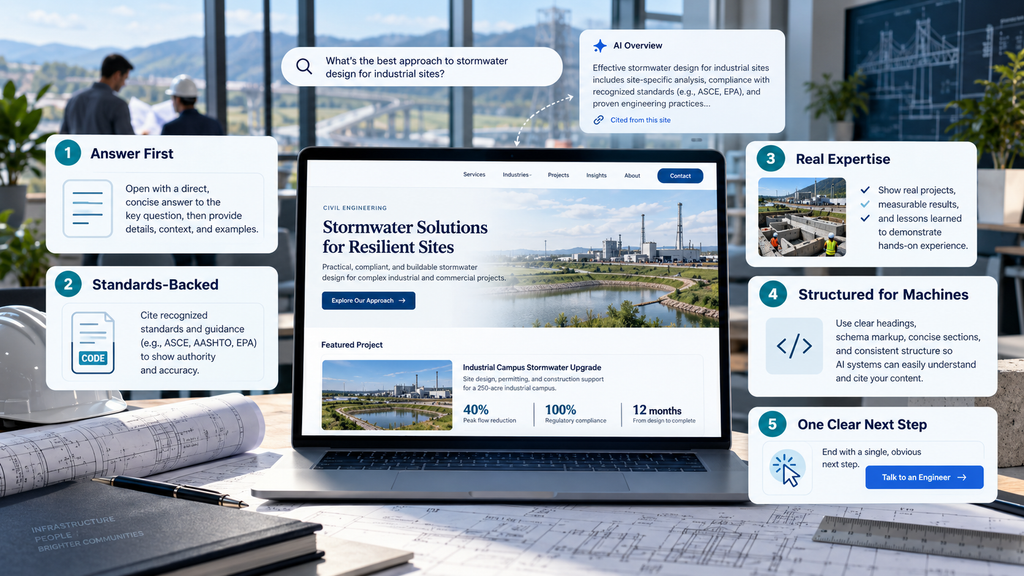
Across the engineering sites we’ve rebuilt, the pattern holds consistently:
Answer first — lead with the direct answer, not three paragraphs of throat-clearing before it.
Standards-backed — name the actual code or standard by its real designation, don’t gesture vaguely at “industry best practices.”
Real expertise — specific project types, specific outcomes, not generic claims that could describe any firm in the discipline.
Structured for machines — clear headings, short paragraphs, content a system can extract cleanly, reinforced by proper schema markup so the structure is machine-confirmed, not just visually implied.
One clear next step — a single obvious action, not five competing calls to action pulling the reader in different directions.
This is the same framework behind the results in our engineering business growth case study, where standards-specific content is now directly cited in AI Overviews for substation design, power system studies, and NERC compliance queries — not because the firm wrote more, but because what it wrote finally matched how buyers actually search.
A before-and-after
Before: “Our electrical engineering team delivers innovative, reliable power solutions for a wide range of clients.”
After: “We perform arc flash studies and IEEE 1547-compliant interconnection engineering for utility-scale and commercial power systems, including protective relay coordination and NERC compliance documentation.”
Same firm, same actual capability, same underlying expertise. One sentence is unsearchable and unquotable — it could sit on any electrical firm’s homepage in the country without changing a word. The other is both specific to this firm and specific to what a buyer typed.
A second before-and-after, for a service page rather than a homepage
Before: “Our civil engineering division supports land development projects of all sizes with professional site planning services.”
After: “We prepare stormwater management designs and site plans for commercial and residential permit submissions, including grading plans and erosion control documentation that meet local jurisdictional requirements.”
The second version does three things the first doesn’t: it names the actual deliverables (stormwater management design, site plan, grading plan, erosion control documentation), it states who the work is for (permit submissions, commercial and residential), and it uses language a developer or municipal reviewer would recognize on sight. That’s the difference between a page that describes a firm and a page that answers a query.
Accuracy matters more than volume
One caution worth stating plainly: never reference a standard, code, or certification your firm doesn’t actually hold or work to. A claim that can’t be independently corroborated — through a licensing board, an association membership, or a published project — is a liability, not an asset, once AI systems and cautious buyers start cross-checking sources against each other. Standards language earns trust only when it’s true; used loosely, it does the opposite of what this entire approach is meant to accomplish.
FAQ
Why doesn’t generic marketing language rank well for engineering firms?
It has little to no keyword overlap with what buyers actually search, and it gives search or AI systems nothing specific to match a query against or extract as a direct answer.
Do I need to use every technical term relevant to my discipline?
No — only the terms that map to services you actually offer. Accuracy matters more than coverage; don’t reference a standard or service you don’t actually deliver.
Should this content go on service pages or in blog posts?
Primarily on service pages — that’s where both buyers and AI systems expect to find a direct, authoritative answer. Blog content supports and deepens that, it doesn’t replace it.
Will using technical terms make the content harder for non-technical buyers to read?
Not if it’s written clearly — name the standard, then explain what it means in plain language in the next sentence. You’re not choosing between technical accuracy and readability; you need both in the same paragraph.
How specific should a service page be?
Specific enough to answer “what exactly does this involve, and under what standard” in the first few sentences — not so specific that it reads like an internal engineering spec a client would need a glossary to follow.
Does this help with Google rankings, AI citations, or both?
Both, and for the same underlying reason: standards-based, specific content matches real search queries and gives AI systems a clean, quotable answer to extract in the same sentence.
How do I find out which specific terms my potential clients actually search?
Start from the services you offer, list the real technical terms and standards involved, then verify search interest — search volume tools and your own Search Console data will show which specific terms are actually being searched in your market.
What if I reference a standard my firm doesn’t hold certification for?
Don’t — an unverifiable claim is worse than a vague one once AI systems and prospects start cross-checking your credentials against outside sources. Only use terms that reflect what you actually deliver, and only claim standards you can back up if asked directly.
Is there a difference between homepage language and service page language?
Yes — the homepage can stay slightly broader since it’s introducing the firm as a whole, but every service page beneath it needs the specific, standards-based version. The two before-and-after examples above show that distinction in practice.