




An engineering firm’s proudest work sits in a 40-page capabilities PDF: stamped drawings, project summaries, client names, scope, and outcome, all professionally laid out, linked from a “Portfolio” page as one big download.
It’s the single most persuasive piece of content on the entire site. And to most AI search systems, it might as well not exist.
This is gap three of the five structural gaps behind almost every invisible engineering site, the framework at the center of our AI SEO for engineering firms service — and it’s one of the most fixable of the five, because the content already exists. It just needs a different home.
Why PDFs are a dead end for AI visibility
Standard web pages are built to be parsed: clear headings, structured text, internal links, metadata a crawler can read directly. A PDF is built to be printed. Text inside a PDF can be selectable or it can be an image of text — and even when it’s selectable, PDF crawling and indexing behavior varies significantly between search engines and AI retrieval systems, and is far less consistent than standard HTML.
Practically, that means: no clear heading structure to signal what’s most important, no internal links connecting the PDF back to related service pages, often no metadata at all, and frequently, no confirmation the content was fully extracted rather than partially skipped. A PDF can render perfectly for the human who downloads it and still hand a crawler nothing but an opaque block of unstructured text — or, worse, a scanned image with no extractable text at all.
A firm can have the single most compelling project on their website and have it functionally invisible to the exact systems that are increasingly deciding who gets recommended. This is precisely the kind of gap our AI search optimization work is designed to catch during an initial audit — it rarely shows up in a rankings report, because the PDF itself was never the thing failing to rank. The page that should have existed around it was the actual gap. It’s also one of the first things we check when running the diagnostic behind our AI SEO for engineering firms framework, precisely because it’s so easy for a firm to miss on its own — everything looks fine from the outside.
Why this gap is so easy to miss internally
Here’s what makes this particular gap dangerous: nothing about the site looks broken. The portfolio page loads. The PDF downloads correctly. A prospect who clicks through is genuinely impressed. Every internal signal — traffic to the portfolio page, time spent on it, positive feedback from people who see it — suggests the content is working.
What’s invisible from inside the firm is what a retrieval system sees instead: a page with a single outbound link to a file, and the file itself contributing little to nothing back to the page’s own topical relevance. The portfolio page that should be the strongest proof of expertise on the entire site often ranks for almost nothing, because from a crawler’s perspective, there’s barely any text on it at all.
The projects, credentials, and standards buried this way
This isn’t limited to portfolios. The same pattern shows up in:
- Capabilities statements — the document a firm sends to a new prospect, never published as a page
- Case study one-pagers — a project summary made for print, never turned into web content
- Licenses and certifications — scanned or PDF’d, never listed as text on an About or Credentials page
- Standards and methodology references — the codes and standards a firm actually works to (NERC, IEEE 1547, local permitting codes), documented internally but never mentioned on the live site in a form a crawler can read. We cover exactly which terms matter, discipline by discipline, in the standards language engineering buyers actually search.
- RFP responses and qualifications packages — often the single most detailed, specific writing a firm ever produces about its own capabilities, filed away and never repurposed as public content at all
Each of these is exactly the kind of specific, verifiable evidence that closes gap three — and each one is worthless for AI visibility while it’s locked inside a download.
What “crawlable” actually looks like for a project
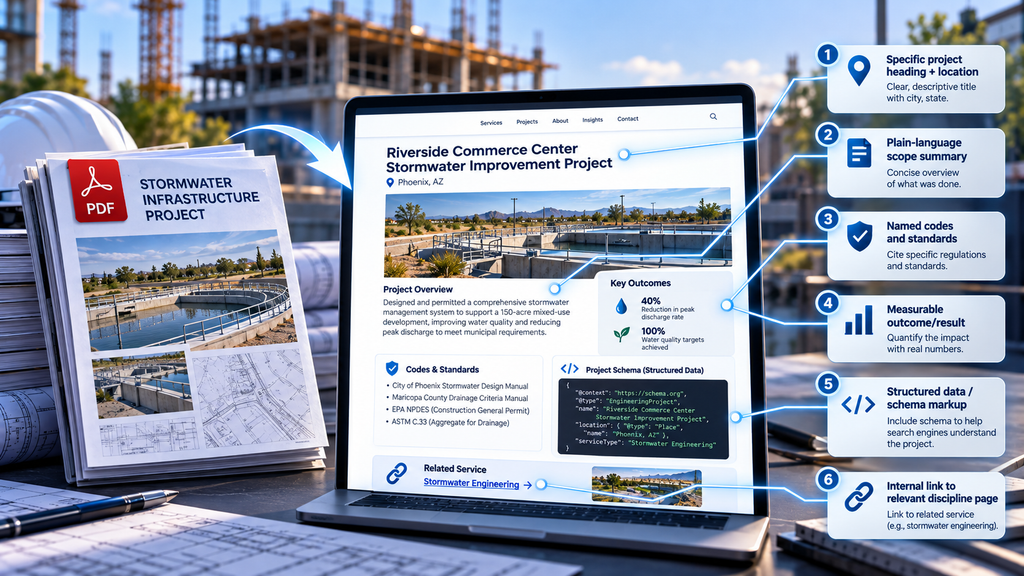
Turning a PDF project into real web content doesn’t mean copy-pasting the PDF’s text onto a page and calling it done. It means restructuring it as an actual page, with each of the following present and clearly separated:
A real heading naming the project type and location. Not “Project 4” or “Commercial Site,” but “Stormwater Management Design for a 40-Acre Commercial Site Development, [City, State]” — specific enough that it could be the direct answer to a search query.
A short paragraph stating the scope in the same language a buyer would search. “Structural retrofit for a 1960s masonry warehouse,” not an internal project code. This is where the language covered in the standards language engineering buyers actually search does double duty — the same rewrite that makes a service page findable makes a project page findable too.
The standards or codes the work complied with, named explicitly. Not “in accordance with all applicable codes,” but the actual standard — IEEE 1547, NFPA 70E, the specific local permitting code — by name.
The outcome, in a sentence a system could quote directly. What changed because of the work. A measurable result where one exists; a clear statement of what was delivered where it doesn’t.
Structured data confirming the service type. See schema markup for engineering firms for the specific schema block that applies here — this is what turns a well-written page into a machine-confirmed one.
A link back to the relevant discipline page — structural, civil, MEP — so the project reinforces that page’s authority instead of sitting isolated as an orphan page with nothing pointing to or from it.
This is the same approach behind the proof points on our engineering business growth case study — a firm whose case study, credential, and project content, published as real pages rather than downloads, now gets cited by ChatGPT, Gemini, and Google AI across 179 separate pages. The same discipline applied outside engineering entirely in our WNY Tennis local SEO and AI search case study, where moving proof points out of static documents and onto real, linked pages was part of what made the content citable in the first place.
A worked example
A civil engineering firm has a stormwater management project buried in a 12-page PDF titled “Portfolio_2024.pdf,” linked once from the homepage footer. The PDF itself is well-designed — clean layout, good photography, clear before-and-after drawings. None of that matters to a system that can’t reliably parse it.
Rebuilt as a standalone page: “Stormwater Management Design for a 40-Acre Commercial Site Development” — with the permitting jurisdiction named in the first sentence, the specific design challenge (a site with limited detention capacity, adjacent to a protected wetland buffer) stated in plain language, the regulatory standard it met named explicitly, and a link to the firm’s civil and site development discipline page sitting naturally in the closing paragraph. The same pattern of turning site-plan and permitting work into standalone, linkable pages is what carried real results in our Sacramento site plans case study and our Florida site plans case study.
The PDF told a reader the firm was capable. The page tells a search or AI system, in extractable text, exactly what the firm did, where, under what standard, and how it connects to the rest of the site’s expertise. Same project, same photographs even, if you want to keep them — completely different visibility, because the underlying format changed from a static document to structured, crawlable content.
How this fits with the rest of the gap-closing work
Rebuilding project pages rarely happens in isolation — it works best paired with the language fix covered in the standards language engineering buyers actually search (so the new page uses real searched terms, not internal jargon), and the schema work covered in schema markup for engineering firms (so the new page is machine-confirmed, not just machine-readable). A single rebuilt project page does some good on its own. A discipline page, its supporting projects, and its schema working together is what actually moves AI citation volume — the full picture of how these pieces reinforce each other is laid out on our AI SEO for engineering firms page, and the results are shown across the full engineering business growth case study.
Where to start if you have dozens of projects in PDFs
Don’t rebuild all of them at once. Start with the projects that map most directly to your highest-value disciplines and the search terms you most want to be found for — see our AI SEO for engineering firms page for the long-tail terms worth prioritizing by discipline. Five strong, fully rebuilt project pages outperform forty half-converted ones.
A practical way to prioritize: for each discipline page you already have (or plan to build), list your three to five strongest, most defensible projects in that discipline — the ones with the clearest outcome and the most specific standard met — and rebuild those first. The goal isn’t archival completeness. It’s giving each discipline page enough supporting proof to be citable on its own.
Keep the PDF available as a download for prospects who want it — that’s a legitimate use. Just don’t let it be the only place the content lives. If you’re not sure which projects to prioritize first, a free AI visibility audit will typically surface the two or three highest-impact rebuilds before you commit to a full project.
FAQ
Do PDFs hurt SEO?
Not inherently — but PDF content is indexed less consistently and with less structure than standard web pages, which makes it a poor primary format for content you need to be found or cited for.
Can AI tools read PDFs at all?
Some AI crawlers can extract text from PDFs, but extraction is inconsistent — headings, structure, and internal links (which carry real weight in how content gets parsed and connected) are often lost entirely. This should be verified against current platform behavior, since it changes.
Should I remove my portfolio PDF?
No — keep it as a downloadable resource for prospects who want a formal document. The fix is publishing the same project content as real web pages too, not removing the PDF.
How many projects should I convert to pages first?
Start with the projects most relevant to your priority disciplines and highest-value search terms, not the full archive. A handful of strong, complete pages outperforms a large batch of thin conversions.
Does this apply to licenses and certifications too?
Yes — the same principle applies to any credential currently locked in a scanned document or PDF. List credentials as text on a Credentials or About page in addition to any formal document.
What should a converted project page include?
A specific heading naming the project type and location, a plain-language description of the scope and challenge, the standard or code it complied with, the outcome, schema markup confirming the service type, and an internal link to the relevant discipline page.
Will this take a long time to implement?
It scales with how many projects you convert. Five well-built pages can be done in a focused sprint; a full archive is a longer, prioritized project — start with what maps to your priority disciplines.
Should I do this before or after fixing schema and content language?
They work best together, but if you have to sequence it, rebuild the highest-priority project pages first using the correct standards language from the start, then layer schema on top — that avoids redoing the same page twice.
Why doesn’t a firm notice this problem on its own?
Because nothing about the site looks broken from the inside — the PDF downloads fine and prospects respond well to it. The gap only becomes visible when you look at the portfolio page the way a crawler does: as a page with almost no extractable text of its own.
Does keeping good photography and design in the PDF mean I lose it if I rebuild the project as a page?
No — the images and layout quality can carry over directly to the new page. The fix is adding structured, crawlable text around them, not stripping out what already works visually.
Where does this fit in the overall AI SEO framework for engineering firms?
It’s gap three of five, and it’s covered in full — alongside the other four gaps and how they interact — on our AI SEO for engineering firms page, which is the best starting point before a free audit.