

Quick answer: A plumbing company can appear prominently in Google Maps near its office and barely appear a few miles away. That does not necessarily mean the Google Business Profile is broken. Local results vary with searcher location, relevance, competition, and prominence. This practical audit explains how US plumbing businesses can measure their Google Maps visibility, diagnose gaps, and connect local search performance to qualified calls.
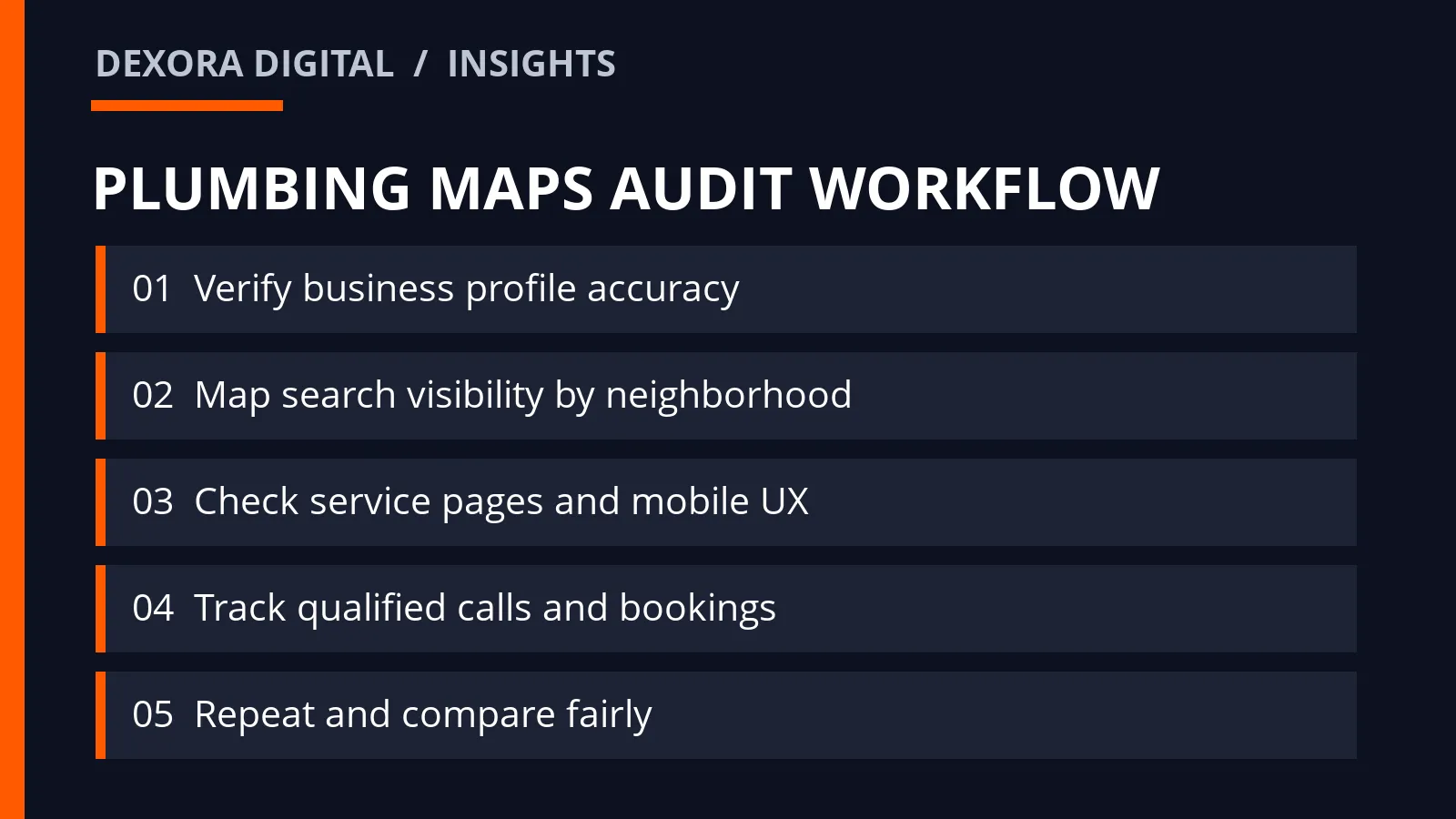
Start with the right question: where are you visible for which plumbing services?
A single screenshot of a search for plumber near me is not a reliable local SEO benchmark. Record the query, approximate search location, device, date, and whether the result appears in the local pack or Maps. Use a repeatable sample of points inside your real operating area. Compare emergency plumber, water heater repair, drain cleaning, and other services only when the business actually provides them.
Google describes local ranking through relevance, distance, and prominence. An optimization program can improve the accuracy and usefulness of business information, but cannot remove the physical distance between a searcher and the business.
Step 1: Establish a clean Google Business Profile baseline
- Confirm that the business is eligible for a profile and that the displayed business name matches the real-world business name.
- Check the primary category and any relevant secondary categories against services actually offered.
- Verify the phone number, website URL, opening hours, special hours, and address or service-area settings.
- Review the profile for duplicates, incorrect map pins, misleading service descriptions, and inconsistent contact details.
- Record the current review count, recent review themes, photo coverage, and the website landing page linked from the profile.
For service-area plumbing businesses that do not receive customers at a staffed location, follow Google’s rules for hiding the address. Listing cities as service areas does not guarantee rankings in each city. Avoid virtual-office or keyword-stuffed business names.
Step 2: Audit Google Maps visibility by location and service
Build a simple grid of real service-area neighborhoods and a short list of commercially relevant queries. For each query-location combination, record whether the business appears, which competitors appear consistently, and which landing page supports the query. Do not treat a grid average as an official Google ranking metric.
| Audit field | Example to record | Why it matters |
| Query | emergency plumber | Separates urgent from research intent |
| Search area | Neighborhood or ZIP | Exposes proximity variation |
| Surface | Maps or local pack | Prevents mixing result types |
| Visibility | Present / not observed | Supports repeatable comparisons |
| Lead action | Call / form / booking | Connects visibility to business value |
Step 3: Match plumbing services to useful website pages
Your homepage should explain the business and its main service area. Individual service pages should answer specific customer questions: what the service covers, common symptoms, the process, practical limitations, and how to request help. A drain cleaning page should not be a lightly edited copy of a water heater repair page.
Location pages can help when they offer genuine local value, such as service availability, locally relevant examples, dispatch information, and verified details. Do not publish dozens of doorway pages that simply swap city names. Link from the relevant service pages and navigation so visitors and crawlers can find the right information.
Step 4: Check reviews and local trust signals
Look beyond star averages. Assess whether reviews are recent, specific, and representative of real plumbing work. Encourage customers to leave genuine reviews through compliant requests, and respond professionally without revealing private details. Never buy reviews or gate requests to only happy customers.
Useful evidence on the website may include actual team information, service explanations, project photographs with permission, warranties where verifiable, and license information where applicable. Do not invent credentials or claim service coverage that cannot be fulfilled.
Step 5: Validate technical SEO and mobile conversion paths
A customer with a burst pipe may be on a phone, under time pressure. Confirm that the website loads, the tap-to-call button works, the contact form submits successfully, and the emergency service details are easy to find. Check indexability, canonical URLs, redirect chains, and structured data against the visible business details.
Structured data can describe a business and its services, but it does not force a Maps ranking. Similarly, an FAQ section should help visitors first; adding FAQ schema does not guarantee a rich result. Keep all structured data consistent with what users can see.
Step 6: Measure calls, forms and booked plumbing jobs
Google Business Profile performance data, Google Search Console, GA4, call tracking, and CRM records answer different questions. GSC reports organic web search clicks and impressions, not every Maps interaction. GBP performance may show profile interactions, but a call click is not the same as a completed, qualified phone conversation.
Use privacy-conscious tracking to connect source and landing page to calls, form submissions, appointment requests, and booked jobs where possible. Deduplicate events and separate spam or wrong-number calls. Compare trends over enough time to account for seasonality, promotions, and weather-related demand.
How to prioritize fixes after the audit
- Critical accuracy issues: wrong phone, broken contact form, wrong address visibility, or incorrect opening hours.
- Indexation and accessibility issues affecting important service pages.
- Missing or weak service content for work the company genuinely performs.
- Poor internal linking between homepage, service pages, and legitimate location pages.
- Review-response processes and profile updates based on real business changes.
- Measurement gaps preventing the team from distinguishing clicks from qualified leads.
Fix the most serious customer-impacting issues first. After each change, record the date, what changed, and which metric you expect it to influence. Avoid attributing all later ranking changes to a single edit without a reasonable comparison.
A 30-day Google Maps visibility audit schedule
Week 1: baseline and accuracy
Verify profile eligibility and details, test calls and forms, export available performance reports, and record representative query-location combinations.
Week 2: website and service-page checks
Review the highest-value plumbing services, internal links, technical crawlability, and mobile usability. Create a short prioritized implementation list.
Week 3: implementation and quality assurance
Correct confirmed issues, update relevant content, and validate live URLs, tracking events, and profile information. Preserve a change log.
Week 4: compare and plan
Repeat the same local visibility observations, inspect lead quality, and choose the next experiment. Four weeks is often too short to judge long-term SEO impact, so treat early results as directional.
Common mistakes that distort plumbing Maps reporting
- Treating one manual search as a citywide ranking.
- Assuming adding service areas makes a company rank in every city.
- Counting all call-button clicks as qualified plumbing leads.
- Using a Google Search Console average position as a Maps-pack ranking.
- Creating duplicate Google Business Profiles for the same eligible business.
- Publishing near-identical neighborhood pages without real local value.
- Claiming guaranteed top-three Maps rankings after a fixed number of weeks.
How this guide fits into a complete plumber SEO strategy
This article is specifically about diagnosing and measuring local visibility. For a broader foundation, read our local SEO for plumbers guide. For profile setup, use our Google Business Profile optimization guide. For search-result factors, see our Google Maps 3-pack ranking factors article. Each covers a different stage of the process.
How to build a practical plumbing lead-quality scorecard
Create a simple monthly scorecard with Google Business Profile interactions, organic landing-page visits, tracked phone conversations, form submissions, booked appointments, and completed jobs. Where possible, record the service requested and broad service-area market without storing unnecessary personal details. A lead from a commercial drain-cleaning enquiry is not necessarily comparable to an irrelevant sales call. Quality, not raw event count, should guide investment decisions.
Example: a plumber ranking in one part of town
Suppose a plumbing company appears for water heater repair near its staffed location but not across a distant suburb. First check whether the business genuinely serves that area, whether the search is being measured consistently, and whether competitors have stronger local relevance. Then review the appropriate service page, business information, reviews, and actual conversion path. Avoid creating a second profile or an artificial office merely to influence proximity.
What to document before changing a Google Business Profile
Record the current primary category, service descriptions, hours, address-display settings, and website link. Keep screenshots or a change log. After making a legitimate update, check that the profile still reflects the real business and that the linked page works. Some profile edits can require review or reverification, so avoid unnecessary mass changes when the existing information is correct.
Service-area pages without doorway content
A useful city page can explain the actual coverage, locally relevant service availability, dispatch constraints, customer questions, and links to specific plumbing services. It should not imply an office exists where none does. If two cities would have almost identical content and no meaningful local distinction, a stronger regional page may be preferable. This reduces maintenance overhead and helps users find accurate information.
What to report to a plumbing business owner
Summarize which technical and profile issues were fixed, which service pages changed, what happened to relevant query visibility, and whether qualified calls or bookings improved. Note any major seasonal or operational factors, such as weather, staffing, and advertising. If the data is too limited to determine impact, say so and specify what additional tracking is needed.
Frequently asked questions
Why does my plumbing business rank in one neighborhood but not another?
Search proximity, relevance, competition, and prominence vary by location. Evaluate the query and location before changing your profile or website.
Does adding more cities to my Google Business Profile improve rankings?
Not automatically. Service-area settings describe where the business operates; they do not override local ranking systems or eligibility requirements.
How can I tell whether Google Maps is generating real plumbing leads?
Combine profile interaction reports with tested call and form tracking, then review which enquiries become qualified appointments or jobs.
Should I build a page for every ZIP code?
Only create pages that offer meaningful, distinct value. Repetitive doorway pages are not a sustainable local SEO strategy.
Get a local SEO and lead-tracking audit
Dexora Digital helps plumbing and other service businesses across the United States with technical SEO, Google Business Profile optimization, conversion-focused website design, and measurement. Review our SEO for plumbers services or request a consultation to discuss your market and current search visibility.
Methodology note: Examples are illustrative. Local visibility and lead outcomes depend on competition, searcher location, website quality, business operations, and measurement configuration.