


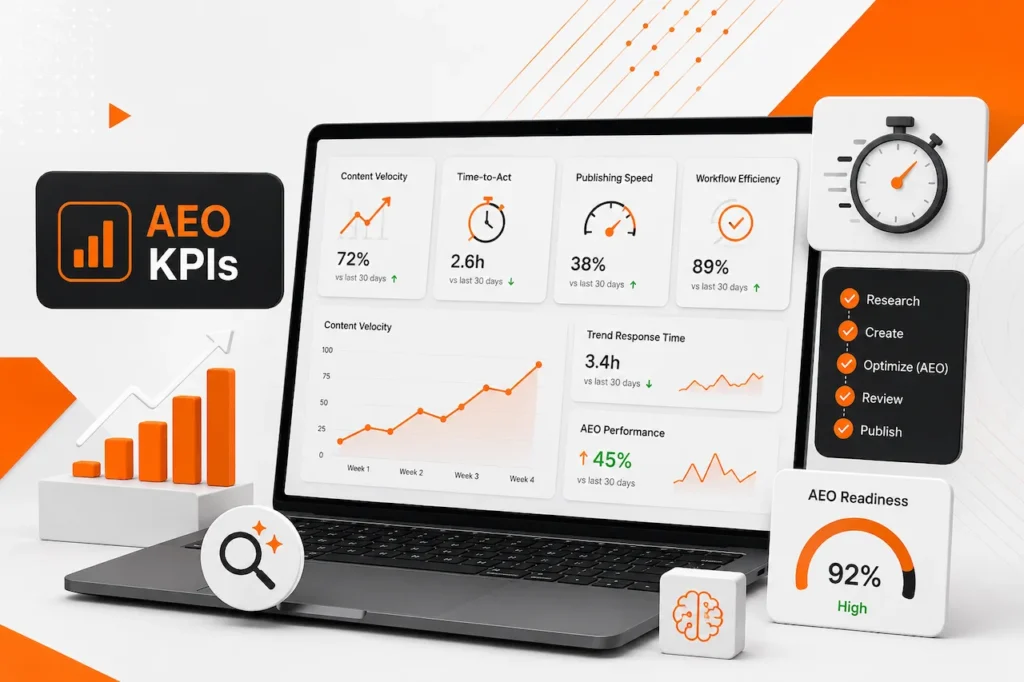
Digital search is evolving well beyond traditional SEO. Answer Engine Optimization, or AEO, is now the strategic focus for organizations working to maximize visibility and engagement inside AI-generated answers, not just traditional search rankings.
For operations managers and leaders running AEO Centers of Excellence, measuring performance requires a different set of KPIs than the ones traditional SEO relied on. Two metrics in particular — content velocity and time-to-act reveal how quickly content moves from idea to publication and how fast an organization responds to shifting market signals.
Why Traditional SEO KPIs Fall Short for AEO
Metrics like page views, keyword rankings, and backlink counts offer limited insight into operational agility. Organizations that only track these outcomes, without measuring the speed and responsiveness behind them, risk real inefficiency and missed opportunities they never see coming until competitors have already moved.
Content velocity and time-to-act fill that gap. They offer actionable insight into execution speed, resource allocation, and how competitively an organization can respond when the search landscape shifts, which happens more frequently now than it did under classic SEO timelines.
What Content Velocity Actually Measures
Content velocity tracks the speed at which content moves from ideation to publication. High content velocity reflects an organization’s ability to execute campaigns quickly and respond to emerging trends while still maintaining quality standards.
Four components make up this metric in practice: ideation time, measuring how long it takes a topic to move from conception to approval; production time, covering the actual writing, editing, and multimedia work; publication time, tracking deployment across platforms and channels; and iteration time, measuring how quickly content gets updated based on feedback or performance data.
Faster content velocity lets a CoE capitalize on trending topics, seasonal shifts, and competitive gaps before they close. Monitoring this metric consistently reveals exactly where bottlenecks are slowing execution, which makes resource allocation decisions far more precise than guesswork.
What Time-to-Act Reveals About Responsiveness
Time-to-act measures the gap between an actionable signal a search trend, a competitor move, an algorithm update and the organization’s actual response, whether that’s new content, an update, or a campaign launch. It evaluates operational agility directly: how quickly a team turns intelligence into action.
This metric breaks into four components as well: signal detection, or how fast the organization notices an opportunity or threat in the first place; decision-making lag, covering the time taken for approvals and prioritization; execution speed, measuring the gap from decision to actual deployment; and iteration cycle, tracking how quickly refinements happen based on early performance data.
A short time-to-act signals a genuinely nimble team, one capable of turning competitive intelligence into engagement and ROI before the opportunity window closes. Longer durations usually point to specific process inefficiencies rather than a general lack of effort the kind of gaps a workflow audit tends to surface quickly.
Building These KPIs Into a CoE Workflow
Implementing these metrics starts with auditing current workflows in full mapping every step from ideation to publication, identifying delays, redundancies, and approval bottlenecks, and documenting exactly where data collection needs to happen to track these KPIs going forward.
From there, defining the metrics clearly matters more than it might seem. Content velocity should be tracked as average days per content piece, segmented by type blog, video, social since a single blended average hides where the real bottlenecks sit. Time-to-act should be tracked as average response time from signal detection through to action, with a clear baseline set before any optimization work begins.
We always advise clients to integrate analytics tools directly into project management and content platforms, rather than tracking these metrics manually in a spreadsheet that goes stale within a month. Real-time dashboards give CoE leaders visibility they can actually act on, not a retrospective report that arrives too late to matter.
Turning KPI Data Into Workflow Improvements
Once baseline data exists, the real value comes from applying it. Automating content approvals removes one of the most common bottlenecks in the entire pipeline. Modular content templates speed up production without sacrificing quality, since teams aren’t rebuilding structure from scratch on every piece. Cross-functional collaboration tools reduce the handoff delays that quietly inflate both velocity and time-to-act numbers.
Assigning clear roles within the CoE matters just as much as the tools themselves. Someone needs explicit accountability for monitoring these KPIs and driving improvement initiatives without that ownership, even well-designed dashboards tend to go unwatched after the first few weeks.
Best Practices for Operational Efficiency
A handful of practices consistently separate CoEs that sustain strong KPIs from those that see an initial improvement fade within a quarter.
Standardizing processes reduces the variability that makes velocity and time-to-act numbers unreliable from one content piece to the next. Prioritizing signals with clear business value keeps resource allocation focused rather than spread thin across every trend that surfaces. Continuous feedback loops reviewing KPI performance regularly and adjusting workflows based on what the data actually shows keep improvements compounding instead of plateauing. Our AI search optimization work builds this same feedback discipline into ongoing engagements, since AEO performance shifts continuously as AI platforms evolve.
Connecting These KPIs to Traditional SEO Metrics
Rankings, clicks, and impressions remain relevant, but they don’t measure operational performance on their own. Combining them with content velocity and time-to-act gives a genuinely complete picture: effectiveness, showing how well content meets user intent; efficiency, showing how fast the CoE actually delivers that value; and agility, showing how quickly the team responds when market signals shift.
Organizations tracking only the traditional metrics tend to see rankings and traffic move without understanding why performance improved or declined the operational layer is what explains the outcome layer.
Monitoring, Benchmarking, and Reporting
Ongoing visibility depends on dashboards that visualize velocity and responsiveness trends over time, not a single point-in-time snapshot. Benchmarking performance across content types and teams reveals where specific processes need attention rather than treating the whole organization as one uniform system.
Automated alerts for delays or missed opportunities catch problems before they compound, and executive reporting that highlights improvements alongside actionable next steps keeps leadership engaged with the data rather than only seeing it during quarterly reviews.
FAQ
What is content velocity?
It’s a measure of how quickly content moves from ideation to publication, reflecting both workflow efficiency and an organization’s overall agility.
What does time-to-act track?
It measures the speed of response from signal detection a trend, competitor move, or algorithm update to actual content deployment or action.
Why do these KPIs matter specifically for AEO CoEs?
They provide actionable insight into operational efficiency, ensuring content gets delivered quickly enough to stay relevant and maximize return on effort.
How can a team improve content velocity?
Standardize processes, use AI-assisted tools where appropriate, automate approval steps, and identify and eliminate specific workflow bottlenecks.
Do these KPIs replace traditional SEO metrics?
No. They complement traditional metrics. Rankings and traffic measure outcomes, while content velocity and time-to-act measure the operational performance behind those outcomes.
What’s the biggest cause of a slow time-to-act?
Decision-making lag is usually the largest factor delays in approvals and prioritization tend to cost more time than actual content production.
How often should content velocity be measured?
Continuously through dashboard tracking, with formal benchmarking reviews on a monthly or quarterly basis to spot longer-term trends.
Can smaller teams realistically track these KPIs?
Yes. Even a simple shared tracking sheet with defined stages captures meaningful data, though dedicated tooling becomes more valuable as content volume grows.
What tools help track these metrics?
Project management systems, content management platforms, and analytics tools that can automatically capture timestamp data across the content pipeline.
What does AEO actually stand for?
Answer Engine Optimization the practice of structuring content so it gets selected for direct-answer boxes, featured snippets, and AI-generated responses.
Why Choose Dexora Digital
We build operational KPI tracking directly into the AEO strategies we deliver, rather than treating content velocity and responsiveness as an afterthought to publishing volume.
- Workflow audits that identify specific bottlenecks before optimization begins
- Dashboards built around content velocity and time-to-act, not just traffic and rankings
- Cross-functional process design that reduces approval and handoff delays
- Ongoing benchmarking that keeps improvements compounding rather than plateauing
If you’d like your current content workflow assessed against these standards, you can start with a free SEO audit to see where the gaps sit.

Local SEO and AI Search (AEO & GEO) Specialist.
Building search visibility that converts into qualified demand.
Today, businesses need visibility on Google Maps and AI powered search and websites that actually convert visitors into leads. I am a Local SEO, AI Search & Conversion Rate Optimization (CRO) Specialist with 5+ years of hands on experience helping businesses turn underperforming websites into high converting growth engines. My work combines Local SEO, Technical SEO, Semantic SEO, GEO/AEO, and conversion focused landing page optimization to ensure brands are discoverable and profitable.
My Experience
I have delivered SEO and web growth projects across the US, UK, Australia, Canada, Finland, Germany, and the Czech Republic, working in industries such as local businesses (electrician, hvac, cleaning, Real estate, healthcare, B2B, eCommerce, SaaS, and environmental services.
Some Results
>> 200+ websites audited globally
>> specifically worked with 100+ local business (80% from USA)
>> 80+ websites improved through technical SEO & schema fixes
>> 20+ businesses featured in Google AI Overviews (SGE)
>> Multi million impression growth for eCommerce & SaaS brands
Book Free Consultation: calendly.com/dexora/30min