
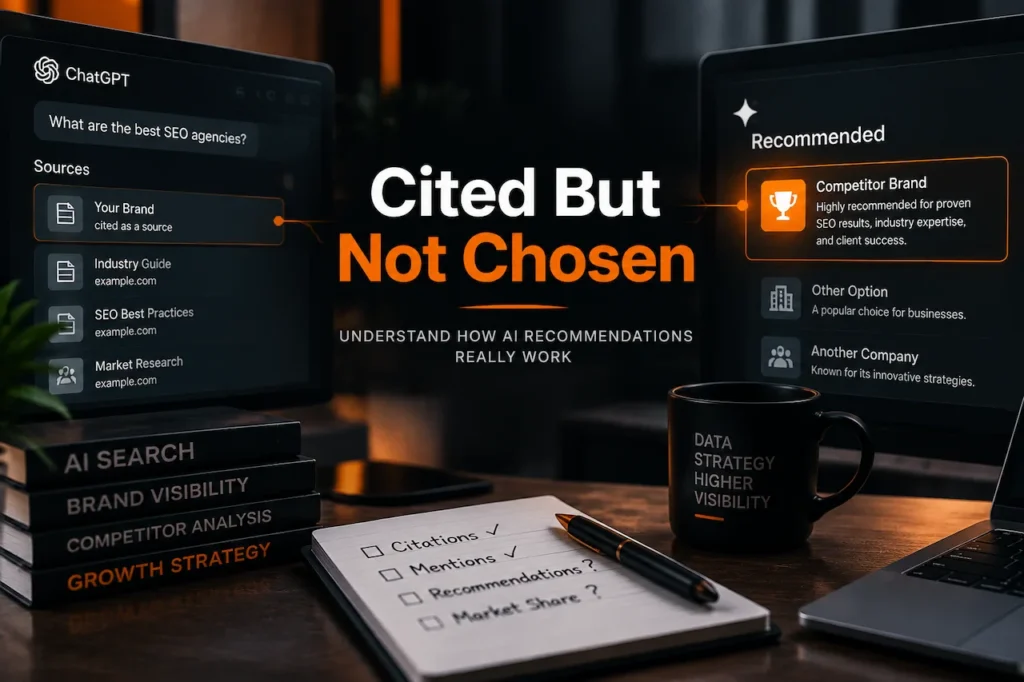
AI search has changed how businesses compete for online visibility. A company can create valuable content, earn citations from AI platforms, and become a trusted source of information, yet another brand may still receive the final recommendation when customers ask AI who they should choose.
Many businesses measure AI success only by checking whether their website appears in AI answers. While citations are important, they do not always create customer trust or influence buying decisions.
The bigger question is:
Does AI understand your expertise strongly enough to recommend your brand?
AI visibility is moving beyond simple mentions and citations. Businesses now need to understand recommendation share, competitor visibility, and the signals that influence AI decision-making.
A brand that is only cited helps educate users.
A brand that is recommended receives the opportunity.
Why AI Citations Do Not Always Create Recommendations
AI visibility has different levels of value.

A citation means an AI platform uses your website or content as a supporting source when generating an answer. It shows that your information is useful and relevant.
A mention means AI connects that information with your brand name. Users begin associating your expertise with your company.
A recommendation is the strongest outcome.
It means AI connects your brand with the user’s goal and positions your business as a possible solution.
These outcomes are not equal.
A business may appear in many AI citations while receiving very few recommendations.
For example, an AI platform may use your content to explain a topic like AI search optimization. However, when a user asks which company they should hire, another business may receive the recommendation.
Your knowledge helped educate the customer.
Your competitor received the opportunity.
This is why businesses need to move beyond citation tracking and understand why AI systems choose one brand over another.
A useful way to analyze this gap is understanding why ChatGPT recommends competitors instead and which signals influence AI decision-making.
AI recommendation visibility depends on more than content quality.
It requires strong connections between:
- Brand identity
- Expertise signals
- Website information
- Customer intent
- Commercial relevance
The goal is not only becoming a source of information.
The goal is becoming the solution AI chooses.
How AI Recommendation Share Works
AI recommendation share measures how frequently your brand appears as a recommended option compared with competitors across relevant AI searches.

Unlike traditional SEO metrics, recommendation share focuses on decision-making visibility.
A website ranking well on Google does not automatically mean AI platforms will recommend that company.
AI systems evaluate different signals, including:
- Brand understanding
- Authority
- Topic relevance
- Content relationships
- Customer intent alignment
A practical AI recommendation framework should measure several areas.
Mention Rate
Mention rate measures how often AI platforms include your brand when answering relevant questions.
A higher mention rate indicates that AI systems associate your company with specific topics.
Citation Rate
Citation rate measures how frequently AI platforms use your content as a supporting source.
Strong citation performance shows content influence, but it does not always mean customers will choose your company.
Recommendation Rate
Recommendation rate measures how often AI actively suggests your business as a solution.
This is the metric most connected with commercial visibility.
Recommendation Position
Where your brand appears also matters.
Being the first recommended option creates a stronger impact compared with appearing as one of many alternatives.
Sentiment Accuracy
AI should describe your company correctly.
Incorrect descriptions can reduce trust even if your brand appears frequently.
Competitor Inclusion
Businesses should monitor which competitors appear when their own brand is missing.
The purpose of recommendation tracking is not chasing individual AI mentions.
The purpose is understanding how AI systems perceive your brand compared with alternatives.
A company with strong citations but weak recommendations may need stronger commercial positioning.
A company with strong recommendations but weak citations may need stronger educational authority.
The goal is creating balance.
Your brand should not only provide information.
It should become associated with the solution.
How Buyer Intent Prompts Reveal AI Recommendation Gaps
Not every AI search represents the same customer intent.
A user researching a topic behaves differently from someone who is ready to choose a service provider.
This is why AI recommendation tracking should analyze different stages of the buyer journey instead of measuring only general visibility.
A brand may appear when users ask educational questions but disappear when users ask AI which company they should hire.
That gap reveals an important problem.
The business is visible, but it is not being selected.
Understanding buyer intent helps identify where AI systems recognize your expertise and where they fail to connect your brand with customer decisions.
Awareness Stage Prompts
Awareness prompts show whether AI systems associate your brand with a specific topic.
Examples:
- “What companies specialize in AI search optimization?”
- “What are the best solutions for improving AI visibility?”
- “How does AI search optimization work?”
At this stage, users are learning.
The goal is building recognition.
If AI does not mention your company during awareness searches, it may indicate that your brand lacks strong topic association.
Businesses need consistent signals across:
- Educational content
- Service pages
- Industry resources
- Expert explanations
- External brand mentions
A strong information ecosystem helps AI understand what your business represents.
Consideration Stage Prompts
Consideration prompts reveal whether AI includes your business among possible options.
Examples:
- “Compare AI search optimization agencies.”
- “Which companies help businesses improve AI visibility?”
- “What are the best GEO agencies?”
This stage is where many businesses discover recommendation gaps.
A company may have excellent educational content but still fail to appear when users compare providers.
This usually means there is a difference between:
- Content authority
- Commercial authority
A business may prove that it understands a topic but fail to clearly communicate why it provides the solution.
A competitive AEO analysis framework helps identify why competitors receive stronger AI visibility and which signals are missing from your brand.
Decision Stage Prompts
Decision prompts represent the highest commercial intent.
Examples:
- “Which company should I hire for AI search optimization?”
- “What is the best AI SEO agency for my business?”
- “Who can improve my brand visibility in AI search?”
These searches reveal whether AI systems connect your brand with customer action.
A business that appears during awareness searches but disappears during decision searches has a recommendation gap.
The objective is not simply being recognized.
The objective is being selected.
Why AI Recommends Competitors Even When Your Content Is Strong
One of the biggest frustrations businesses experience with AI search is seeing competitors recommended while their own content appears only as a source.
The natural question is:
“If AI trusts my content, why does it recommend someone else?”
The answer is that AI platforms do not evaluate only individual articles.
They analyze the complete relationship between:
- Your brand
- Your expertise
- Your website structure
- Your commercial positioning
- Your overall online presence
A business can publish excellent content but still lack the signals required for AI systems to connect that content with a trusted recommendation.
Several factors influence this difference.
Brand Entity Understanding
AI systems need to understand what your brand represents.
If your website publishes content across unrelated topics or does not clearly communicate your specialization, AI may struggle to associate your company with a specific solution.
For example:
A company publishes one article about AI search optimization.
Another company creates a complete knowledge ecosystem around:
- AI search optimization
- Generative search
- Entity understanding
- Search visibility
- AI-driven customer discovery
The second company provides stronger signals.
AI systems need repeated and consistent evidence before connecting a brand with a specific area of expertise.
This is why a strong entity-first SEO strategy is important for businesses competing in AI search.
Entity understanding helps AI systems answer:
- Who is this company?
- What does it specialize in?
- Why should users trust it?
- Is this brand connected to the solution being searched?
Stronger Competitor Authority Signals
Competitors may receive recommendations because AI systems discover stronger supporting signals around their brands.
These signals can include:
- Consistent topic coverage
- Strong service pages
- Industry-specific resources
- External mentions
- Clear expertise positioning
- Customer trust signals
The solution is not copying competitors.
The solution is understanding why AI connects them with the solution.
A useful analysis asks:
What topics are competitors associated with?
What information does AI use when describing them?
Which trust signals are missing from our brand?
What commercial pages support their expertise?
This approach helps businesses create measurable improvements instead of random content changes.
Better Commercial Relevance
Another reason competitors receive recommendations is stronger alignment with commercial intent.
Many businesses create educational content but forget that AI also needs clear commercial context.
For example:
An article explaining:
“What is AI search optimization?”
helps users understand a concept.
A service page explaining:
“How businesses improve AI visibility through structured optimization”
helps AI understand who provides the solution.
Both are valuable.
However, they serve different purposes.
A strong content ecosystem connects:
- Educational resources
- Service pages
- Case studies
- Expert insights
- Conversion pages
This creates stronger relationships between knowledge and business solutions.
Building an AI Recommendation Tracking System
AI recommendation tracking should become an ongoing measurement process.
AI platforms continue changing, competitors continue publishing new content, and customer search behavior continues evolving.
A single AI visibility check is not enough because recommendations can change depending on:
A reliable tracking system helps businesses understand where they currently stand and where improvements are needed.
A practical AI recommendation tracking system includes:
- Testing commercial prompts regularly across multiple AI platforms
- Comparing brand recommendations against competitors
- Measuring mentions, citations, and recommendation frequency
- Reviewing how accurately AI describes your services
- Monitoring visibility changes over time
The purpose is not checking AI answers once.
The purpose is creating a repeatable process.
Businesses should understand:
- Where does AI recognize our expertise?
- Where does AI recommend competitors?
- Which topics create the strongest opportunities?
- Which improvements increase recommendation visibility?
Companies that consistently track AI search visibility can make decisions based on real patterns instead of assumptions.
Testing Across Multiple AI Platforms
AI platforms do not always provide the same results.
A brand may perform well in one AI platform but remain invisible in another.
This happens because different AI systems evaluate information differently.
Businesses should test the same buyer-intent prompts across platforms such as:
- ChatGPT
- Google AI experiences
- Perplexity
Then compare:
- Brands mentioned
- Sources selected
- Recommendations provided
- Competitor visibility
- Descriptions generated
This reveals whether the problem is broad or platform-specific.
For example:
A company may discover that:
- ChatGPT understands its expertise but does not recommend it
- Google AI surfaces its educational content but not service pages
- Perplexity cites competitors more frequently
Each situation requires a different improvement strategy.
The goal is not simply increasing mentions.
The goal is improving the probability that AI connects your brand with customer decisions.
A complete generative engine optimization guide helps businesses understand how AI systems discover, evaluate, and select information from different sources.
Creating an AI Recommendation Visibility Report
A useful report should focus on business outcomes, not only AI appearances.
The report should measure:
- Number of prompts tested
- Brand mention frequency
- Recommendation frequency
- Competitor appearance rate
- Sentiment accuracy
- Visibility changes over time
A strong reporting system helps businesses understand whether AI systems are:
- Recognizing their expertise
- Describing their services correctly
- Including them in buyer comparisons
- Recommending competitors instead
The goal is not achieving one successful AI response.
The goal is building consistent visibility across customer discovery journeys.
Businesses should also monitor their AI brand visibility because recommendation performance depends on how accurately AI understands the relationship between a company, its expertise, and its market position.
Real World Example: Measuring Recommendation Gaps
I worked with a business that had strong educational visibility across search engines.
Their content was valuable, detailed, and frequently used as a reference source.
However, when we tested commercial AI prompts, competitors appeared more often as recommended options.
The initial assumption was that competitors had better content.
After analysis, we found the problem was not content quality.
The business had information authority but weaker recommendation signals.
The improvement process focused on:
- Strengthening commercial content
- Improving entity connections
- Building clearer service relationships
- Expanding supporting authority resources
- Monitoring competitor recommendation patterns
The goal was not simply increasing citations.
The goal was improving how AI connected expertise with customer decisions.
This distinction is becoming increasingly important because AI search is moving from information retrieval toward decision support.
Businesses that understand this shift will have a stronger advantage.
Why Choose Us
At Dexora Digital, we help businesses improve AI visibility by combining search strategy, entity optimization, and measurement frameworks designed around how AI platforms understand and recommend brands.
We focus on understanding why AI systems choose certain brands over others instead of only tracking basic mentions.
Our approach includes:
- Experience developing SEO and AI search strategies across different industries
- Data-driven analysis of citations, mentions, and recommendations
- Focus on improving brand authority instead of chasing individual AI appearances
- Platform-specific analysis to identify AI visibility gaps
- Strategies designed to connect business expertise with customer intent
AI search success requires more than publishing content.
Businesses need a complete system that connects:
- Brand positioning
- Content authority
- Entity understanding
- Commercial relevance
- Customer trust signals
For businesses that want a complete analysis of their current search performance and AI visibility opportunities, an SEO consultation can help identify gaps and create a practical growth roadmap.
Conclusion
AI visibility is no longer only about being cited.
Businesses must understand whether AI systems recognize their expertise strongly enough to recommend them.
A brand can appear in many AI answers and still lose valuable customer opportunities if competitors receive the final recommendation.
Measuring recommendation share helps businesses understand:
- Where they are visible
- Where competitors have an advantage
- Which signals influence AI decisions
- Which improvements can increase recommendation opportunities
The future of search belongs to companies that are not only discovered by AI but trusted by AI.
FAQs
What is AI recommendation tracking?
AI recommendation tracking measures how often AI platforms mention, recommend, and position a brand compared with competitors for relevant searches.
It helps businesses understand whether AI systems recognize their expertise and connect their brand with customer decisions.
Why does AI cite my website but recommend competitors?
AI may find your content useful but still have stronger signals connecting competitors with the solution.
Factors such as entity understanding, authority signals, commercial relevance, and brand consistency influence recommendations.
Is AI recommendation visibility the same as SEO ranking?
No.
SEO rankings measure visibility in traditional search results, while AI recommendation visibility measures how AI systems represent your brand inside generated answers.
How can businesses improve AI recommendation visibility?
Businesses can improve visibility by:
- Strengthening entity signals
- Creating authoritative content
- Improving commercial pages
- Building consistent brand information
- Monitoring AI responses regularly
How often should AI recommendation tracking be performed?
Regular monitoring is recommended because AI systems, competitors, and customer behavior continue changing.
Can a brand rank well on Google but still not be recommended by AI?
Yes.
Traditional rankings and AI recommendations use different evaluation systems.
A brand may need stronger entity signals, commercial relevance, and authority connections to improve AI recommendations.
What metrics matter most for AI recommendation tracking?
Important metrics include:
- Brand mention rate
- Citation frequency
- Recommendation rate
- Competitor appearance rate
- Sentiment accuracy
- Recommendation position
How can I check whether AI recommends my competitors more often?
Create buyer-intent prompts and test them across AI platforms regularly.
Compare:
- Brands mentioned
- Recommendations given
- Sources cited
- Position in answers
Improve Your AI Recommendation Visibility With Dexora Digital
AI search is changing how customers discover and choose businesses.
Being cited is valuable, but being recommended is where AI visibility creates stronger commercial opportunities.
Dexora Digital helps businesses understand how AI platforms perceive their brand, identify recommendation gaps, and build strategies that improve visibility across modern search experiences.
Our team can help you measure:
- AI mentions
- Citations
- Competitor visibility
- Recommendation opportunities
- Brand authority signals
Book an SEO consultation today and understand how your brand can become the trusted recommendation in AI search.
Want help putting this into practice? See our AI search optimization services or book a free consultation.