



Updated: August 27, 2026
Traditional SEO competitor analysis focuses on rankings, keywords, backlinks, and traffic. However, search behavior is changing. With AI Overviews, ChatGPT, Perplexity, and other AI-powered search experiences, businesses are no longer competing only for clicks — they are competing to become trusted sources that AI systems understand, reference, and recommend.
This is where Competitive AEO Analysis becomes important. Instead of only analyzing which keywords competitors rank for, businesses need to understand which entities, topics, questions, and relationships help competitors appear in AI-generated answers.
A strong Competitive AEO Analysis helps identify semantic gaps, AI citation opportunities, and content weaknesses that competitors leave behind. By understanding these gaps, businesses can create more complete, authoritative, and AI-friendly content that improves visibility across modern search platforms.
What Is Competitive AEO Analysis?
Competitive AEO Analysis is the process of analyzing how competitors perform in answer-driven search environments and identifying opportunities to create better, more complete content.
Traditional competitor analysis usually focuses on:
- Keyword rankings
- Backlinks
- Organic traffic
- Domain authority
Competitive AEO Analysis goes deeper by evaluating:
- Entities competitors are associated with
- Questions they answer
- Topics they cover
- Relationships between concepts
- AI citations and mentions
- Content structures that help AI understand information
The goal is not simply to copy competitor content.
The goal is to understand:
Why does AI select their content instead of yours?
A complete analysis helps businesses discover:
- Missing information
- Weak topical coverage
- Unanswered user questions
- Missing entities
- Opportunities for stronger expertise signals
Before performing AEO analysis, businesses should understand their current technical and content foundation through a detailed SEO audit to identify existing visibility barriers.
SEO vs AEO vs GEO: How Search Competition Has Changed
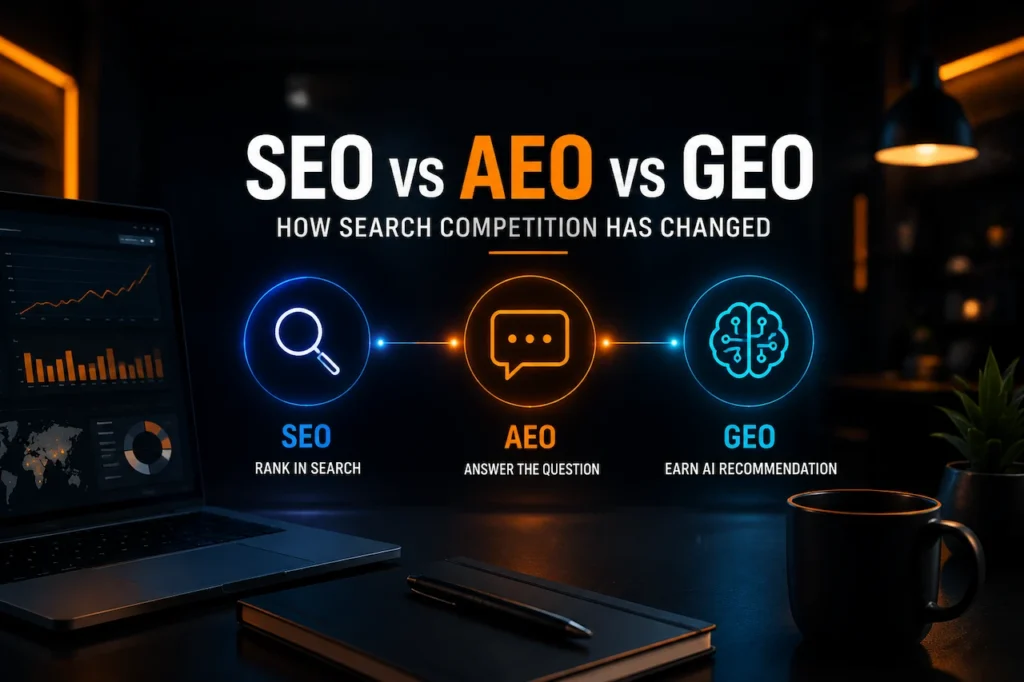
Search optimization has expanded beyond traditional rankings.
SEO (Search Engine Optimization)
SEO focuses on improving visibility in traditional search results.
Main signals include:
- Keywords
- Technical performance
- Content quality
- Backlinks
- User experience
The goal:
Rank higher and attract organic traffic.
AEO (Answer Engine Optimization)
AEO focuses on helping content appear in direct answers.
Important elements include:
- Question-based content
- Clear definitions
- Concise answers
- FAQ sections
- Structured information
The goal:
Provide answers that search systems can easily understand.
GEO (Generative Engine Optimization)
GEO focuses on improving visibility in AI-generated responses.
Important signals include:
- Brand authority
- Entity understanding
- First-party information
- Expert content
- AI citations
The goal:
Become a trusted source for AI recommendations.
Businesses looking to understand the relationship between these approaches can explore GEO vs AEO vs SEO and how modern search strategies work together.
Why Semantic Gaps Matter in AI Search
A semantic gap exists when competitors cover important concepts, relationships, or user needs that your content does not address.
A keyword gap means:
“You are missing a search phrase.”
A semantic gap means:
“You are missing the meaning, context, or supporting information behind the topic.”
AI systems do not only analyze individual keywords.
They understand:
- Entities
- Relationships
- Context
- User intent
- Supporting concepts
For example, a page about Local SEO may mention keywords like:
- Local SEO services
- Google rankings
- Maps optimization
However, competitors may also cover:
- Google Business Profile
- Reviews
- Local citations
- NAP consistency
- Local backlinks
- Customer trust signals
Those additional concepts create a stronger semantic footprint.
A semantic footprint represents the complete information ecosystem around a topic, including:
- Related entities
- Subtopics
- Questions
- Supporting concepts
- Industry relationships
This is why modern SEO campaigns require more than keyword research. Businesses need a complete SEO campaign strategy that combines technical optimization, content depth, authority, and AI visibility.
The 4-Step Competitive AEO Analysis Framework
Step 1: Identify Competitors and Their Semantic Footprint
The first step is understanding who you are actually competing against.
In traditional SEO, competitors are websites ranking for your keywords.
In AEO, competitors may be different.
Your AI competitors may include:
- Industry publications
- Research websites
- Review platforms
- Government resources
- Educational websites
- Businesses with stronger entity authority
To identify competitors, analyze:
- Google AI Overviews
- ChatGPT responses
- Perplexity citations
- Search result pages
Look for repeated sources and brands appearing in answers.
Then analyze competitor content:
- Page structure
- Headings
- FAQs
- Schema markup
- Entity mentions
- Topic coverage
- Internal linking
The objective is discovering what semantic territory competitors already own.
Step 2: Analyze Semantic and Entity Gaps
After mapping competitors, compare their content coverage against yours.
Look for:
Missing Subtopics
What important sections do competitors include that your page lacks?
Example:
Topic:
“AI Search Optimization”
Competitors may cover:
- AI Overviews
- ChatGPT optimization
- Entity SEO
- Structured data
- Brand mentions
A weaker page may only explain basic AI search concepts.
Missing Questions
AI systems are heavily question-driven.
Analyze:
- FAQs competitors answer
- Questions appearing in search results
- Related user concerns
Adding these answers improves content completeness.
Missing Entities and Relationships
Entities help AI systems understand context.
For example:
Topic:
“Competitive AEO Analysis”
Related entities include:
- Answer Engine Optimization
- Semantic SEO
- AI Overviews
- Knowledge Graph
- Entity optimization
- Generative AI
A page covering these relationships provides stronger context.
Businesses can strengthen these improvements through professional AI Search Optimization strategies focused on visibility across AI-driven search experiences.
Step 3: Evaluate Opportunity Impact
Finding semantic gaps is only the first part of Competitive AEO Analysis.
Not every missing topic or entity will create meaningful growth.
The next step is evaluating which opportunities can provide the highest impact.
A strong evaluation process considers four factors:
Search Intent Alignment
A semantic gap is valuable only when it matches what users actually need.
Analyze:
- What questions users ask
- What problems they are trying to solve
- Where they are in the buying journey
- Whether the topic supports business goals
For example:
A missing FAQ about a technical concept may improve visibility, but a missing section explaining pricing, comparisons, or solutions may create more business value.
The priority should always be:
User need + business value + AI visibility potential
Competitive Difficulty
Not every opportunity is equally achievable.
Evaluate:
- Number of competitors covering the topic
- Authority of competing pages
- Depth of existing content
- Quality of available information
- Brand strength
A smaller semantic opportunity with high relevance may provide more value than competing for an extremely broad topic dominated by established brands.
AI Answer Potential
Modern AEO analysis must consider whether a topic has potential to appear in AI-generated responses.
High-value opportunities usually include:
- Frequently asked questions
- Comparison queries
- Definitions
- Step-by-step explanations
- Industry-specific problems
- Expert recommendations
AI systems prefer content that provides:
- Clear answers
- Complete context
- Reliable information
- Strong entity relationships
Business Relevance
The final priority should connect with business objectives.
A semantic gap is more valuable when it can support:
- Lead generation
- Service visibility
- Brand authority
- Customer education
- Conversion opportunities
The goal is not creating more content.
The goal is creating content that improves visibility and business outcomes.
Step 4: Prioritize and Execute AI-Ready Content
After identifying and evaluating semantic gaps, the next step is turning opportunities into optimized content.
A strong AEO content strategy should focus on:
- Clear structure
- Complete topic coverage
- Entity relationships
- Direct answers
- Supporting evidence
- User-focused explanations
Create Content Based on Semantic Opportunities
Instead of writing content around a single keyword, build pages around a complete topic ecosystem.
For example:
Target topic:
Technical SEO
A weak article may only explain:
- What technical SEO is
A stronger AEO-focused article covers:
- Crawlability
- Indexing
- Core Web Vitals
- Structured data
- JavaScript rendering
- Site architecture
- Mobile performance
- Common technical issues
This creates stronger topical understanding.
Businesses can improve their technical foundation through technical SEO services that address crawling, indexing, performance, and website structure.
Build AI-Friendly Content Structures
AI systems need content that is easy to understand.
Important formatting practices include:
Clear Definitions
Start important sections with direct explanations.
Example:
“Competitive AEO Analysis is the process of evaluating competitor visibility in AI-powered search environments to identify semantic, entity, and citation opportunities.”
Question-Based Sections
Cover real user questions:
- What is Competitive AEO Analysis?
- How do AI systems choose sources?
- Why does my competitor appear in AI answers?
- How can I improve AI visibility?
Entity-Rich Content
Include relevant entities naturally.
Avoid adding keywords randomly.
Instead, explain relationships between concepts.
Example:
AEO connects with:
- AI search
- Semantic SEO
- Entity optimization
- Structured data
- Generative AI
Structured Data
Schema helps search engines understand:
- Organizations
- Articles
- Services
- FAQs
- Relationships between information
However, structured data should support valuable content, not replace it.
AI Citation Gap: Why Competitors Appear in AI Answers
One of the biggest differences between SEO competitor analysis and AEO competitor analysis is understanding AI citation gaps.
A citation gap exists when:
- Competitors are mentioned by AI systems
- Competitors are used as references
- Competitors appear in generated recommendations
- Your brand is missing
This does not always mean competitors have better rankings.
AI systems evaluate:
- Authority
- Relevance
- Entity clarity
- Content completeness
- Trust signals
- First-party information
How to Find AI Citation Opportunities
A practical process:
1. Test Important Customer Questions
Search:
- Google AI Overviews
- ChatGPT
- Perplexity
- Gemini
Use questions your customers ask.
2. Record Mentioned Sources
Track:
- Which brands appear
- Which pages are cited
- What information is referenced
3. Compare Against Your Content
Identify:
- Missing information
- Missing evidence
- Weak explanations
- Missing entities
4. Create Better Supporting Content
Improve:
- Depth
- Accuracy
- Expertise
- Structure
- Original insights
AI visibility is built by becoming a stronger source, not by manipulating a single ranking factor.
Tools for Competitive AEO Analysis
A complete analysis usually combines traditional SEO tools with AI research methods.
SEO Research Tools
Useful for:
- Competitor keywords
- Ranking pages
- Backlinks
- Content analysis
Examples:
- Semrush
- Ahrefs
Technical Analysis Tools
Useful for:
- Crawling
- Indexing issues
- Website structure
Examples:
- Screaming Frog
- Google Search Console
AI Search Research
Useful for:
- Citation analysis
- AI visibility checks
- Answer comparisons
Examples:
- ChatGPT
- Perplexity
- Google AI Overviews
- Gemini
Creating an AEO Content Brief From Competitor Research
The final output of Competitive AEO Analysis should not only be a list of gaps.
It should become an actionable content plan.
A strong AEO content brief includes:
Target Topic
Define the main subject and user intent.
Required Entities
List important concepts, brands, tools, and relationships.
Missing Competitor Coverage
Document:
- Missing sections
- Missing questions
- Missing examples
- Missing evidence
Content Structure
Plan:
- H2 sections
- FAQs
- Comparison sections
- Definitions
- Supporting resources
Internal Linking Strategy
Connect the new content with relevant authority pages.
A complete SEO ecosystem requires strong relationships between content assets, services, and supporting resources. Businesses can explore broader SEO services strategies to build stronger topical authority and search visibility.
Common Competitive AEO Analysis Mistakes
1. Only Comparing Keywords
Keyword gaps are useful, but AEO requires deeper analysis.
Businesses should also compare:
- Entities
- Questions
- Relationships
- AI citations
2. Copying Competitor Content
The goal is not creating a similar page.
The goal is creating a more complete and trustworthy resource.
3. Ignoring Search Intent
A page can cover many topics but still fail if it does not answer the user’s actual question.
4. Not Monitoring AI Results
AI search changes quickly.
Businesses should regularly check:
- AI Overviews
- ChatGPT responses
- Perplexity citations
5. Creating Content Without Authority Signals
AI systems need confidence.
Strengthen content with:
- Expert authorship
- Original research
- Case studies
- First-party insights
Businesses can strengthen authority signals by showcasing real projects through Dexora Digital case studies
Frequently Asked Questions About Competitive AEO Analysis
Q. What is Competitive AEO Analysis?
Competitive AEO Analysis is the process of analyzing competitor visibility in AI-powered search environments to identify gaps in content, entities, questions, and AI citation opportunities.
Unlike traditional competitor research, it focuses on understanding why AI systems select certain sources and how businesses can improve their chances of being referenced.
Q. How is Competitive AEO Analysis different from traditional SEO competitor analysis?
Traditional SEO competitor analysis focuses on:
- Keyword rankings
- Backlinks
- Organic traffic
- Domain authority
Competitive AEO Analysis focuses on:
- AI citations
- Entity coverage
- Semantic relationships
- Question coverage
- Content completeness
- AI answer visibility
SEO helps you compete in search results.
AEO helps you compete in answers.
Q. What is a semantic gap in SEO and AEO?
A semantic gap occurs when your content does not cover important concepts, relationships, entities, or questions that users and AI systems expect for a topic.
For example, a page about SEO may discuss keywords but miss:
- Search intent
- Entities
- Technical optimization
- AI search
- Authority signals
Filling these gaps creates more complete content.
Q. Why do competitors appear in AI answers while my brand does not?
Competitors may appear because AI systems find their content:
- More complete
- More authoritative
- Better structured
- Easier to understand
- Supported by stronger evidence
The solution is not simply adding more keywords.
Businesses need to improve:
- Topic coverage
- Entity relationships
- Expertise signals
- Content quality
- Brand authority
Q. How do AI systems choose which websites to cite?
AI systems consider multiple signals, including:
- Content relevance
- Information quality
- Authority
- Context understanding
- Entity relationships
- Source reliability
Strong AI visibility comes from becoming a trusted information source.
Q. What tools can be used for Competitive AEO Analysis?
A complete analysis may use:
SEO Tools
- Semrush
- Ahrefs
Website Analysis Tools
- Screaming Frog
- Google Search Console
AI Research Tools
- ChatGPT
- Perplexity
- Gemini
- Google AI Overviews
Each tool provides different insights into rankings, content, technical issues, and AI visibility.
Q. How often should Competitive AEO Analysis be performed?
AEO analysis should be performed regularly because:
- Competitors update content
- Search results change
- AI systems evolve
- New entities become important
Quarterly reviews are a practical starting point, with additional analysis for major industry changes.
Q. Does AEO replace SEO?
No.
AEO builds on SEO foundations.
Strong AI visibility still requires:
- Technical SEO
- Helpful content
- Authority
- Clear website structure
Businesses should combine SEO, AEO, and GEO rather than treating them as separate strategies.
Q. Can small businesses benefit from Competitive AEO Analysis?
Yes.
Small businesses can use AEO analysis to find opportunities that larger competitors miss.
Examples:
- Industry-specific questions
- Local expertise
- Unique customer experiences
- First-party knowledge
Smaller brands can compete by becoming highly relevant and authoritative in specific topics.
Businesses targeting local audiences can also strengthen visibility through a focused Local SEO services strategy combined with AI search optimization.
Q. What is the relationship between semantic SEO and AEO?
Semantic SEO focuses on helping search engines understand topics, entities, and relationships.
AEO applies similar principles to answer-driven search experiences.
Both focus on:
- Meaning
- Context
- User intent
- Topic completeness
Q. How can businesses improve AI citation opportunities?
Businesses can improve AI visibility by:
- Creating comprehensive content
- Adding expert insights
- Publishing original information
- Improving entity clarity
- Answering customer questions
- Building authority
The goal is creating content AI systems can confidently reference.
Improve Your AI Search Visibility With Dexora Digital
AI search is changing how customers discover businesses.
Traditional keyword research alone is no longer enough. Companies need to understand:
- What competitors cover
- Which entities matter
- Which questions remain unanswered
- Why AI systems select certain sources
At Dexora Digital, we help businesses analyze competitive gaps, improve semantic coverage, optimize for AI search, and build stronger visibility across modern search platforms.
Our approach combines:
- SEO analysis
- AEO strategy
- GEO optimization
- Semantic content planning
- Technical improvements
- Authority building
If you want to discover where competitors are gaining AI visibility and identify the opportunities your business is missing, book a SEO consultation with Dexora Digital.