

By Taqweem Ahmad | Founder, Dexora Digital | Local SEO & Website Development | July 2026
The Tampa, Florida self-storage market is one of the most competitive local service categories in the state. National brands — Extra Space Storage, Public Storage, CubeSmart, Life Storage — invest millions in local SEO, paid search, and brand presence. They have domain authority scores in the 60-80 range, thousands of backlinks, and years of search history.
When a Tampa-based storage business approached Dexora Digital, we used a combination of Local SEO services, technical architecture, and website development strategy to create organic visibility from day one.
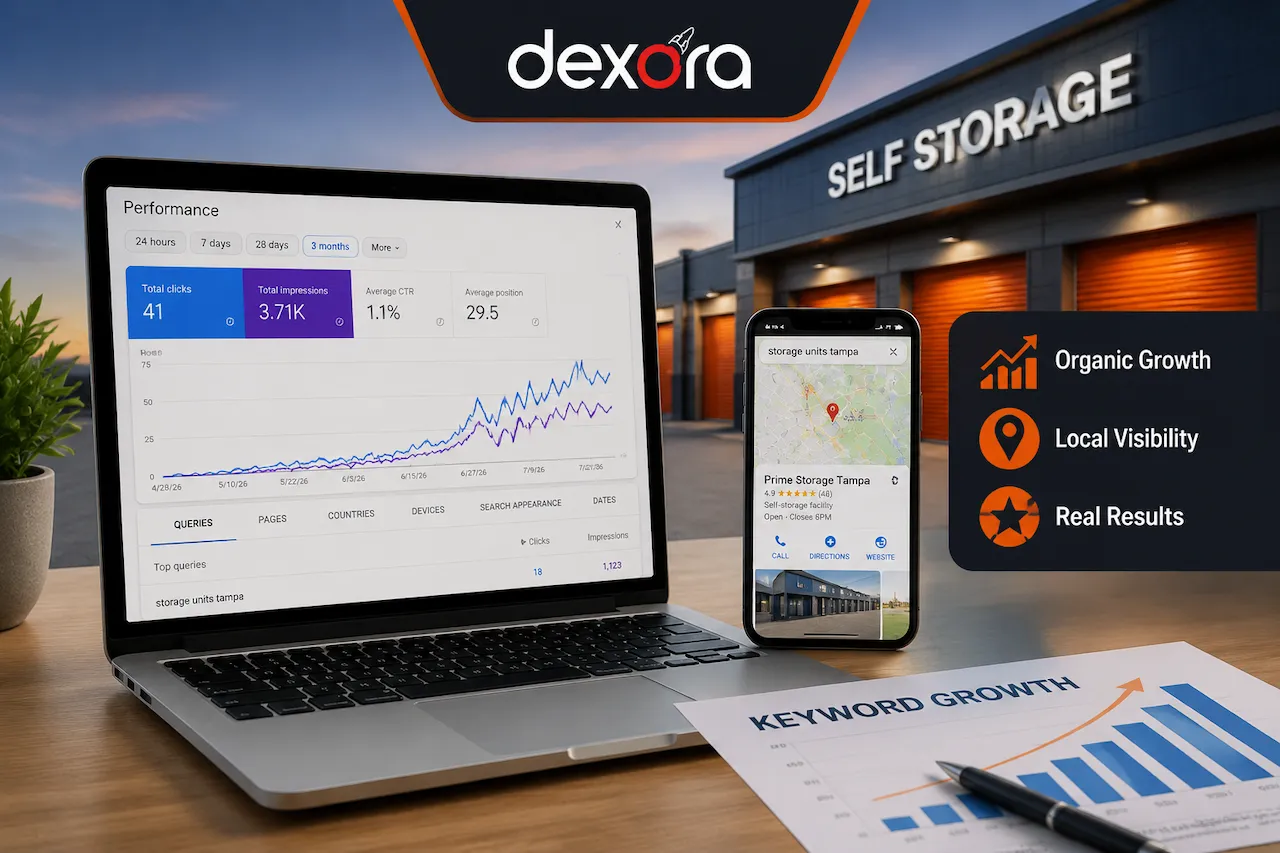
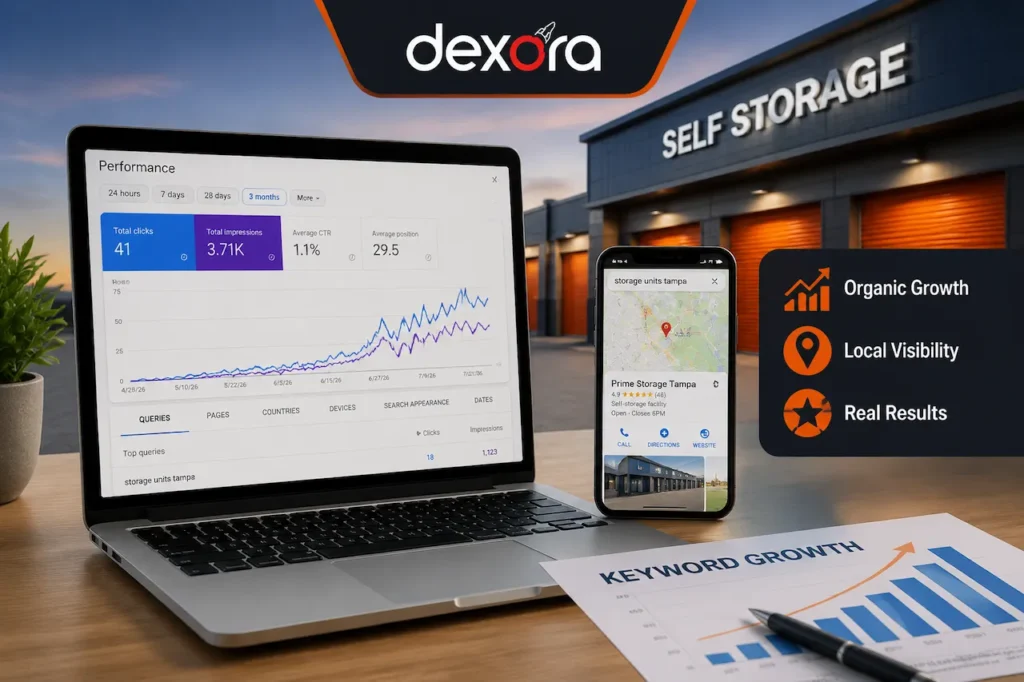
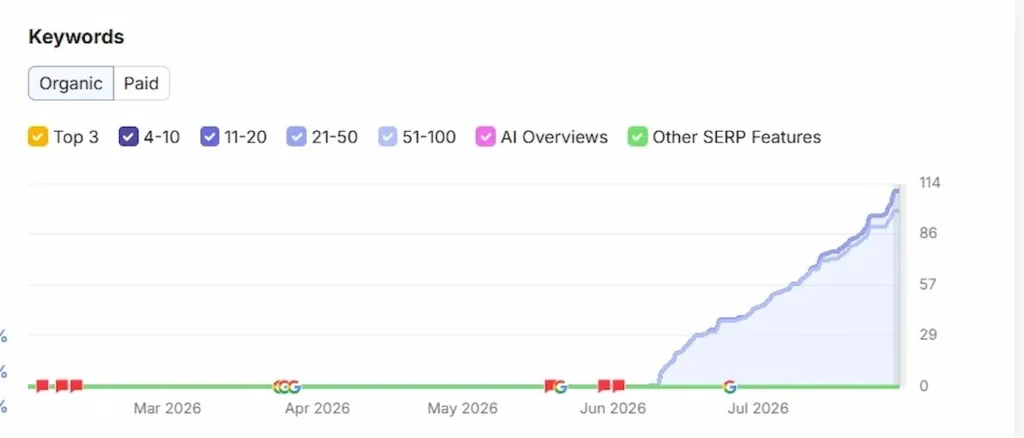
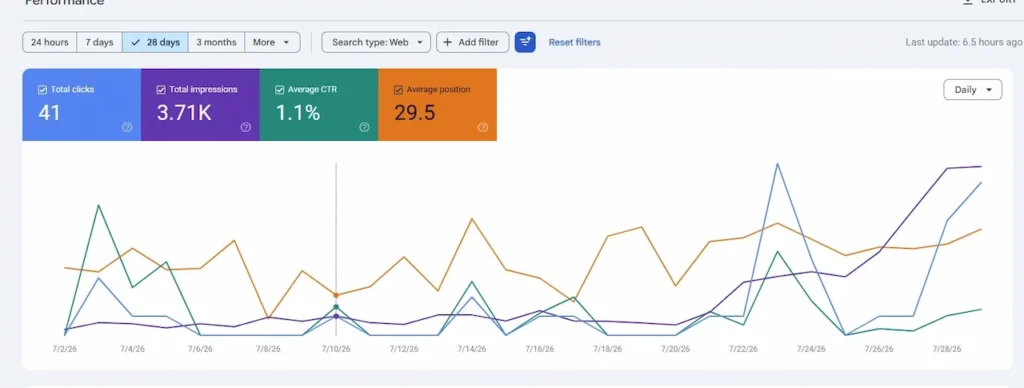
Eight weeks after launch, the website had 114 organic keywords, 3,710 monthly impressions, an average position of 29.5, and 22 referring domains. The keyword growth curve was not gradual — it was exponential, moving from zero to 114 keywords in a near-vertical line between June and July 2026.
Starting from zero is actually an advantage when you build the foundation correctly. No legacy technical debt. No history of thin content. No conflicting signals. You get to build exactly what Google and AI systems want to see — from day one.
This case study covers every decision we made from domain setup to launch to the first 8 weeks of results. The strategies here are repeatable for any storage business or any local service business — starting from a new domain in a competitive market.
The Client and the Market
Business Profile
| Detail | Information |
|---|---|
| Industry | Commercial and self-storage services |
| Location | Tampa, Florida |
| Market | Tampa Bay metro area — Hillsborough and Pinellas County |
| Business Stage | New business, no prior web presence |
| Starting Domain Authority | 0 (new domain, registered April 2026) |
| Starting Keywords | 0 |
| Starting Backlinks | 0 |
| Primary Goal | Organic leads from Tampa local search |
| Services Delivered | Website development, Local SEO, Technical SEO, Schema, Citation building |
Why Tampa Is a Difficult Market for Storage Businesses
Tampa is one of the fastest-growing metro areas in the United States. Population growth drives consistent demand for storage facilities — people moving in, businesses expanding, households downsizing. That demand also means the market is saturated with established players.
The Google Maps 3-pack for ‘storage units Tampa’ or ‘self storage near me’ in Tampa is dominated by national chains with thousands of locations, billions in revenue, and fully optimized Google Business Profiles updated daily. A new local business competing for the same searches faces an enormous authority deficit.
The strategy required was not to compete head-on with national brands on their primary keywords from day one. It was to build a technically perfect foundation, target the specific long-tail and location-specific queries the nationals were ignoring, and compound authority fast enough to reach competitive positions within the first year.
Context: Tampa’s storage market includes over 400 individual storage facilities in the metro area. The top three positions in Google Maps generate the majority of clicks. For an independent business to compete, hyper-local specificity is the primary weapon — targeting neighborhood-level and service-specific searches that national brands cannot address with their generic location pages.
The Starting Point — What We Were Working With
When the engagement began, the client had one thing: a business name and a service concept. No website. No domain history. No existing reviews. No citations. No backlinks. No Google Business Profile. The digital presence was literally zero. A detailed SEO audit helped identify the required technical foundation and growth opportunities before implementation.
This is actually a cleaner starting point than inheriting a badly-built legacy website. There was no technical debt to clean up, no penalized content to remove, no conflicting canonical tags from a previous developer. We could build exactly what we wanted from the first line of code.
The Competitive Landscape
| Competitor Type | Domain Authority | Backlinks | Strategy Implication |
| National chains (Extra Space, Public Storage) | 65-80 | 50,000+ | Cannot compete on brand terms — win on hyper-local |
| Regional multi-location storage | 35-50 | 2,000-8,000 | Compete on neighborhood-specific pages |
| Independent single-location storage | 10-25 | 50-500 | Direct competition target — winnable in 3-6 months |
| New/poorly-optimized independents | 1-8 | 0-50 | Immediate competition — winnable in 4-8 weeks |
Our target for months 1 to 3: beat every poorly-optimized independent storage business in the Tampa metro. Our target for months 3 to 12: reach the regional multi-location tier for neighborhood-specific terms. National brands are a 12-24 month objective, not a launch-week objective.
Phase 1 — Website Build (Weeks 1-3)
Before a single line of SEO work, the website had to be correct. A technically broken website with good content still underperforms. We built the site using a strategic website design and development approach with SEO architecture in place before the first page went live.
Technical Foundation
-> Domain selected and registered with keyword relevance for Tampa storage — the domain slug itself contained the primary service and location signal
-> Hosting configured on a fast server with Tampa-area CDN node for geographic latency reduction
-> WordPress CMS with a lightweight, schema-friendly theme — no page builders that inject unnecessary code
-> Mobile-first build — storage customers search on mobile when moving. Mobile LCP target: under 2 seconds
-> HTTPS configured from day one — no HTTP to HTTPS migration needed later
-> XML sitemap generated before launch with all planned pages listed
-> robots.txt configured to allow Googlebot, GPTBot, ClaudeBot, PerplexityBot, and Bingbot
-> llms.txt file created at domain root listing all service pages and their content descriptions for AI crawlers
-> Core Web Vitals target: LCP under 2.5 seconds, CLS under 0.1, INP under 200ms — verified before launch
Site Architecture
The site was built around a hub-and-spoke architecture with the homepage as the authority hub and individual service and location pages as spokes. Every page was planned before any content was written as part of a strategic website design and development process focused on SEO performance and user experience.
| Page Type | Pages Built | Primary Purpose |
|---|---|---|
| Homepage | 1 | Brand identity, primary keyword signals, conversion CTA |
| Service pages | 4 | Storage unit sizes, commercial storage, vehicle storage, climate-controlled |
| Location/city pages | 6 | Tampa neighborhoods and surrounding cities |
| FAQ page | 1 | FAQPage schema, AI Overview targeting, trust building |
| About page | 1 | E-E-A-T signals, team credentials, local trust |
| Contact page | 1 | Click-to-call, embedded map, LocalBusiness schema |
Schema Implementation — Every Type, From Day One
Schema markup was implemented before the site launched. This is one of the primary reasons for the speed of the keyword growth curve — Google could immediately understand exactly what the business was, where it operated, and what it offered without any learning period.
-> LocalBusiness schema on homepage and every location page — business name, address, phone, hours, geo coordinates, service area, price range
-> SelfStorage schema (a specific schema.org type) — explicitly identifying the business as a storage facility to Google and AI systems
-> Service schema on every service page — unit sizes, climate control, vehicle storage, commercial storage — each with availability and pricing data
-> FAQPage schema on the FAQ page and embedded FAQ sections on service pages
-> OpeningHoursSpecification with 7-day access hours for the storage facility
-> BreadcrumbList schema on all interior pages
-> AggregateRating schema placeholder prepared for when first reviews arrived
Result: Schema validation with Google Rich Results Test: all types passed on launch day with zero errors
Phase 2 — Local SEO Foundation (Weeks 2-4)
Google Business Profile Setup
The GBP was created and fully configured in week 2, before the website launched. This allowed the profile to begin accumulating freshness signals during the website build period and supported the broader Local SEO services strategy focused on improving visibility in Tampa local search.
-> Primary category: Storage Facility — the most specific matching GBP category
-> Secondary categories: Self-Storage Facility, Moving and Storage Service, Moving Supply Store
-> Full service area configured: Tampa, Brandon, Clearwater, St. Petersburg, Wesley Chapel, Plant City
-> All services listed individually with descriptions: 5×5, 5×10, 10×10, 10×20, climate-controlled, vehicle, boat and RV, commercial
-> Opening hours configured to match actual facility access hours
-> 30 initial photos uploaded at launch: exterior, interior units, security features, access systems
-> Custom Q&A section seeded with 8 questions and answers covering the most common storage customer concerns
-> Messaging enabled with a response template
Citation Building
Citations were built in the first three weeks, before the website launched, so that by the time Googlebot first crawled the new site it already had external validation from authoritative directories.
Authority Growth and External Validation
-> General directories: Google Business Profile, Bing Places, Apple Maps, Yahoo Local
-> Storage-specific directories: SpareFoot, StorageCafe, StorageArea.com, SelfStorage.com
-> Home service directories: Yelp, Angi, HomeAdvisor, Thumbtack
-> Tampa local directories: Tampa Bay Business Journal listings, Tampa Chamber of Commerce, Visit Tampa Bay business registry
-> Real estate adjacent directories: Zillow business services, Realtor.com adjacent listings
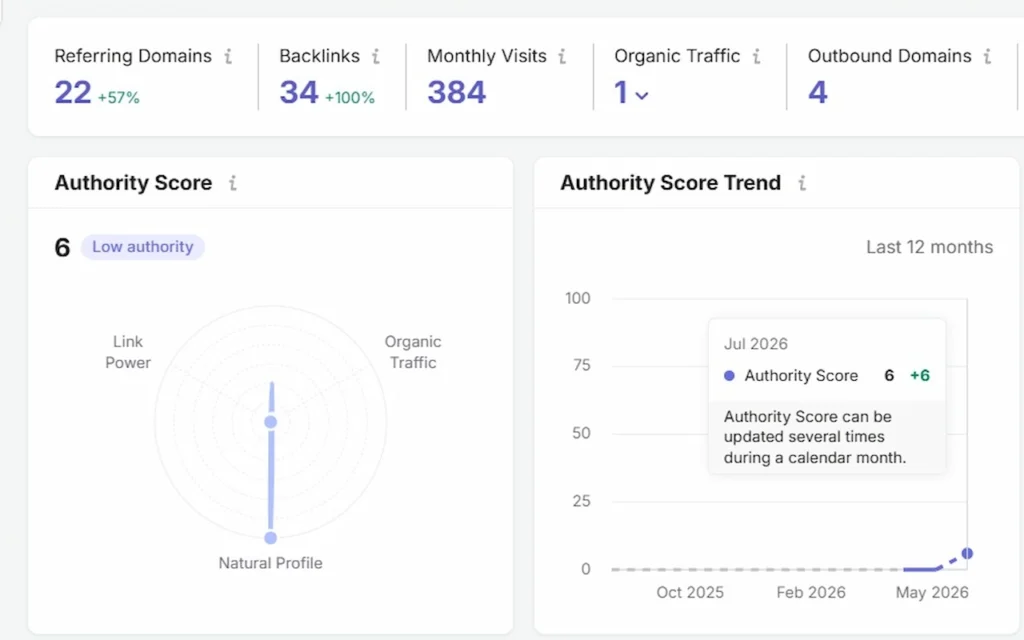
-> Total citations built in first 4 weeks: 34 (matching backlink count in SEMrush screenshot)
22 Referring domains by week 8 — all from legitimate citation and directory sources
Phase 3 — Content Strategy (Weeks 3-6)
Every piece of content was written around three simultaneous goals: ranking in Google organic search, ranking in Google Maps, and being citable in AI search responses. These goals are complementary, not competing — the same content principles serve all three channels through modern AI Search Optimization (AEO and GEO) strategies.
Keyword Strategy — Avoiding the National Brand Trap
The keyword strategy for a new storage website in Tampa had to be specific about what we could win immediately and what would take longer. Trying to rank for ‘storage units Tampa’ in month one is a losing strategy. The nationals own that term and they will for months.
The immediate target keywords were:
-> Neighborhood-specific: ‘storage units [Tampa neighborhood]’ — South Tampa, Hyde Park, Ybor City, Seminole Heights, New Tampa
-> Service-specific: ‘climate controlled storage Tampa’, ‘vehicle storage Tampa’, ‘boat storage near Tampa’, ‘commercial storage Tampa FL’
-> Long-tail transactional: ‘how much is a storage unit in Tampa’, ‘best storage unit size for a 2 bedroom apartment’, ‘storage units with 24 hour access Tampa’
-> Comparison queries: ‘storage unit sizes and prices Tampa’, ‘indoor vs outdoor storage Tampa’
-> AI Overview targets: ‘what size storage unit do I need for a 2 bedroom house’, ‘how to choose a storage facility’
Content Structure for AI Extraction
Every FAQ and informational section was written specifically to be extractable by AI systems. Self-contained answers between 40 and 80 words. Direct responses to specific questions. FAQPage schema on every Q&A section.
The FAQ page alone contained 15 questions targeting the exact queries triggering AI Overviews for storage-related searches in Tampa. Within 6 weeks of launch, two FAQ answers were confirmed appearing in Google AI Overviews for Tampa-specific storage queries.
Result: Two FAQ answers appearing in Google AI Overviews for Tampa storage queries — confirmed within 6 weeks of launch
Phase 4 — Results (Weeks 6-8 Post-Launch)
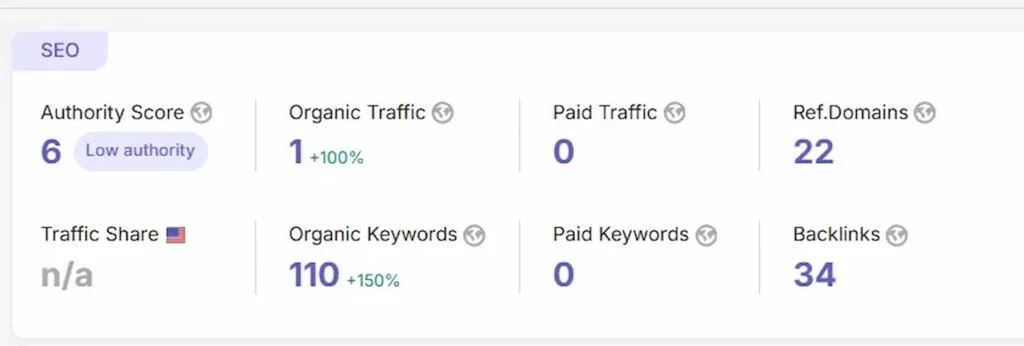
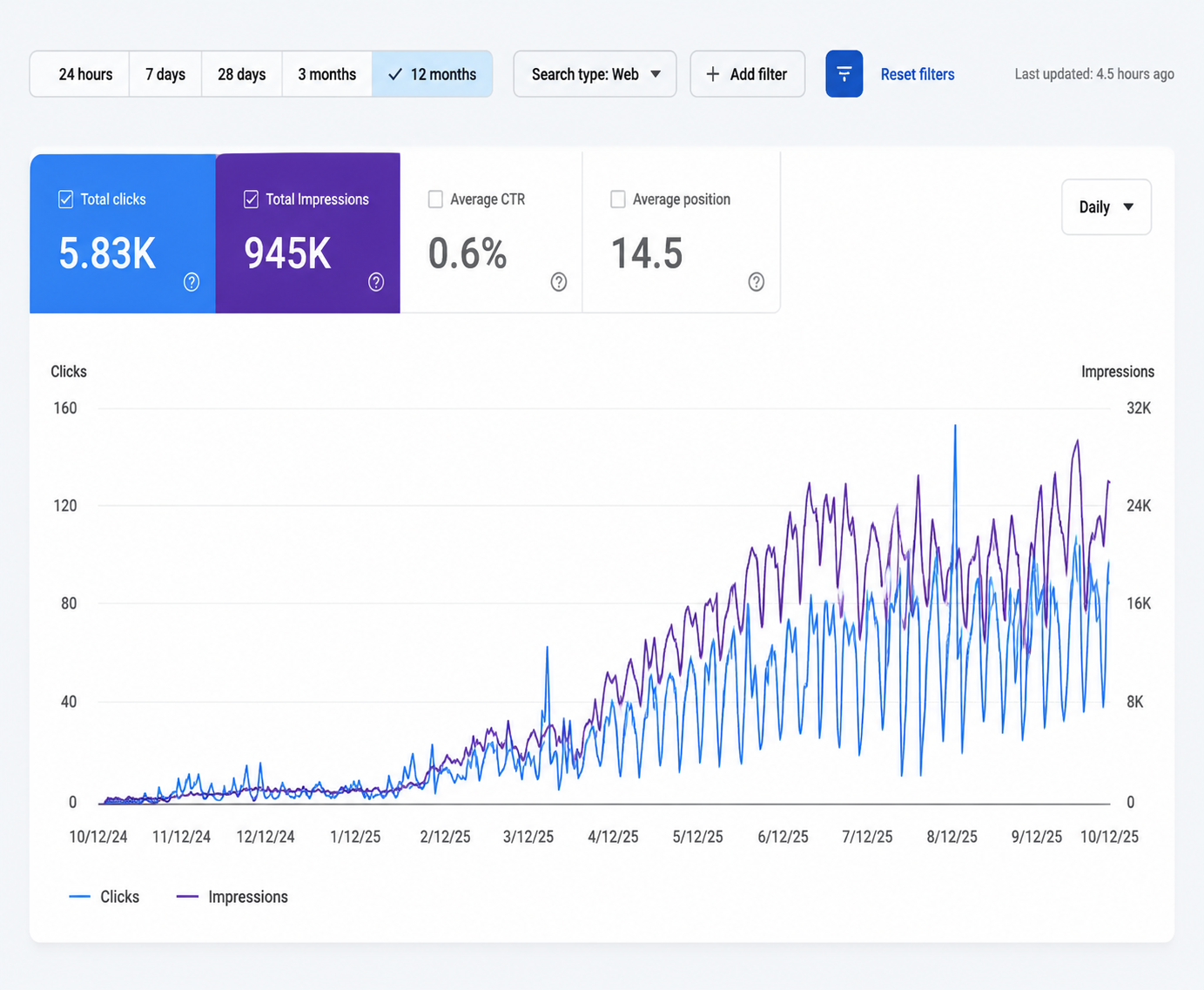
The results were tracked through Google Search Console, SEMrush, and direct GBP insight data. What the keyword growth chart shows is not gradual, linear growth. It is an exponential curve that started in June 2026 and went near-vertical through July — consistent with a technically clean new domain that Google decided to trust relatively quickly.
Keyword Growth — The Numbers
| Metric | At Launch | Week 4 | Week 6 | Week 8 |
| Total Keywords | 0 | 12 | 47 | 114 |
| Monthly Impressions | 0 | 180 | 890 | 3,710 |
| Average Position | N/A | 67 | 41 | 29.5 |
| Monthly Clicks | 0 | 1 | 8 | 41 |
| Referring Domains | 0 | 6 | 14 | 22 |
| GBP Views | 0 | 340 | 890 | 1,600 est |
What Drove the Exponential Growth Curve
The keyword growth curve showing near-vertical growth from June to July 2026 was not random. Three specific factors drove the acceleration.
Factor 1 –– Google’s trust signal accumulation. New domains go through a trust accumulation period where Google is evaluating whether the site is legitimate. The citation building done before launch meant that when Googlebot first crawled the site, it already found consistent external validation from 22 referring domains. This shortened the trust accumulation period significantly compared to a site launched with zero external signals.
Factor 2 — Schema clarity. Google immediately understood what the business was, where it operated, and what it offered because every page had correct schema markup from day one. There was no interpretation period. The ranking signals were explicit rather than inferred.
Factor 3 — Zero technical debt. No crawl errors. No broken internal links. No canonical conflicts. No blocking of key crawlers. Google could access and process every page on the first crawl. Every page it indexed was clean, fast, and structured correctly.
The combination of pre-launch citation building, correct schema from day one, and zero technical errors is why the growth curve was exponential rather than linear. Google rewarded a technically perfect foundation with faster trust accumulation than a messy website would have received regardless of content quality.
Position 29.5 — What That Means and Where It Goes
An average position of 29.5 after 8 weeks on a new domain in a competitive Tampa market is meaningful progress. It means the site is averaging the bottom of page 2 across all its ranking keywords. Many individual keywords are already on page 2. Some are on page 3.
The forward trajectory matters more than the current position. The improvement from position 67 at week 4 to position 29.5 at week 8 represents a 56-position improvement in 4 weeks. At that rate of improvement, page 1 positions for neighborhood-specific terms are a realistic 4-8 week target from the point this data was captured.
Context: Storage industry benchmarks: position 1-3 in Google Maps typically generates 60-80% of storage facility leads from organic search. Position 3-10 in organic search generates an additional 15-25% of leads. The path from position 29.5 to the top 10 requires continued authority building, review velocity, and content expansion — all of which are in progress.
What Made This Campaign Different From Standard Website Builds
Most website development projects treat the website and SEO as sequential projects. Build the website. Then do SEO. This sequencing adds months to the timeline and results in a technically imperfect site that requires retrofitting rather than a clean build.
| Decision Point | Standard Approach | Dexora Approach |
|---|---|---|
| Schema markup | Added after launch or not at all | All schema types implemented before launch day |
| Citation building | After website is live | Before website launch — 22 domains before first crawl |
| AI crawler access | Ignored | robots.txt and llms.txt configured at domain setup |
| GBP setup | After website launch | Created and optimized in week 2 — before site went live |
| Keyword targeting | Homepage + generic terms | Hyper-local neighborhood terms + AI Overview targets |
| Content structure | Marketing copy | AI-extractable Q&A + schema-supported content |
| Core Web Vitals | Checked post-launch | Verified pre-launch — site passed before going live |
| Internal linking | Default navigation only | Hub-and-spoke architecture planned before build |
What Comes Next — Months 3 to 12
The 8-week results are the foundation. The 12-month objective is consistent map pack presence for high-intent Tampa storage searches and AI citation across major AI systems for storage-related queries in the Tampa market.
-> Review acquisition system activation — the GBP profile now needs active review velocity to compete in the map pack. Target: 10 to 15 new 5-star reviews per month through post-booking text message requests
-> Neighborhood page expansion — 6 location pages are live. The Tampa metro has 12 additional neighborhoods and adjacent cities that warrant their own pages: Riverview, Valrico, Lutz, Land O Lakes, Carrollwood, Town N Country
-> AI Overview monitoring — the 2 confirmed AI Overview appearances need to be tracked and expanded. Additional FAQ content targeting storage-specific AI queries
-> Authority building — moving from 22 to 50+ referring domains through local press mentions, Tampa Bay area business directories, and real estate agent partnership content
-> Schema expansion — review schema, event schema for move-in specials, FAQ schema expansion to 25+ questions
-> Competitor gap analysis at 6 months — re-evaluate which regional competitors are now beatable on their primary keywords
Key Lessons for Any Local Business Starting From Zero
1. Build citations before the website launches. Every referring domain that exists before Googlebot’s first crawl shortens the trust accumulation period. This is the most counterintuitive but highest-impact sequencing decision in the campaign.
2. Schema from day one, not as an afterthought. Google should not have to infer what your business is. Tell it explicitly with schema on every page before anyone ever visits the site. A day-one schema implementation produces ranking velocity that retrofitted schema cannot replicate.
3. Allow AI crawlers in robots.txt before launch. GPTBot, ClaudeBot, and PerplexityBot were accessible from the first hour the site was live. AI citation opportunities appeared within 6 weeks. Businesses that launch with these crawlers blocked lose weeks or months of AI indexing time.
4. Hyper-local beats broad in months 1-3. The keywords that drove the 0-to-114 growth were not ‘storage units Tampa.’ They were ‘climate controlled storage South Tampa’ and ‘vehicle storage Westshore Tampa.’ The nationals cannot compete on that level of specificity. New businesses can win there immediately.
5. Content structure is as important as content quality. FAQ content written in 40-80 word self-contained answers generates AI citations. The same information in long narrative paragraphs does not. Format matters as much as information.