


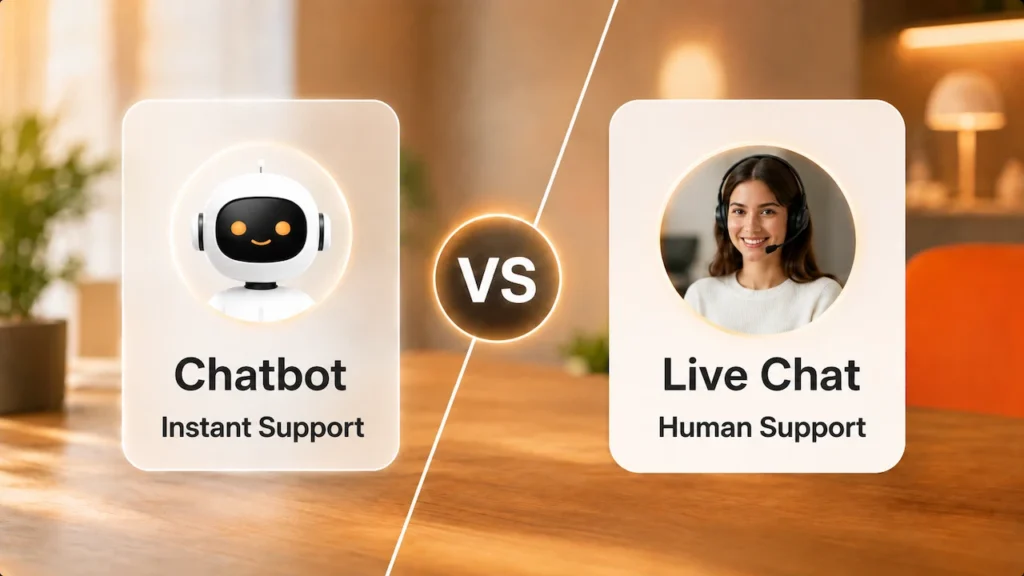
Every local service business owner asks us some version of the same question once their website starts getting real traffic: should the chat widget on the site be a bot, a real person, or both? The honest answer depends entirely on what “converts better” actually means for that specific business, and most comparisons online skip straight past that detail.
We have implemented both across enough plumbing, HVAC, electrical, and home services clients to know the answer isn’t universal. It’s a tradeoff between speed, cost, and the complexity of what a visitor actually needs answered and getting that tradeoff wrong costs leads either way.
What “Chatbot Development Frameworks” Actually Means
Before comparing chatbots against live chat, it’s worth being specific about what a chatbot even is in 2026, because the term covers a wide range of underlying technology with very different conversion behavior.
- Rule-based frameworks. Decision-tree bots that walk a visitor through pre-set options “Are you looking for: Emergency Service / Free Quote / Existing Customer Support.” These are cheap to build, predictable, and handle high-intent, simple queries well.
- NLP-based frameworks. Bots that parse natural language input and match it to intents, allowing visitors to type a question in their own words rather than clicking through a decision tree. These require more setup but handle a wider range of visitor phrasing.
- LLM-based frameworks. The newest category, built on large language models rather than pre-scripted intents. These can handle open-ended questions, hold context across a conversation, and escalate to a human only when genuinely necessary but they require careful guardrails for a local service business, where an incorrect answer about pricing or availability creates a real problem.
- Hybrid frameworks. Most of the chatbot implementations we build for local service clients combine a rule-based front door for common, high-intent actions with an LLM layer underneath for anything that falls outside the scripted paths.
Which framework a business needs depends directly on the complexity of the questions their visitors actually ask a detail most generic chatbot-versus-live-chat comparisons skip entirely.
How Local Service Businesses Actually Use Chat Today
Chat, in either form, serves three core jobs for a local service business: capturing leads outside business hours, qualifying leads before they reach a team member, and answering the small set of questions that come up constantly service area, pricing range, availability, emergency response.
The mistake we see most often is treating chat as a single tool rather than three separate jobs that might need different solutions. After-hours lead capture and lead qualification are jobs a well-built chatbot handles reliably. Complex, emotionally charged conversations an emergency water leak, a confusing insurance claim question are jobs that genuinely benefit from a human.
Where Chatbots Win on Conversion
For local service businesses, chatbots consistently outperform live chat in a few specific, measurable situations.
- After-hours and overflow coverage. A chatbot never sleeps, never gets overwhelmed during a call surge, and captures contact information from every visitor who arrives outside staffed hours. We have seen firsthand that after-hours chatbot lead capture alone often justifies the entire implementation cost for emergency service businesses like plumbing and HVAC.
- Speed on simple, high-intent queries. A rule-based or hybrid bot answers “Do you service my zip code?” or “What’s your typical callout fee?” instantly, with zero wait time. Visitors asking simple questions convert better with instant answers than with a “someone will respond shortly” live chat delay.
- Consistent lead qualification. A chatbot asks the same qualifying questions every time service needed, location, urgency — before handing a lead to the team, which means sales staff spend time on leads that are already partially qualified instead of starting every conversation from zero.
- Cost at scale. Once built, a chatbot handles unlimited simultaneous conversations at no marginal cost. Live chat staffing costs scale directly with conversation volume, which becomes expensive fast for a business running paid ad campaigns that drive traffic spikes.
Where Live Chat Still Wins
Live chat is not obsolete, and for a specific slice of local service conversations, it converts noticeably better than even a well-built chatbot.
- High-stakes or emotionally charged situations. A visitor dealing with a burst pipe or a no-heat emergency in freezing weather wants to know a real person is handling their situation, not that they’re working through a script. Live chat or a fast bot-to-human handoff converts better here specifically because it reduces anxiety, not just because it answers questions.
- Complex, non-standard questions. Custom project quotes, insurance-related questions, or anything requiring judgment rather than a lookup genuinely need a human who can reason through specifics a bot wasn’t built to handle.
- High-ticket services. For services with a significant price point full HVAC system replacement, major electrical panel upgrades visitors researching a large purchase convert better after a real conversation that can address hesitation in real time, something even a strong LLM-based bot struggles to replicate convincingly for a skeptical buyer.
The Real Answer: Most High-Converting Setups Use Both
Framing this as a strict either-or misses how the highest-converting local service businesses actually structure chat. The pattern we implement most often is a hybrid: a chatbot handles the front door, qualifies the visitor, and either resolves the conversation directly or hands off to a live team member when the conversation crosses a complexity threshold.
This gets a business the coverage and cost efficiency of a chatbot without losing conversions on the subset of visitors who genuinely need a human. It also means live staff time gets spent on the conversations most likely to close, rather than fielding the same handful of repetitive questions all day.
If you’re already investing in traffic through local SEO for home services or paid campaigns, the chat experience a visitor lands on directly affects how much of that traffic actually converts which makes this a conversion question as much as a technology one. It’s worth reviewing alongside a broader conversion rate audit rather than in isolation, since chat is one part of a larger conversion path that includes page speed, form friction, and call-to-action placement.
Common Mistakes Local Service Businesses Make With Chat
A handful of patterns show up repeatedly across the local service businesses we’ve audited chat setups for:
- Deploying a generic, off-the-shelf chatbot with no local service-specific training, so it fumbles basic questions about service area or emergency response
- Running live chat with no after-hours coverage plan, losing every lead that arrives outside staffed hours to silence
- Building a chatbot with no clear handoff path to a human, frustrating visitors with genuinely complex or urgent questions
- Never reviewing chat transcripts to identify the questions visitors ask most, which means the bot’s scripted paths go stale and stop matching real visitor intent
- Treating the chat widget as a “set it and forget it” tool rather than something reviewed and refined alongside the rest of the site’s conversion performance
What This Means for Your Business
The right answer depends on your service mix and call volume more than on general chatbot-versus-live-chat trends. A business built around simple, standardized bookings routine maintenance visits, straightforward quotes leans further toward a chatbot-first setup. A business handling frequent emergency calls and high-ticket replacements benefits more from a hybrid model with a fast, reliable path to a human.
We have built exactly this kind of chat strategy for home service clients like the plumbing businesses covered in our work on Google Business Profile optimization for plumbers, where lead volume and urgency vary widely by service type within the same business.
Why Choose Dexora Digital for Chatbot Development
We build chatbot strategy around your actual call and lead volume, not a generic template pulled from a different industry.
- Framework selection rule-based, NLP, LLM, or hybrid matched to the real complexity of your visitor questions
- Local service-specific training on service area, pricing ranges, and emergency response language
- Clear escalation paths from bot to human for high-stakes or high-ticket conversations
- Chat performance reviewed as part of overall conversion strategy, not left as a standalone tool
- Direct access to the team building and refining the bot, with ongoing updates based on real transcript data
Explore our full chatbot development services to see how we scope and build this for local service businesses specifically.
Conclusion
Chatbots and live chat aren’t competing for the same job they’re suited to different parts of the same conversation funnel. Chatbots win on speed, coverage, and cost for simple, high-intent queries. Live chat wins on complex, high-stakes conversations where a visitor needs to feel heard by a real person. The businesses converting best usually run both, with a bot handling the front door and a clear path to a human when a conversation genuinely needs one. Book a free consultation and we’ll map out which setup fits your call volume and service mix.
Frequently Asked Questions
Is a chatbot or live chat better for a local service business?
Neither option is universally better because they handle different types of conversations. Chatbots perform best for instant answers, lead capture, and qualification, while live chat performs better for complex or emotionally sensitive enquiries. Most local service businesses achieve stronger conversions by using both.
Which chatbot development framework works best for local service businesses?
A hybrid chatbot framework is usually the most practical choice for local service businesses. It uses rule-based flows for common actions such as bookings and service-area checks, while an NLP or LLM layer handles less predictable questions. This provides speed without forcing every visitor through a rigid script.
What is the difference between rule-based and LLM-based chatbots?
Rule-based chatbots guide visitors through predefined questions and answer options. LLM-based chatbots can understand open-ended questions, remember conversation context, and respond more naturally. However, LLM chatbots require stronger controls to prevent inaccurate answers about pricing, availability, or services.
Do chatbots increase leads for home service businesses?
Chatbots can increase captured leads by responding immediately when staff members are unavailable. They are especially effective for visitors arriving after business hours or during periods of high call volume. Their main advantage is preventing interested prospects from leaving without submitting their details.
Why do chatbots convert well for simple service enquiries?
Visitors asking about service areas, availability, callout fees, or appointment times usually want an immediate answer. A chatbot can provide that information without making them wait for a staff member. This speed reduces friction and helps move high-intent visitors toward booking or requesting a quote.
When does live chat convert better than a chatbot?
Live chat performs better when a visitor has a complex, urgent, or emotionally charged problem. Situations involving emergency repairs, insurance questions, or expensive projects often require reassurance and professional judgment. A real person can respond to hesitation and unusual circumstances more effectively.
Can a chatbot handle emergency service requests?
A chatbot can collect the service type, location, contact details, and level of urgency. It can then route the request immediately to the appropriate team member. However, serious emergencies such as burst pipes or heating failures should include a fast handoff to a real person.
How does a chatbot qualify leads before they reach the team?
A chatbot can ask every visitor the same important questions, such as their location, required service, urgency, and preferred appointment time. This gives the business useful information before the first human conversation begins. Staff can then prioritize qualified and urgent enquiries more efficiently.
Is chatbot development cheaper than staffing live chat?
A chatbot generally requires a higher initial development cost but has relatively stable ongoing expenses. It can manage multiple conversations simultaneously without requiring additional staff for every increase in traffic. Live chat costs rise with staffing hours, conversation volume, and after-hours coverage.
Can chatbots help local service businesses outside normal working hours?
Yes, after-hours lead capture is one of the strongest advantages of a chatbot. It can answer common questions, collect contact details, and record booking requests while the office is closed. This is particularly valuable for plumbing, HVAC, electrical, and other emergency service businesses.
Why is a bot-to-human handoff important?
A clear handoff prevents visitors from becoming trapped in an automated conversation that cannot resolve their problem. The chatbot should recognize urgent, complex, or high-value enquiries and transfer them to a staff member. This keeps automation efficient without sacrificing trust or potential conversions.
How should businesses improve chatbot performance over time?
Businesses should regularly review chat transcripts to identify unanswered questions, failed conversations, and common visitor requests. The chatbot’s scripted flows, knowledge, and escalation rules should then be updated using that information. Chat should be treated as an ongoing conversion tool rather than a one-time installation.
Not sure whether your business needs a chatbot, live chat, or both? Let Dexora Digital build the right setup to capture and convert more leads.
Book a Free Consultation
Local SEO and AI Search (AEO & GEO) Specialist.
Building search visibility that converts into qualified demand.
Today, businesses need visibility on Google Maps and AI powered search and websites that actually convert visitors into leads. I am a Local SEO, AI Search & Conversion Rate Optimization (CRO) Specialist with 5+ years of hands on experience helping businesses turn underperforming websites into high converting growth engines. My work combines Local SEO, Technical SEO, Semantic SEO, GEO/AEO, and conversion focused landing page optimization to ensure brands are discoverable and profitable.
My Experience
I have delivered SEO and web growth projects across the US, UK, Australia, Canada, Finland, Germany, and the Czech Republic, working in industries such as local businesses (electrician, hvac, cleaning, Real estate, healthcare, B2B, eCommerce, SaaS, and environmental services.
Some Results
>> 200+ websites audited globally
>> specifically worked with 100+ local business (80% from USA)
>> 80+ websites improved through technical SEO & schema fixes
>> 20+ businesses featured in Google AI Overviews (SGE)
>> Multi million impression growth for eCommerce & SaaS brands
Book Free Consultation: calendly.com/dexora/30min