
Most small businesses lose leads after hours, not during them. A visitor lands on your site at 9 p.m., asks a question, gets no answer, and moves to the next result.
We built this guide because that gap is fixable. Below, we break down what AI chatbot development actually involves, what it costs, and how to launch one without wasting budget on the wrong build.
What AI Chatbot Development Actually Means
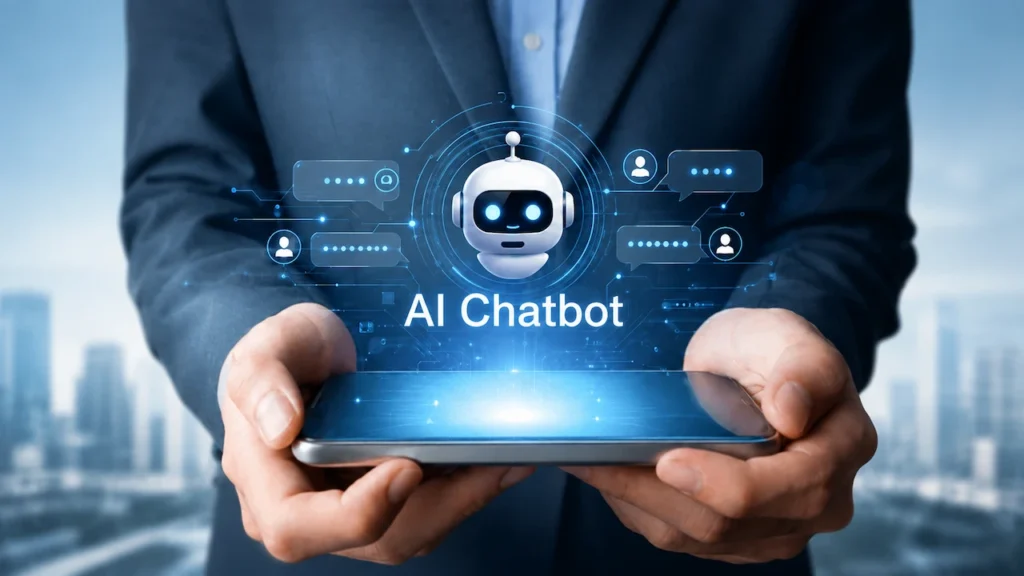
AI chatbot development is the process of designing, training, and deploying a conversational system that answers questions, qualifies leads, and books appointments on your behalf. It is not a static FAQ widget bolted onto your homepage.
A properly built chatbot connects to your CRM, understands your services well enough to answer specific questions, and hands off to a human only when the conversation genuinely needs one. We prioritize a strategy where the bot does the repetitive work and your team handles the decisions that require judgment.
There are three components involved in any real build:
- Conversation design — the actual flow, tone, and decision logic
- Integration — connecting the bot to your CRM, calendar, and lead-routing tools
- Training data — the FAQs, service pages, and pricing information the bot draws answers from
Skip any one of these and the chatbot becomes another abandoned tool sitting on your site.
Why Small Businesses Can’t Ignore This in 2026
The average small business owner underestimates how much revenue disappears in the gap between “visitor asks a question” and “someone responds.” We have seen firsthand how this plays out across service businesses, e-commerce stores, and B2B companies: leads do not wait for business hours, and the first business to respond usually wins the job.
Three shifts are pushing this from optional to necessary this year:
- Response speed now decides deals. Buyers compare multiple vendors in the same sitting, and the first clear answer often wins the inquiry.
- Staffing costs keep rising while the questions customers ask stay repetitive pricing, availability, service areas, and booking.
- AI-native customers expect instant answers. People increasingly try the chat widget before they try the phone.
None of this means you replace your team. It means the twelve questions your team answers every single day get handled instantly, freeing your staff for the conversations that actually close.
Types of AI Chatbots Worth Building
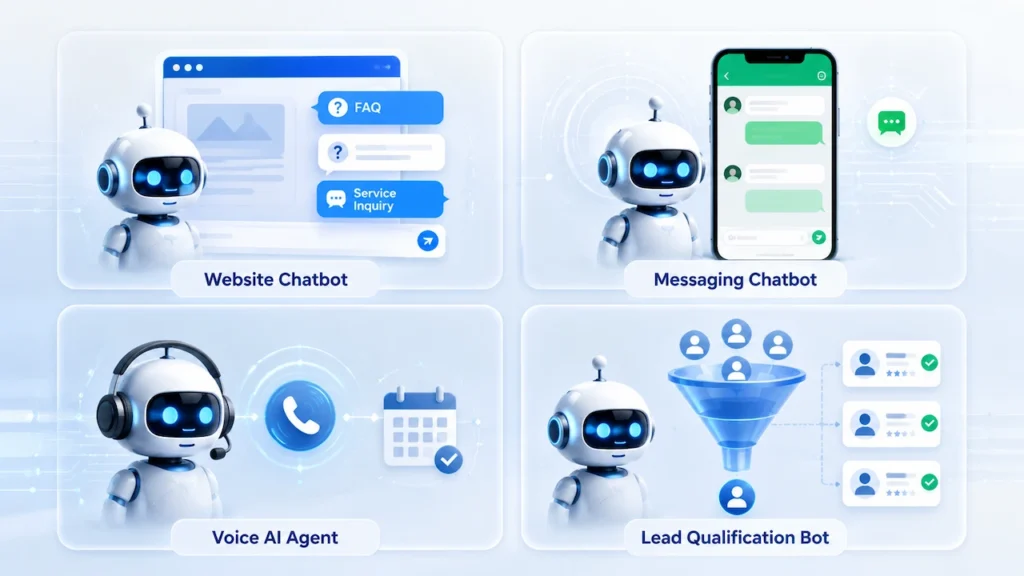
Not every business needs the same setup. The right build depends on where your customers already are and how complex your sales process is.
Website chatbots handle FAQ, service inquiries, and initial lead capture directly on your site. This is the starting point for most businesses and typically the fastest to launch.
WhatsApp business chatbots work well for businesses whose customers already message on WhatsApp — home services, real estate, and international audiences in particular.
Voice AI agents answer and route inbound calls, book appointments, and handle overflow when your phone lines are busy. These pair naturally with a website chatbot rather than replacing it.
Lead qualification bots sit behind your ad campaigns, scoring and routing leads automatically so your sales team only spends time on prospects that are actually ready to buy.
Most businesses start with one and expand once they see what the data shows about where conversations are actually happening.
What AI Chatbot Development Services Actually Cost
Pricing varies more than most vendors admit upfront, and the gap usually comes down to scope. We always advise clients to ask exactly what is included before comparing numbers across proposals.
| Chatbot Type | Typical Investment | Timeline |
| Starter website chatbot (FAQ + lead capture) | Lower budget, fixed scope | 1–2 weeks |
| Full AI business system (chatbot + voice + CRM integration) | Mid-to-higher budget, custom scope | 4–6 weeks |
| WhatsApp automation add-on | Add-on pricing | 1 week |
| Ongoing training and optimization | Monthly retainer | Continuous |
The number that matters more than the price tag is what the bot is trained on. A chatbot fed generic prompts answers generically. A chatbot trained on your actual services, pricing structure, and FAQs answers the way your best employee would.
How We Approach a Chatbot Build
Every build should start with an audit, not a template. We analyze your customer journey, your most repeated questions, and where leads are currently falling through, then document exactly where automation earns its cost back.
From there, the process follows four stages:
- AI business audit — mapping your support workflow and support volume to find the highest-impact automation opportunities
- Automation roadmap — prioritizing what to build first based on actual ROI, not what sounds impressive
- System implementation — building and connecting the chatbot, CRM, and lead routing before testing it against real scenarios
- Performance monitoring — tracking conversation quality and lead accuracy so the bot improves instead of drifting
This mirrors the framework detailed on our AI tools and automation services page, where we walk through the full system for businesses ready to automate lead capture end to end.
Which Chatbot Should You Start With?
Most businesses ask us to build everything at once. We advise against it. Starting narrow and expanding based on real conversation data almost always outperforms launching four automations simultaneously.
A simple way to decide where to start:
- If most of your leads come through your website, start with a website chatbot. It is the fastest to launch and gives you the clearest data on what customers actually ask.
- If your customers already text or WhatsApp you informally, a WhatsApp chatbot will feel native rather than forced, and adoption tends to be immediate.
- If missed calls are your biggest leak, a voice AI agent addresses the problem directly, especially for businesses that get overflow calls during peak hours.
- If your ad spend is generating leads faster than your team can qualify them, a lead qualification bot pays for itself by routing only the leads worth a phone call.
Once the first system is live for 30 to 60 days, the conversation logs tell you exactly where the next automation should go. Guessing upfront wastes budget; the data afterward does not.
Mistakes That Sink Chatbot Projects
We have audited enough half-finished automations to know where projects go wrong before launch.
- Launching without training data. A bot with no service-specific content defaults to vague, unhelpful answers.
- No human handoff path. Customers get stuck in a loop with no way to reach a person when the question is genuinely complex.
- Ignoring the CRM connection. A chatbot that captures leads but does not route them anywhere is a lead graveyard, not a growth tool.
- Treating launch as the finish line. Conversations should be reviewed monthly and the bot retrained as your services or pricing change.
Avoiding these four issues accounts for most of the difference between a chatbot that pays for itself and one that quietly gets ignored.
Why Choose Dexora Digital for Your Chatbot Build
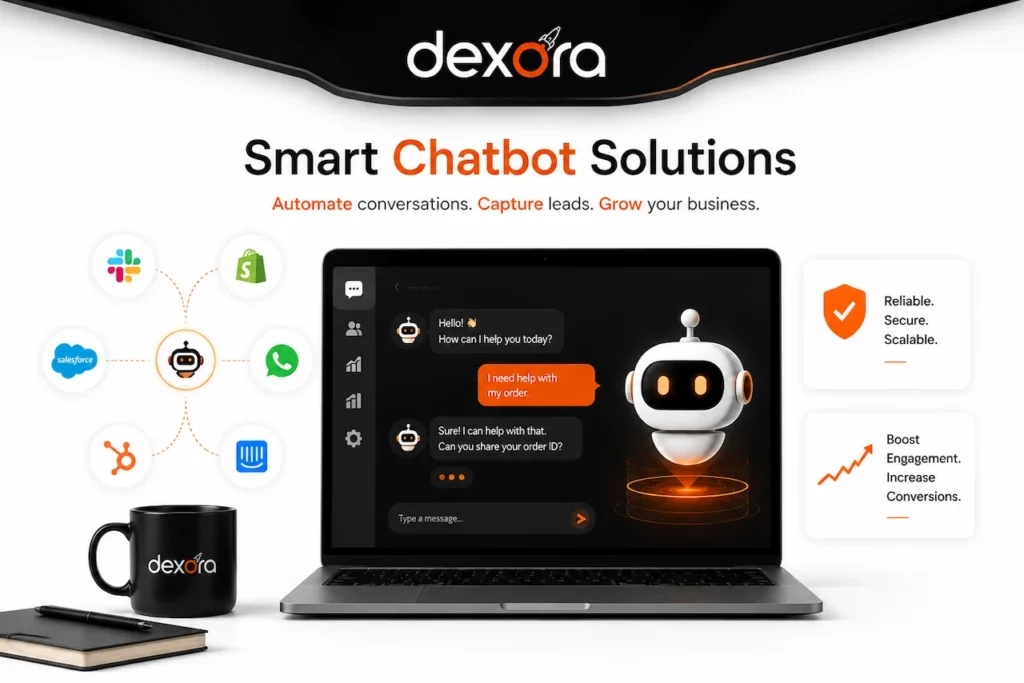
We build AI chatbots the same way we build SEO campaigns around measurable business outcomes, not vanity features.
- Every chatbot is trained specifically on your business, services, and FAQs before launch
- Full CRM and calendar integration so captured leads route instantly, not manually
- Starter builds launch in 1–2 weeks; full systems in 4–6 weeks
- Direct access to the team building your system, not an account manager reading from a script
- Performance monitored monthly so conversation quality improves instead of stalling
Conclusion
AI chatbot development is no longer a nice-to-have for small businesses competing on response speed. The businesses winning leads in 2026 are the ones answering in seconds, not hours. A well-trained chatbot pays for itself the first month it captures a lead your team would have otherwise missed. If you are ready to see where automation fits your business, book a strategy call and we will map it out together.
Frequently Asked Questions
How much does AI chatbot development cost for a small business?
Starter website chatbots typically launch within a fixed, lower budget and a 1–2 week timeline. Full AI business systems with voice agents and CRM integration run higher and take 4–6 weeks, depending on scope.
Do I need a developer to maintain the chatbot after launch?
No. A properly built chatbot is trained and maintained by your provider, with monthly monitoring to keep answers accurate as your services or pricing change.
Can a chatbot replace my customer service team?
No, and it should not try to. A chatbot handles repetitive, routine questions so your team can focus on conversations that need judgment, relationship-building, or complex problem-solving.
What is the difference between a chatbot and a voice AI agent?
A chatbot handles text conversations on your website or WhatsApp. A voice AI agent answers and routes phone calls. Many businesses run both together for full coverage.
How long does it take to see results from a chatbot?
Most businesses see measurable lead capture improvement within the first 30 days of launch, particularly for after-hours and weekend inquiries that previously went unanswered.
Stop losing valuable leads after hours. Book a strategy call with Dexora Digital to build an AI chatbot tailored to your business, customers and growth goals.

Local SEO and AI Search (AEO & GEO) Specialist.
Building search visibility that converts into qualified demand.
Today, businesses need visibility on Google Maps and AI powered search and websites that actually convert visitors into leads. I am a Local SEO, AI Search & Conversion Rate Optimization (CRO) Specialist with 5+ years of hands on experience helping businesses turn underperforming websites into high converting growth engines. My work combines Local SEO, Technical SEO, Semantic SEO, GEO/AEO, and conversion focused landing page optimization to ensure brands are discoverable and profitable.
My Experience
I have delivered SEO and web growth projects across the US, UK, Australia, Canada, Finland, Germany, and the Czech Republic, working in industries such as local businesses (electrician, hvac, cleaning, Real estate, healthcare, B2B, eCommerce, SaaS, and environmental services.
Some Results
>> 200+ websites audited globally
>> specifically worked with 100+ local business (80% from USA)
>> 80+ websites improved through technical SEO & schema fixes
>> 20+ businesses featured in Google AI Overviews (SGE)
>> Multi million impression growth for eCommerce & SaaS brands
Book Free Consultation: calendly.com/dexora/30min