
AI-driven search has changed what digital visibility actually depends on. Traditional signals like keyword density, backlink counts, and content length have been steadily superseded by semantic signals, entity understanding, and structured data clarity. As AI-powered platforms increasingly rely on entity recognition and contextual relationships rather than exact keyword matching, brands need to shift from keyword-first tactics toward entity-first SEO.
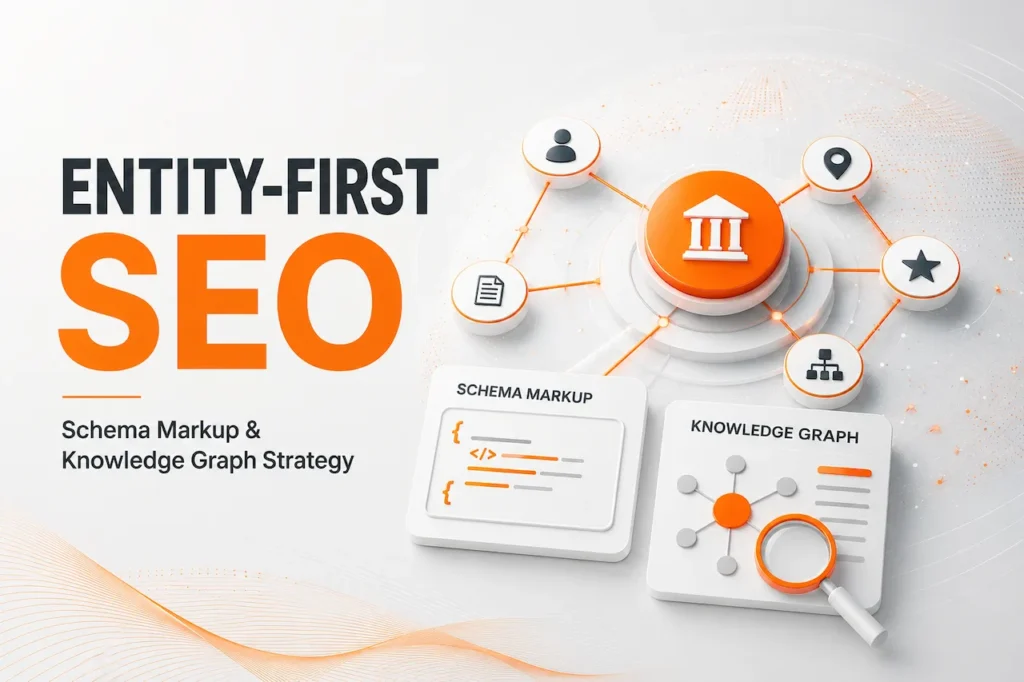
Entity-first SEO is the practice of optimizing content, site structure, schema markup, and knowledge graph relationships so AI systems can understand, categorize, and accurately reference a brand. Instead of optimizing for individual keywords in isolation, the work shifts toward optimizing for entities, relationships, and meaning.
What Entity-First SEO Actually Means
Keyword optimization alone is no longer enough. Search engines and AI systems now understand intent through entities, relationships, and context.
Entities include people, brands, products, locations, and concepts. Using accurate schema markup for SEO helps search engines connect these entities and understand how they relate. When those signals are weak or inconsistent, visibility can decline across search results, AI summaries, and generative responses.
Why Schema and Structured Data Matter So Much
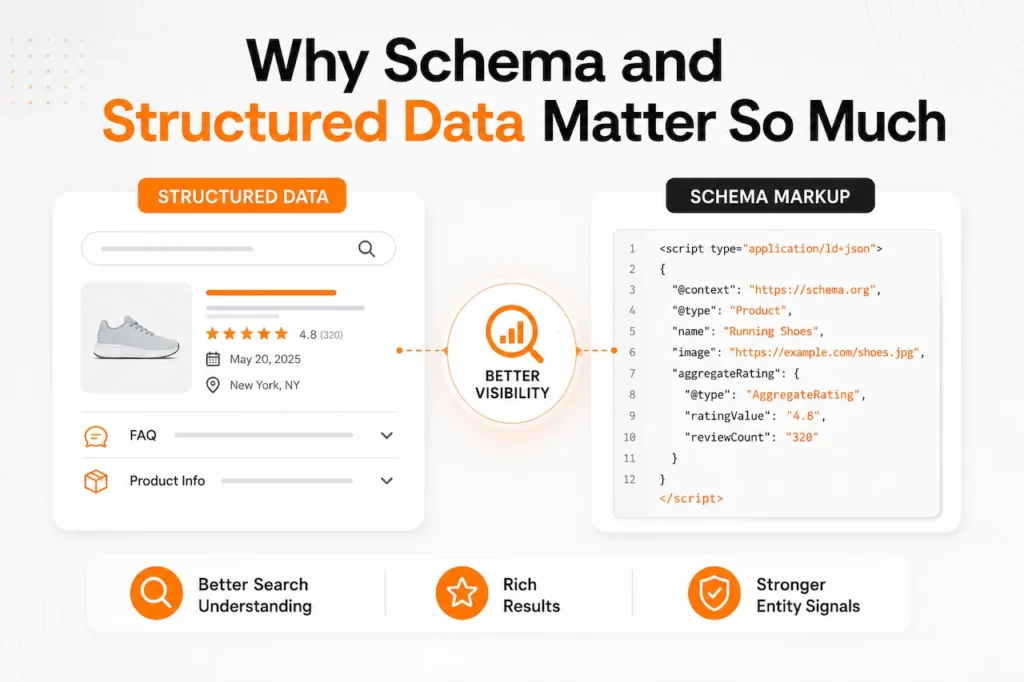
Structured data, implemented through JSON-LD schema markup, supplies machine-readable meaning that lets search engines categorize content, recognize entities, define relationships, and map everything into a coherent knowledge graph. Schema is the bridge between content written for humans and meaning interpretable by machines.
Entity-first SEO genuinely cannot succeed without strong, accurate, and complete structured data underneath it. Content alone, no matter how well-written, leaves AI systems guessing at relationships that schema would otherwise state explicitly.
Building an Entity Identification Foundation
Every entity-first strategy starts with a thorough entity audit a semantic inventory identifying every relevant entity across the brand ecosystem. Primary entities typically include the brand or organization itself, founders and executives, products or services, industry categories, certifications, geographic service areas, and notable clients. Secondary entities cover subtopics, related concepts, methodologies, and the technologies a business actually uses.
A proper audit classifies exactly how these entities currently appear across the website, in Google’s Knowledge Graph, across public data sources, and on third-party platforms. This step alone often surfaces the next major issue: entity confusion.
AI systems frequently misinterpret entities when brand names overlap with other companies, when data conflicts across different sources, or when information is incomplete or outdated in one place but current in another. Fixing this confusion is foundational work consistent naming, centralized entity definitions, and harmonized metadata across every platform where a brand appears are what actually resolve it.
From there, mapping relationships between entities matters just as much as identifying them individually. Entities don’t exist in isolation; they form a semantic web. Defining relationships like product solves problem, brand operates in industry, or person works as role gives AI systems the connective tissue needed to represent a brand accurately.
Implementing Schema Markup Properly
JSON-LD is the standard format for a reason: it implements cleanly, separates from on-page HTML without disrupting formatting, and reads consistently across every major search engine and LLM.
Every entity needs the correct schema type assigned Organization, Person, Product, Service, Article, FAQPage, and LocalBusiness are among the most common, and choosing the wrong type genuinely weakens knowledge graph accuracy even when the underlying data is correct. Partial schema is one of the most common mistakes we see in client audits: each entity needs complete properties, including name, description, image, location, category, and related entities, since rich properties give AI systems meaningfully deeper context than a bare-minimum implementation.
Using sameAs properties to link authoritative external profiles LinkedIn, Crunchbase, government business registries, verified social profiles strengthens entity trust considerably, since AI systems use these connections to validate identity across sources rather than relying on a single self-reported page. A technical SEO audit is often the fastest way to catch incomplete or incorrectly typed schema before it undermines an otherwise solid entity strategy.
Structured data also needs continuous validation, not a one-time implementation check. Testing through tools like Google’s Rich Results Test and the Schema.org validator on a regular schedule catches errors that would otherwise weaken entity signals silently over time.
Writing Content That Reinforces Entities Naturally
Semantic content creation ensures written text reinforces entity connections without falling into keyword repetition. This means writing for meaning rather than exact-match phrasing, replacing repetition with contextual explanation and supporting concepts that actually clarify what an entity is and how it connects to others.
Each entity needs a clear role defined in the content itself: what it is, what it does, why it matters, and how it connects to other entities on the page. Hierarchical structure proper headings, subheadings, and well-organized paragraphs helps AI systems parse this meaning efficiently, while contextual clues do more work than simple repetition ever could. Rather than repeating a product name five times in a paragraph, explaining its category, benefits, and intended audience gives AI systems far richer signal to work with.
This consistency needs to extend across the entire site, not just a single article. Entity-first SEO is fundamentally a site-wide discipline rather than a page-level tactic.
Building Toward Knowledge Graph Dominance
Major entities benefit from having dedicated, centralized hub pages complete with full schema, authoritative descriptions, strong internal linking, and supporting external citations. AI systems tend to treat well-built hub pages as canonical sources for a given entity, making them disproportionately valuable.
Internal linking for SEO plays a bigger role here than in traditional optimization alone. Anchor text that clarifies functions, roles, categories, and relationships between entities creates semantic pathways that help AI systems associate related concepts across a site. External authority matters too consistent appearances across business listings, industry publications, and third-party knowledge bases strengthen credibility signals.
Advanced Strategies Worth Building Toward
Entity clustering grouping a primary guide with supporting articles, FAQs, glossaries, and case studies around a shared topic builds genuine topic authority rather than isolated page-level relevance. Cross-referencing these entities across the site deepens relationship clarity further, and as entities evolve over time, schema needs to be updated to reflect those changes rather than left static.
Quarterly entity audits help prevent the kind of slow decay that undermines even well-built entity structures: schema that falls out of date, relationships that no longer reflect current reality, and conflicting information that’s crept in across different pages over time.
Monitoring and Measuring Entity Visibility
Tracking whether entities actually appear in AI summaries, knowledge panels, and generative responses is the clearest indicator of semantic penetration. Missing entities in these outputs point directly to gaps in coverage that content and schema work alone can close.
We always advise clients to treat schema accuracy as an ongoing refinement process rather than a finished project adding missing fields, correcting outdated attributes, and refining relationships incrementally tends to produce steadier improvement than periodic large rebuilds. Monitoring brand sentiment across AI-generated descriptions matters too, since these systems incorporate sentiment into how they represent a brand, making consistent and factual descriptions genuinely important beyond pure accuracy.
Common Pitfalls to Avoid
Inconsistent naming conventions across different platforms confuse AI systems in ways that are surprisingly hard to diagnose after the fact. Missing entity properties leave schema technically valid but functionally thin, giving AI systems far less to work with than a complete implementation would. Choosing the wrong schema type for an entity, over-complicating site structure unnecessarily, and neglecting supporting content that would otherwise reinforce entity relationships all quietly undermine an otherwise sound strategy.
FAQ
What is entity-first SEO?
It’s the practice of optimizing content and structured data so AI systems can understand, classify, and accurately reference a brand’s entities, shifting focus from keywords to meaning.
How does schema markup improve AI search visibility?
Schema provides machine-readable definitions of content, letting AI search engines place entities correctly within knowledge graphs and generate accurate summaries.
Can existing content be retrofitted for entity-first SEO?
Yes. Entity audits, schema implementation, and semantic restructuring can transform older content into AI-friendly assets without requiring a complete rewrite.
What are the most common pitfalls in entity-first SEO?
Inconsistent naming across platforms, missing entity properties, incorrect schema type selection, and a lack of supporting content that reinforces relationships.
How is entity-first SEO different from traditional keyword SEO?
Traditional SEO optimizes for keyword matching and rankings. Entity-first SEO optimizes for how AI systems understand relationships between people, products, and concepts.
What schema type should a local business use?
LocalBusiness schema, combined with Organization properties, gives AI systems the clearest signal for location, service area, and business identity together.
How often should schema markup be validated?
Regularly, using tools like Google’s Rich Results Test — errors that accumulate silently over time weaken entity signals well before they become visibly obvious.
Does entity-first SEO replace traditional SEO?
No. It builds on the same foundation of technical health and content quality, adding a semantic layer that helps AI systems interpret that foundation correctly.
What is a knowledge graph in this context?
It’s the structured network AI systems use to map relationships between entities — connecting a brand to its products, industry, location, and related concepts.
How can a small business start with entity-first SEO?
Begin with a basic entity audit identifying core brand, product, and service entities, then implement complete schema markup before expanding into hub pages and clustering.
Why Choose Dexora Digital
We build entity-first principles into every technical SEO engagement, treating schema and knowledge graph work as foundational rather than optional add-ons.
- Entity audits that identify inconsistencies across your site and third-party platforms
- Complete schema implementation, not partial markup that leaves AI systems guessing
- Internal linking strategies designed around entity relationships, not just page authority
- Ongoing validation cycles that catch schema decay before it affects visibility
If you’d like your current entity signals reviewed, you can start with a free SEO audit to see exactly where the gaps sit.