



Engineering companies often have exactly what modern search systems need: specialist knowledge, technical experience, complex problem-solving expertise, and subject-matter authority.
The problem is that much of that expertise never becomes searchable information.
Service pages stay thin. Technical knowledge remains inside proposals, PDFs, drawings, project files, and engineers’ heads. Websites describe capabilities without answering the detailed questions buyers, project managers, utilities, contractors, and other professionals actually ask.
Generative Engine Optimization (GEO) creates an opportunity to change that.
For engineering firms, GEO means making technical expertise easier to discover, understand, verify, and use across Google AI Overviews, AI Mode, ChatGPT Search, Gemini, Perplexity, and other generative search experiences.
It does not replace SEO. Google’s current guidance says its generative Search features continue to rely on core Search ranking and quality systems, making traditional SEO fundamentals part of the foundation for AI visibility.
Why Engineering Companies Need a Different GEO Strategy
Engineering search behavior is different from many consumer markets.
A potential client may not search only for:
“engineering company near me”
They may research:
- short circuit studies for renewable projects
- electrical interconnection requirements
- arc flash analysis methodology
- structural load calculations
- utility compliance requirements
- commercial MEP coordination
- power-system modeling
- specific IEEE or regulatory standards
- engineering solutions for a technical failure
These queries require expertise rather than generic marketing copy.
That is where engineering companies can have an advantage.
The original GEO research found that optimization effectiveness varied by domain, suggesting there is no single tactic that performs identically across every industry. A 2026 review of 45 GEO studies reached a similar conclusion: topical relevance was among the more reproducible factors, while generic optimization tactics transferred inconsistently between systems.
For engineering firms, this makes domain expertise particularly important.
The goal should not be to make technical content sound like generic “AI SEO content.”
The goal is to turn genuine engineering expertise into the clearest and most credible source available for a specific technical question.
For the broader methodology behind this approach, see our Generative Engine Optimization guide.
How AI Search Finds Engineering Expertise
Generative search engines do not all discover sources in exactly the same way.
Understanding that distinction prevents engineering companies from chasing supposed universal GEO shortcuts.
Google AI Overviews and AI Mode
Google says generative Search experiences use information from its Search index and remain connected to core Search ranking and quality systems. Google can also use query fan-out, expanding one complex question into related information needs before building its response.
That is especially relevant for engineering.
A question such as:
“What studies are required before connecting a solar project to the grid?”
can involve several connected topics:
- interconnection requirements
- load flow
- short circuit analysis
- protection coordination
- stability studies
- utility standards
- project capacity
- point-of-interconnection requirements
A website that demonstrates legitimate depth across these connected subjects gives retrieval systems more useful information than a single shallow page targeting one exact phrase.
Our Google AI Overviews optimization guide explains the Google-specific layer in greater detail.
ChatGPT Search
OpenAI says public websites can appear in ChatGPT Search. Publishers who want their content discoverable for summaries and snippets should ensure OAI-SearchBot is not unintentionally blocked.
ChatGPT Search can also rewrite a user’s request into one or more targeted search queries before retrieving information.
For engineering firms, that reinforces the need for content covering the real technical concepts behind customer questions rather than relying on exact-match keyword repetition.
Technical accessibility creates eligibility.
Expert information creates the reason to use the source.
The Biggest GEO Problems Engineering Websites Face
Engineering companies often struggle with AI and organic search for reasons unrelated to the quality of their engineering work.
The website simply does not communicate that expertise effectively.
Technical Expertise Is Not Searchable
Engineers may understand a subject deeply, while the website gives it only two paragraphs.
A service such as power-system studies, structural engineering, commissioning, or MEP design may involve dozens of processes, standards, calculations, deliverables, and client questions.
Those subjects should become useful web content.
A strong semantic SEO strategy helps map the relationships between services, technical concepts, regulations, industries, problems, and informational queries.
Technical SEO Creates Discovery Barriers
Crawl errors, weak internal architecture, slow templates, duplicate pages, poor canonicals, rendering issues, and orphaned content can prevent strong engineering information from performing.
In the engineering campaign behind this article, the initial audit found technical SEO weaknesses alongside limited visibility and content gaps.
This is why our technical SEO service treats accessibility and information architecture as foundational rather than optional.
Websites Describe Services Instead of Demonstrating Expertise
“Providing innovative engineering solutions” tells a retrieval system very little.
A stronger page explains:
- the problem being solved
- when the service is required
- the engineering methodology
- standards involved
- inputs required
- expected deliverables
- limitations
- common failure points
- who reviews the work
- practical examples
That is substantially more valuable to both prospective clients and search systems.
Authority Exists Offline but Not Online
Many engineering firms already have authority:
licensed engineers, completed projects, technical reports, certifications, utility experience, industry partnerships, and specialist teams.
But those signals may not be clearly connected online.
Our guide to entity-first SEO and schema explains how clear author, organization, service, and subject relationships help machines interpret who produced the information.
A Practical GEO Strategy for Engineering Companies
A sustainable strategy should improve five areas together.
Fix Technical Discoverability
Audit:
- indexability
- robots directives
- canonical URLs
- XML sitemaps
- internal links
- page rendering
- duplicate content
- mobile usability
- important crawler access
Do not assume that publishing more content solves a discovery problem.
Technical eligibility comes first.
Build Content Around Engineering Expertise
Use subject-matter experts to identify what potential clients genuinely need to know.
Good topics often come directly from:
- proposal questions
- client emails
- RFQs
- engineering reviews
- project objections
- utility comments
- compliance issues
- technical failures
- design alternatives
- common misunderstandings
Then turn those issues into service pages, technical guides, FAQs, comparison content, and case studies.
This is stronger than producing generic AI-written articles around keyword lists.
Google’s current generative Search guidance specifically emphasizes valuable, unique, non-commodity content.
Create Clear Topic Clusters
Engineering topics naturally form semantic clusters.
For example, a power-engineering company might connect:
Pillar: Power System Studies
Supporting content:
- load-flow studies
- short circuit studies
- arc flash studies
- protection coordination
- transient stability
- harmonic analysis
- grid interconnection
- IEEE standards
- weak-grid analysis
Each supporting page should answer a distinct information need and link contextually to the relevant service or pillar page.
This helps users navigate expertise while making relationships between topics clearer to search systems.
Demonstrate Real Experience
Original engineering information is one of the strongest assets a specialist firm can publish.
Where confidentiality allows, include:
- project examples
- anonymized calculations
- before/after outcomes
- engineering diagrams
- screenshots
- methodologies
- lessons learned
- standards applied
- technical constraints
- expert commentary
For another example of how technical expertise can be translated into measurable search and AI visibility, see our engineering SEO and AI search case study.
Earn Relevant External Authority
Engineering GEO should not stop at the company website.
Relevant references can come from:
- engineering publications
- industry associations
- project partners
- trade publications
- technical directories
- professional organizations
- conference coverage
- credible media
- original research citations
This is the same relevance-first approach used in our off-page SEO services.
Authority should be earned because the company contributes useful expertise, not manufactured simply to create AI mentions.
What We Changed for a Real Engineering Client
The engineering campaign that originally formed the basis of this article started with a technically capable B2B firm that had very little organic search visibility.
The website did not reflect the client’s real expertise.
The audit identified several compounding problems:
- limited organic visibility
- technical SEO weaknesses
- content gaps
- weak search-intent alignment
- poor backlink quality
- limited readiness for emerging AI-driven search experiences
Instead of treating GEO as a separate add-on, the campaign combined it with the broader SEO strategy.
Technical Foundation
The work included:
- page-speed improvements
- broken-link fixes
- sitemap corrections
- mobile improvements
- duplicate-content cleanup
- indexation corrections
- canonical implementation
Content and Topical Coverage
Existing content was expanded around real engineering concepts rather than isolated exact-match keywords.
New technical articles, guides, and supporting pages filled gaps in the client’s topical coverage, while contextual internal links connected informational content to relevant commercial pages.
Authority Building
The backlink profile was reviewed, and the strategy shifted toward more relevant industry sources rather than treating raw link quantity as the objective.
Search and AI Readiness
Content structure was improved so technical answers were easier to understand, while factual accuracy, clear headings, supporting evidence, and useful explanations became part of the editorial process.
Importantly, these changes should not be interpreted as a universal “AI formatting formula.”
Modern GEO research shows that retrieval and citation behavior varies between systems and queries.
Results and What Engineering Firms Can Learn From Them
The campaign produced measurable organic improvements:
| Metric | Result |
| Organic visibility index | +10.84% |
| Average keyword ranking improvement | +39 positions |
| Keywords showing positive movement | 284+ |
| Organic traffic and lead inquiries | Increased |
These results were recorded in the original campaign analysis.
The important lesson is not that one GEO technique caused the improvement.
The gains came from multiple improvements reinforcing one another:
technical health + stronger content + broader topical coverage + internal linking + authority building + ongoing measurement
That matters for engineering companies because their search problems are rarely caused by one missing keyword.
Often, the real issue is that their expertise is fragmented across a technically weak website with insufficient depth and little external corroboration.
GEO works best when it improves the entire information system surrounding that expertise.
How Engineering Companies Should Measure GEO Performance
Engineering firms should measure more than rankings.
Traditional SEO metrics remain important:
- impressions
- ranking positions
- clicks
- organic leads
- qualified inquiries
- conversion rates
Then add AI-specific visibility metrics:
- brand mentions in AI answers
- citations to company URLs
- cited pages
- recommendation frequency
- competitor share of voice
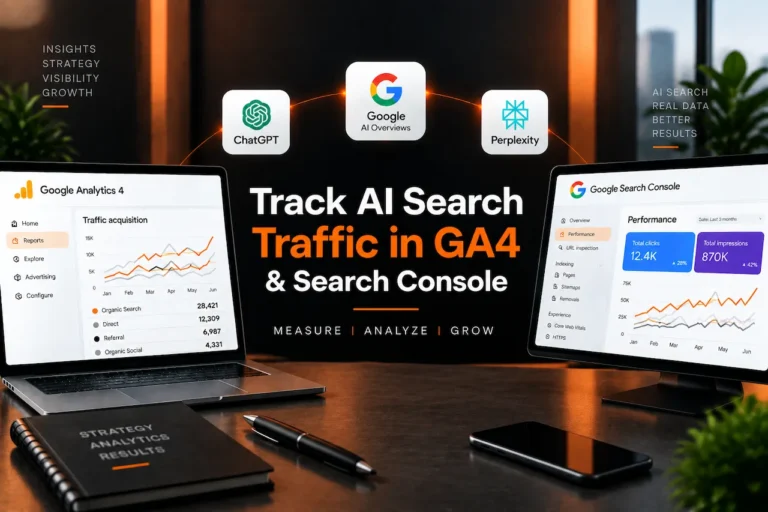
- ChatGPT referral traffic
- AI-assisted conversions
OpenAI says publishers allowing OAI-SearchBot can identify ChatGPT referral traffic through analytics platforms.
Do not judge GEO performance from one prompt screenshot.
Generative results can vary across prompts, platforms, query wording, and repeated runs. Current GEO research recommends repeated measurements because visibility is stochastic rather than a fixed ranking position.
For an initial technical and content baseline, our All-in-One SEO Audit Tool can help identify issues before a broader search campaign begins.
Businesses that need implementation across technical SEO, specialist content, authority, and AI visibility can also explore our AI search optimization services.
Frequently Asked Questions About GEO for Engineering Companies
What is GEO for engineering companies?
GEO for engineering companies means improving technical content and brand signals so AI search systems can discover, understand, cite, and recommend engineering expertise across platforms such as Google AI, ChatGPT Search, Gemini, and Perplexity.
Is GEO different from engineering SEO?
Yes, but they overlap heavily. Engineering SEO focuses on organic rankings, traffic, and conversions, while GEO adds visibility inside generated answers, citations, and AI recommendations. Strong technical SEO and expert content remain foundational to both disciplines.
Can engineering companies appear in ChatGPT Search?
Yes. OpenAI says public websites can appear in ChatGPT Search. Engineering firms should keep important content publicly accessible, avoid unintentionally blocking OAI-SearchBot, and publish technically credible information that directly addresses relevant customer and industry questions.
Does Google AI require separate engineering content?
No. Google says publishers do not need separate content for every possible AI or fan-out query. Engineering companies should instead publish useful, authoritative pages covering real information needs and avoid excessive near-duplicate content.
What engineering content works best for GEO?
Technical guides, standards explanations, methodology pages, project examples, comparisons, FAQs, and expert-led articles can be effective when they genuinely answer engineering questions. Original information and first-hand experience help differentiate specialist firms from generic publishers.
Do engineering firms need schema for GEO?
Schema can clarify authors, organizations, services, breadcrumbs, and other entities, but it should not be treated as a guaranteed AI citation factor. Google says no special structured data is required specifically for generative Search.
Should engineering content be simplified for AI?
Engineering content should be clear without becoming technically inaccurate. Define specialized terminology, structure complex explanations logically, and give direct answers where useful. Do not remove necessary technical detail merely to create artificially short “AI-friendly” paragraphs.
How can engineering companies build AI-search authority?
Publish first-hand technical expertise, connect content into focused topic clusters, earn references from credible engineering sources, maintain clear expert and company entities, and support important claims with standards, primary documentation, or original project evidence.
How should engineering firms track GEO results?
Track citations, brand mentions, cited URLs, AI referral traffic, prompt-level visibility, competitor share of voice, organic rankings, qualified leads, and assisted conversions. Use repeated tests because generative responses can change across platforms and individual runs.
Is Your Site Ready for AI-First Search?
GEO isn’t the future. It’s the current state of search.
Every day a site isn’t structured for AI-generated answers is a day competitors have the opportunity to claim that visibility instead.
Whether the starting point looks like this engineering client’s technically weak, content gaps, no AI visibility or something less severe, the same integrated approach applies: fix the foundation, build real topical depth, structure for citation, and build authority that compounds.
From Core Web Vitals to GEO-ready content Dexora delivers results that compound over time.
Get your free SEO + GEO audit today
Contact us at info@dexoradigital.com