


Google search is changing quickly, and website owners can no longer focus only on traditional blue-link rankings. Many users are now finding answers directly inside search results through Google AI Overviews.
These AI-generated summaries are changing how people discover information, compare options, and decide which websites to trust. Your website now needs to do more than rank it needs to be clear, well-structured, and useful enough for Google to understand and potentially feature within these results.
What Are Google AI Overviews?
Google AI Overviews are AI-generated summaries that appear in some search results when Google determines a synthesized answer would serve the user better than a standard list of links. Instead of only showing organic results, Google combines information from multiple sources into a summary, then links out to the supporting websites behind it.
This changes how content gets surfaced. A page competes not only for a traditional ranking position, but also for inclusion as a supporting source inside the AI-generated summary itself. Content that is confusing, shallow, or poorly organized becomes harder for Google to extract cleanly, which lowers the odds of being selected at all.
Why This Shift Matters for Your Business
AI Overviews change how users interact with search results. Some users get enough from the summary alone and only click through to whichever source looks most credible and relevant. This means your content needs to stand out through quality and clarity, not just position.
For service providers, agencies, eCommerce brands, and local businesses, appearing inside AI-influenced results can position a website as a trusted source earlier in the decision-making process, before a user has even compared competitors directly. The sites most likely to benefit are the ones that answer real questions clearly and provide enough supporting depth for Google to treat them as a reliable reference.
Start With a Crawlable, Indexable Foundation
Before anything else, confirm your important pages are actually accessible to search engines. If Google can’t crawl or index a page properly, it can’t use that content anywhere — including inside AI Overviews.
We see this gap constantly during audits: pages blocked by robots.txt, accidentally set to noindex, buried too deep in the site structure, or weakened by thin internal linking. Review your core blog posts, service pages, and landing pages to confirm they’re indexable, properly linked internally, and not duplicated across multiple URLs. Check that canonical tags are correct and that your sitemap includes every page that matters.
A technically clean site gives Google a stronger foundation for evaluating everything else about your content. A technical SEO audit is the fastest way to confirm this foundation is solid before investing further in content work.
Give Each Page One Clear Topic
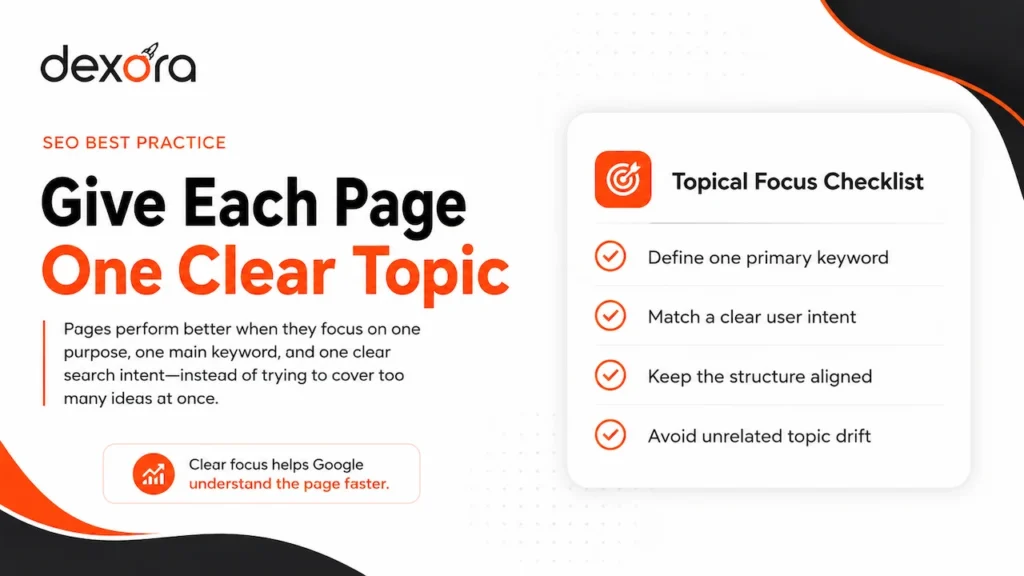
A common mistake is targeting too many ideas on a single page, which weakens topical clarity. A page performs better when it has one clear purpose and stays focused on that purpose throughout.
If a page is about Google AI Overviews, it should stay centered on what they are, why they matter, and how to optimize for them not drift into unrelated territory without reason. Every page needs a clear main keyword, a clear user intent, and a structure that matches what the searcher actually expects to find. When a page stays focused, Google understands the topic faster, and users get direct value without wading through unrelated material.
Write Headings That Match Search Intent
Headings aren’t just visual dividers they organize content for both readers and search engines. Strong headings make it easier for Google to follow the flow of an article and identify which section answers which part of a query.
The H1 should clearly reflect the page’s main topic. H2 headings should divide the article into meaningful sections definitions, steps, examples, mistakes, FAQs and H3 headings can break those down further when a section needs more depth. Good headings also improve scannability: a reader should be able to glance at the page and immediately understand what it covers, which builds trust before they’ve read a single paragraph.
Answer the Main Question Early
Many articles take too long to get to the point, and that’s a real weakness for AI-driven search. If the core answer is buried several paragraphs in, the page becomes harder to interpret quickly both for readers and for the systems generating AI summaries.
This doesn’t mean an article should be short or shallow. It means the opening needs to clearly state the topic and address the main question early, before expanding into supporting detail, examples, and related guidance. A strong introduction tells both the reader and Google exactly what the page delivers, which removes ambiguity from the very first paragraph.
Add Depth Without Adding Fluff
Depth matters, but padding hurts. A page that repeats the same point in slightly different words doesn’t become more useful just because it’s longer it becomes deeper by adding genuine context, examples, comparisons, and practical detail.
We always advise clients to think through the follow-up questions a reader is likely to have after the initial search. Someone researching AI Overview optimization may also want to understand technical SEO, schema, content structure, and how to measure results. Covering those connected ideas in an organized way without diluting the core topic makes a page feel complete rather than thin.
Strengthen Your E-E-A-T Signals
Google increasingly weighs signals related to experience, expertise, authoritativeness, and trustworthiness when evaluating content quality, particularly for pages meant to educate or advise. This isn’t a single ranking factor, but it shapes how everything else on the page gets interpreted.
Content should clearly come from a credible source supported by author information, business details, a real About page, contact information, and case studies that reflect genuine experience rather than generic summary text. Consistency matters here too: branding, service claims, and supporting content all need to align. A polished site with thin, vague content struggles to build real authority, while a site with practical, well-supported detail sends far stronger trust signals.
Use Internal Linking to Build Topical Depth
Internal linking helps search engines understand how your pages relate to each other, and it helps users discover relevant information naturally as they read. A page about Google AI Overviews should connect to related pages covering technical SEO, content strategy, or broader AI search optimization work where those pages exist on the site.
This builds topical depth across the whole website instead of isolating each article as a standalone piece. It also signals to Google that the site covers the subject area broadly, not through one page in isolation. Internal links should feel like a natural part of the reading experience supporting the user’s next question rather than being forced in for their own sake.
Keep Key Information in Readable Text
Some sites lean too heavily on visuals, sliders, or hidden tabs to communicate what they do. Design can improve presentation, but the core meaning of a page still needs to exist clearly in text form, because that’s what search engines actually interpret.
If your services, process, or expertise are only shown inside banners or graphics, that weakens clarity for both users and crawlers. Make sure every page includes direct written explanations of what you do, who you help, and why it matters. Well-written text remains one of the strongest foundations for search visibility, especially as more of search becomes AI-assisted.
Treat Schema as Support, Not a Shortcut
Schema markup helps search engines understand content types, business details, FAQs, and other page elements more precisely. It’s genuinely useful, but many site owners add it and expect results without improving the underlying content first.
Schema adds real value when it supports an already strong page. On a page with thin or unclear content, schema markup won’t fix the core problem it will just describe a weak page more precisely. Use schema where it makes sense, but keep the primary focus on content quality, structure, and relevance.
Keep Reviewing and Refreshing Over Time
Optimizing for Google AI Overviews isn’t a one-time task. Search evolves, user behavior shifts, and competitors update their content regularly, which means pages that perform well today may need a refresh later to stay useful.
Review key pages on a set schedule. Update outdated wording, expand thin sections, fix structural issues, and strengthen internal linking as new content gets published. The sites that stay visible long-term are consistently the ones treating content as something to maintain, not something to set and forget.
Mistakes That Undermine This Work
A few patterns show up repeatedly in the audits we run. Generic content that says very little is one of the most common articles technically cover a topic but never say anything specific enough to be useful. Overly broad articles that never fully answer the target question are another, often stretched across too many subtopics to do any of them justice.
Unnatural keyword repetition weakens both readability and trust, even when the intent behind it is understandable. Publishing AI-assisted content without real human editing is another frequent issue the drafting speed is useful, but skipping review for accuracy and original value produces thin, mass-produced pages that hurt trust more than they help visibility. Ignoring technical issues entirely, on the assumption that content alone will carry performance, remains one of the most consistent gaps we find across new client audits.
FAQ
Q: What is Google AI Overview?
Google AI Overview is an AI-generated summary Google places at the top of search results to answer a query directly. It draws information from multiple websites and links back to the sources it pulls from. We treat this feature as an added visibility layer that sits above traditional organic rankings, not a replacement for them.
Q: Can small websites appear in Google AI Overviews?
Yes, small websites can appear in AI Overviews when their content answers the search query clearly and directly. Site size doesn’t determine eligibility content quality, structure, and relevance do. We’ve seen smaller, well-optimized pages get selected over larger competitors on the same query.
Q: Does schema markup help with Google AI Overviews?
Schema markup helps Google interpret page content more accurately, but it doesn’t replace strong writing or solid technical SEO. We use schema to support content that’s already well-structured, never as a standalone fix. On a thin page, schema just describes the weakness more precisely it doesn’t solve it.
Q: How do I write content specifically for AI Overviews?
Answer the main question within the first two to three sentences, then expand with supporting detail, examples, and related subtopics. Structure the page with clear headings so Google can extract specific sections cleanly. We build every page around this direct-answer-first approach before adding depth.
Q: Is traditional SEO still important for AI Overviews?
Yes, traditional SEO is the foundation AI Overview visibility is built on. Crawlability, indexing, internal linking, and trust signals all directly affect whether Google can use a page as a source. We never separate AI Overview work from core SEO one supports the other.
Q: How long does it take to see results from this kind of optimization?
Results depend on your site’s current authority, technical health, and competition level in your niche. Most sites see measurable movement within three to six months of consistent work. We track this progress through regular reporting rather than expecting a single fix to move the needle.
Q: Do AI Overviews replace the need for ranking well in Google?
No, AI Overviews work alongside organic rankings rather than replacing them. Pages that already rank well are more likely to get pulled in as supporting sources. We focus on strengthening both together instead of prioritizing one over the other.
Q: What’s the biggest technical mistake that blocks AI Overview visibility?
The most common blocker we find is accidental exclusion robots.txt errors, mistaken noindex tags, or weak internal linking that keeps Google from crawling a page at all. We check for this first in every audit, before reviewing content quality.
Q: Should every page target AI Overview inclusion?
No, only pages answering a clear, specific question are strong candidates. Transactional or navigational pages — checkout flows, contact pages typically won’t appear regardless of how well they’re optimized. We focus this effort on informational and service-education content.
Q: How is optimizing for AI Overviews different from regular SEO?
It builds on the same technical and content foundations as regular SEO but places extra weight on answering questions directly and completely. Pages need enough depth to be extracted cleanly by Google’s summarization system. We layer this focus on top of standard SEO rather than treating it as a separate discipline.
Why Choose Dexora Digital
We treat AI Overview visibility as an extension of solid SEO fundamentals, not a separate service bolted on afterward.
- Technical audits that catch crawlability and indexing issues before they block visibility
- Content restructured around direct answers, not just keyword density
- E-E-A-T signals built into every page through real author and business detail
- Internal linking strategies designed around topical depth, not random placement
- A free SEO audit that scores your site’s current AI Overview readiness
If you want to see exactly where your site stands, you can start with a free SEO audit or book a strategy call to walk through the findings together.

Local SEO and AI Search (AEO & GEO) Specialist.
Building search visibility that converts into qualified demand.
Today, businesses need visibility on Google Maps and AI powered search and websites that actually convert visitors into leads. I am a Local SEO, AI Search & Conversion Rate Optimization (CRO) Specialist with 5+ years of hands on experience helping businesses turn underperforming websites into high converting growth engines. My work combines Local SEO, Technical SEO, Semantic SEO, GEO/AEO, and conversion focused landing page optimization to ensure brands are discoverable and profitable.
My Experience
I have delivered SEO and web growth projects across the US, UK, Australia, Canada, Finland, Germany, and the Czech Republic, working in industries such as local businesses (electrician, hvac, cleaning, Real estate, healthcare, B2B, eCommerce, SaaS, and environmental services.
Some Results
>> 200+ websites audited globally
>> specifically worked with 100+ local business (80% from USA)
>> 80+ websites improved through technical SEO & schema fixes
>> 20+ businesses featured in Google AI Overviews (SGE)
>> Multi million impression growth for eCommerce & SaaS brands
Book Free Consultation: calendly.com/dexora/30min