


Search is no longer only a list.
It is becoming an answer.
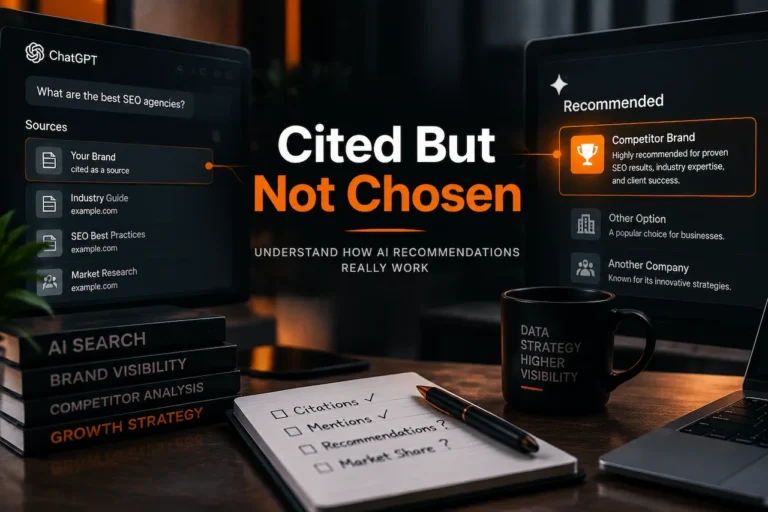
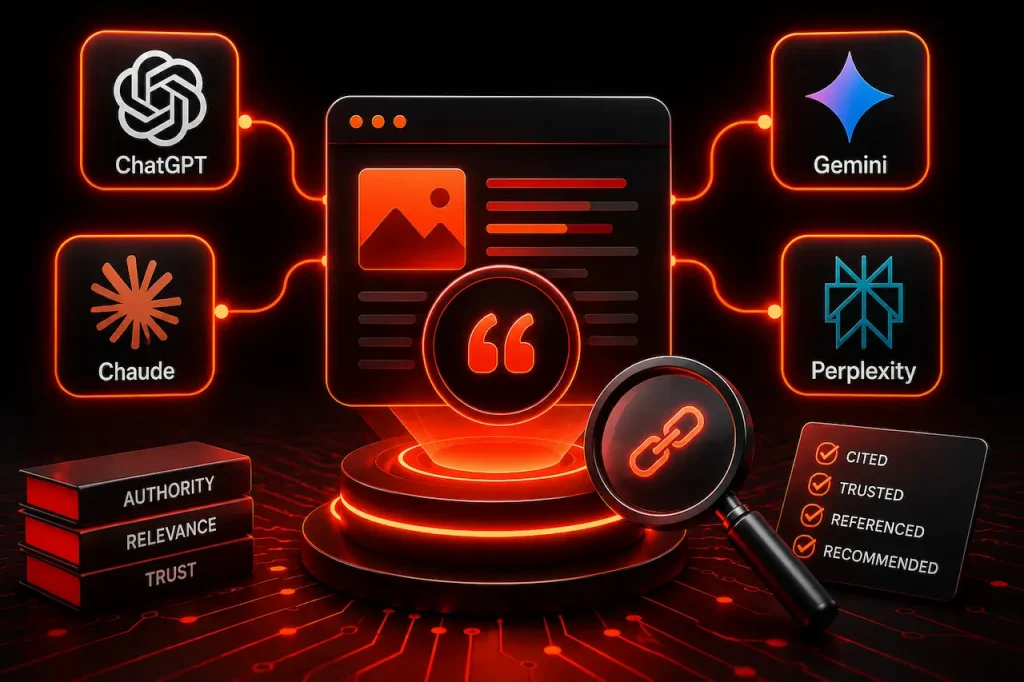
That answer may come from ChatGPT. Gemini. Claude. Perplexity. Google AI Overviews. Or the next AI assistant your customers start using next month.
The question is simple.
Will your brand be part of the answer?
That is what LLM SEO is about.
LLM SEO is the process of improving your website, brand signals, content structure, and authority so large language models and AI search systems can understand, retrieve, mention, and cite your business.
Not manipulate.
Not trick.
Earn.
Traditional SEO still matters. Google still needs crawlable pages, helpful content, links, structured data, and strong technical foundations. Google’s own guidance for AI features says website owners should focus on helpful, reliable, people-first content and make sure pages are eligible for Search features.
But LLM SEO adds another layer.
Your content must be easy to retrieve.
Your brand must be easy to understand.
Your claims must be easy to trust.
That is the new work.
Learn more about AI Search Optimization Services
What Is LLM SEO?
LLM SEO means optimizing your brand and content so large language models can understand, reference, and cite you in AI-generated answers.
LLM stands for large language model.
These models power tools like ChatGPT, Gemini, Claude, Perplexity, and many AI search experiences.
Some AI systems answer from trained knowledge. Some use live web retrieval. Some combine both.
That difference matters.
A normal Google search result sends users to links.
An AI answer may summarize the topic first, then cite sources or mention brands.
So your goal is not only ranking.
Your goal is retrieval, recognition, and citation.
LLM SEO focuses on:
- clear entity signals
- structured content
- answer-first explanations
- topical authority
- trustworthy sources
- brand mentions
- external citations
- technical accessibility
- consistent business information
- service pages that explain expertise clearly
The old question was:
“Can we rank?”
The new question is:
“Can AI systems understand why we deserve to be mentioned?”
That is harder.
And better.
SEO vs AEO vs GEO vs LLM SEO
These terms overlap, but they are not identical.
Confusing them leads to weak strategy.
SEO
SEO improves visibility in traditional search engines like Google and Bing.
It focuses on rankings, crawlability, indexing, content, links, technical performance, and user intent.
SEO is still the foundation.
Without SEO, LLM SEO becomes guesswork.
AEO
AEO means Answer Engine Optimization.
It focuses on getting content selected for direct answers, featured snippets, voice answers, People Also Ask, and AI-generated summaries.
AEO rewards clear, direct, structured answers.
GEO
GEO means Generative Engine Optimization.
It focuses on being cited or included inside generative AI answers.
This includes tools that synthesize answers from multiple sources.
Read the Generative Engine Optimization Guide
LLM SEO
LLM SEO focuses specifically on how large language models understand, retrieve, mention, and cite brands, pages, and entities.
It includes SEO, AEO, and GEO.
But it also asks a deeper question.
Does the model know who you are?
If the answer is no, your website may rank and still be invisible in AI answers.
That is the gap most businesses are missing.
How ChatGPT, Gemini, Claude, and Perplexity Find Sources
AI platforms do not all work the same way.
That is why LLM SEO cannot rely on one tactic.
Some systems use live search. Some use retrieval from indexed sources. Some generate from model knowledge. Some cite sources. Some do not always cite.
Perplexity is strongly citation-led. Google AI Overviews show links that help users explore more. Google explains that AI Overviews provide snapshots with links, and its Search documentation gives site owners guidance for inclusion in AI features.
ChatGPT, Gemini, and Claude can behave differently depending on browsing, connectors, model settings, and query type.
But the source-selection pattern is usually similar.
AI systems need sources that are:
- crawlable
- clear
- relevant
- authoritative
- current
- well-structured
- consistent with other sources
- useful for answering the query
They do not need another generic blog.
They need a source they can trust.
That is why weak AI content is not a strategy.
It is noise.
Why Brand Mentions Matter in LLM SEO
LLMs understand patterns.
If your brand is never mentioned anywhere except your own website, there is less evidence to connect your brand with a topic.
Brand mentions help AI systems understand that your business exists in a real market.
These mentions can come from:
- client websites
- directories
- case studies
- podcasts
- interviews
- guest posts
- industry roundups
- review platforms
- social profiles
- Google Business Profile
- LinkedIn company page
- trusted third-party citations
For Dexora Digital, the goal is not just to say:
“Dexora offers SEO services.”
The goal is for the web to repeatedly connect Dexora Digital with:
- SEO services
- Local SEO
- Technical SEO
- AI Search Optimization
- GEO
- AEO
- LLM SEO
- website audits
- lead generation
- Taqweem Ahmad
Consistency creates recognition.
Recognition creates retrieval.
Retrieval creates visibility.
Entity Signals: The Foundation of AI Visibility
An entity is a thing search systems can understand.
A person. A company. A service. A location. A product. A topic.
LLM SEO works better when your important entities are clear.
For a service business, core entities include:
- brand name
- founder name
- services
- industries served
- locations served
- client types
- credentials
- case studies
- social profiles
- business descriptions
- related topics
Your website should make these connections obvious.
Not once.
Across the whole site.
For Dexora Digital, that means pages should consistently connect:
- Taqweem Ahmad → Founder → SEO strategist
- Dexora Digital → SEO agency → Local SEO + AI Search Optimization
- Services → SEO, Local SEO, Technical SEO, AI Search, Lead Generation
- Proof → audits, client results, case studies, testimonials
- Topics → AEO, GEO, LLM SEO, AI Overviews, ChatGPT search
AI systems need a map.
Entity SEO builds that map.
Topical Authority: Why One Blog Is Not Enough
One article does not make you an authority.
A cluster does.
If you want to be cited for LLM SEO, you need supporting content around the topic.
A strong AI search cluster may include:
- What is LLM SEO?
- GEO vs AEO vs SEO
- How to rank in AI search engines
- How Google AI Overviews affect SEO
- LLMs.txt guide
- AI search visibility audit
- Best AI visibility tools
- How to optimize service pages for LLMs
- Case study showing AI search growth
This creates topical depth.
AI systems are more likely to trust a site that has covered the topic from multiple useful angles.
Not because the site published more.
Because the site explained more.
Read the LLMs.txt AI SEO Guide
Read How to Rank Your Site in AI Search Engines
Structured Content Makes LLM SEO Easier
LLMs prefer clarity.
Humans do too.
A strong LLM-ready page should be structured around answers, not paragraphs of filler.
Use this format:
- Direct answer
- Short explanation
- Specific example
- Supporting evidence
- Practical next step
Bad content hides the answer.
Good content exposes it.
Example:
Weak:
“There are many factors that influence AI visibility, and every business should consider different strategies depending on the platform.”
Strong:
“To improve AI visibility, make your content crawlable, answer search questions directly, strengthen brand entity signals, earn external mentions, and build topical authority around your core services.”
The second version can be used.
The first version can be ignored.
That is the difference.
Source Credibility: Why AI Search Rewards Trust
AI answers are risky.
They can be wrong.
That is why credible sources matter.
Google’s structured data documentation explains that structured data helps Google understand page information and eligibility for certain Search features.
But structured data alone is not credibility.
Credibility comes from the whole page.
Add:
- author name
- author experience
- publish date
- last updated date
- real examples
- references
- case studies
- clear methodology
- transparent limitations
- contact information
- organization details
Do not fake authority.
Build it.
A page written by a named expert with real experience is stronger than a page written by “Admin.”
For this article, the author should be:
Taqweem Ahmad — Founder of Dexora Digital. SEO strategist specializing in Local SEO, Technical SEO, AEO, GEO, and AI Search Optimization.
That matters.
Because trust needs a face.
How to Optimize Service Pages for LLMs
Most service pages are not built for AI search.
They are built like brochures.
That is why they fail.
A strong LLM-ready service page should answer the questions a buyer would ask before contacting you.
For example, an AI Search Optimization service page should clearly answer:
- What is AI Search Optimization?
- Who needs it?
- What problems does it solve?
- What platforms does it target?
- What is included?
- How does the process work?
- What results are realistic?
- What does it not guarantee?
- How is it different from normal SEO?
- Why should the reader trust this provider?
That structure helps humans.
It also helps AI systems summarize your service accurately.
Service page checklist for LLM SEO
Every major service page should include:
- one clear H1
- direct definition of the service
- who the service is for
- who it is not for
- what is included
- process section
- results section
- FAQ section
- internal links to related services
- author or reviewer signal
- Service schema
- FAQ schema
- Organization schema
- clear CTA
Do not write:
“We provide customized AI search solutions for businesses.”
Write:
“AI Search Optimization helps businesses improve visibility in Google AI Overviews, ChatGPT search, Gemini, Claude, and Perplexity by improving content structure, entity signals, topical authority, and technical accessibility.”
That is clearer.
Clear pages get cited more often.
LLM Visibility Checklist
Use this checklist before publishing any LLM SEO content.
Content clarity
- Does the page answer the main query in the first 100 words?
- Does every H2 answer a real search question?
- Are paragraphs short?
- Are definitions clear?
- Are examples specific?
Entity signals
- Is the brand name clear?
- Is the author named?
- Are services clearly connected?
- Are related topics internally linked?
- Is the business information consistent?
Technical access
- Is the page indexable?
- Is the canonical correct?
- Is the page in the sitemap?
- Is the page mobile-friendly?
- Does it load quickly?
- Are important sections visible in HTML?
Authority
- Does the page include real experience?
- Does it cite credible sources?
- Does it link to case studies?
- Does it include proof?
- Does it avoid fake guarantees?
AI citation readiness
- Can an AI tool summarize the page easily?
- Are claims specific?
- Are facts supported?
- Is the page better than competing articles?
- Does the page deserve to be cited?
That last question is the most important.
If the answer is no, optimize harder.
Common LLM SEO Mistakes
Most brands do not lose AI visibility because of one technical problem.
They lose it because their website is forgettable.
Mistake 1: Publishing generic AI content
Generic content does not build authority.
It adds more sameness to the web.
LLMs already have enough sameness.
Mistake 2: Ignoring brand entity signals
A site can have good articles and still have weak brand clarity.
That makes it harder for AI systems to connect the brand with the topic.
Mistake 3: Treating LLMs.txt as the whole strategy
LLMs.txt can help communicate preferred content access.
But it is not a replacement for strong content, technical SEO, authority, and brand mentions.
Learn more in our LLMs.txt AI SEO Guide
Mistake 4: No external proof
If every claim about your brand comes only from your own website, trust is limited.
Earn mentions elsewhere.
Mistake 5: No service-page depth
AI systems need enough information to explain what you do.
A 400-word service page is rarely enough.
Thin service pages create thin understanding.
A Practical LLM SEO Strategy for 2026
Start with your money pages.
Not your blog.
Your service pages are where revenue happens.
Step 1: Audit current AI visibility
Search your brand and services inside:
- ChatGPT
- Gemini
- Claude
- Perplexity
- Google AI Overviews
Check whether your brand appears.
Check competitors.
Check what sources are cited.
Write down the patterns.
Step 2: Strengthen your service pages
Improve definitions, process sections, FAQ content, schema, proof, and internal links.
Make every service page answer the buyer’s real questions.
Step 3: Build supporting topic clusters
Create guides around your core services.
For Dexora, the cluster should include:
- LLM SEO
- AI Search Optimization
- GEO
- AEO
- Google AI Overviews
- LLMs.txt
- AI visibility audits
- Semantic SEO
- Technical SEO for AI search
Step 4: Build external mentions
Earn brand mentions from credible sites.
Do not chase spam backlinks.
Chase relevance.
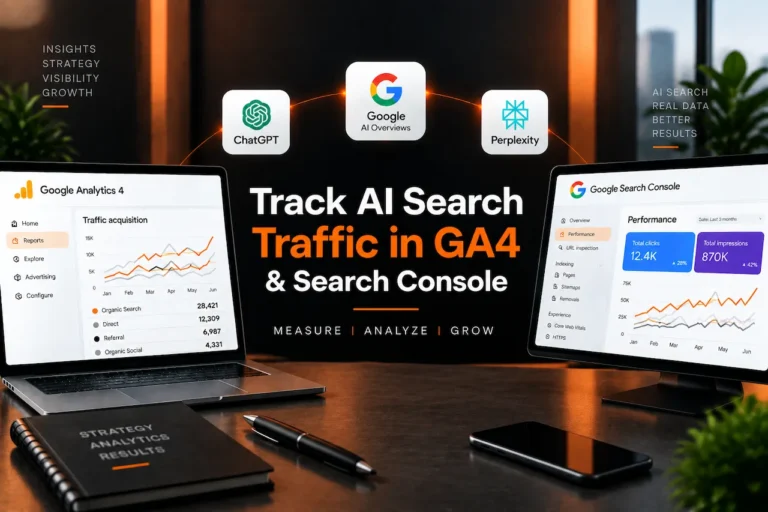
Step 5: Track AI visibility monthly
Run the same prompts every month.
Track:
- brand mentions
- competitor mentions
- cited URLs
- missing topics
- incorrect descriptions
- source patterns
AI visibility is not a one-time fix.
It is a monitoring system.
FAQ: LLM SEO
What is LLM SEO?
LLM SEO is the process of optimizing your website, content, brand entity signals, and authority so large language models can understand, mention, and cite your business in AI-generated answers.
Is LLM SEO different from normal SEO?
Yes, but it depends on normal SEO. Traditional SEO focuses on search rankings. LLM SEO focuses on retrieval, citation, brand understanding, and visibility inside AI-generated answers.
How do I get cited by ChatGPT or Perplexity?
Create clear, trustworthy, crawlable content that answers specific questions, earns external mentions, shows author expertise, and builds topical authority. Perplexity and other AI search systems often rely on web sources, so source credibility matters.
Does LLMs.txt help with LLM SEO?
LLMs.txt may help communicate which content AI systems should use, but it is not enough by itself. Strong content, technical SEO, entity clarity, and authority still matter more.
Do backlinks matter for LLM SEO?
Yes, but not all backlinks. Relevant brand mentions, trusted citations, and links from topical sources can help AI systems understand credibility and authority.
Can an agency guarantee AI citations?
No. Nobody can honestly guarantee citations in ChatGPT, Gemini, Claude, Perplexity, or Google AI Overviews. The goal is to improve the signals that make your brand easier to understand, retrieve, and trust.
Final Thoughts
LLM SEO is not a shortcut.
It is a trust system.
The brands that win will not be the ones shouting “AI” the loudest.
They will be the ones with clear answers, strong entities, useful service pages, credible proof, and real authority across the web.
AI search does not remove the need for SEO.
It reveals who was building real authority all along.
Taqweem Ahmad is the founder of Dexora Digital and an SEO strategist specializing in Local SEO, Technical SEO, AI Search Optimization, AEO, GEO, website audits, and lead generation systems. He has worked across 200+ website audits and helps businesses improve visibility across Google Search, Google Maps, and AI-driven search experiences.
Want to know whether your brand appears in ChatGPT, Gemini, Claude, Perplexity, and Google AI Overviews?
Get a free SEO and AI Search audit from Dexora Digital.