

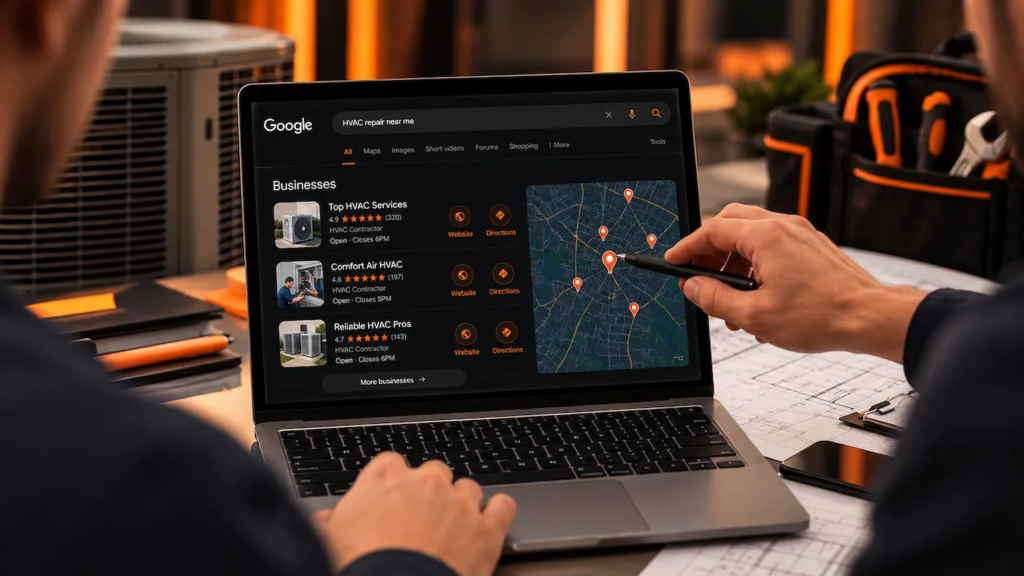
Local SEO for HVAC companies helps heating and cooling contractors connect with homeowners who are actively searching for repair, installation, and maintenance services. When an air conditioner breaks down during summer or a furnace stops working in winter, customers often turn to Google to find a reliable local contractor.
However, appearing in search results does not automatically generate service calls. Your Google Business Profile, service pages, customer reviews, and website experience must give potential customers a clear reason to choose your business.
In this guide, we explain how HVAC companies can improve Google Search and Maps visibility, target valuable local searches, and turn relevant website traffic into qualified service calls, installation estimates, and booked jobs.
ow HVAC customers search bef
How HVAC Customers Search Before They Call
HVAC customers search differently depending on the urgency of their problem, the service they need, and their stage in the buying process.
A homeowner dealing with a broken air conditioner may search for immediate repair assistance, while someone planning a system replacement may compare contractors, equipment options, warranties, and installation estimates.
Understanding these differences helps HVAC companies create relevant service pages and improve their local SEO strategy.
| Search intent | Example search | Customer priority |
| Emergency repair | Emergency AC repair near me | Immediate availability and a phone number |
| Specific service | Heat pump repair in Dallas | Relevant expertise and service coverage |
| Local contractor | HVAC contractor in Houston | Reviews, credentials, and reputation |
| Installation | AC replacement estimate | System options, experience, and quotation |
| Maintenance | Furnace maintenance service | Scheduling, service details, and reliability |
Emergency searches generally require fast access to contact information and accurate availability details. Installation searches often involve more research because customers want to understand the process, expected costs, and contractor qualifications.
HVAC companies should align their website content, Google Business Profile, and calls to action with these different customer needs.
Why HVAC Companies Struggle to Appear in Local Search
Many HVAC businesses provide reliable heating and cooling services but struggle to attract customers through Google Search and Maps.
The problem is often a combination of incomplete business information, weak service-page targeting, limited local credibility, and website performance issues.
For example, an HVAC contractor may offer emergency AC repair across several nearby cities but fail to communicate those services and locations clearly on its website. Another company may have a complete Google Business Profile but lack dedicated pages for high-value services such as furnace replacement or heat pump installation.
Local search competition also plays an important role. Established competitors may have stronger local relevance, more recognized businesses, and better evidence of customer experience.
Google’s local results consider relevance, distance, and prominence. This means a business cannot guarantee a top position simply by adding location keywords or publishing additional pages.
A successful HVAC local SEO strategy should improve how accurately the business is represented, how easily customers discover relevant services, and how confidently they can request assistance.
1. Optimize Your Google Business Profile for More HVAC Calls
Your Google Business Profile is one of the most important parts of local SEO for HVAC contractors. It helps customers discover your business through Google Search and Maps, compare nearby providers, and find accurate contact information.
For emergency HVAC searches, customers may prioritize businesses that clearly display their services, operating hours, and phone numbers. A complete and accurate profile helps them decide whether to contact you.
Google evaluates local results using relevance, distance, and prominence. Although you cannot directly control every ranking factor, you can improve how accurately your business is represented.
Focus on these Google Business Profile improvements:
- Business Categories: Choose the most accurate primary category and add relevant secondary categories where appropriate.
- HVAC Services: Include the repair, installation, maintenance, furnace, heat pump, and other services your business genuinely offers.
- Service Areas: Identify the locations you actually serve without claiming nonexistent offices or coverage.
- Business Information: Keep phone numbers, website links, operating hours, and emergency availability accurate.
- Original Photos: Add relevant photographs of technicians, equipment, service vehicles, and completed installations.
- Customer Reviews: Request genuine feedback after completed jobs and respond professionally to customer experiences.
For example, an HVAC company offering emergency AC repairs should make its actual emergency availability easy to understand. Customers searching outside normal business hours need reliable information before calling.
Google recommends that local businesses claim and manage their Business Profile so they can provide accurate details for Search, Maps, and Knowledge Panel results. Read Google’s business-details guidance.
An optimized profile should work alongside your website, helping potential customers move from local discovery to a relevant service page or direct enquiry.
For HVAC contractors looking to improve their visibility in Google Search and Maps, our local SEO services focus on strengthening local search presence and connecting businesses with relevant customers.
2. Create Service Pages That Target High-Intent HVAC Searches
A single HVAC services page may not provide enough information for customers searching for specific heating and cooling solutions. Someone needing emergency furnace repair has different priorities from a homeowner planning a complete air conditioning replacement.
Dedicated service pages help HVAC companies explain their capabilities, address relevant customer questions, and target searches associated with their most valuable services.
For example, an AC repair page should discuss common cooling problems, diagnostic services, service availability, and how customers can request assistance.
An AC installation page should focus on system options, the installation process, equipment considerations, warranties, and how to request an estimate.
The same approach applies to furnace repair, heat pump installation, ductless mini-split systems, and preventive maintenance.
Each priority service page should include:
- A clear explanation of the service and the problems it addresses.
- Relevant service areas and actual availability.
- Information about the company’s experience and qualifications.
- Genuine customer reviews or completed-work examples.
- A suitable CTA, such as requesting a repair visit or installation estimate.
For instance, an emergency AC repair page may benefit from a prominent phone CTA, while a heat pump installation page may perform better with a consultation or estimate request.
Effective SEO for HVAC companies should connect the right search query with the right service page and a relevant next step.
Our SEO services for lead generation help businesses strengthen service-page relevance, improve organic search visibility, and attract customers searching for their specific services.
3. Build Useful HVAC Service Area Pages Without Duplicate Content
HVAC customers frequently include city names, neighborhoods, and nearby locations when searching for heating and cooling services. Your website should clearly explain where your company operates and which services are available in those areas.
However, publishing dozens of nearly identical location pages is not an effective long-term strategy. Pages that simply replace one city name with another provide limited value to potential customers.
A useful HVAC service area page should explain the company’s actual coverage, relevant services, scheduling information, and local experience.
For example, an HVAC contractor serving Dallas, Plano, and Frisco may create distinct location pages when it can provide meaningful information for each area. This might include relevant installation examples, customer feedback, local service details, or climate-related considerations.
Location pages should also connect visitors to the appropriate AC repair, furnace maintenance, heat pump, or installation services.
Avoid creating misleading office addresses or promising response times that your business cannot consistently provide.
The goal of HVAC service area SEO is to help customers confirm that your business serves their location and provides the services they need.
4. Use Reviews and Real Project Proof to Build Customer Trust
Hiring an HVAC contractor involves trust, particularly when customers need emergency repairs or are investing in expensive heating and cooling equipment.
Before booking a service, homeowners may compare customer reviews, technician qualifications, warranties, and previous installation experience.
A company with strong service capabilities can still lose potential customers if its website provides little evidence of reliability.
HVAC businesses should highlight genuine customer experiences, professional credentials, and relevant completed work.
For example, a heat pump installation page can include photographs of completed projects, a description of the installation work, and customer feedback where permission is available.
Service pages should also clearly explain applicable warranties, maintenance options, and technician qualifications.

Customer reviews are particularly valuable when they describe actual service experiences, such as punctuality, communication, problem resolution, and installation quality.
Rather than relying on generic statements about excellent service, provide specific evidence that helps customers evaluate your company.
This approach strengthens website credibility and gives potential customers more confidence before requesting an estimate or scheduling a visit.
5. Fix Technical SEO Issues That Limit HVAC Search Visibility
Technical SEO helps search engines discover, crawl, and index your HVAC website while supporting a reliable experience for potential customers.
Many HVAC customers search from mobile devices, especially when they need urgent heating or cooling repairs. Slow-loading pages, difficult navigation, and broken contact options can create unnecessary barriers.
Important technical SEO checks include:
- Indexing: Confirm that priority HVAC service pages are accessible to search engines and eligible for indexing.
- Mobile Performance: Optimize large images, page loading, and mobile usability.
- Website Structure: Connect relevant service pages, service area pages, and educational content through internal links.
- Metadata: Use accurate page titles and headings that reflect each service.
- Redirects and Canonicals: Address broken URLs and unnecessary duplicate page versions.
- XML Sitemap: Include appropriate indexable service and location URLs.
For example, an HVAC website may have a useful furnace repair page, but if the page is unintentionally marked noindex, it cannot appear in Google’s normal organic search results.
Similarly, a mobile page that loads slowly or hides its phone number may discourage customers who need immediate assistance.
Structured data can help Google understand your business information. It must be accurate, visible on the page, and representative of the real business. It does not guarantee a ranking or a rich result. Review Google’s LocalBusiness structured-data guidelines.
We recommend reviewing technical issues alongside lead tracking so website improvements support both search visibility and customer enquiries.
Our technical SEO services help identify crawling, indexing, website performance, and structural issues that may limit the visibility of important HVAC service pages.
6. Create Helpful HVAC Content That Supports Service Bookings
Not every HVAC customer is ready to schedule a service immediately. Some homeowners research common heating and cooling problems before deciding whether they need professional assistance.
Helpful website content allows HVAC companies to answer these questions while introducing relevant services.
For example, an article about an air conditioner freezing up can explain common causes, warning signs, and when professional diagnosis may be necessary.
A guide comparing AC repair and replacement can help homeowners understand the factors that influence their decision, including equipment age, repair history, efficiency, and installation requirements.
Useful HVAC content topics include:
- Common signs that an air conditioner needs repair.
- When to repair or replace an aging HVAC system.
- Factors affecting furnace replacement costs.
- Heat pump installation considerations for different climates.
- Seasonal HVAC maintenance and inspection recommendations.
- Common reasons heating or cooling systems stop working.
Each article should provide accurate information and connect naturally to a relevant service page where appropriate.
Avoid publishing repetitive content simply to target more keywords. Useful articles should answer real customer questions and reflect reliable HVAC knowledge.
Google’s people-first-content guidance emphasises useful, reliable information created for people rather than material designed only to manipulate rankings. Read the guidance.
A well-organized content strategy can support organic visibility while helping customers move from research toward a suitable service enquiry.
Service pages target high-intent searches. Helpful content supports customers earlier in the decision process and gives your site more opportunities to earn visibility.
Useful HVAC content topics include:
- How to know whether to repair or replace an AC unit
- What causes an AC system to freeze up
- How often a furnace needs maintenance
- Heat pump versus central AC for your climate
- How much an HVAC replacement may cost and what affects the price
- When a ductless mini-split is a good choice
- What to do if the furnace stops working
Answer the question honestly. Do not publish dozens of shallow AI-generated pages. Google’s people-first-content guidance emphasises useful, reliable information created for people rather than material designed only to manipulate rankings. Read the guidance.
7. Strengthen HVAC Visibility in AI-Powered Search
AI-powered search is creating additional ways for homeowners to research heating and cooling services. Customers may use ChatGPT, Gemini, Perplexity, or Google AI features to understand HVAC problems, compare equipment options, and explore local service providers.
However, AI search visibility should complement an existing SEO strategy rather than replace it.
AI search does not remove the need for SEO. Google states that there are no extra technical requirements for a page to appear as a supporting link in AI Overviews or AI Mode. The page needs to be indexed and eligible to appear in Search. See Google’s AI-search guidance.
For HVAC businesses, the strongest foundation includes accurate company information, useful service pages, original project evidence, customer reviews, and clear explanations of common heating and cooling questions.
For example, a contractor offering heat pump installation can publish detailed information about its services, relevant equipment experience, service locations, and completed projects.
This content helps customers understand the company and makes its information more accessible to search systems.
AI citations and mentions can provide additional visibility, but they do not guarantee service calls or booked installations.
We recommend measuring AI search performance alongside relevant website traffic, customer enquiries, and other business outcomes where reliable data is available.
Our AI search optimization services help businesses improve how clearly their expertise, services, and company information are represented across AI-powered discovery channels.
How Seasonal HVAC Searches Affect Local SEO Strategy
HVAC search demand often changes with seasonal temperatures, weather conditions, and equipment maintenance needs.
During hot weather, homeowners may search for emergency AC repair, cooling problems, and air conditioning replacement services. In colder months, searches related to furnace repair, heating maintenance, and heat pump performance may become more important.
These patterns vary by location. An HVAC contractor operating in Arizona may experience different seasonal demand from a company serving Minnesota or another colder region.
HVAC businesses should review historical search data and their own service records to identify when demand increases for different services.
A practical seasonal SEO strategy may include updating relevant service pages before peak demand, publishing useful maintenance content, and confirming that business hours and emergency availability remain accurate.
For example, an HVAC company could review its AC repair page before summer, ensuring the service description, contact information, customer reviews, and booking options are current.
Seasonal planning should also consider high-value installation and replacement services, which may involve longer research and decision-making periods than emergency repairs.
By preparing content and service information ahead of seasonal demand, HVAC companies can improve their readiness to attract relevant searches and respond to customer needs.
How to Turn HVAC Website Calls Into Booked Jobs
Increasing phone calls is an important goal for many HVAC businesses, but not every call becomes a qualified lead or a booked service appointment.
A customer may click a phone number without completing the call. Another caller may reach voicemail, request a service outside the company’s coverage area, or contact several contractors before making a decision.
This is why HVAC lead generation should be measured beyond website traffic and phone clicks.
Businesses should understand the complete customer journey, from discovering a service to contacting the company and scheduling work.
Important conversion considerations include:
- Answered Calls: Identify whether incoming enquiries reach the appropriate team.
- Response Time: Review how quickly missed calls and online requests receive follow-up.
- Lead Qualification: Determine whether enquiries match the services and locations offered.
- Booking Process: Make it straightforward for customers to schedule repairs, consultations, or estimates.
- Conversion Tracking: Connect website and local search enquiries with actual appointments where possible.
For example, an HVAC company might receive numerous emergency AC repair calls during summer but lose opportunities because customers cannot reach someone outside normal working hours.
In that situation, improving call handling may generate more booked jobs without requiring a proportional increase in website traffic.
The objective is to connect local SEO performance with meaningful business outcomes, including qualified enquiries, scheduled appointments, and completed service opportunities.
Our website design services help businesses create user-friendly websites with clear service information, accessible contact options, and conversion-focused layouts that support customer enquiries.
A Practical 30-Day Local SEO Plan for HVAC Companies
Improving local SEO becomes easier when HVAC companies focus on priority services, accurate business information, and measurable customer actions.
The following four-week plan provides a practical starting point.
Week 1: Audit Local Visibility and Lead Tracking
Review Google Search Console, Google Business Profile performance, service pages, location coverage, customer reviews, and existing lead tracking.
Identify which HVAC services and geographic areas represent the strongest business opportunities. Compare your visibility with relevant local competitors and document the most important gaps.
Week 2: Optimize High-Value HVAC Service Pages
Choose two or three commercially important services, such as AC repair, furnace replacement, heat pump installation, or maintenance plans.
Improve their page titles, headings, service descriptions, customer proof, local relevance, and conversion options.
Make sure customers can quickly understand what each service includes and how to request assistance.
Week 3: Improve Local Credibility and Customer Trust
Update your Google Business Profile, confirm operating hours, and review service-area information.
Request genuine customer reviews after completed work and add relevant testimonials, technician qualifications, and installation examples to priority website pages.
Week 4: Resolve Technical Issues and Measure Results
Review indexing, redirects, mobile performance, internal linking, and structured data.
Check whether calls, contact forms, and appointment requests are being measured accurately.
Use the findings to identify the next month’s priorities rather than making changes based only on rankings.
The goal of the first 30 days is to address important weaknesses, establish reliable measurement, and create a foundation for continued local SEO improvements.
What HVAC Companies Should Measure Beyond Rankings
Keyword rankings and Google Maps visibility are useful indicators, but they do not provide a complete picture of HVAC marketing performance.
A business may improve its search positions without receiving more qualified calls. Similarly, website traffic may increase while appointment bookings remain unchanged.
HVAC companies should evaluate visibility alongside customer actions and business outcomes.
| Performance metric | What it helps evaluate |
| Organic search impressions and clicks | Visibility and engagement for relevant searches |
| Google Business Profile interactions | Customer activity through local listings |
| Phone clicks and tracked calls | Interest in contacting the business |
| Answered and qualified calls | Whether enquiries reach the business and match its services |
| Estimate and appointment requests | Customer intent to schedule work |
| Booked service appointments | Conversion from enquiry to scheduled work |
| Conversion rate by service page | Which pages contribute to enquiries |
| Completed jobs and revenue | Commercial outcomes where attribution is reliable |
For example, an HVAC company may receive fewer website visits than a competitor but generate more valuable installation enquiries because its service pages attract customers with stronger buying intent.
We recommend reviewing these metrics regularly and comparing results by service type and location.
The objective is to understand which SEO improvements contribute to qualified demand, not simply which keywords move higher in search results.
Frequently asked questions
What is local SEO for HVAC companies?
Local SEO for HVAC companies involves improving a heating and cooling business’s visibility in Google Search and Maps for relevant local searches. It includes Google Business Profile optimization, service-page SEO, accurate location information, customer reviews, and technical improvements that help potential customers find and contact the business.
How can an HVAC company rank higher on Google Maps?
HVAC companies can strengthen their local presence by maintaining accurate Google Business Profile information, choosing appropriate categories, collecting genuine reviews, and providing useful service and location information. Google Maps rankings depend on relevance, distance, and prominence, so no individual optimization guarantees a top position.
Do HVAC companies need separate pages for AC repair and installation?
Yes, when both services are important to the business. AC repair customers often need immediate assistance, while installation customers may research equipment, warranties, and estimates. Separate pages can address these different needs and provide more relevant information and calls to action.
Can AI search help HVAC contractors generate more leads?
AI-powered search can provide additional opportunities for HVAC businesses to be discovered by potential customers. Accurate company information, useful service content, genuine reviews, and original experience can support discoverability, but AI visibility does not guarantee enquiries or bookings.
How long does HVAC SEO take to generate service calls?
HVAC SEO timelines depend on competition, location, website condition, and existing search visibility. Technical improvements may be implemented quickly, while sustained organic visibility and consistent service enquiries generally require ongoing work over several months. Results should be evaluated through relevant calls, qualified leads, and booked appointments.
Get More Qualified HVAC Service Calls With Local SEO
Your HVAC website should do more than attract search traffic. It should help homeowners find relevant services, trust your business, and request assistance when they need it.
At Dexora Digital, we help HVAC companies improve Google Search and Maps visibility, strengthen service pages, and identify website conversion opportunities.
Request a Free Local SEO & AI Visibility Audit to understand what may be limiting your service calls, installation enquiries, and local search performance.
Ready to improve your HVAC company’s Google visibility and generate more qualified service enquiries? Contact Dexora Digital to discuss your local SEO challenges and explore opportunities to attract more customers.