
Service-area businesses often face a difficult local SEO challenge.
A company may provide excellent services across multiple cities but still struggle to appear when customers search from nearby locations. This creates an important question:
Can a service-area business rank in nearby cities without having a physical office there?
Many businesses assume that if they cannot appear in Google Maps results for another city, they have no opportunity to gain visibility there.
That assumption is not completely correct.
Google Maps rankings and organic local rankings work differently. While proximity plays a major role in map visibility, businesses can still build strong organic visibility in nearby cities through relevant content, authority, and a strong local SEO strategy.
The key is understanding which ranking factors businesses can influence and which limitations are controlled by Google’s location-based systems.
A realistic local SEO strategy does not focus on manipulating location signals.
It focuses on proving relevance, building trust, and creating value for customers in the areas a business serves.
Why Service-Area Businesses Struggle to Rank in Nearby Cities

Google’s goal is to provide users with the most relevant businesses for their specific location.
When someone searches for a local service, Google evaluates multiple signals to determine which companies should appear.
One of the strongest signals is proximity.
This creates a challenge for service-area businesses because they often serve multiple locations from one main office.
A company may have:
- Excellent customer reviews
- Strong service quality
- Years of experience
- A professional website
- High customer satisfaction
However, a competitor located closer to the searcher may still have an advantage in Google Maps.
For example:
A roofing company located in one city may serve an entire county. However, when someone searches for roofing services in a neighboring city, Google may prefer businesses physically closer to that customer.
This does not mean the service-area business cannot rank.
It means the business needs to understand where proximity creates limitations and where optimization can create opportunities.
Many companies make the mistake of focusing only on Google Maps.
They believe local visibility depends entirely on appearing in the Map Pack.
However, organic local search provides another opportunity to reach customers searching for services in nearby cities.
A successful local SEO strategy considers both:
- Google Maps visibility
- Organic city-level rankings
Google Maps helps businesses appear during local discovery searches.
Organic rankings help businesses capture customers searching for specific services in specific locations.
Understanding this difference is the foundation of sustainable local growth.
Understanding the Google Maps Proximity Wall
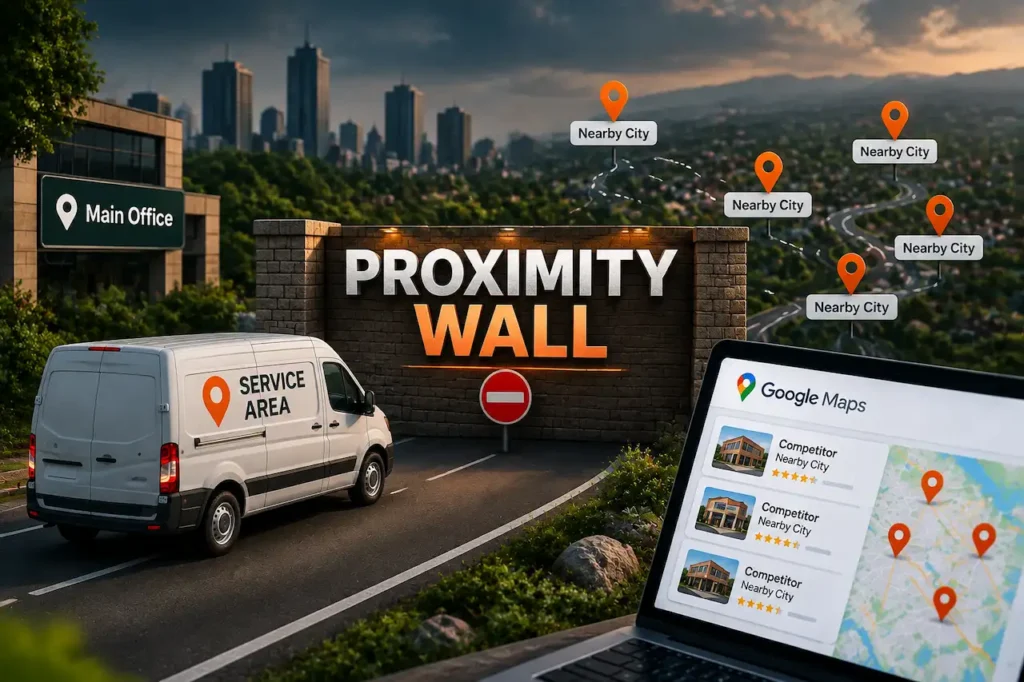
The Google Maps proximity wall describes the challenge businesses experience when distance affects their ability to appear in local map results.
Google Maps is designed around local convenience.
When users search for a service, Google wants to show businesses that are most relevant and capable of serving that location.
Because of this, businesses located closer to the searcher often receive an advantage.
A company can have:
- Better reviews
- Stronger website content
- More experience
- Higher customer satisfaction
Yet a nearby competitor may still appear higher because of location.
This is especially noticeable in competitive industries such as:
- Roofing
- Plumbing
- HVAC
- Legal services
- Home improvement
- Healthcare services
A business trying to rank in another city may notice that Google Maps visibility decreases as the search location moves farther away from its actual address.
However, proximity is only one part of local ranking.
Google also evaluates:
- Relevance
- Business information accuracy
- Reviews
- Website signals
- Overall authority
This means businesses should focus on improving the signals they can control.
Creating fake offices or false locations is not a sustainable strategy.
It creates inaccurate information and can damage long-term trust.
Instead, businesses should build genuine local relevance by showing search engines and customers that they actually serve those areas.
A proper understanding of Google Maps ranking factors helps businesses focus on realistic opportunities instead of trying to manipulate location signals.
The goal is not pretending to be located everywhere.
The goal is becoming the most relevant business for the locations you genuinely serve.
The Geo Grid Experiment: Testing Local Ranking Distance
Instead of guessing how far a service-area business can rank, businesses should test their visibility using a geo grid experiment.
A geo grid experiment measures rankings from multiple points around a target location. It provides a more accurate picture of how rankings change depending on the searcher’s physical position.
A single ranking check can be misleading.
A business may appear in position three when searching from its office location but disappear completely when the search is performed from another part of the city.
A proper geo grid test compares visibility across different distances, such as:
- 5-mile radius
- 10-mile radius
- 15-mile radius
- 20+ mile radius
The purpose is not only checking rankings.
The purpose is understanding ranking patterns.
A geo grid experiment can reveal:
- Where visibility begins to decline
- Which competitors dominate specific areas
- Whether proximity is the main limitation
- Whether website relevance or authority needs improvement
For example:
A business may rank strongly within five miles but lose visibility beyond fifteen miles.
This suggests proximity is creating a limitation.
Another business may perform poorly even close to its location.
In that case, the problem may not be distance.
The issue may be related to:
- Weak website content
- Poor local relevance
- Limited reviews
- Weak authority signals
Testing creates better decisions.
Instead of assuming why rankings change, businesses can identify where optimization efforts will have the highest impact.
Google Maps Rankings vs Organic City Page Rankings
One of the biggest mistakes service-area businesses make is treating Google Maps rankings and organic city rankings as the same thing.
While both contribute to local visibility, they are influenced by different signals and require different strategies.
Google Maps visibility depends heavily on local business signals.
Important factors include:
- Business location
- Google Business Profile information
- Reviews
- Relevance
- Proximity
Organic city rankings work differently.
They depend more on:
- Website relevance
- Content quality
- Internal linking
- Authority
- How effectively a page answers user needs
This creates an important opportunity for service-area businesses.
A company may struggle to appear in Google Maps results for another city because competitors have physical locations closer to customers.
However, the same company can still create strong organic visibility by building useful city-specific pages.
These pages should not simply mention a city name repeatedly.
They should demonstrate:
- Experience serving that area
- Understanding of local customer needs
- Relevant services
- Real examples
- Helpful information
The goal is creating pages that provide confidence to customers.
A person searching for a service in another city wants to know:
“Does this company actually serve my area?”
“Have they helped customers like me?”
“Why should I choose them?”
A strong location pages SEO strategy focuses on building relevance and trust instead of creating thin pages designed only for rankings.
How Service-Area Businesses Can Improve Nearby City Visibility
Service-area businesses cannot remove every limitation caused by distance.
However, they can improve how search engines understand their service coverage and local relevance.
The strongest strategies focus on proving value in the locations they target rather than creating artificial signals.
A practical approach includes:
- Creating unique city pages that explain services, customer needs, and local experience
- Connecting service pages with location pages through clear internal linking
- Adding real proof such as projects, testimonials, and customer experiences
- Building local authority through useful content and consistent business information
City pages should be created with customers in mind.
A person searching from a nearby city wants confidence that the business understands their location and can solve their problem.
A strong local page should answer:
Does this business actually serve my location?
Has this company worked with customers like me?
Why should I choose this company instead of another provider?
Search engines are becoming better at identifying whether pages provide genuine value or simply repeat location keywords.
Businesses that create useful local resources have a stronger chance of earning organic visibility.
The goal is not creating hundreds of similar pages.
The goal is creating valuable location experiences.
Building a Local Ranking Measurement System
Local SEO decisions should come from data instead of assumptions.
A ranking measurement system helps businesses understand:
- Where opportunities exist
- Where competitors are stronger
- Which locations need improvement
- Which strategies create the biggest impact
A useful local measurement process includes:
- Tracking rankings from different geographic locations
- Comparing Google Maps performance with organic rankings separately
- Monitoring competitors across target cities
- Reviewing changes after content updates
- Measuring leads and conversions from different service areas
The purpose of measurement is not collecting rankings alone.
The purpose is understanding customer visibility.
A business may discover that one nearby city has strong organic opportunity but limited Map Pack potential because of proximity.
Another location may require stronger authority before rankings improve.
Data helps businesses prioritize resources.
Instead of trying to rank everywhere at once, companies can focus on areas where growth is realistic.
A strong local keyword research process helps identify which locations and search terms represent the best opportunities.
Real World Example: Expanding Local Visibility Without Fake Locations
I worked with a service-area business that wanted to increase leads from surrounding cities.
The company believed the biggest obstacle was not having physical offices in those markets.
The initial idea was creating additional location profiles to appear closer to customers.
However, this approach would have created inaccurate business information and introduced long-term risks.
Instead, we analyzed the actual search environment.
The process involved:
- Reviewing ranking behavior at different distances
- Comparing Google Maps visibility
- Studying competitor presence
- Identifying organic ranking opportunities
The results showed two different situations.
In Google Maps, proximity created a clear limitation.
Businesses physically closer to searchers often had an advantage.
However, organic search provided much more opportunity.
By improving location pages, strengthening internal relationships, and creating more relevant content, the business could compete for nearby city searches without creating false locations.
The strategy focused on realistic growth.
The lesson was clear:
A service-area business does not need to overcome Google’s proximity system artificially.
It needs to understand where proximity matters and where strong content, relevance, and authority can create opportunities.
Improving Local Visibility With a Complete Service Area SEO Strategy
Expanding into nearby cities requires more than creating location pages.
A successful approach combines:
- Website optimization
- Local content strategy
- Internal linking
- Customer proof
- Business information consistency
Service-area businesses should create a clear connection between their services and the locations they serve.
For example:
A company serving multiple cities should help customers understand:
- What services are available in that area
- How the company has helped similar customers
- Why the business understands local needs
- How customers can get started
This creates stronger relevance for both users and search engines.
The goal is not creating pages that exist only for rankings.
The goal is creating pages that support real customer decisions.
A structured service area SEO strategy helps businesses expand visibility while maintaining accuracy and long-term trust.
Using AI and Data to Improve Local Expansion
Local search is becoming more competitive because businesses are no longer competing only for traditional rankings.
Search engines are becoming better at understanding:
- Business relevance
- Customer intent
- Service relationships
- Location context
Businesses can use data and AI-supported analysis to identify:
- Which cities have ranking opportunities
- Which competitors dominate specific areas
- Which services have higher demand
- Which pages need improvement
A data-driven approach helps businesses avoid wasting resources on locations where competition or proximity creates unrealistic barriers.
Instead of trying to rank everywhere, businesses can prioritize locations where they have the strongest opportunity to succeed.
A modern AI local SEO strategy can help businesses analyze patterns, improve content decisions, and create smarter local growth plans.
Why Choose Us
At Dexora Digital, we help service-area businesses improve local visibility through research-driven SEO strategies focused on sustainable growth.
We understand that local SEO is not only about ranking in Google Maps.
It is about creating a complete visibility system that connects businesses with customers across the areas they serve.
Our approach includes:
- Experience creating local SEO strategies for multi-city businesses
- Data-based analysis to identify realistic ranking opportunities
- Separate strategies for Google Maps and organic local rankings
- Location page optimization focused on customer value
- Local content strategies designed for long-term growth
- Measurement systems to track progress and opportunities
We focus on building genuine local relevance instead of using risky shortcuts.
The goal is helping businesses become trusted options in the markets they serve.
Conclusion
A service-area business can rank in nearby cities without creating fake offices, but success depends on understanding how local search actually works.
Google Maps visibility may be limited by proximity, especially when competitors are physically closer to customers.
However, organic local rankings create opportunities through strong location pages, useful content, authority signals, and customer-focused optimization.
Businesses that test ranking distance, measure performance, and focus on genuine value can expand their service areas sustainably.
The goal is not appearing everywhere.
The goal is becoming the most relevant choice where your business can genuinely help customers.
FAQ
Can a service-area business rank in cities where it has no office?
Yes.
A service-area business can rank organically in nearby cities through strong location pages, relevant content, internal linking, and authority signals.
However, Google Maps rankings may be more difficult because proximity plays a major role.
Why does Google Maps favor businesses closer to the searcher?
Google uses proximity as a local relevance signal because users generally want businesses that can serve their location conveniently.
A nearby business may receive an advantage even if another company has stronger reviews or content.
Are location pages still important for service-area businesses?
Yes.
High-quality location pages can help businesses rank organically when they provide useful information about the area, customer needs, services, and experience.
Thin pages that only replace city names are unlikely to provide strong value.
Can a business create multiple Google Business Profiles for different cities?
No.
Businesses should only create Google Business Profiles for legitimate locations that meet Google’s guidelines.
Fake locations can damage visibility, trust, and long-term SEO performance.
How can I test my local ranking distance?
A geo grid experiment can measure rankings from different search locations and show where visibility increases or decreases.
This helps identify whether proximity, content, authority, or other factors are limiting performance.
Should I focus on Google Maps or organic city rankings?
Both are important, but they require different strategies.
Google Maps depends more heavily on location and business profile signals.
Organic city rankings depend more on website relevance, content quality, authority, and optimization.
How many city pages should a service-area business create?
The number depends on actual service areas and business goals.
Businesses should prioritize valuable pages for locations they genuinely serve instead of creating large numbers of low-quality pages.
How can I improve local rankings in nearby cities?
Businesses can improve nearby city visibility by:
- Creating useful location pages
- Improving internal linking
- Building local authority
- Adding customer proof
- Optimizing service pages
- Monitoring competitor performance
Expand Your Local Visibility With Dexora Digital
Ranking in nearby cities requires more than adding location names to a website.
Businesses need a strategy that understands Google Maps limitations, organic ranking opportunities, customer intent, and local authority.
Dexora Digital helps service-area businesses identify realistic growth opportunities, improve local visibility, and build sustainable SEO systems.
Our team can help with:
- Local SEO analysis
- Service area expansion strategy
- Location page optimization
- Google Maps visibility improvements
- Local ranking measurement
If you want to understand where your business can realistically rank and how to grow visibility in nearby cities, SEO consultation can help create a clear roadmap.