
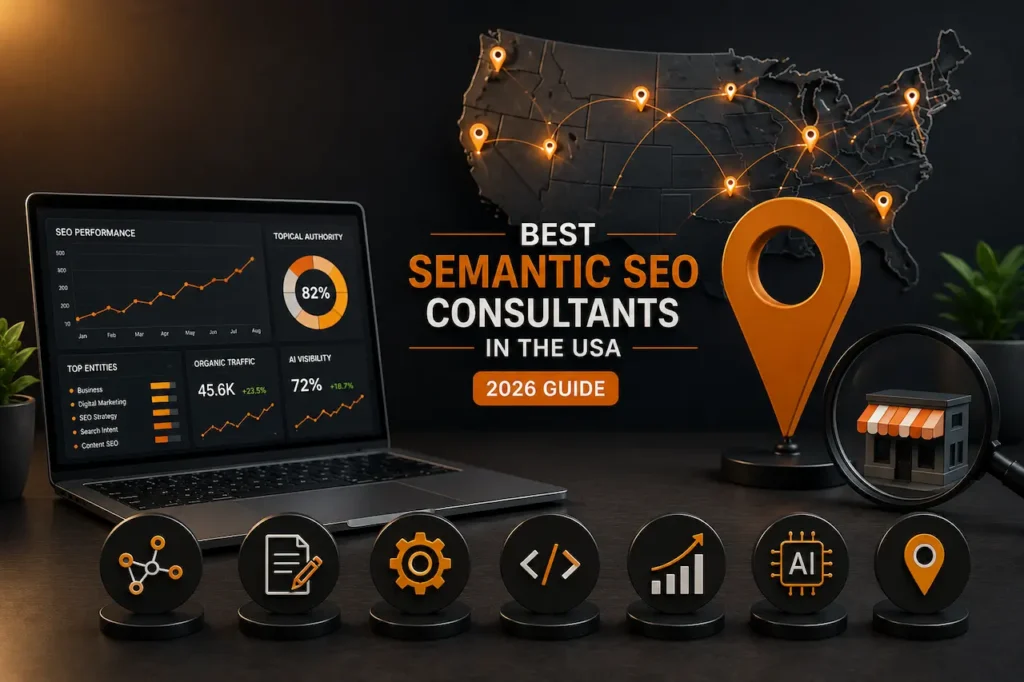
Semantic SEO has moved beyond adding related keywords to an article. In 2026, strong semantic SEO focuses on entities, search intent, topical authority, content relationships, internal linking, technical accessibility, structured data, and AI search visibility.
The best semantic SEO consultants understand how these elements work together. They do not simply provide a spreadsheet of keywords or recommend publishing more blog posts. They analyze how search engines understand a business, how pages relate to one another, and where the website has gaps compared with competitors.
This guide compares five semantic SEO agencies and explains what to look for before hiring one.
Who Is the Best Semantic SEO Consultant?
There is no single consultant that is best for every business. The right choice depends on your website size, industry, technical complexity, budget, and goals.
For enterprise-level relevance engineering and information retrieval, iPullRank is a strong option. Seer Interactive is suited to research-heavy enterprise work. Victorious focuses strongly on entity-first SEO and connected content systems. Searchbloom combines SEO, AI search, content, and implementation. Dexora Digital focuses on hands-on semantic, technical, local, AEO, and GEO implementation for small and mid-sized businesses.
The most important factor is not the agency’s position on a list. It is whether the consultant can diagnose your website and build a semantic strategy around your actual business.
What Is Semantic SEO?
Semantic SEO is the process of optimizing a website around meaning, context, entities, relationships, and search intent rather than treating keywords as isolated phrases.
For example, a company targeting “commercial solar installation” should not only optimize for that exact phrase. A complete strategy may need to address installation costs, permits, system capacity, financing, maintenance, tax considerations, commercial property types, and other related concepts.
The goal is not to place every related term on one page. Each concept should have a logical place within the website.
Dexora’s semantic SEO strategy guide explains how entities, topics, content architecture, and internal relationships can work together as a broader search strategy.
What Does a Semantic SEO Consultant Do?
A semantic SEO consultant studies how a website, its content, and its business entities are connected.
Typical work can include:
- Search intent research
- Entity mapping
- Topic mapping
- Topical authority analysis
- Content gap analysis
- Competitor semantic analysis
- URL architecture
- Internal linking
- Content optimization
- Technical SEO
- Structured data
- Authority development
- AI search analysis
A good consultant also knows when not to create another page. Several keywords may represent the same intent and belong on one stronger page.
That distinction can prevent thin content, duplicate pages, and keyword cannibalization.
How We Evaluated the Best Semantic SEO Consultants
Semantic SEO requires a different evaluation framework from a traditional “best SEO agencies” list.
We compared consultants across the following areas:
1. Entity and Semantic Expertise
Does the consultant understand entities, attributes, relationships, search intent, and semantic relevance?
2. Topical Authority
Can the consultant build a connected content system instead of producing unrelated articles?
3. Content Architecture
Can they decide which topics deserve separate URLs and which belong together?
4. Internal Linking
Can they connect pillar, supporting, informational, and commercial pages naturally?
5. Technical SEO
Can they solve indexing, crawlability, canonicalization, rendering, and architecture problems?
6. AI Search Readiness
Can they explain how semantic SEO supports modern AI-assisted discovery without promising guaranteed citations?
7. Evidence and Methodology
Do they publish research, frameworks, case studies, tools, or detailed explanations of their approach?
8. Business Fit
Can they work effectively with the size, resources, market, and complexity of the business?
Current 2026 competitor guides are also putting strong emphasis on entity optimization, topical authority, Knowledge Graph concepts, structured data, AI search, content architecture, and consultant methodology.
Top Semantic SEO Consultants in the USA
| Consultant | Best For | Main Strength |
|---|---|---|
| iPullRank | Enterprise | Relevance engineering and information retrieval |
| Seer Interactive | Large organizations | Research, analytics, SEO and GEO |
| Victorious | Mid-market and enterprise | Entity-first SEO and content systems |
| Searchbloom | Growth companies | SEO, AI search and implementation |
| Dexora Digital | SMB, local and specialist B2B | Semantic, technical SEO and GEO |
This table should be treated as a practical comparison rather than a universal ranking. The right consultant depends on your requirements.
1. iPullRank
Best for: Enterprise organizations with advanced technical, content, and AI-search requirements.
iPullRank has built its positioning around Relevance Engineering, connecting information retrieval, content strategy, technical SEO, digital PR, and generative search. Its published work discusses areas such as entity recognition, semantic similarity, embeddings, passage-level retrieval, and AI-search measurement.
Its approach is particularly relevant for large websites where conventional keyword research is not enough to understand content relationships and retrieval.
Strengths:
- Advanced technical expertise
- Information retrieval
- Enterprise SEO
- AI-search research
- Content engineering
Best fit: Large or technically complex organizations.
2. Seer Interactive
Best for: Enterprise businesses that want data-led search strategy and AI-search research.
Seer combines SEO, analytics, audience research, and generative search strategy. Its current work places strong emphasis on understanding how audiences search and how brands appear across emerging search experiences.
This makes it a good option for organizations with established marketing teams and large amounts of performance data.
Strengths:
- Original research
- Analytics
- Enterprise experience
- SEO and GEO integration
- Audience intelligence
Best fit: Large organizations with substantial internal resources.
3. Victorious
Best for: Mid-market and enterprise businesses that want entity-focused SEO integrated with broader search marketing.
Victorious focuses on connected visibility across technical inclusion, search targeting, content retrieval, and authority development. Its semantic approach emphasizes entity clusters, search intent, content relationships, and avoiding keyword cannibalization.
Strengths:
- Entity-focused SEO
- Content architecture
- Technical SEO
- Search intent
- AEO integration
Best fit: Established companies wanting a managed SEO program.
4. Searchbloom
Best for: Companies that want semantic content, technical SEO, AI search, digital PR, and conversion work under one provider.
Searchbloom’s current AI-search work emphasizes relevance, evidence, inclusion, mentions, and transformation. Its approach connects semantic content with technical accessibility and external authority.
Strengths:
- SEO implementation
- AI search
- Content
- Digital PR
- CRO
Best fit: Mid-market companies seeking broader search execution.
5. Dexora Digital
Best for: Small and mid-sized US businesses, local businesses, specialist B2B companies, engineering organizations, and brands that want strategy plus implementation.
Dexora combines semantic SEO with technical SEO, content optimization, internal linking, local SEO, AEO, GEO, and conversion-focused SEO.
The advantage for smaller and specialist businesses is that semantic SEO does not have to be treated as an isolated project. It can be connected to technical fixes, content, local visibility, authority, and lead generation.
Strengths:
- Semantic SEO
- Technical SEO
- AEO and GEO
- Content optimization
- Internal linking
- Local SEO
- Hands-on implementation
Best fit: Businesses that want practical strategy and implementation rather than recommendations alone.
How to Choose the Right Semantic SEO Consultant
Do not hire an agency simply because it appears in a “best semantic SEO consultants” article.
Ask how the consultant would approach your actual website.
A proper diagnosis should review:
- Organic visibility
- Important commercial pages
- Search intent
- Existing content
- Keyword cannibalization
- Crawlability
- Indexing
- Internal links
- Entity clarity
- Competitor coverage
- Content gaps
- Conversion tracking
- AI-search visibility
A consultant should be able to explain what is wrong, why it matters, and what should happen next.
How Topics Should Be Mapped to URLs
One of the biggest differences between strong and weak semantic SEO is the way topics are assigned to pages.
A weak strategy might create:
- One page for every keyword
- One page for every minor variation
- Multiple pages targeting the same intent
A stronger approach asks whether several queries represent the same user need.
For example, “semantic SEO services,” “semantic SEO agency,” and “semantic SEO consultant” may overlap significantly. The correct architecture depends on the actual intent and the business model.
The objective is to create the smallest useful set of pages that completely satisfies distinct search needs.
Topical Authority and Semantic Content Clusters
Topical authority is not created by publishing hundreds of unrelated blog posts.
A stronger structure looks like:
Pillar topic
↓
Major subtopics
↓
Supporting content
↓
Commercial pages
↓
Contextual internal links
Each page should have a clear role.
For example, a website focused on semantic SEO might have a main semantic SEO guide supported by pages covering entity SEO, topical authority, semantic content, Knowledge Graph concepts, internal linking, and AI search.
This creates a connected subject rather than a collection of independent articles.
Semantic Competitor Gap Analysis
Competitor analysis should go beyond comparing keywords and backlinks.
A semantic gap analysis should identify:
- Missing entities
- Missing subtopics
- Missing questions
- Missing content types
- Missing relationships
- Missing evidence
- Missing commercial information
- Missing internal links
For example, if a competitor explains entity relationships, Knowledge Graph concepts, internal linking, AI retrieval, and implementation while your page only explains semantic keywords, the gap is topical and conceptual, not simply keyword-based.
Dexora already has a competitive AEO and semantic gap framework that can be used as part of this broader approach.
Internal Linking in Semantic SEO
Internal links help connect related concepts across a website.
A semantic internal-link strategy should identify:
- Pillar pages
- Supporting pages
- Commercial pages
- Orphan pages
- Related entities
- Important pages receiving insufficient internal authority
Links should be placed where they help users understand the subject, not inserted randomly to force exact-match anchor text.
This is also where descriptive anchor text and logical site architecture become important.
What Should a Semantic SEO Consultant Deliver?
Before hiring a consultant, ask what you will actually receive.
A serious project may include:
- Entity map
- Topic map
- Search-intent map
- Content gap analysis
- Competitor semantic gap
- URL architecture
- Internal-link plan
- Content briefs
- Technical audit
- Structured-data recommendations
- Content consolidation recommendations
- AI-search visibility analysis
- Reporting framework
A spreadsheet containing keywords and blog titles is not the same thing as a complete semantic SEO strategy.
Semantic SEO, Technical SEO and Schema
Semantic content cannot perform properly if important pages cannot be crawled, indexed, rendered, or understood.
Review:
- Indexability
- Canonicals
- XML sitemap
- Robots.txt
- Rendering
- Internal links
- Mobile performance
- Core Web Vitals
- Duplicate content
Dexora’s technical SEO guide covers the technical foundations that need to be addressed before expanding a website’s topical coverage.
Structured data can also help search engines understand supported information, but it should accurately represent visible content. It should never be sold as a shortcut to rankings or AI citations.
For implementation guidance, see Dexora’s schema markup guide.
Semantic SEO and AI Search in 2026
Semantic SEO is increasingly relevant to AI-assisted search because modern retrieval systems need to interpret the meaning and relationships within information.
However, semantic SEO does not guarantee that ChatGPT, Gemini, Perplexity, Claude, or Google AI Overviews will cite a website.
A credible strategy should focus on:
- Clear entities
- Accurate information
- Complete intent coverage
- Original information
- Strong content relationships
- Technical accessibility
- Author transparency
- First-party evidence
- Independent mentions
For the distinction between traditional search, answer engines, and generative search, see Dexora’s SEO vs AEO vs GEO guide.
Who Should Hire Which Semantic SEO Consultant?
Small Businesses
Look for a consultant who can fix foundational SEO, improve content architecture, build topical relevance, and implement recommendations without requiring a large enterprise team.
SaaS Companies
Look for expertise in product entities, commercial intent, comparison content, topical authority, technical SEO, and AI search.
B2B Companies
Prioritize consultants who understand complex buyer journeys, technical subjects, expert content, and commercial search intent.
Local Businesses
Choose a provider that understands entities, local relevance, Google Business Profile, local content, reviews, and local authority.
Enterprise Businesses
Enterprise websites may need information retrieval, large-scale architecture, governance, advanced technical SEO, data analysis, and international or multi-market implementation.
Warning Signs When Hiring a Semantic SEO Consultant
Be careful with consultants who:
- Guarantee rankings
- Guarantee ChatGPT or AI Overview citations
- Sell “LSI keywords” as their main methodology
- Recommend one page for every keyword
- Produce mass AI content without original value
- Ignore technical SEO
- Cannot explain search intent
- Treat schema as a ranking shortcut
- Hide their link-building methods
- Report only keyword positions
- Cannot show practical deliverables
Advanced terminology does not automatically prove expertise. A consultant should be able to explain entities, topical authority, semantic relationships, and retrieval in simple business terms.
How Much Does Semantic SEO Cost?
There is no fixed price for semantic SEO because projects vary significantly.
Cost depends on:
- Website size
- Competition
- Number of markets
- Technical complexity
- Content volume
- Research requirements
- Implementation responsibility
- Reporting
- Internal stakeholders
A small content and architecture audit is very different from rebuilding semantic architecture across a large enterprise website.
Always request a written scope that separates strategy, content, development, outreach, reporting, and implementation.
Dexora’s Semantic SEO Framework
At Dexora, semantic SEO can be viewed as an eight-step process:
1. Entity Mapping
Identify the business, services, products, people, locations, and important concepts.
2. Intent Mapping
Understand what users actually want from each search.
3. Topic Architecture
Organize the main subject into pillars and supporting topics.
4. Content Optimization
Improve existing pages before creating unnecessary new ones.
5. Internal Linking
Connect related pages through natural contextual relationships.
6. Technical Accessibility
Make sure important information can be crawled, indexed, rendered, and understood.
7. Authority
Build relevant external mentions, links, evidence, and trust.
8. AI Search Visibility
Improve clarity and consistency so the business and its expertise are easier for modern search systems to interpret.
This framework connects semantic SEO with traditional search, AEO, GEO, and commercial SEO rather than treating each as a separate campaign.
Final Verdict
The best semantic SEO consultant depends on the business.
iPullRank is a strong choice for advanced enterprise relevance engineering and information retrieval. Seer Interactive is better suited to research-led enterprise organizations. Victorious focuses on entity-first SEO and connected content systems. Searchbloom combines semantic relevance with broader SEO, AI search, digital PR, and CRO. Dexora Digital is positioned for businesses that need hands-on semantic, technical, local, AEO, and GEO implementation.
The most important question is not:
“Who ranks #1 on a best consultants list?”
Instead, ask:
“Who can understand my business as an entity, map my search intent, identify my semantic gaps, build the right content architecture, fix technical barriers, strengthen internal relationships, and measure the resulting business impact?”
That is what separates a real semantic SEO strategy from a keyword list.
Frequently Asked Questions
What does a semantic SEO consultant do?
A semantic SEO consultant organizes a website around entities, topics, relationships, and search intent. Their work may include content mapping, architecture, technical SEO, internal linking, structured data, optimization, and authority development.
Is semantic SEO different from traditional SEO?
Semantic SEO extends traditional SEO by focusing on meaning, context, entities, relationships, and intent. Keywords remain useful, but they become part of a broader website and content architecture strategy.
Who is the best semantic SEO consultant in the USA?
There is no universal best provider. iPullRank suits advanced enterprise work, Seer suits research-led organizations, Victorious suits entity-focused SEO, Searchbloom suits broader implementation, and Dexora suits hands-on specialist businesses.
Does semantic SEO require schema markup?
No. Schema can help search engines understand eligible information, but semantic SEO also depends on content quality, entities, search intent, architecture, internal links, technical accessibility, and external authority.
Does semantic SEO help with AI search?
Semantic SEO can improve clarity and relevance across modern search systems, but it cannot guarantee AI citations. Strong content, accessible pages, clear entities, and independent evidence remain important.
What is a semantic content cluster?
A semantic content cluster is a group of connected pages covering distinct but related search intents around a central topic. Each page has a defined purpose and connects naturally through internal links.
Can semantic SEO fix keyword cannibalization?
Yes. Intent mapping can identify pages competing for similar searches. Depending on the situation, pages can be consolidated, redirected, repositioned, or given clearer and more distinct purposes.
Should small businesses hire semantic SEO consultants?
Small businesses can benefit when they have weak content architecture, duplicate pages, unclear services, poor internal linking, or limited topical visibility. The project should remain proportional to market size and business goals.
What should I ask before hiring a semantic SEO consultant?
Ask for their methodology, entity or topic map, content-gap process, internal-link strategy, technical audit approach, implementation responsibilities, reporting framework, case studies, and success measurements.
How long does semantic SEO take?
There is no universal timeline. Results depend on competition, technical health, authority, content quality, implementation speed, crawl frequency, and the amount of topical coverage required.
Is semantic SEO just about LSI keywords?
No. Modern semantic SEO is much broader than related keywords. It focuses on entities, attributes, relationships, search intent, content architecture, topical authority, internal linking, and technical accessibility.
How do I compare semantic SEO agencies?
Compare their methodology, entity expertise, content architecture, technical SEO, AI-search understanding, case studies, deliverables, communication, implementation ability, and suitability for your business rather than choosing based only on rankings.

Local SEO, Website Design & AI Search (AEO/GEO) Specialist.
Building search visibility that converts into qualified demand.
Today, businesses need visibility on Google Maps and AI-powered search, plus a website that actually converts visitors into leads. I’m a Website Design, Local SEO, AI Search, and Conversion Rate Optimization (CRO) Specialist with 7+ years of hands-on experience helping businesses turn underperforming websites into high-converting growth engines. My work combines website design and redesign, Local SEO, Technical SEO, Semantic SEO, AEO/GEO, and conversion-focused landing page optimization to make sure brands are both discoverable and profitable.
My Experience
I have delivered SEO and web growth projects across the US, UK, Australia, Canada, Finland, Germany, and the Czech Republic, working in industries such as local businesses (electrician, hvac, cleaning, Real estate, healthcare, B2B, eCommerce, SaaS, and environmental services. I also delivered 1000+ SEO audits delivered globally.
Some Results
>> 100+ local businesses ranked in Google Maps (80% from USA)
>> 80+ websites improved through technical SEO & schema fixes
>> 50+ businesses cited in ChatGPT and Google AI Overviews
>> Multi-million impression growth for eCommerce & SaaS brands
>> 200+ websites developed
Book Free Consultation: calendly.com/dexora/30min